Home Articles Forums Gallery Marketplace Videos

WoodCentral Forums

Knowledge You Can Build On — Est. 1998

V11 vs. O1 end grain

Posts

V11 vs. O1 end grain

#1

V11 vs. O1 end grain

David Weaver

Bill tricked me into testing end grain tonight by telling me that it would take few feet to damage the irons.

I used a 9" wide cherry flatsawn board, very agreeable wood, and I'll admit this test is idealized. Generally, we are truing up the end of the board with saw marks on it or something of the sort, and the cut is interrupted. I can't prove it, but I think this interrupted cut is probably much harder on an edge.

Plus, well, this is cherry. If you've ever pared good cherry, it's relatively agreeable and the straws are really close together.

I weighed the shavings, and I'm glad I did. sort of.

- (the back of the board is beveled to prevent spelching so the average shaving is 8.75" or so.

- PM V11, 1088 strokes. 794 feet, approximately. 150 grams planed (that's not a misprint)

- O1, 1013 strokes, 738 feet, approx. 175 grams planed (also not a misprint)

The wear profile on the blades was obviously different. No loyalty to beam strength on the shavings, so no rub type wear on the back scooped out due to the cap iron (which was set off a little bit, but close enough that it would've affected the wear pattern in long grain).

I'm not doing any more end grain tests.

Sharpening was charlesworth type method again, 1 micron diamond finish, 35 degree bevel.

Planing is easy at first and gradually gets harder, but the iron in both cases stays in the cut longer. Why is that? I don't know. Is it because the end grain doesn't have the spring that the long grain has?

The O1 entices you to keep planing longer. The resistance increases faster, but keep advancing the iron little by little and it keeps cutting.

The quality of the shavings at the end of each was in favor of the V11. Both still had continuous shavings at the end, but V11's shavings hung together a little better.

Another test where the numbers don't tell the tale of shoulder fatigue - I think the O1 had a lot more planing resistance, and probably the evidence that it will keep cutting but entice you to increase shaving thickness is in the weight planed.

The target for this was shavings .003" thick, but it is difficult to be precise with that because they're hard to measure. you pick them up, they fall apart. If they're folded over a little bit, you straighten them out and they break.

This board, by the way, has been planed in the past and was approximately 3/4" wide.

(this is house O1, of course). I can post pictures another day if anyone is interested.

I don't think I'm going to plane any more edge quality tests. This is probably the last of the planing, and would've been accelerated, I'm sure, with something much tougher or more fibrous, like oak. I don't keep oak on hand because I have a severe distaste for its appearance.

Out of curiosity, I wanted to see how thick of a shaving I'd need to set to get a clean shaving with the O1 iron on the beech long grain board that the abrasive and angle tests were done on. 3 1/2 thousandths. That's very dull.

Because it's no the same type of wood, I can't really translate these results against the beech (as in, beech heart long grain with a 2-2 1/2 thousandth shaving - 840 feet vs. 740 in ideal endgrain cherry, is that reasonable? It's actual, so guessing at reasonable doesn't matter. This is too plain of a test to cheat on the results).

Re: V11 vs. O1 end grain

#2

Also..

David Weaver

I expected to see little lines on the end grain as this test progressed, but not a single line of damage or nicking showed up on the end of the boards at any point with either iron.

The edge pictures show the same story - no damage at all, just wear.

The most miserable test to perform by a factor of 5, but I may question whether or not I put the damage in the iron going forward when I see lines on end grain. That's probably from contamination.

I have some other interesting pictures from this process that are unrelated to sharpening. There is some brown filth that accumulates on the cap iron and stains it. You can't wipe it off with your fingers. IT looks like ash (like from something that was overheated), but it doesn't smell like anything, and it would if it had actually been burnt. Is it some kind of dirty particles that are contained in the wood? I don't know.

Re: V11 vs. O1 end grain

#3

Re: Also..

Kees

I recognise that brown filth when I was doing my tests on the planing machine. It appeared about a mm higher then the cutting edge as if the shaving lifts up after the cut and then curls back towards the iron. No idea either what it is.

Re: V11 vs. O1 end grain

#4

Brown stuff

Bill Tindall, E.Tn.

Same brown stuff that gathers on saw blades and router bits? If it is a deposit then it must be volatiles condensing from the wood. Is this area a high friction area? Not clear where this deposit is. Picture?

Re: V11 vs. O1 end grain

#5

Significant result leading to puzzlement

Bill Tindall, E.Tn.

What ever you are doing results in vastly, maybe 10X, longer edge life than what I am doing. Given that I now shoot ends often when building I need to learn what is different. My edge life is so poor I have started avoiding shooting to avoid frequent sharpening on the more difficult to sharpen very thick skewed LV plane.

Re: V11 vs. O1 end grain

#6

Re: V11 vs. O1 end grain

David Weaver

Brown stuff. Let me know if this works.

http://imgur.com/gallery/gX1JPEF

I don't know what the nature of this site is, but it's free. Apparently, it doesn't like my content because it says I get minus three points.

It looks like the site is a social media popularity contest.

Re: V11 vs. O1 end grain

#7

a couple of thoughts

david weaver

If I was snipping the ends off of short sticks, I don't think I'd get this.

However, I do use my shooting plane from time to time, and the sharpening frequency is less than once a month. I'm sure it planes several hundred feet of short stick ends before I sharpen it, but they also start as sawn (usually).

There is another variable here. In the shooter, I have to apply pressure from both sides of the plane. It would not be possible to get the number of feet that I got with a shooter - I have a plane that is used in long grain orientation more or less on an end grain board. There is down pressure from the handle angle and the weight of the plane and my arms to go with it.

None of this results in me banging the plane into the cut and I do not drag the plane backwards (the end grain board put an extreme shine on the bottom of the bronze Lv, right down the middle. It was already shiny, but end grain must work as a burnisher, just as the french named tool that I'm sure autocorrect would change if I typed it.

Shavings 3 to 4 thousandths of an inch, and ease the plane onto the cut with a very slightly skew (very slight, the point of the test is still to keep the cut occurring on the same part of the iron. Too much skew and that's not possible).

I am very surprised by the result.

I would be willing to bet I have the heaviest and largest skew shooting iron of anyone on here, but I still look forward to sharpening it (obviously, that wasn't used on this test). It takes a tiny bit longer than a stanley iron freehand because I usually can't remember how I got the wedge out of the plane without damaging the finial. Over the course of use, it gets seated tight (the wedge is purpleheart, just like the infill).

If I ran this test again, I would get the same results with all of these variables. Once again, PM V11 was subjectively easier to use, and O1 has more resistance at the outset. But it didn't give up.

Long grain must have some spring that makes it easier for it to give way when planing it and prevent the plane from entering.

If you get much better results with a 35 degree final microbevel, you will be forced to admit its superiority!!!! :b

Re: V11 vs. O1 end grain

#8

brown stuff - the box of shavings

david weaver

That box of shavings is from the V11 iron. Have a look at the shavings on the top. Those continuous end grain shavings are actually the ones from the end of the test - the box contains all 150 grams of shavings. I had to push them down into the box a couple of times.

I'm kind of pleased with myself for planing that much end grain on a single sharpening, but I also don't want to test it again without having a mock 3 foot board made of wood glued together. Which, as you mentioned in email, adds the variable of glue, and we don't want that.

Re: V11 vs. O1 end grain

#9

Re: V11 vs. O1 end grain - different results

Derek Cohen (in Perth, Australia)

David, your results are very different to mine. I used a LN #51 on a Stanley #52 shooting board, which is a reliably repeatable variable.

I was able to compare Clifton O1, LN A2, and PM-V11. The O1 was by far the worst performer, capable of about half the work of the A2. The PM-V11 was about double that of the A2.

In other words, PM-V11 completed about 4 times that of the O1.

Regards from Perth

Derek

Re: V11 vs. O1 end grain

#10

Comment

Bill Tindall, E.Tn.

I could complete several pieces of furniture without edge failure with David's result. I can't. There is a variable or variables going on here that are not recognized. The three of us are experiencing vastly different results. I predicted David would be planing tens of feet before seeing substantial damage. He planed hundreds. I would like to identify what is different for it would vastly improve my use of the shooting board if the technique could be translated to the shooting board.

I gather David has a board mounted vertical in a vice? He is planing with 35 degree bevel, me 30. A very heavy plane. End point is lift. Yours? Mine-won't pick up a shaving on shooting board. If end grain planing is akin to chiseling end grain the bevel angle could be a huge difference. What about board orientation? What else. Technique? blade entry?

This was supposed to be a trivial experiment. Didn't turn out that way. Why will lead to a discovery.

Re: V11 vs. O1 end grain

#11

Re: V11 vs. O1 end grain - different results

david weaver

Who made the O1 blade and what was the final bevel? I think hardness is probably important here.

Bill can test my iron now if he's willing, I'm done testing. I'd suspect It's 62 hardness.

I had a vintage (well, have) butcher iron in a wooden push me pull you smoother and it will not take many thinner end grain shavings in a shooting board. It's a pain to reset, so it is set to take a thick shaving and now that I have shootenstein, it goes unused.

Re: V11 vs. O1 end grain

#12

Re: Comment

Derek Cohen (in Perth, Australia)

Bill, I am curious to know which shooting plane you have, the shooting board design you are using, and what results you get?

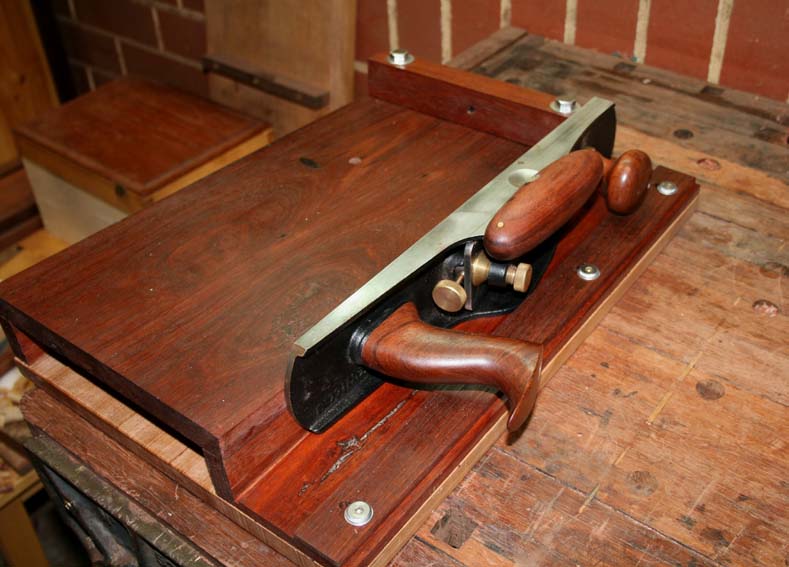
I have compared many different planes (wooden, iron, low angle, high angle, bevel up and bevel down), different bevel angles, different shooting boards (wooden, iron, ramped, flat) ... and the conclusions are categorical: the longest lasting iron and shooting plane configuration is a low angle bevel up (either a Veritas LA Jack or, better still, a Veritas Shooting Plane, with a PM-V11 iron and a 25 degree bevel. Nothing else comes close.


Regards from Perth

Derek

Re: V11 vs. O1 end grain

#13

Re: Comment

david weaver

Yeah, you tricked me with that one. I thought I would do this test quickly, get some serious edge damage, take some "cool" pictures and do a couple more abrasive/angle tests last night.

It takes me an hour to do two edge tests with sharpening and pictures - on long grain. It took several hours with this, and I started with the V11 taking a picture every 73 feet (100 shavings). I contemplated 50 shavings at first.

With O1, I took them only every 200 shavings, but the cut resistance is much greater than long grain, so 200 shavings leads to fatigue.

Yes on the board being in a vise. There is a great deal of advantage to planing end grain like this rather than in a shoot board - the plane does the work in terms of giving itself weight into the cut with your arms, and you don't have to bear down on it. On a shoot board, if everything isn't ideal, you *do* have to force the plane unless you have it in a track, and even when you have it in a track, it can't really get the same downforce that you get with long grain.

If anyone would like to perform this test on a wide piece of cherry, I'd like to hear their results.

I figured last night that there may be some folks who may want to accuse me of doctoring results, but after the amount of work it took to plane and make pictures, I am not interested in anyone questioning the legitimacy unless they are willing to do the identical experiment. It would be easy to live stream an hour session of end grain planing to duplicate the results, but nobody would appreciate the confirmation to a level that would match the effort in doing it.

It would just be "oh, OK, your'e right - it's right there on video.

One more important point with this. I have never planed the ends of panels with a stanley plane that was sharp and had to sharpen it right away instead of continuing to plane long grain. I think that if someone is doing this type of work and they feel the need for a trick plane or feel the need to go sharpen after any endgrain work, then something is wrong *unless* the wood is really difficult. As i mentioned via email, after making shootenstein, I tried to use the purpleheart offcut from the wedge to test edge life. It immediately destroyed every iron that saw it within fewer than a dozen strokes.

you can see by the quality of the shavings in the box that this was a very relaxed test for an iron, none are separated, even once the plane became too dull to stay in the cut. Throughout the entire test, no edge flaws were observable on the board. The end finish of the board gradually got more rough (which caused the end to appear lighter in color), but it never got to a condition that wouldn't be appropriate for a show surface until the plane began to skip. O1 never skipped, but it did become too hard to push practically (leading to tester abuse rather than complete failure to function).

Re: V11 vs. O1 end grain

#14

Re: V11 vs. O1 end grain - different results

Derek Cohen (in Perth, Australia)

Who made the O1 blade and what was the final bevel? I think hardness is probably important here.

David, as I mentioned, I compared Clifton O1 (the older, hammered iron), LN A2, and PM-V11. I tried 25 degrees .. ugh! Not good. 30 degrees is the ideal for bevel down. (25 degree bevel up still blows these away).

Hardness was not a factor here since the blades were those that were available for purpose. The hardness just becomes an academic issue since the average user cannot manipulate this.

Regards from Perth

Derek

Re: V11 vs. O1 end grain

#15

Re: Comment

Derek Cohen (in Perth, Australia)

Yes on the board being in a vise. There is a great deal of advantage to planing end grain like this rather than in a shoot board - the plane does the work in terms of giving itself weight into the cut with your arms, and you don't have to bear down on it. On a shoot board, if everything isn't ideal, you *do* have to force the plane unless you have it in a track, and even when you have it in a track, it can't really get the same downforce that you get with long grain.

David, I disagree with this. The only reason you would need to "bear down" on a shooting board is if you are not using a decent board design. The issue is easily overcome by adding a side fence to the runway, which will guide the plane. That is, keep it tracking forwards.

The Stanley #51 offers a track, which is really a side fence ...


I began including this on the ramped boards I made years ago ...


It is essential to use this side fence with this style of plane, but it is an advantage for all shooting planes ...


The disadvantage of testing end grain as you have done is that you add an extra variable into the mix, where as the shooting board removes it.

Regards from Perth

Derek

Re: V11 vs. O1 end grain

#16

Re: V11 vs. O1 end grain - different results

david weaver

Cliftons irons don't wear as well as mine based on beach's page.

What wood again was it that you used for your testing?

I'm sure (Well, not sure, but suspect) that variance of wood in these tests could greatly favor one iron over another if you could find something that favored wear resistance vs. toughness and so on.

If you have american cherry, you can strap one of your irons into the vise, bevel off the back side, measure the shavings (collect them) and duplicate this.

If you have a look at the picture that I posted of the "box o shavings", you can see that the last shavings were continuous, but they do not have a waxy look. That and getting harder to push are the only two things i noticed while performing the test.

The O1 shavings held together ever so slightly less well near the end, but they did not fall apart. Anyone who has ever picked up this type of shavings may wonder how I got such a photo perfect box of shavings, as they will break if you pick them up and handle them. I found during the test that the plane would hold about 15 shavings. Each 15 shavings, I turned the plane over above the box and dropped the shavings in. With a separate test plane (another stanley plane with my O1 iron, I took 200 shavings off of the end of the board before starting and hoped that I'd find that 300 would be where the planes stopped. So these two irons are not the only ones that were used. I suspect that iron would've lasted almost as long).

You are right about the various irons, (most) people cannot really manipulate the hardness, and really are going to just want to know where to buy the iron in the test. I think it's critical in end grain and chiseling to compare steels at a similar hardness level if they tolerate it (O1 has just as much tolerance for hardness as V11), and this iron is what I make for myself because I'm not subjected to those constraints, and at the hardness level, it takes a better edge and holds it longer than an iron specified at 58-60. Or to be more clear, I'm more interested in what V11 does against a similar O1 iron, and not just something softer that may lead people to conclude the wrong thing (that the alloy is responsible for the performance more than the hardness).

In the long grain tests, it's clear that the alloy is more responsible for the performance difference.

If Bill confirms that he will test my O1 iron, then we will know the hardness for sure. I oil quenched it after heating it likely to about 1600 degrees and tempered it to 390ºF, which is the highest hardness value that it would tolerate without chipping. Tempering to 360ºF did not yield the same performance (the iron gave up its initial edge). Hock's iron is slightly harder than mine, but it suffered a couple of defects during the long grain test against mine. Visually, it appears to have worn more slowly, but the longevity in the end was similar.

Neither was close in hardness to a vintage iron other than some of the harder stanley irons. It would not be hard to duplicate my O1 iron by buying the same stock, heating to the same point, tempering to the same temperature, but I consider finding this tempering point, and proper hardening to be a (low brow, albeit) achievement in getting exactly what I want out of an iron. Low tendency for wire edge retention, excellent edge taking off of natural stones, good hardness and lack of defects in use.

Someone viewing my report once it's posted can conclude that they'll probably see the same performance out of a hock iron, but it's unlikely they'll see the same longevity out of an iron taken out of an older wooden plane or one of the softer stanley irons (i think some of the harder stanley irons would come close, though - especially the solid steel irons, as they're probably oil hardening steel).

Re: V11 vs. O1 end grain

#17

Query

Wiley Horne

I have noticed that there is quite a difference in blade life between (1) high-impact: giving the plane a running start and having high impact at the board edge, vs. (2) low-impact: ease the plane up to the board edge, verify you have a bite, and pull the plane through the cut.

I gather David is doing low impacr, and starting with an eased edge. Both might matter.

Wiley

Re: V11 vs. O1 end grain

#18

Re: Comment

david weaver

No, it's not an extra variable. It is a different variable.

Fences on shooting planes are less precise than you think. they do not have the ability to do anything other than retain the plane, as a lighter set in cut will remove any pressure the plane has on the cut.

There is no more downpressure in this test than there is in the long grain test. The weight of the plane, and the weight of your arms. Not the weight of your body on top of that.

none of these shavings except for the last 100 feet or so showed lack of interest in entering the cut. You cannot generate the same quality of force with a shooting plane. They are good at what they do, but they cannot get nearly as much out of a sharpening cycle as just using a bench plane with wood in a vise. The pain from this test isn't bearing down on the plane, it is the lateral pressure needed to actually cut end grain. This in itself may generate more downforce on the plane since the handle is oriented in such a way that if you generate one, you generate another.

But, the result of picking up a shaving after the end of this on long grain (3 or 3 1/2 thousandths) shows that the iron is more dull, but it is not by any means drastically different in condition than post long-grain test.

I learned also, a while ago, that a #4 smoother is better at this than a bevel up LV jack. No damage to the iron occurs, you can plane like you would plane long grain, and the lack of perfection on the sole of the plane (along with less surface area) makes avoiding sticky skippy planes on end grain easier. This is one of the reasons that my shooting board rarely needs sharpening. It's only needed for small sticking.

I *guess* I will give shootenstein a fresh edge tonight and see what kind of footage I can get out of it without having to bear inward on the plane. The effort is two-fold, by the way. The need on a larger piece of wood to push the wood in toward the plane is not insignificant. We don't generally notice how much effort this actually is because we've never standing in-situ doing this for long. Board in bench eliminates this and is far less effort supposing the wood is large enough to allow planing to a mark or knife line. This is also how I trim drawer sides (not in the shooting board). Knife mark, plane to the mark.

Re: V11 vs. O1 end grain

#19

Re: Query

david weaver

Low impact. I'd refer to it as a bump start, which is setting the plane at the start of the cut, and giving it a little bit of a push to get through the entry into the cut.

What you're describing is why I would guess (and will not duplicate, it would require constantly sawing the end off of this board, and I would not have enough length) that the interrupted saw cut end may damage the edge sooner. Especially on a harder wood where that interrupted cut has more chance for damage.

I also would expect hammering the edge into the cut (which may seem tempting as a way to reduce effort, but I would guess is actually far more due to fighting to stay in the cut controlled) would lead to some visible damage that would show up on the board ends, and thus cause the shavings not to remain as pretty as they are in the picture in one of the other posts in this thread.

The result from both irons here is pretty spectacular, and it is not manipulated by me aside from having good technique.

It may put people off, but I am seeing in daily use from experience some of the benefits that warren describes as subtlety. I doubt many on here can keep an edge as well as I do, or do the same volume of work with the same level of effort due to refinement in technique. at the same time, Brian can probably do better than me by a lot and warren much better, because these are things you will naturally learn to do in getting results and making life easier on you as the user both in downtime sharpening or (avoiding) repairing blade damage from disuse, and in getting results that do not vary (like avoiding seeing lines on the ends of boards from edge defects that may cause shavings to split, etc).

The reason I doubt there are few here who would match this is because you never really start to appreciate it until you're using a plane for everything. In the description of surface gazer vs. shaving lifter, the shaving lifter type of user never gets the continuous use where they would start to do these things and appreciate the difference in the quality of engagement they would have with the tools and using them.

It reminds me of my grandfather with his equipment farming. He repaired his own equipment, worked almost all day every day, and knew everything about how it worked, how to get the most work done in a day, and how to do so without abusing it. It took more than a couple of endrow turns or days as a steering wheel holder for another owner for him to learn that.

Re: V11 vs. O1 end grain

#20

Impact

Bill Tindall, E.Tn.

This variable plus bevel angle could be what is leading to my low results. I have not been fussy about driving the plane into end grain.....at 30 degrees. I need to mend my ways I suspect.

Derek's order of edge life correlates near perfect with David's long grain results which we now know are largely a measure of abrasion resistance. I think Derek is challenging the blade with abrasion and I am subjecting my blade to both abrasion and toughness. When impact enters as a significant variable then we are testing like we would test a chisel. David's O-1 blade was made to have properties that would lead to exceptional chisel life- high hardness and high bevel angle.

Re: V11 vs. O1 end grain

#21

Re: V11 vs. O1 end grain - different results

Derek Cohen (in Perth, Australia)

What wood again was it that you used for your testing?

I'm sure (Well, not sure, but suspect) that variance of wood in these tests could greatly favor one iron over another if you could find something that favored wear resistance vs. toughness and so on.

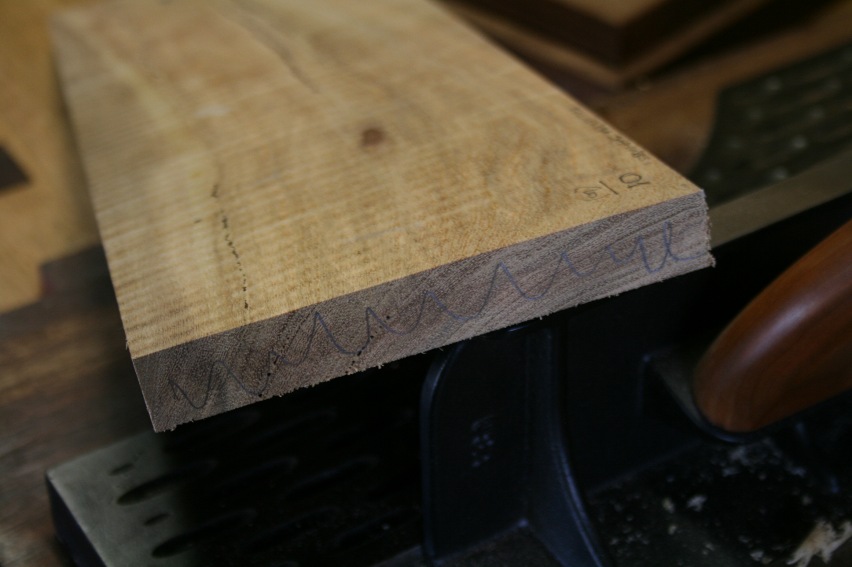
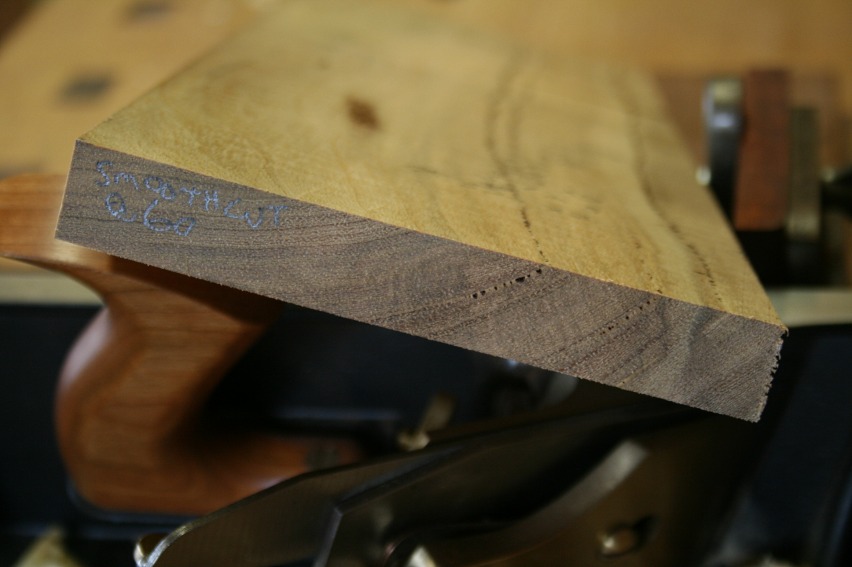
David, the last lot was back in 2013, but I have done this on-and-off for many years, reporting results all the time. The tests were aimed at "real world" usage. This involved looking at the quality of the finish as well, along with whether the blade edge was still sharp enough to work. A plane session ended when the blade could no longer cleanly shave end grain radiata pine. Photos were taken at each step (all on my website).

The end grain shavings also were those that I would take when doing actual furniture-making ...


This is what I was shooting ...


The wood is West Australian Curly Marri. It is not quite as hard or as abrasive as Jarrah. You asked me about it once on SMC, looked it up yourself, and reported "Google janka hardness says 1600, or slightly harder than hard maple, and I'm sure the curl makes it plane even harder".

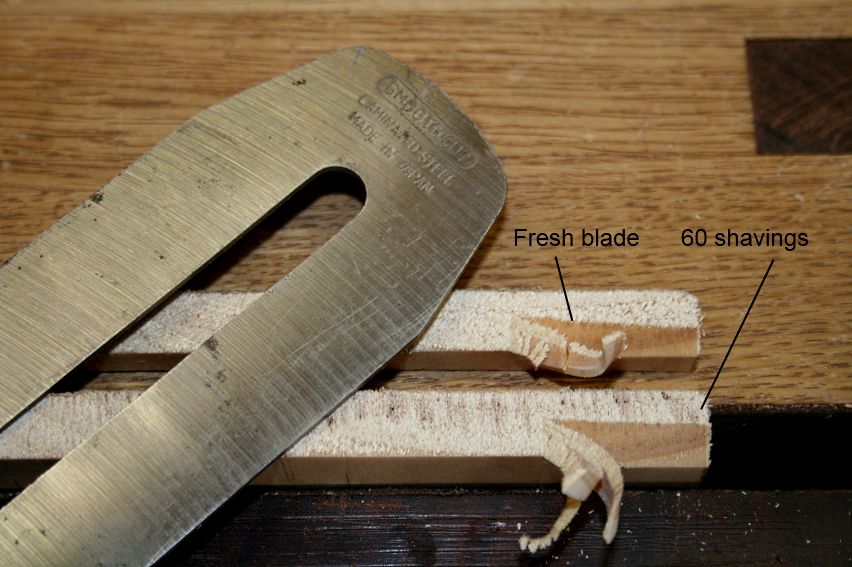
Incidentally, in addition to the Clifton O1, I have also use a Japanese Smoothcut, which is not your average O1 steel. This outperformed both the Clifton and the LN A2. After 60 sides, it was still producing a clean result ...


And this is the performance at that stage on the end grain Radiata Pine ...


Very impressive. But not as good as PM-V11.

Regards from Perth

Derek

Re: V11 vs. O1 end grain

#22

Yes

Bill Tindall, E.Tn.

"I'm sure (Well, not sure, but suspect) that variance of wood in these tests could greatly favor one iron over another if you could find something that favored wear resistance vs. toughness and so on."

Re: V11 vs. O1 end grain

#23

Re: Query

Derek Cohen (in Perth, Australia)

I have noticed that there is quite a difference in blade life between (1) high-impact: giving the plane a running start and having high impact at the board edge, vs. (2) low-impact: ease the plane up to the board edge, verify you have a bite, and pull the plane through the cut.

Wiley, there should never be "high impact" when shooting end grain. In my book, that signifies poor technique.

The blade should be sharpe enough that one can rest the edge against the work piece and simply push it through.

There is another issue. One of the tests I did was comparing bevel up vs bevel down shooting planes. I was fortunate to have both the LN #51 and the Veritas Shooting Plane. Both have a 20 degree skew and both fit the Stanley #52 shooting plane. The only difference is the 45 degree bed on the LN and the 12 degree bed on the Veritas. I held the bevel angles equal (30 degrees) and also used lower (25 degrees) for the BU. That should have favoured the LN. But the BU "won" by the proverbial mile. It was no contest whatsoever.

One of the conclusions reached was that a higher cutting angle will be associated with more wear. Another way of looking at it is that the higher cutting angle created more impact, which creates more wear.

Regards from Perth

Derek

Re: V11 vs. O1 end grain

#24

Re: V11 vs. O1 end grain - different results

david weaver

The smoothcut is the same rikizai iron as the tsunesaburo (presumably it's just made by tsunesaburo).

In my duration tests on long train, it lasted the same as my house O1 iron. It was harder and failure was slightly different, but I would expect my O1 iron would last as long as it does in anything.

Note the shavings in the box that I showed a picture of. None of them show defects. cherry is probably an ideal wood to do this with, as would be poplar - it doesn't have the lack of density and voids that radiata pine would have once minor dullness has started. It has convinction in its straws where they are tight against each other without being harsh or stringy.

But this is *very much* a real world test, at least as much so as shooting, as most people who are shooting anything other than very small pieces should actually be planing them in the vise instead. I have planed far more wood volume in the manner of this test than I ever have with a shooting plane. It's faster, it doesn't rely on a board being accurate over 6 inches, and it doesn't require me to use a different plane. I'm not surprised to find that warren and brian have both said (unless i'm misquoting one of them) that they also do it.

I'm not aiming the results of the endgrain test at a point and shoot or gadget user, I'm aiming them at someone who will be willing to do the planing. I suspect most people have a relationship with a skew plane that Bill mentions - they dread using the plane because they despise sharpening it. That's a shame, because freehand maintenance of a skew plane is just as easy as it is with a straight bladed plane. If that is ever a hindrance, those folks should think about switching to what i'm doing.

This is also probably one of those cases where you've maybe noted that I write off your experience with jarrah as being irrelevant for people comparing tools over here, especially if they're going to do a lot of hand work. Purpleheart destroyed every blade I used on it. If I could find something slightly less violent and then accelerate the test with it, and aim the results at someone who is actually going to be planing the ends of cherry panels, it risks being completely irrelevant. I've put far too much effort into care with the variables in this test to leave questions like that to ponder.

My results may not be useful to someone working 1800 hardness wood in Australia, and folks who can't duplicate the results because they're changing variables or don't work the same way will have to consider what the difference is if they care. If they do what I did, they will find two things:

* they'll actually enjoy end grain planing, and not from the gadget novelty of a shooting board plane with a fence or any other such things

* they'll probably get the results that I got with this test and not feel the need to assert that it's not practical

Re: V11 vs. O1 end grain

#25

Re: Comment

Derek Cohen (in Perth, Australia)

I learned also, a while ago, that a #4 smoother is better at this than a bevel up LV jack. No damage to the iron occurs, you can plane like you would plane long grain, and the lack of perfection on the sole of the plane (along with less surface area) makes avoiding sticky skippy planes on end grain easier.

David, we shall have to agree to disagree. My own experiments show the opposite results. Consistently.

Regards from Perth

Derek