1000g water stones
Wiley Horne
Hi all,
What is your favorite waterstone in the 800-1200g range, for use with O-1 or straight high carbon steel?
What about for use with mild alloy, like blue steel or A-2?
Thanks. Wiley
Knowledge You Can Build On — Est. 1998
1000g water stones
Wiley Horne
Hi all,
What is your favorite waterstone in the 800-1200g range, for use with O-1 or straight high carbon steel?
What about for use with mild alloy, like blue steel or A-2?
Thanks. Wiley
Re: 1000g water stones
Derek Cohen (in Perth, Australia)
Wiley, I absolutely love the Shapton Pro 1000. It does a great job on all steel types. It is also hard enough that it does not wear quickly and go out-of-flat, which is a big issue with the coarser stones. This is the only Shapton I still use.
Regards from Perth
Derek
Re: 1000g water stones
David Weaver
shapton pro 1000 if you don't want to soak a stone, and bester 1200 if you do.
1000g water stones...really?
Bill Tindall, E.Tn.
I regard you plane enthusiasts as unduly picky but insisting a stone weigh 1000g seems over the top. No doubt it has to do with the stone's inertial response to the blade passing over it providing another dimension of scratch orientation, but I remain skeptical.
Re: 1000g water stones...really?
Wiley Horne
Hi Bill,
Here’s my semi-tongue-in-cheek assessment of this vital matter:
International System of Units (SI) says that gram is abbreviated ‘g’, and is separated by a space from the numerical amount. Thus, 1000 g.
The no-space ‘g’ is still free to be pressed into service for ‘grit’. 
Wiley.....Motto: no nit too small
Re: 1000g water stones
Jim Matthews
King 800 works fine on my circa 1970 MARPLES chisels and ECE "Chrome Vanadium" plane blades, and Opinel pocket knife. They're also cheap.
I still get base grinding done on a coarse diamond plate.
Re: 1000g water stones
Derek Cohen (in Perth, Australia)
Jim, the King 800 was my first waterstone some 25+ years ago. I used it for nearly a decade, along with other King stones, such as the Gold 8000. The problem with the King 800 is not just that it is best suited to O1 steel, but that it wears quickly and, unless you are mindful of using the whole face when honing, needs to be flattened frequently.
Regards from Perth
Derek
Re: 1000g water stones
Warren in Lancaster, PA
I use a King 800 stone followed by oil stones. The King stones are more sophisticated than many of the early 21st century stones. King stones can be made to cut more or less aggressively depending on skill of the user. So you first use it to remove wear, then get it in nice shape for the oil stones.
Lately there has been an emphasis on aggressive cutting, with no thought to the condition of the edge.
Re: 1000g water stones
david weaver
The same is true for some of the other stones, too. The shapton pro can be used in different conditions to cut faster or slower, or to intentionally burnish. It's a little less susceptible to being gouged than the king, but there's nothing wrong with king stones - their lack of flatness tendencies, at least in my opinion, make them a better stone for a freehand sharpener (who can control flatness with sharpening) than someone who thinks they're going to do heavy work with a guide.
I could take pictures of the edges created by various synthetics (the ones I still have), but pictures of one stone looking more coarse than another don't really tell the whole story. A soft arkansas edge has fairly large looking grooves that are less uniform than a king 800, but the actual quality of the edge is far finer and the wire edge is more organized and comes off more easily without leaving so much tooth.
Re: 1000g water stones
Steve Elliott
The King 800 is my favorite of the relatively few stones I've tried in this grit range. It gives a better surface with a matte (hazy) look than the others, which give shinier surfaces that aren't as refined. By refined I mean requiring less work on finer stones.
Re: 1000g water stones
Wiley Horne
Thanks to all! Will get the King 800 and the Shapton Pro 1000.
Wiley
Re: 1000g water stones
david weaver
When you get the shapton, glue (epoxy, contact cement, silicone, whatever your choice) the shapton stone to something flat with a little bit of mass. You'll much appreciate it in use (if you use the plastic box, stiction may cause the stone to lurch off of the base/box and end up on the floor - broken).
It's a stone that can sometimes allow a vacuum to form between it and the blade, and the mass of the moving blade and your moving parts attached to it is enough to cause it to take short trips to places where it shouldn't go.
Re: 2700 g stones
david weaver
in my travels, I found (on japanese auctions) low cost versions of atagoyama stones. Actually, they are nearly all low cost, but dealer markup of them can make them quite expensive.
the cost for a 6 pound stone from a hardware dealer in japan was $235. To my surprise, it had good action and was good enough to finish a razor. This kind of thing isn't common.
The other day, I was bidding on a 4 kg suita that looked pretty good, but I had to admit i have so many stones that it was unlikely to be better than some of my better ones and would just sit.
It sold for $162. Some would say that's a ridiculous cost, but it's fairly minimal in the world of good cutting finishers. It would've required surface shipping, too.
2kg finsihing stones from current or recent mines are fairly common, but the shipping rate structures from japan pretty much mean low cost shipping below 2kg and only very slow low cost shipping above that. I found out through trial and error that no stone above 1.7kg is going to be 2kg or less boxed.
How do I know all of this? There were a few unscrupulous stone flipping dealers several years ago, they're probably still all around. I would see the $200 atagoyama stones being sold from $700-$1000 and talked up, and i didn't like it. So, I ordered gobs and gobs of stones like that from japan, set up a site on etsy, graded all of the stones and sold them at cost. I told my buyers where I was getting them and how I chose them, knowing that they would go do the same thing then and counter some of this kind of thing.
Since then, a bunch of other people started doing it, so my goal was accomplished and i stopped.
This kind of thing doesn't harm the high service dealers like alex gilmore who go over and actually find uncommon stones rather than just flipping common stones and overselling their capabilities.
I saw finish stones on buyee as large as 11 kg. There are graded distribution avenues to get stones from japan, but there's a whole lot of old dealer stock or slightly irregular stones that ends up on japan's version of ebay at the hands of antique flippers over there. Some of them know enough to demonstrate the cutting capabilities of the stones properly.
Re: 1000g water stones
Wiley Horne
“the mass of the moving blade and your moving parts attached to it is enough to cause it to take short trips to places where it shouldn't go.”
In a few words, you have captured the reality of many episodes in my shop (which I was glad no one was there to see).
Thanks for the advice on the Shapton—I will find a way to make it hold still. I recall the King being heavy, so am sure it will behave.
Wiley
Re: 1000g water stones
david weaver
The kings are happy under their own weight and either rasp a blade or create a rolling slurry. Since they like soaking, affixing them to a base (like the bester) tends to be temporary.
I think you'll like both stones. The king works like a soft natural stone and the shapton works like a hard natural stone on steroids (it will load with certain HSS, though - and king will be slow to cut with that type of steel, leading us back to what Bill and Steve have often advocated - silicon carbide is a good minimum and diamonds are even better).
Re: 1000g water stones
Warren in Lancaster, PA
I reserve the King stone for chisels 1/2 inch and wider and plane irons. That helps keep it flat. I overlap the edge of the stone with the tool. i sharpen hundreds of tools between flattening.
I use a Washita stone for carving gouges, narrow chisels, and anything else that would be rough on the King.
Re: 1000g water stones
Wiley Horne
David,
Thanks for the additional detail. I didn’t imagine Shapton would do much more than annoy HSS or similar alloy.
Wiley
Re: 1000g water stones
Brian Holcombe
800 Chosera is good, but I’m not particular I can use almost any of them. I like King hyper, Shapton etc.
I was up at Chris Hall’s shop a few weeks back and used his sintered stones, very much enjoyed the experience but not sure the brand. On the other end of the scale I used a 20k gokumyo and also enjoyed that.
Re: 1000g water stones
Wiley Horne
Warren,
Thank you. That’s very helpful about keeping the King flat, and about taking narrow edges to a harder stone. I like to do sideways sharpening on the edges of stones, but will use your overlap method to avoid dishing.
Wiley
Re: 1000g water stones
Derek Cohen (in Perth, Australia) It's a stone that can sometimes allow a vacuum to form between it and the blade, and the mass of the moving blade and your moving parts attached to it is enough to cause it to take short trips to places where it shouldn't go.
David wrote:
When you get the shapton, glue (epoxy, contact cement, silicone, whatever your choice) the shapton stone to something flat with a little bit of mass. You'll much appreciate it in use (if you use the plastic box, stiction may cause the stone to lurch off of the base/box and end up on the floor - broken).
Wiley, I discovered early on that my Shaptons would move slightly, and so epoxied them to 1/4” glass plate. This is an 8000. The 1000 is cream ...
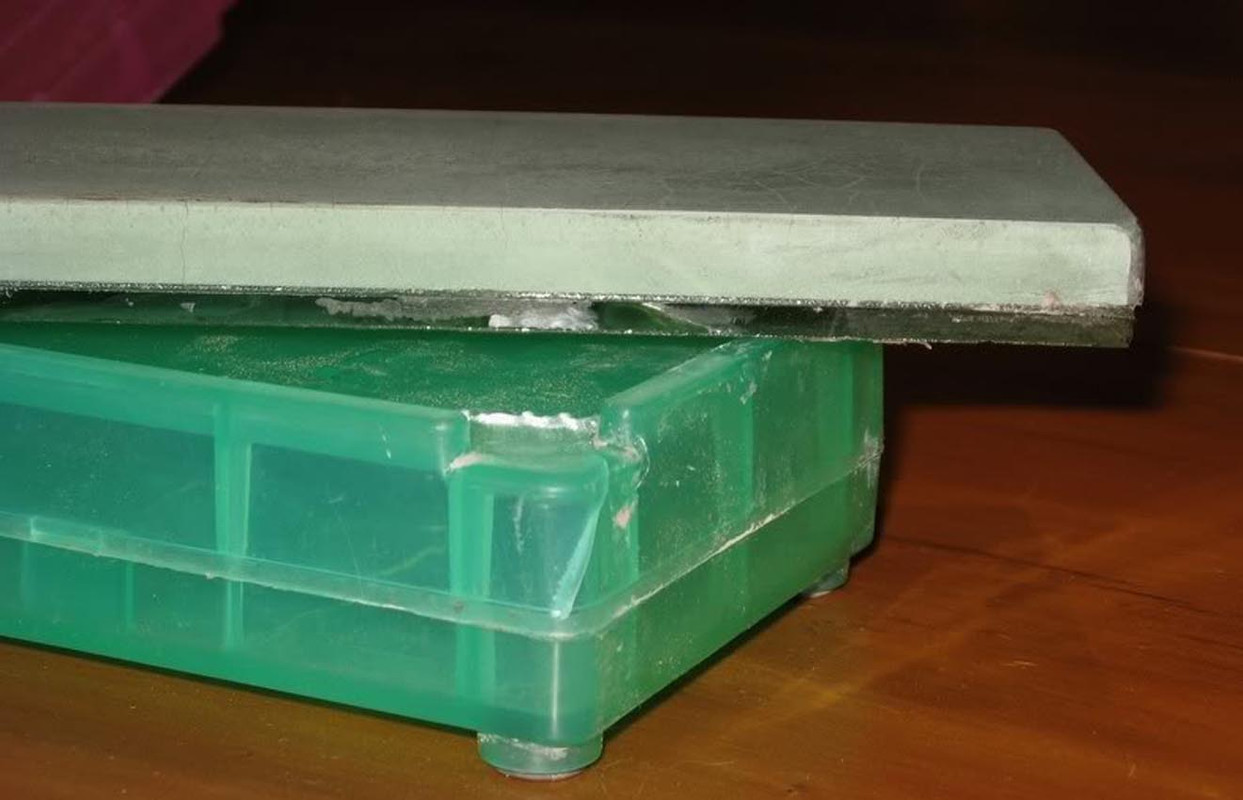
The glass solved the problem of movement, plus it added a little extra heft. It did not interfere with the stone fitting in its plastic case (which is a nice touch - and acts as a holder when using the stone).
To deal with stiction, an issue with all the Shaptons, add a little liquid soap to the water you spray.
As David pointed out, the King is slow. The slowness and softness were the reasons I moved to Shapton all those years ago. I also side sharpen, but am careful to work the whole surface of a stone. If you do not, the King will quickly wear unevenly. That was my warning early on. Frankly, after the Shapton Pro 1000, I do not see the point of the King 800. It has more negatives than positives going against it.
Regards from Perth
Derek
Re: 1000g water stones
Wiley Horne
Derek,
Thanks for the helpful insights. Your photo of the neat glass solution reminds me I’ve got 6 played-out fixed diamond stones sitting around making drawers dirty—think I’ll use one of those with the Shapton.
On the King 800, I just decided to listen to Warren and Steve, as I did you with your strong recommendation of the Shapton 1000. I don’t see the two stones as competitors, though they’re in the same nominal grit range. Will experiment to find which steel likes which stone.
Warren situated the King as a set-up for his natural stone which came next in line; I may find the same with the particular natural Japanese stones I like. Maybe the vintage plough irons or moulding plane irons will respond to it. Or maybe the King will end up doing kitchen knives in the sink where the water is .
I’ve heard good things about the Chosera stones that Brian referenced—do you have experience with them? I hold your opinions in high regard!
Wiley
Re: 1000g water stones
David Weaver
It'll sharpen HSS. Whether or not it will cut all of the carbides, I don't know.
The loading comment is based on my experience with the muji irons, and I can't remember if it may have been only an issue with the finer ones (5k/15k). The loading or glazing is different than shutting off the cutting action of a natural stone with a really tough steel. What happens is little pinpoints of HSS seem to get stuck in the surface of the stone and instead of the abrasive getting shut off/dulled/stunted, the metal swarf sticks in the surface of the stone.
It's really bizarre. The trick to preventing that stuff is to keep a relatively dry (in concentration, not dry to the touch, but something that's got a high concentration of swarf vs. water) slurry on the surface of the stone.
As far as stiction goes, if you're working the back of something on it, you can as derek says, add something to break the grip on the surface, but you can also do something as simple as add a drop or two of water ahead of where you're going with iron and gradually shuffle the iron in short strokes from one end toward another, then back down. Vs. trying to take 8 inch long strokes in one shot from end to end.
It sounds counterproductive, but the short strokes gradually moving from one end to another actually help keep the stone clear and prevent much liquid suspension between the stone and iron and you get a very fast cutting action that way.
If you ever tried to put thick oil on an oilstone and then try to swipe the flat side of an iron from one end to the next, you'l know what I mean - you just don't get as good of bite, and sometimes none with an oilstone like that.
after I figured out the little shuffle strokes, I don't remember having stiction issues again. There's no reason I'm aware of to not use soap, but I guess I was too lazy to track it down.
Re: 1000g water stones
Derek Cohen (in Perth, Australia)
I’ve heard good things about the Chosera stones that Brian referenced—do you have experience with them?
Hi Wiley
I've heard good things about them as well, but not used them.
To be frank, I am very far from David's position when it comes to sharpening. I have tried a few different systems over the years in a search to determine what works best for me, but my numbers involved are pitiful by comparison.
I have settled on two sharpening systems, and have been using them for some years. I am not inclined to change them .. unless it can be demonstrated that there is a good reason.
The first system is a Shapton Pro 1000, followed by Sigma 6000 and 13000 (these are far better on the A2, PM-V11, HSS, and M4 steels than the Shapton Pro 5000, 8000 and 12000). This is the system I am more inclined to use in my workshop.
The second system is one designed for mobility (where water is uncertain, such as wood shows), and this is a worn Ezy-lap 600 grit, and Medium and Ultra Fine Spyderco. I may use this system in the shop as well.
I follow both systems with Veritas green compound rubbed on planed hardwood.
These systems work well, and that is all I ask.
With the exception of Japanese chisels, all blades are hollow ground (on CBN), and the amount of steel left for honing is very little. Sharpening is fast. My only claim to fame in sharpening is speed. I am not a sharpening guru.
Regards from Perth
Derek
Re: we're sort of in the same boat...
david weaver
I have, of course, churned through a lot of material as a hobby. It's not really related to woodworking though I wanted to find the fastest way to sharpen once I started dimensioning - or more accurately, what would provide the least interruption and wasted effort.
It's probably accurate to say that I only use one method, and even with HSS now, I do the same thing (one method). Grab the tool, rub it on the stone. Generally grind the tool when the edge to rub gets too big.
(no grind for japanese tools, not that you can't).
I can see the appeal of a king 800 from the standpoint of someone who has used a lot of natural stones, especially the folks who like softer natural stones (there are some) and can maintain flatness like warren would (the same way you'd do it freehand).
For the typical person (not you) following a video with a guide, the king will work, but it's not the best (messy, requires the user to keep it flat, and the avenues that the slurry allows will be lost on someone like that).
Despite all of the follow-ons after the shapton pro, though, I'm not aware of anything that I'd call "better", even for a jig puller. Diamond plates are pretty good, but flatness isn't really consistent, neither are scratches, and there isn't a diamond plate that will maintain considerable speed like a shapton pro.
The bester 1200 is just sort of a soakable version of the same thing, and the chosera 800 is like a smoother version of it. The bester 1000 is soft (a completely different stone, better for knives), and the chosera 1000 is a bit finer than its grit would suggest.
(I've sold most of those, but tried a lot).
Favorite "sharpening thread" ever
Jonathan Elliott
I'm loving following along with this very mature and respectful dialogue about sharpening and learning a lot.
How refreshing compared to so many that degrade into close minded arguments  There is no "best way" but lots of very experienced people have developed things that work for them through lots of trial and error and it's insightful for those of us earlier in our journey to hear about those.
I haven't developed a system of my own yet so I love reading about the different experiences people have had as they developed the system(s) that work best for them. It is very insightful and will certainly aid in my personal sharpening journey to what works best for me. Not having to start from ground zero is very welcome though and so I thank everyone for sharing their experiences in such a respectful way. 


