Glad to have you back, Charlie...
david weaver
Seriously.
Knowledge You Can Build On — Est. 1998
Glad to have you back, Charlie...
david weaver
Seriously.
Re: "Journeyman's journal"
david weaver
I can't say for sure when that writer found out about the double iron, but he asked a few questions on my videos a few years ago (about tapering moulding plane irons, etc) and may have either picked up using a double iron here or on my set of videos.
I'll give him points for diligence if he can sit through them.
Of course, he could've gotten advice from somewhere else entirely.
I sometimes get him confused with stavros gakros or someone else with a similar name.
Re: tales from the selectively stingy
Charlie
You should stop and consider for a moment that having used sandpaper you were being precisely historically accurate.
Re: "Journeyman's journal"
Charlie
That's fine but it has nothing to do with the reason I linked to the article, or the others I linked to either.
Re: Glad to have you back, Charlie...
Charlie
Phew, won't be back for long. Things have changed a lot. Just felt like stirring the pot for old time's sake.
Re: tales from the selectively stingy
david weaver
Well, I have a bit of an oppositional ...well, issue. So now I'm going to have to buck the historical trend.
There may be utility to sanding, but it is seriously lacking in the stimulation department (at one point, sanding cherry caused me to have an asthmatic response, too, but laying off of sanding seems to have made that subside). I'd do it if it didn't feel so dumb, though.
I'll just have to cherry pick literature where I can find it, like the Hasluck section where the author describes taking the life right out of a carving by sanding it.
Re: tales from the selectively stingy
Charlie
I enjoy sanding in an oil finish and have done so on enough occasions to make a judgment that the hand planed surfaces look just as great, but *felt* magnitudes better, after the sanding. That tactile feel you know. I don't think I'm alone in this, though in the current environment I'm not sure how many people would 'fess up to it.
Re: tales from the selectively stingy
david weaver
I have done the same. It feels great. silky fingertips.
My bias toward planing causes me to follow up something like this with gray and then white scotchbrite, with oil in both while doing it. It's divine. It's also (from a laziness standpoint) a lot easier to get through if the planing is perfect before you do it.
This kind of finish is about the dandiest thing you'll ever find on a guitar or violin neck if you can convince people that it's OK if it looks a little dirty after while. I did this twice to gibson guitars (not really valuable ones, just kind of valuable) after reprofiling necks and then upcharged for it and sold them on it being custom work (I was cleaning up what gibson didn't finish on mid level models). The people who bought them paid willingly and about pooped over the feel.
Re: tales from the selectively stingy
Charlie
Feel is obviously of paramount importance with a guitar.
Re: Somewhere....
Derek Cohen (in Perth, Australia)
Hey Charlie, I do miss your stirring of the pot. Welcome back 
Sandpaper is quite often used in fine instruments, etc, because the surfaces are curved and the objective is to have a surface that shows no marks on something like a violin or archtop guitar.
David, this is really the point. We all know why we prefer hand planes to sandpaper on flat surfaces - its relatively dust-free and leaves a clearer surface.
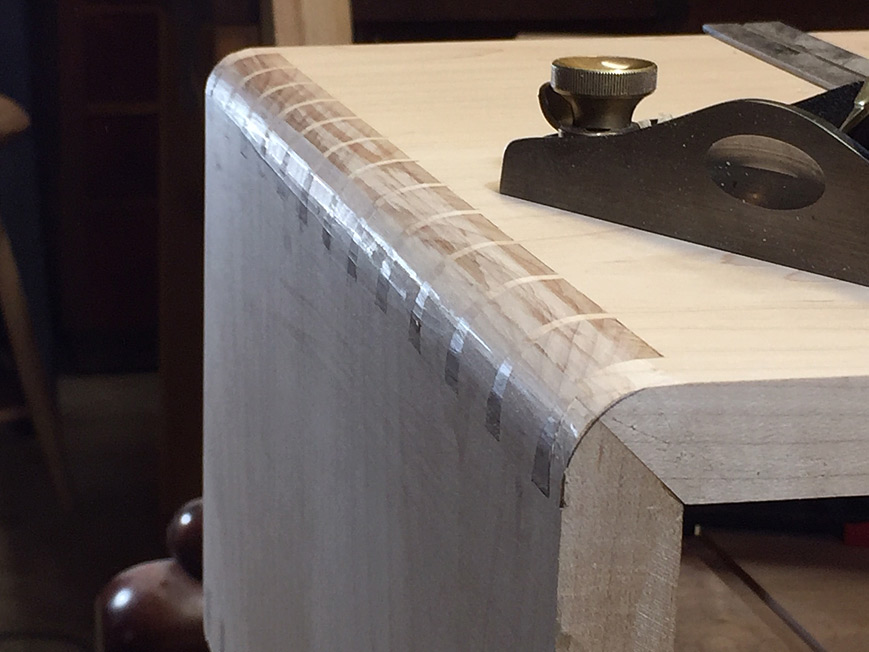
However, there are some surfaces where sanding is a preferred method and, frankly, anything else is likely to leave a lesser surface. Curved and rounded edges come to mind. For example, I scrape, then sand, curved drawer fronts.

I smoothed off the rounded dovetails (created with planes) with sandpaper.
Some flat surfaces are easier to sand, such as the 1/4” thick panels I have been making for drawer bottoms. These run cross-grain, which makes with-grain planing less attractive. Planing 1/4” thick drawer sides is no biggie.
So why the antagonism towards sandpaper? This discussion is off the original topic of blade steel. Why? Because someone reacted to the notion that work could be done better with a double iron when sandpaper was mentioned. Sometimes it is not always about double irons.
I look forward to more on the blade steels.
Regards from Perth
Derek
Re: Somewhere....
David Weaver
Not sure where the double iron came into this.
I gathered this - the post was about blade steel, demonstration of a plane being used to smooth was shown, and despite the superiority of the blade steel, the subject project (which is flat, we're not talking about guitars or curved drawers) was sanded after planing.
Nothing to do with the double iron, and more a question of why wouldn't such a nice blade leave a finish ready surface?
At least I gather that's where warren was going. This is sort of a repeat (ex double iron or M4) of many prior threads. Well, not sort of. Without the discussion of M4, this is the same as many prior.
The blade test has two purposes - one to determine how long each of these blades will last before it stops taking a shaving on its own. The second is whether or not the iron can deliver a finish ready surface during the process and for how long.
I mentioned setting the double iron to test these irons, but it has less to do with tearout mitigation and more to do with setting the plane up for the test exactly how a sensible person would do it.
That's too bad...
John in NM
Your comments in this thread strike me as some welcome common sense in an environment of a lot of dogma invented by people who seem to think their way of skinning a cat is the only way in which a cat may be skinned. So even if you don't stick around, it was nice seeing you pop up again 
Re: Product Dev. & Some User Data
E Phillip Smith
Thanks for the post. Interesting reading on sand paper history and use.
My woodworking style is an all of the above style, I use whatever fits the need which mostly is power tools, but appreciate hand tools.
Re: Somewhere....
Derek Cohen (in Perth, Australia)
The blade test has two purposes - one to determine how long each of these blades will last before it stops taking a shaving on its own. The second is whether or not the iron can deliver a finish ready surface during the process and for how long.
David, I think that the second issue is by far the more meaningful one. It really does not matter how long a plane blade can cut if the surface is not worth having. If you recall the testing I did with chisels, the criterion was that the blade had to slice end grain pine. It it did not do so, the trial ended.
Regards from Perth
Derek
Re: Somewhere....
E Phillip Smith
Glad to see your post on the CPM M4.
I would argue that both test are important. Many of the people on the hand tool forum would argue that a finish ready surface is critical but much of the work working world are good with making a reasonably clean cut and touching with sand paper if needed.
A couple of examples.
The last couple of weeks I've be doing finish carpentry on a patio. All of the boards (kiln dried pressure treated yellow pine) have significant planer marks on the surface. Surface of the boards were sanded with belt sander, simply too much work with hand plane, but all of the show edges were hand planed with the 4.5 LN with M4 iron and the touched up with sandpaper to make sure finish paint had good adhesion.
Earlier this week I made three pieces of custom molding about 1 1/2" wide to go on the facia. It's been rainy and I wanted to paint before install. Sanding and painting outside was not an option. Inside I could sand with random orbital sander and fill shop with dust, not a real option. Sand with drum sander and fill dust collector with nasty dust, not a good option. OR handplane which I did with the M4 iron. Surface is more than acceptable for paint.
At this point this iron has planed half mile of shavings of North American hardwood and soft wood. I have pulled the iron for sharpening. I hit a staple the other night and it left a very small nick in the blade.
The staple...
David Weaver
..and some other things.
Bill and I have been talking on and off offline. I'm sure that while my M4 chisels were tough, the steel is more appropriate yet for irons than it is for chisels, because it's not spectacularly tough compared to some high toughness steels, but it's very abrasive resistant and will go to high hardness. That combination should make it lift a shaving for a long time without user force.
You mention half a mile of shavings. I'd bet that's pretty accurate, actually. I found in a test years ago with maple that I would've by shaving not lifting, sharpened an LN A2 iron around 1000 feet of planing. I managed to force it through 1100 shavings on a 20 inch board, but I was attempting to get to a point where it wouldn't take a 2 thousandth shaving at all no matter how much I forced it. That was a mistake, because the last several hundred shavings were in a state that nobody would ever use a plane, and the shavings came off of the plane but literally had fuzz on them.
I'd love to try making an m4 plane iron at some point, and then on the other end, I think I'm going to cut irons out of 1084 and 1095 later today. Talk about the other end of the spectrum. My house made o1 iron pictures are up, and it is, I hope, going to be a long wearing iron for such an alloy, but I suspect the 3V and some others will make it look not so good.
As far as the staple goes and situations where there is paint or any free floating abrasives that may be on a surface, M2 separates itself from more plain steels easily. I"m sure M4 would do it further yet. If one has diamonds, then there really isn't much that's trouble to sharpen - as you say, the prep the first time can be torture, and the grinding can be slow, because while the diamonds cut hard things, they don't cut hard things as deeply.
Two things keep me from making a whole bunch of exotic irons...3 i guess.
1) cost
2) I have seen discussion that some of the steels can work harden easily. If you're cutting out irons by hand as I am, that would really be torture, and maybe even make finishing an iron impossible.
3) if paul bos is no longer hardening irons, I'm afraid that I would have an exotic steel that's not heat treated as well as it could be, and that would be a real shame.
I vaguely recall the japanese having a record for the most feet planed between sharpenings, and at one point, andrews steel had that record (togo reigo), but I think the HAP40 (m4) irons have that record now.
Beyond all of it, I'm really drawn (in the process of regular work) by carbon steel and a really simple sharpening setup. I'll post separately - now that I've started this, Bill has pointed me toward a document that he has from k&K and they pretty much nailed all of this down already, but we don't have a full translation. A simple setup that doesn't get contaminated (like a turkish oilstone or a washita), and perhaps one other oilstone that follows it if a really fine edge is needed (I have a white synthetic japanese oilstone that says "barber oilstone" on it, and nothing more - it's a real treat).
The test I'm running has increased in the PIA factor because I'm prepping all of these irons to the microscope standard at once. I don't think there is anyone who sharpens every iron they use every time to the standard I'm showing here. I'ts not a matter of sharpness, but the obligation to continue to remove every part of the edge until there are no visible defects anywhere that will be in the cut.
we all have dogma...
David Weaver
..whether it's someone who sticks to a single method or someone who thinks the answer is that every method is the same or equally viable.
Re:Heat Treating
E Phillip Smith
"3) if paul bos is no longer hardening irons, I'm afraid that I would have an exotic steel that's not heat treated as well as it could be, and that would be a real shame. "
Paul Bos had a great reputation with the knife makers, but the real expertise in heat treating tool steel is the TOOL and DIE makers. They make parts for auto and many other industries and THEY all have great QC data on how long parts last, much better objective data than knife makers.
The M4 iron was heat treated by Mid South Metalurgical outside of Nashville. They heat treat parts for the auto industry and others in the southeast. If memory serves me correctly the M4 iron was heat treated to give an effective Rockwell hardness of 64 and cyro treated also.
Correct...
John in NM
The trick is to know about it and force yourself to ignore it now and then. If that sounds too preachy, I'll admit I don't even manage it half the time.
Re: Somewhere....
Charlie
Thanks Derek.
It may just be that notable American (and other) antiques, from the most well-known makers, had the hell sanded out of them. Somebody was using it. It was expensive and laborious to make. 2+2=4. Who else would have been using it if not professional shops?
Worth thinking about.
Re: Somewhere....
David Weaver
I wonder how much of that work was actually sanding.
My real objection to sanding isn't really the sanding, it's laziness but on top of that, the fact that most amateur makers starting out can't resist sanding lines off of work and thinking that a continuous lineless piece is more visually interesting than one with lines.
I frequented a guitar making forum for a very short period of time, and then left - the work there wouldn't have been stimulating to many of us. Much of it was sanded absolutely to death (whereas the neck treatment is wonderful, and it would feel nice on a large open surface if the wood allowed (like an oiled neck through bass guitar), quite often, every single crisp line is sanded off of a modern guitar.
Once you get to the late 1800s and dovetailed furniture factory is common, I'd suspect there is some labor vs. paper cost going on - that it was cheaper to sand because the cost of labor was lower and sanding is easier to do on a power assisted basis than planing.
Not contending that chippendale's production didn't include sanding, but I wonder how much was done with milled tooth type files, etc, before getting there.
Stanley makes a plane that would've planed derek's drawer fronts pretty easily, but it may not be that widespread in australia. You could still sand there, but even with sanding, maximum laziness (and preservation of lines and dimension) appears to be achieved with planing as well as possible first.
Re:Heat Treating
David Weaver
Thanks for the name of the heat treater.
I see some knife supply places offer bar stock for fairly reasonable and name the mill that it's from.
Maybe it's something for me to fiddle with in the future. The clicque name of M4 would probably make it fairly easy to sell any irons I didn't want to keep, even if it cost $100 each to make them with heat treatment and surface grinding. The stock cost, depending on what length iron I'd make, would be about $20 to $40 per iron.


