Home Articles Forums Gallery Marketplace Videos

WoodCentral Forums

Knowledge You Can Build On — Est. 1998

Demonstrating the Knew Concepts fretsaw

Posts

Demonstrating the Knew Concepts fretsaw

#1

Demonstrating the Knew Concepts fretsaw

Derek Cohen (in Perth, Australia)

While working on the current build (I will post this later), I took a couple of minutes to make a very short video using a Knew Concepts fretsaw to remove the waste from pins. The purpose is to demonstrate how to efficient this process is, as compared with chopping the waste out. Note that the wood is 20mm thick Hard Maple (it is indeed very hard wood!). These are mitred through dovetails for the carcase of a side table with drawers.

https://www.youtube.com/watch?v=M6O4rY_0zQs&feature=youtu.be

Regards from Perth

Derek

Re: Demonstrating the Knew Concepts fretsaw

#2

Re: Demonstrating the Knew Concepts fretsaw

TomD

I find it is a lot easier for beginners, but not for experts. I don't see the guys who do the dovetailing competitions using this technique. It requires two entire processes, vs just doing one correctly. By correctly I mean a process that actually goes without wasted motion cleanly through to completion.

Of course regardless of how expert one is, some people just prefer using a saw. I have a special technique that uses a saw, and I have spoken of my fascination with FK's technique that uses the twisty saw, though that is for somewhat rough work.

In making, say, a through dovetail, and chiselling, on cuts off the equivalent of one of the boards, with a chisel. Not something one would routinely do, in say, crown molding. But I guess that is part of the charm. Or so one can tell oneself.

In the past, it was common to have lots of small drawers in furniture that one rarely sees these days, people don't seem to have that kind of stuff, or maybe they have too much of it. I remember seeing this Hedley video where he cut, or perhaps someone in his shop cut, those scale of dovetails with one cut from each side, the wood was probably around 3/8". Probably not maple. You need a special chisel. Now there is a fast technique.

If the Knew concepts saw cut to the line without any additional work, that would be an advance. When I bought one of the early ones, it did not do that for me, and the difference between the KC and other saws, or even stationary fret saws was not of any interest to me, remove 2 mm of wood in some areas vs 1, was not an improvement, for the extra awkwardness of the size, or the cost, so back it went, as I already have two high grade saws, if not as good.

There are some pretty good teachers out there who show a two pass method where the early wasting is all done with a chisel. I like that kind of methodology in teaching. It consists of practicing the main skill but leaving some training wheels on so that as you learn you are getting good results all along. For instance freehand sharpening, but with a jig in your back pocket should you take the angles on your tool for a ride. Eventually you learn to sharpen properly, but in the meantime, you are still able to keep all your tools in proper order. Of course a two step process where the first removal is just short of the line is a common technique in itself.

The big advantage to sawing is for your ears. Or for, say, sleeping children under the same roof. Wasting wood with a fretsaw is pretty sweet on those terms. My concession there was to replace my chisel striking hammers with a urethane mallet decades ago, I will even use ear plugs, but a fret saw also shine in noise reduction.

Re: Demonstrating the Knew Concepts fretsaw

#3

Re: Demonstrating the Knew Concepts fretsaw

Derek Cohen (in Perth, Australia)

Tom, efficiency requires context. In this case the wood is 20mm thick hard Hard Maple. The carcase has required 48 pins and 48 tails. This is not some soft Mahogany or even some medium hard wood, such as Black Walnut.

I have had the choice of sawing/paring verses chopping out waste in equally hard wood for decades now. Noise is not the only factor in chopping - generally swearing and visits to the physiotherapist are also to be factored in :)

Seriously, I cannot imagine anyone preferring to chop out waste in such hard wood. It is not only frustrating, but it will be hard on chisel steel. The chisels I used here were Koyamaichi for the chopping, Kyohisa for most paring, and Blue Spruce for finer detail work, if necessary. The Koyamaichi hold an edge very well, but even they would fair poorly if chopping 3mm thick chunks. I tend to chop in 1mm slices. This is easier on the steel.

It is obvious that the less wood to pare, the less effort/time/wear is involved. Sawing accurately therefore becomes an important strategy in the efficient removal of dovetail waste.

Regards from Perth

Derek

Re: Demonstrating the Knew Concepts fretsaw

#4

Re: Demonstrating the Knew Concepts fretsaw

Don Stephan

When paring the remaining thin section of wood, does spelching still occur - tearing out of wood between the two surfaces? It may not affect the overall strength of a glued dovetail joint, but I hate getting spelching.

Re: Demonstrating the Knew Concepts fretsaw

#5

Re: Demonstrating the Knew Concepts fretsaw

Derek Cohen (in Perth, Australia)

Hi Don

Prevention of spelching comes down to a few factors: the sharpness of the edge (which is a reason for good steel), the technique when chopping (take thin slices to reduce wear at the blade edge), and the nature of the wood itself (softer woods are generally more vulnerable than harder woods).

I wrote up a pictorial a few years back on the sequence I use for clearing the waste from dovetails. This featured Tasmanian Oak, which is not a true oak but a Eucalyptus. It is similar in feel and look to White Oak (or what I know as White Oak).

Here are a few (self-explanatory) images:


A good test of the cleanliness of baselines is the inside of the drawer ...


The article is here: http://www.inthewoodshop.com/Furniture/ThroughDovetails3.html

Regards from Perth

Derek

Re: Demonstrating the Knew Concepts fretsaw

#6

Re: Demonstrating the Knew Concepts fretsaw

Don Stephan

An informative and helpful reply as always, if sadly lacking in some of those enjoyable down under expressions. Thanks DC.

Re: Demonstrating the Knew Concepts fretsaw

#7

Derek, you've mentioned the Blue Spruce saw, too

Joe shelton

Can you comment about choosing one or the other?

You have my attention as to sawing waste, but I'm almost bewildered by the variety of saws by Knew Concepts.

The Blue Spruce seems far less varied, if I ignore color.

Knew Concepts offers a kit to use certain blade types, and maybe the same option from Blue Spruce.

Do you see a notable advantage to one type blade or another?

Thanks for any remarks or commentary you choose to offer.

Joe

Re: Demonstrating the Knew Concepts fretsaw

#8

Re: Derek, you've mentioned the Blue Spruce saw, t

Derek Cohen (in Perth, Australia)

Hi Joe, the only mention I made of Blue Spruce was in regard to their detail/dovetail chisels. Incidentally, these is an example when, theory does not match practice. That is, we all seem to hate A2 steel, but these get really sharp, and do such a fantastic job as mini paring chisels.

Regarding their coping/fretsaw, I have no experience if it. Only what I have seen on their website. Comparisons wth the Knew Concept are inevitable, because they are the only two premium builds, but the BP is as separated from the KC on price as the KC is separated from a cheapish Olson.

On price, the Blue Spruce coping saw is $325 and then you need to add on $50 for the fretsaw adapter. In other words, $375 for a fretsaw. The Knew Concepts coping saw is $159, by comparison. The two makes are hardly in the same price range until you move to the KC 5" Titanium fretsaw, which is $225 (still $150 cheaper than the BP).

The fretsaw size I would recommend for removing dovetail waste is at the cheap end of the KC range, the 3" (MkIII) fretsaw with swivel action and quick release. This is $99.

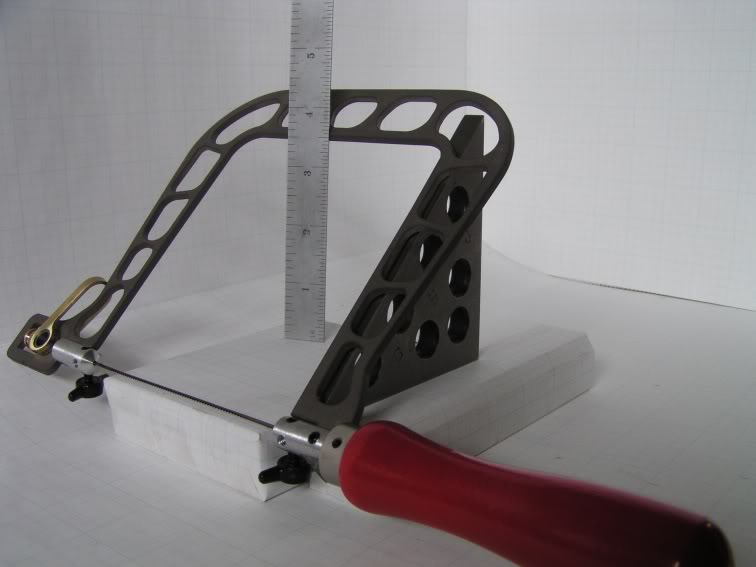
Why the 3”. Simply because the blade swivels 45 degrees, and this permits for 99% of any dovetail waste removal that may be made. A deeper saw is not needed (ironically, all I have are 5” and 8” saws). Lee Marshall and I discussed this during the development of the design of the fretsaw for woodworkers, and he sent me this series of photos to demonstrate depth of cut of 3”/5”/8” bodies ...


If you are unfamiliar with how the Knew Concepts fretsaw came to be designed, this is the story: http://www.inthewoodshop.com/ToolReviews/KnewConceptsFretsaw.html

Regards from Perth

Derek

Re: Demonstrating the Knew Concepts fretsaw

#9

Re: Derek, you've mentioned the Blue Spruce saw, t

Joe shelton

Thanks very much, Derek. Kind of you to elaborate.

Joe

Re: Demonstrating the Knew Concepts fretsaw

#10

Re: wow....

david weaver

...I stopped paying attention to boutique tools more or less once I was topped off...

...but once in a while, I hear something that's still surprising. $375 for a fret saw. :\

Re: Demonstrating the Knew Concepts fretsaw

#11

Re: wow....

Warren in Lancaster, PA

I wonder if any of the buyers will actually saw any fretwork.

Re: Demonstrating the Knew Concepts fretsaw

#12

Re: wow....

david weaver

I'm guessing not a whole lot. I walked through the minefield of this stuff getting toward 15 years ago now. I'm glad I'm not just picking up the hobby now.

This does remind me that I'd love to have an older finely made all wood fretsaw to replace the saw that I have. Maybe I'll go look for one to replace the metal long-reach fret saw that I've had for years (and that works fine).

I did use a coping saw this weekend with a coarse blade to cut waste out for dovetails. Surprisingly, it worked fine, and fast.

Re: Demonstrating the Knew Concepts fretsaw

#13

Re: I guess if I want a wooden fret saw...

david weaver

...I'll make one. I see exactly one available for almost $200 shipped.

I cut something that would be referred to as fretwork about once a year. The $17 saw will be fine.

I'll say that I did overextend myself on a second coping saw (I use them to cut brass sides for planes from time to time - it's nice to have a second one just for that to keep the blades in the saw separate). I paid $15 to get one made by millers falls. It's not really better than a $10 hardware store saw, but I like the way it looks.

Cuts dovetail waste really fast!!

Re: Demonstrating the Knew Concepts fretsaw

#14

Scroll saw blades for dovetail waste

Wiley Horne

David and all,

I doubt many here use Japanese saws for dovetails, but it may be worth a mention for those who do, or are considering it. A dozuki—rip or crosscut—will have a plate thickness of about 12 thousandths (0.012”). So, if you want to saw the dovetail waste (which I do), you’re into the world of scroll saw blades, in order to find a saw with a thin-enough blade to get it down the kerf, but not such a huge number of tpi that it’s impractical for wood.

For example, here is my saw,

https://www.flickr.com/photos/78661951@N07/47966720871/in/album-72157689864241771/

Blade thickness is 0.012”, and kerf is a little shy of 0.013”. I use a fretsaw (even though I’ve never sawn a fret, and don’t plan to), with scroll saw blades. Am working through a gross of Olson No. 2 skip-tooth blades. I understand Pegas is a better blade, and their 12-thousandths blade is a No. 3 in their system—you have to check the thickness before buying. The Olson’s are a bit dull.

One advantage I like about sawing the waste is that, for the tailboards of a drawer, you can gang the drawer sides, two or four in a bunch, saw all the angle cuts at once; then with the boards still in the vise, saw all the waste; so you’re pretty far down the road on one set-up. Ganging the sides means a minimum of marking—basically all the scribelines, pattern on one face only, and the end grain. Maybe someone who did this for a living would mark only the scribe lines.

FWIW,

Wiley

Re: Demonstrating the Knew Concepts fretsaw

#15

Re: Scroll saw blades for dovetail waste

david weaver

Hi, wiley - I don't use pull saws for dovetails now, but I don't have any reason that I don't other than that I made dovetail saws. I started with a combination dozuki and moved to a rip dozuki and used a fret saw because of it. I like to horse my saws a little bit when I get in a rhythm, I guess, but I moved to a coping saw before moving to western saws. What's different? I use a fast coping saw blade, I may or may not remove some of the set and I have sharpened them before if it looks like it would help (this is a matter of two minutes of sharpening, just freshening the teeth).

The different part is that I start at the edge of a saw kerf and go straight down through the pin or tail waste and cut a comma shaped piece of wood out and then back across. I would suspect that the total speed is about the same, but there's no need to have a saw that can sink into the saw kerf.

My saw plates are .018", which some people will see as not that much larger, but it is much larger in function.

I'm sure I could use a (good, expensive, boutique) fret saw well, and the blade breaking issue that the cheaper ones have looks like it goes away with the more expensive saws. Horsing that cut down through the waste and then across is something i like the feel of, though (as well as the fact that it eliminates kerf size dictating the blade used). I have the coping saw at my bench no matter what for making tool handles, so it eliminates another saw that has to be monitored.

I mark both sides of the cut but do cut the tails in pairs (the first part for me usually). I never cope right at the baseline, though I could probably be convinced to do that if I was making shop furniture (drawers for a bench, etc) where functionality and speed was all that mattered.

Re: Demonstrating the Knew Concepts fretsaw

#16

Re: Scroll saw blades for dovetail waste

TomD

I don't like sawing out with such small blades, it just bogs down. I don't use my Japanese dovetails saws much any more since the Independence ones came along.

Lee Valley had a really nice saw that didn't rotate, and that I just bent the blade on, worked fine for cutting out DTs, if one wants to do that kind of thing. I bought a KW when they came out, but returned it. It is certainly a nice saw, and I would have had one if I didn't already own 3.

I have a high end power fretsaw, no idea why I bought it, though it is useful for some things around the shop, I don't use it to cheat the dovetails though it can cut to the line on the tail, which is an actual speed up over chopping, which is not the case with the hand saws.