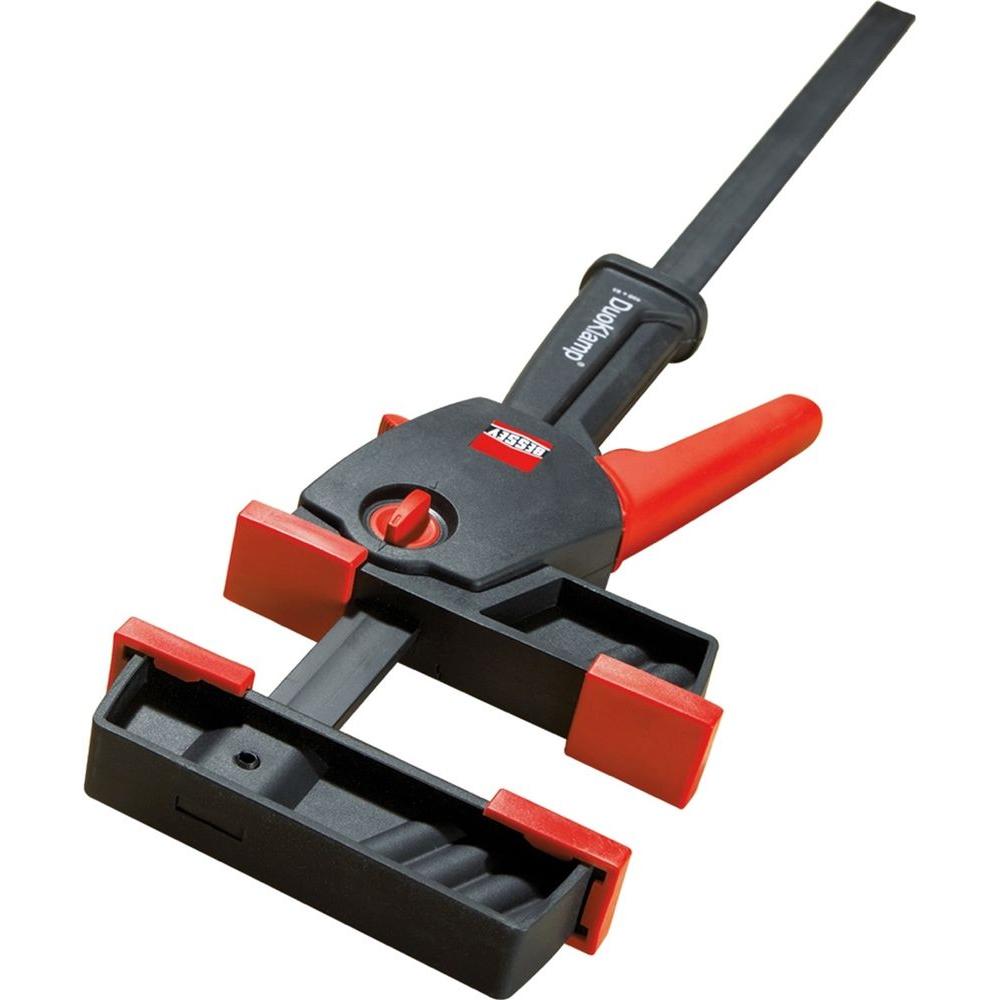
Long version: How many times does it come to pass that you need to get a quick clamp on something, to make it hold still til you can get to the other end of the board with both hands free? Sometimes, all that is needed is a quick-clamp that will later be replaced. They’re pretty cheap IIRC.
Yesterday’s mail brought a big box o’ aluminum bar/spreader clamps from Lee Valley. See link below. For glue-up situations where you need a one-hand clamp, cause you need the other hand for positioning, but you also want it to be a real clamp—you don’t want to touch that piece again once clamped.
These clamps look to be a German design, they say ‘patented in US and Germany’. They’re bigger than you think they’re going to be—they fill up your hand. But still can be manipulated with one hand, once you figure out how to get a finger on the release-trigger, which is awkwardly placed. They are parallel and they are hell for stout—you can use them where real pressure is wanted.
For something quick and temporary, I would still grab for a light duty Quik-clamp, but these really mean business. The spreader mode is useful.
I've got a couple of the irwin branded plastic clamps, and a couple of generics that rockler sold years ago for cheap (maybe they still do).
They work very well, and I no longer automatically assume I need bone crushing pressure for everything (despite the magazine articles i read first starting out suggesting that everything should be doused in huge amounts of glue and then clamed to 100 or 150 pounds per square inch).
I don't know if anyone else remembers those discussions, but they were comical because people were starting to suggest that maybe bessey clamps weren't enough to ensure a decent joint because laid on their side, they may not be able to put that much pressure on each square inch.
I love my Irwin Quick-grips. I used to only find then handy occasionally until I discovered they came in a stronger version. The 300lb ones. I have three different sizes and use them constantly in my chair shop. The reversible jaws are great for taking apart chairs that need repair.---Jack
The tiny ones they make however,I find just about useless.
I use the tiny Irwin quick clamps all the time in my bow making shop. I've got four and they find all sort of uses.
One I especially like is when adding the camber (inward curve) to difficult to camber bows. I heat the bow stick, position one or two wood blocks on my workbench to rest the stick on, and one or two clamps go where the curve is needed. Works when all else fails. Usually...
I use ones by Wolfcraft. I have Irwins and some cheaper brands, but the Wolfcrafts are my helpers when I do carpentry work. The spring action to open up the clamp is quite strong, so there's no fuss and they open up fairly quickly (and not too much like the Irwins) when you're holding something heavy with the other hand. They also hold really tight.
I have eight Irwin squeeze clamps, 6" and 12". They're very handy.
I have a couple of Bora squeeze clamps; they leave some sort of residue and you can see the pattern of the clamp pad on the stock after removing the clamp. They aren't greasy or dirty and I've cleaned them with water and with mineral spirits but they still leave an image. So I don't use them on finish-sanded parts.
They look pretty neat. I've got some of the older quick-grip, from before Irwin bought the company that originated the design (not sure of that history; it could be someone else bought the original company and then Irwin absorbed that company...). I find they're mainly helpful for holding boards I'm cutting. When I want actual clamping, F- or C-clamps (depending on the size of the work) are my preference.
But these, and some of the other designs in this thread, may be superior to what I've got.
The Kant-twist clamps are also great and I have one I use for a particular clamping task in bow making. Works better than anything else. You can extert a huge amount of pressure with them! One needs to be careful or you can destroy a small workpiece...
I'd like to refine my practices in bending gunstocks. I use, as nearly as I'm able, the techniques in Bob Smalser's article. Briefly, this to wrap the wood with clean cotton strips, aim IR lamps at the critical area, and continually soak the cotton with heated oil.
So far, I've gotten the bends I wanted, and even accounted for springback successfully.
Still, there has been variability, due to either the finish on the stock or overheating to the point of darkening some areas.
So, how do you heat wood? And do you think your technique would work on a piece with greater sectional area?
The thickest bow stick that I've ever cambered was about 16mm. It was for an oversized bass bow in pernambuco. I taper the sticks before bending them, so only one end was this thick, the other was around 9mm. The length was ~26" long.
The rough cambered thickness was 16mm but the final planed bow was 14.5mm so you bend a bit oversize to compensate for any twist that might occur. I usually use about a 1.5mm oversized blank.
I initially bend bows using dry heat with a large wick alcohol lamp. Later tweaks to the straightness or camber are done with a smaller wicked alcohol lamp. The larger has a ~5/8" wick, the smaller about 1/4". Other bowmakers use a very soft flame of a Bunsen burner, hot air guns and small electric hot plates. Traditionally, small charcoal braziers were used. I once used a small hibachi grill!
Pernambuco is relatively easy and forgiving to bend with dry heat. I also make bows with figured and unfigured snakewood and other alternative species which are much more difficult. If you overheat any bow blank, especially a thick one, you can get cracks that form that will appear to close up once cool, but they are still there. You have to heat the stick up slowly.
I only bend a small portion of a stick, say 4-5" maximum at any one time. If I was using a larger heat source, like a hot plate, I guess you could heat and bend a longer section.
I mark off the region I wish to add/remove camber or to straighten with white chalk. Easy to just wipe off when done. The chalk marks show my extents to heat the wood and I hold the stick and play it constantly through the open alcohol flame. When it is hot enough, and this takes experience, the bow is ready to bend. The stick is bent against a curved wooden form, but the resulting curve is gauged by eye.
A thin violin bow (5mm) might take only 15 -20 seconds to heat to effect a small change. The 16mm thick bass bow would take several minutes to heat up, again going slowly to prevent overheating the outside "skin" and developing cracks.
Not sure how these techniques might help your gunstock straightening - sounds like you have a method that works. Especially since the cross section you are working with is much larger than a typical bow blank.


 y.