Home Articles Forums Gallery Marketplace Videos

WoodCentral Forums

Knowledge You Can Build On — Est. 1998

Chopping Dovetails and Spelching

Posts

Chopping Dovetails and Spelching

#1

Chopping Dovetails and Spelching

Don Stephan

Especially with softer woods like pine and poplar, when chopping in from each side at the base of the recess that receives a tail or pin, the center of the opening will break back towards the other end, a phenomenon I have seen referred to as spelching. This is not a clear description I know, but I do not have a picture to post.

This seems to occur regardless of how hard or softly a sharp chisel is tapped. With pine the breakout can be within 1/16" of the surface of the board. The 2nd practice board this morning is swirling grain in cherry, and the spelching is much less, perhaps because the grain direction is not parallel to the edge of the board. I understand the end grain that breaks out does contribute to the strength of a glued dovetail joint, but spelching in softer woods can be frustrating. Has anyone found ways to reduce it?

Re: Chopping Dovetails and Spelching

#2

Jack Guzman from Maine

small bites

Jack Guzman from Maine

I find that If I try to take a bigger piece with each chop I get more breaking out. Chop,back cut--chop,back cut. Flip it over. Repeat chop,back cut,etc. I almost always get some breakout/spelching in the center but if I take small bites it is minimal.

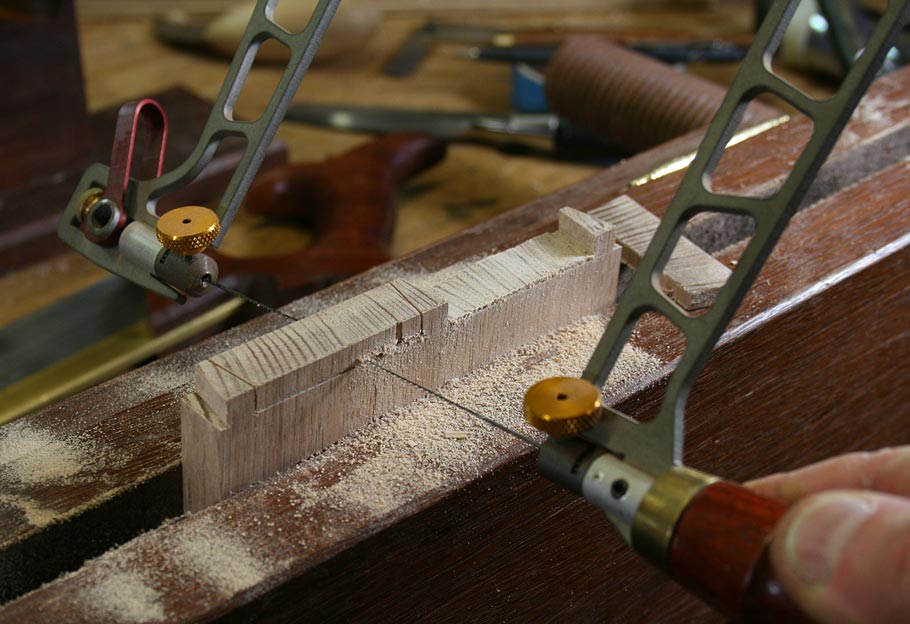
Sawing the baseline with a fret saw or like and paring the rest will totally eliminate any spelching.

Re: Chopping Dovetails and Spelching

#3

Re: Chopping Dovetails and Spelching

TomD

The reason this happens is because you are using blunt force to sever the fibers. This occurs if the chisel is dull, or more likely the chisel has wedged in and is not cutting due to being wedged higher in the cut. Also if you flip the board you can get this effect from unsupported fibers.

Sharp chisels; removal of waste with a saw, or chopped out away from the line first (both waste time); Lower angle bevels so the chisel doesn't jam; better quality wood.

Best technique for efficiency and effect is possibly the Klausz version which is in the original Dovetail a Drawer video. The detail here is that on the first side he notches in, like the wedge cut felling a tree, this leaves some support for the second side. On the secon side he notches under which is faster. He does get a little damage, but not enough to affect anything. The problem with sawing is that you are doing double the work. Dovetails can have the waste removed with a saw, or a chisel. Using both is poor technique, but it is an easy way to get a start.

"I understand the end grain that breaks out does contribute to the strength of a glued dovetail joint, but spelching in softer woods can be frustrating. Has anyone found ways to reduce it?"

Did you mean to say: "does not contribute to the strength". That seems to be what most people believe. It is not correct. Side grain glued to endgrain is stronger than the side grain (which is to say as strong as when we laminate or joint two pieces for width). If you meant to say what you actually said, you have advanced understanding.

Re: Chopping Dovetails and Spelching

#4

Re: Chopping Dovetails and Spelching

Sgian Dubh

In short, sharper chisel, smaller cuts, even if that means using a narrower chisel, say 3 mm or 6 mm wide chisel to start removing the waste, reserving the wider chisel(s) for final paring to the line.

Between pins reasonably widely spaced apart, say 25 or 30 mm apart, and after sawing out the bulk of the waste with a coping saw, I quite commonly start paring with a 6 mm chisel working back to the shoulder line. Then I switch to a 10 or 12 mm chisel, followed by an 18 mm chisel and finally a 25 mm chisel. Essentially I'm using the already created pathway of the narrower chisels to provide a reference surface for the wider chisels.

This methodology can be applied to soft wood species, hard wood species, and those that have definite hard/soft parts, e.g., many of the conifers, and ring porous hardwoods such as oak. Each individual piece of wood will tell you how much you need to gradually increase chisel width to clear waste, or even if you need to use the method I've described at all. In some woods, you can go straight to the widest chisel and pare back to the shoulder line with few problems. Slainte.

Re: Chopping Dovetails and Spelching

#5

Small bites and backing

Wiley Horne

Hi Don,

What Jack and others have said—small bites, and chisel bevel 30 degrees or a bit less.

When you’re chopping down through end grain, right at the baseline, especially when everything is clamped down, it doesn’t take long before the backing board underneath the workpiece gets pretty well chewed up. You get a trench in the backing right beneath the baseline—please don’t ask me how I know this. So there’s air underneath the baseline instead of support. Air support brings spelching. There’s a simple fix—move the backing to bring fresh wood into place.

Dunno if this figures in your work, but thought it worth mentioning just in case.....

Wiley

Re: Chopping Dovetails and Spelching

#6

20 degree primary bevel is the answer

GolfSteve in Calgary

I had this problem when dovetailing in soft white pine using my very, very sharp Lie-Nielsen chisels, which I think had 35 degree bevels. It didn't matter how sharp the chisel was or how small a bite I took with the chisel, the spelching was horrible on that piece of wood.

Rob Cosman suggested regrinding a chisel to 20 degrees. I ground a cheap Record blue handle chisel to a 20 degree bevel, sharpened it up, and the spelching almost disappeared!

Re: Chopping Dovetails and Spelching

#7

Species matters

Jim Matthews

Thickness and condition (of the wood) can vary greatly in some species.

I would suggest a change in technique, if results are consistent with your boards:

dovetails as usual with a backsaw, coping saw parallel to base, fine rasp UPWARD from knife line to center and pare the last.

I refitted some antique drawers with reclaimed Long Leaf pine and this worked.

Re: Chopping Dovetails and Spelching

#8

Re: Chopping Dovetails and Spelching *LINK*

Steve Voigt

See link below.

Also, sawing out the waste with a coping saw, and then paring, will mostly obviate this problem (and is faster).


Hayward on chopping dovetails

Re: Chopping Dovetails and Spelching

#9

Non-issue? And an alternative ...

Derek Cohen (in Perth, Australia)

Especially with softer woods like pine and poplar, when chopping in from each side at the base of the recess that receives a tail or pin, the center of the opening will break back towards the other end, a phenomenon I have seen referred to as spelching. This is not a clear description I know, but I do not have a picture to post.

This seems to occur regardless of how hard or softly a sharp chisel is tapped. With pine the breakout can be within 1/16" of the surface of the board. The 2nd practice board this morning is swirling grain in cherry, and the spelching is much less, perhaps because the grain direction is not parallel to the edge of the board. I understand the end grain that breaks out does contribute to the strength of a glued dovetail joint, but spelching in softer woods can be frustrating. Has anyone found ways to reduce it?

Don, if the area of spelch is centred in the middle third of the pin or tail, it is a non-issue. There is no structural help from this section when gluing the boards together, since both are end grain.

With thinnish boards, where the centre third threatens to spread across the width, care needs to be taken how the waste is removed. The method I use would be considered inefficient by Tom, since it involves both sawing and paring, but it leaves sweet, clean joinery. I am not racing the clock, but I also would not call my work slow.

Step 1 - undercut the baseline and create a chisel wall. (15 seconds) ...


An important reason for doing this is that this ensures that the inside and outside baselines are preserved. The end result will be a clean finish inside and outside the drawer.

Step 2 - saw the waste leave 1mm waste (20 seconds) ...


Step 3 - chop out the top half. I work from the inside first. Take 0.5mm slices ....


Flip and do the other side, stopping as close to the centre as possible ... which means that a smidgeon will remain.

Step 4 - Pare the centre with a narrow chisel (less resistance). It is OK to slightly undercut at this stage ...


Outside ...


Inside ...


Regards from Perth

Derek

Re: Chopping Dovetails and Spelching

#10

Re: Chopping Dovetails and Spelching

Don Stephan

Thanks everyone for your replies.

Interestingly, Lie Nielsen recommends a cutting angle (secondary, if you use one) no less than 30 degrees in softer woods which I interpret to be cherry and walnut and a cutting angle of 35 degrees in oak. The reason is that the A2 steel used in their chisels can chip, especially if levering out the waste, when the cutting tip is thinner.

The excerpt to the Hayward book in the link was interesting, the same approach shown by Frank Klaus in the dovetailing VCR I have (old but still a good reference) and the approach I use.

Next time I'll try lighter taps on the chisel. If spelching still is an issue I'll have to take more time to use my old low tech coping saw for the bulk of the waste.

Re: Chopping Dovetails and Spelching

#11

Re: Chopping Dovetails and Spelching

TomD

On the one hand it is weird that a lot of knives, normally used to cut soft things like bread or meat, use a 45 degree included angle in the edge, while woodworking edges are finer. On the other hand, I would not pay much heed to LN if they are responding to people who pry so roughly they break modern A2 edges. There is no telling the monsters who use their tools. Reminds me of my LV story where they showed me a basket full of returned Iyoroi mortising chisels, every one of which had been snapped off. I've been using my set for 40 years.

I copied this chisel from Mac Hedley's shop (as see in some episode of the WWS). The angle of the tool is so low, say 5 degrees that in pine you can drive it right through with a tap from one side, and one from the other. No need to undercut from either side. Only works for thinner stock say 5/16 and down. But it is fun.

Re: Chopping Dovetails and Spelching

#12

Re: Chopping Dovetails and Spelching

Joe shelton

And does it only work in pine? Or is it generally useful for dovetails?

Re: Chopping Dovetails and Spelching

#13

A chisel is a wedge

Brian Holcombe

A chisel used with the bevel toward the end grain will drive the waste away. A chisel with the back toward end grain will drive into the end grain increasing the cutting force needed and causing a larger undercut which will no doubt tear out a big chunk of the end grain.

Turn the chisel around and chop a set of dovetails.

Re: Chopping Dovetails and Spelching

#14

LN's comments are a 50/50 mix

david weaver

50% of the mix is that A2 steel doesn't make a lot of sense in chisels other than blunt chisels, and there is chipping at less than their suggested angles (but anyone who prescribes a 20 degree chisel that is truly 20 degrees should admit that edge damage occurs there - you take the trade off for less resistance).

The other 50% of the mix is that (as the farmers around me would say) a fair percentage of LN's clientele are folks who could break an anvil with a rubber hammer.

I had LN's sash mortise chisels and found them to be delightful. I've also found over the years that their A2 irons are the best of the A2 irons, but that well purchased (as in good quality) and carefully hardened and tempered O1 that's oriented properly when it's cut from stock will match any A2 in planing (beat it in the hands of an experienced planer) and will fare better in chisels.

I think LN's story with A2 is that their heat treater will not do O1. I recall when they dropped O1, there wasn't some kind of long business story about it, their heat treater just stopped or the one that was doing O1 stopped.

Every O1 bench plane iron that I have made and tempered to light straw is more productive than any A2 iron that I've had. They will just plane far further into the wear cycle (and operate longer in terms of reduced clearance thanks to using a cap iron) and continue to leave a good surface.

But, the deal with LN's chisels is half true at most. At least half of the issue is users.

There are other issues with A2, but probably each little issue (like A2 not sharpening on washita stones because chunks disappear from the edge, not because the stone isn't fine enough, but stuff is literally pulled out) just adds another strike against it. The one for it is that it is extremely stable and makes less work for LN after heat treatment because it doesn't move much.

Re: Chopping Dovetails and Spelching

#15

Re: LN's comments are a 50/50 mix

Warren in Lancaster, PA

I think that the decision to use A2 steel and the decision to make socket chisels rather than tang chisels are both driven by manufacturing concerns. I think it is cheaper to machine a socket chisel than to make a tang chisel and have to fit a handle on it. And probably cheaper to deal with A2 than a low chrome steel. A2 machines easily in the annealed state and hardens with little very distortion. I would not call these premium chisels.

Re: Chopping Dovetails and Spelching

#16

Re: LN's comments are a 50/50 mix

david weaver

I'm sure the stock costs more than silver steel drill rod would, or flat stock in any plain steel shy of the boutique carbon steels, but I recall seeing one of these chisels made in a CNC lathe on line from either square or round stock (probably round).

The processes are far detached from what we'd think in terms of making a chisel. The traditional method (in modern terms) would involve die forging, and with good stock, that still makes a superb chisel. Even purchasing premium O1 rod (something domestic like Precision) and CNC maching a chisel and heat treating it properly would make a fine grained tough chisel, but it would move some.

Having moved further along in the making and using, the only thing that leaves me with a bit of a bitter taste is the way these chisels were marketed. They are very finely finished, but were marketed as being socketed and A2 as though the combination was an improvement both in part and in sum. Socket allows for a shorter billet, for the socket and handle to be made and joined with little or no hand input and the A2 allows for stability.

I don't think they could've been made there any other way, and the bloggers like Chris Schwarz and some of the video makers went right along with it.

They are good chisels for what they are, but they are what they are (I am speculating, but I'd say form dictated by process rather than process dictated by form) - and that is not something equivalent to a mid to late 1800s cast steel chisel like a ward or I&H sorby.

I see hitachi white japanese tools and Ward or IH Sorby chisels as pretty much being the same thing. One hardened to about 61/62 and the other 64/65. But it's no accident that hitachi white is preferred for japanese chisels.

Warren -I saw your comment on SMC regarding stanley plane irons. I'm tempted as i've thought the same thing - I believe that stanley's irons are in a lower hardness range to suit the users, but that the stock is very high quality. What I'm tempted to do is reharden them, as I've found my own O1 irons (which I assumed would be subpar) to be superior in use to most of the modern replacement irons. I just don't think some of the modern stuff is made with much care as far as what's going on at the edge is concerned. Much is certainly very precisely made, but I shouldn't be able to get high quality domestic stock and outrun a hock O1 iron so easily with nothing more than a coffee can forge.

At a commercial level, I doubt the market would ever get it. They'll (typical new users) paint by the numbers regarding whatever they're sold and repeat the marketing lines (like the comments about ECE primus planes having long wearing irons - their irons are terrible - each that I've tried has been in the lowest quartile, probably 10% and I was happy to see that brent beach found the same, though he doesn't really know what he's concluding about the pictures he shows as he hasn't grasped that wear bevel length isn't important if the edge is blunt and not close to uniform).

Re: Chopping Dovetails and Spelching

#17

Manufacturing concerns over specs

Jim Matthews

I think you're both on the right track regarding the choices made by the sellers.

The market for tools like these competes with other shiny "Man toys" like fishing gear, boats, vintage audio and precision watches.

It's not an attempt to capture the hand tool market, which is miniscule.

Having owned, and found most modern steels unresponsive to my clumsy handling, I bought a set of Barr chisels, which are clearly made by hand (not CNC perfect) but feel like a tool built for the task.

Re: Chopping Dovetails and Spelching

#18

Re: Manufacturing concerns over specs

david weaver

The finish level on LN tools is really great. It's obviously the main focus, and it's what (in my opinion) pleases the buyers of them the most - being able to get a tool out of a pack and do little to it and start working.

There's some merit to that.

But there is a lot of art missing in them once you get a hold of an old ward chisel. Not just the fact that it looks old and with some life to it (it does), but they way they sharpen and work, and the way their proportions are more suited to grabbing the handle of a tool and just working with it. Turning it over and removing waste in a corner, etc. It's just proportionally and metallurgically superior for the task.

There are a lot of later similarly-shaped sheffield made chisels that are crap, though. Earlier marples chisels were wonderful. I bought an unused probably late 60s set off of ebay last year and some of them are unhardened, yet others (a set of three parers that said "chrome vanadium" on them) from the same era are OK. Not sure what the deal is, but the older ones are safe when they can be found, but usually overpriced when they're sold from a US seller.

I wouldn't want to serve the market that LN serves. It would be like the posts on woodnet used to be (assuming it's still the same). They reset after a year and the discussions never progress into anything meaningful.

Re: Chopping Dovetails and Spelching

#19

Re: LN's comments are a 50/50 mix

Warren in Lancaster, PA

I think it is wrong to assume that older tools were more highly tempered because of less skill or less sophistication. It is very easy to get a harder tool: just temper at a lower temperature. Yet the historic makers who made tools for professional woodworkers probably tempered to a hardness closer to old Stanley than to Hock. Moxon (1677) notes that a "dark goldish Colour" is used for tempering edge tools and similar temper was used into the 19th century or more.

Today people read on some blog that a plane iron should be thick and hard, and so they make that kind and brag about. It is not like they know what they are doing.

Re: Chopping Dovetails and Spelching

#20

Re: LN's comments are a 50/50 mix

david weaver

Not necessarily less skill, but sharpenability. Some of it may have been less assumed skill, though. A friend's dad was a trade carpenter (he's long dead now) in the UK. He took care of his tools well enough and used them HARD, but sharpened with a carborundum stone and an india stone. I'm sure most of his sharpening was done on site, and the tools showed the abuse of site work.

Once stanley had a lot of customers working on site with mail order millwork, I'd assume the skill level of the user went down.

The 1900 or so irons seem to be slightly harder than the WW2 era tools, though it can be hit or miss. I'm sure some would like to assume that the laminated stanley irons would be harder, but I haven't found that to be universally true (even on irons with little use and no sign of being abused).

I don't think any professional maker would've tempered an iron to hock standards at any point because a site worker or a craftsman using only stones wouldn't tolerate it.

I'd be willing to bet that stanley's pre WWII stock is at least as good of quality as the base stock that hock's irons use, as I've had several of those in the past (sold all except one A2 that is in a plane....actually, it's the record from the UK joiner/carpenter mentioned above - it was given to me because his son isn't sentimental to say the least, but I'm waiting for a time that he'll actually take it back and not putting an iron that I'm too fond of in it because I know he won't use it when he does - the record iron that was in it was beyond recovery).

At any rate, I prefer stanley's irons to hock. I prefer mine to stanley's but it's not something that would move the needle. The problem with the hock irons is more fundamental - they don't fail in a fine way (the O1s), at least in the several I've seen. George actually brought this up to me separately after I sold mine off - he prefers a dark straw or even light brown. I didn't ask him why, but I suspect it's because he was actually making things with his tools and couldn't stand chipping irons.

I have some other hock made irons - one directly from ron - that do not exhibit the chippiness of the bench plane irons, but one was left over from a custom project and the other two came through Ron Brese, so those aren't exactly an option. Not sure if the starting stock for those is different.

My findings with Starrett O1 and Precision Presto O1 (both on the higher side of O1 steel, but not by any means expensive if you're doing something useful with them) across the board so far make me think that most substandard O1 irons are due to substandard starting stock. I haven't tempered my shooting plane yet. It must be 64 hardness, and it's a nuisance because of it, but I wanted to see how it would hold up. It's 40 degrees and bevel down with no back bevel or any of that nonsense, and it doesn't chip on any reasonable wood.

It's just hard to discuss any of these things without context. It's like the average discussion of a 59/60 hardness (deep straw or dark straw) iron being called too soft. What's the context? Working Cherry? No way. Anyone who thinks that's too soft is probably working with too thin of a shaving. Can more work be accomplished with a harder highly alloyed iron? Not in my experience. What about the stones? The fastest are the most productive? Also, not in my experience. I like an iron at 61/62 better than one at 59/60, but if I was working on a site somewhere, that wouldn't be the case. If I'd never made tools, I wouldn't care or know about any of it. If I'd never bought all of the stones that I've had, I'd never know that you can basically tell the hardness of an iron or knife (or chisel) with a familiar washita stone. It probably wouldn't make any difference with what I'm making, but I'd have gone away from anything more alloyed than oil hardening steel because it leaves lines on work and only lasts longer in a contest of 1 thousandth shavings.

Re: Chopping Dovetails and Spelching

#21

Somewhere in...

david weaver

...that verbose response, I missed the point. I agree with what you're saying, I think.

The main point is that stanley irons are not "soft" as according to modern bloggers due to some kind of lower spec or lower quality. They are very intentionally made the way they were made at the hardness they were tempered to (which is generally less than something like a parallel iron in an infill plane), and not because the steel was junk or some nonsense.

They didn't really go "full south" in quality until the rounded top irons showed up in planes (not sure if that was the 70s). Those can be extremely soft and gummy.

I haven't found any of the irons of other manufacturers to be better despite their claims and marketing pictures (record, millers falls, etc.. all are OK, but not better than stanley's offerings).

Re: Chopping Dovetails and Spelching

#22

Re: Somewhere in...

TomD

It is rather funny to see the LN brand at the low end. I didn't have much use for it as it was not my preferred format. Though I do own a few of their early planes that at one point were quite favourably priced. I don't really use them, and have thought of selling them.

I don't see where tang chisels are preferred? When did that happen. Socket chisels always seemed ideal to me, though most of my chisels are tang socket, which might be the best of both worlds, certainly part of both worlds. I use my Barr chisels a lot, and they are a good away brand, I take them on the road as they are easier to sharpen, and seem made for pros with their powerful transition from socket to blade.

Sockets take up a lot more material, and would be a lot more expensive to make, unless one were really really set up for it. In stock removal, like CNC there would be huge waste of material. Tang are lower tech in the old days with the burning in method, and today with bonding. Bonding produces a very effective attachment, if lacking a little in artfulness.

My dad was born in 1925, and the Swedish chisels he owned were socketed. I don't know where he got them, or if they were second hand, they were mismatched. He probably put them together around '55. They were hard, and a bit tough to sharpen. The main feature they had was the handles never stayed put. I was quite surprised when buying my own chisels to find it was possible to get them with handles that remained attached.

Re: Chopping Dovetails and Spelching

#23

Re: Somewhere in...

david weaver

I wouldn't put them at the low end, just the spec seems to be aimed toward beginners (or especially tailored to). They're really good chisels, but at the cost (to be fair, the cost has remained the same or close for probably more than a decade), they're just no better than something like ashley iles O1 chisels (I'd rather use the latter, and those are half the price or less).

As far as socketed chisels, I'm not sure when things sort of moved around in terms of preferences, but all of the old cabinet chisels are tang type. Modern chisels that are tang/socket combination (like the AI chisels) are nice to use since the socket usually isn't large and they feel about the same in use as an older chisel.

Not sure how much of that was due to the manufacturing methods. With a CNC lathe, no problem on a socket and no handle fitting required. I'm sure 200 years ago, it was easier to manufacture a chisel with a tang, but I've never heard of anyone recreating the bolster that's on the older chisels. George mentioned that the blacksmiths at CW puzzled over doing that neatly. It would be easy with a modern press to die forge a chisels and then file the bolster to make it look like it was hand done (also pointless - just mentioning regarding the bolster as I have no idea what makers would've done before die forging was common).