Home Articles Forums Gallery Marketplace Videos

WoodCentral Forums

Knowledge You Can Build On — Est. 1998

Broad hatchets

Posts

Broad hatchets

#1

Broad hatchets

Bill Houghton, Sebastopol, CA

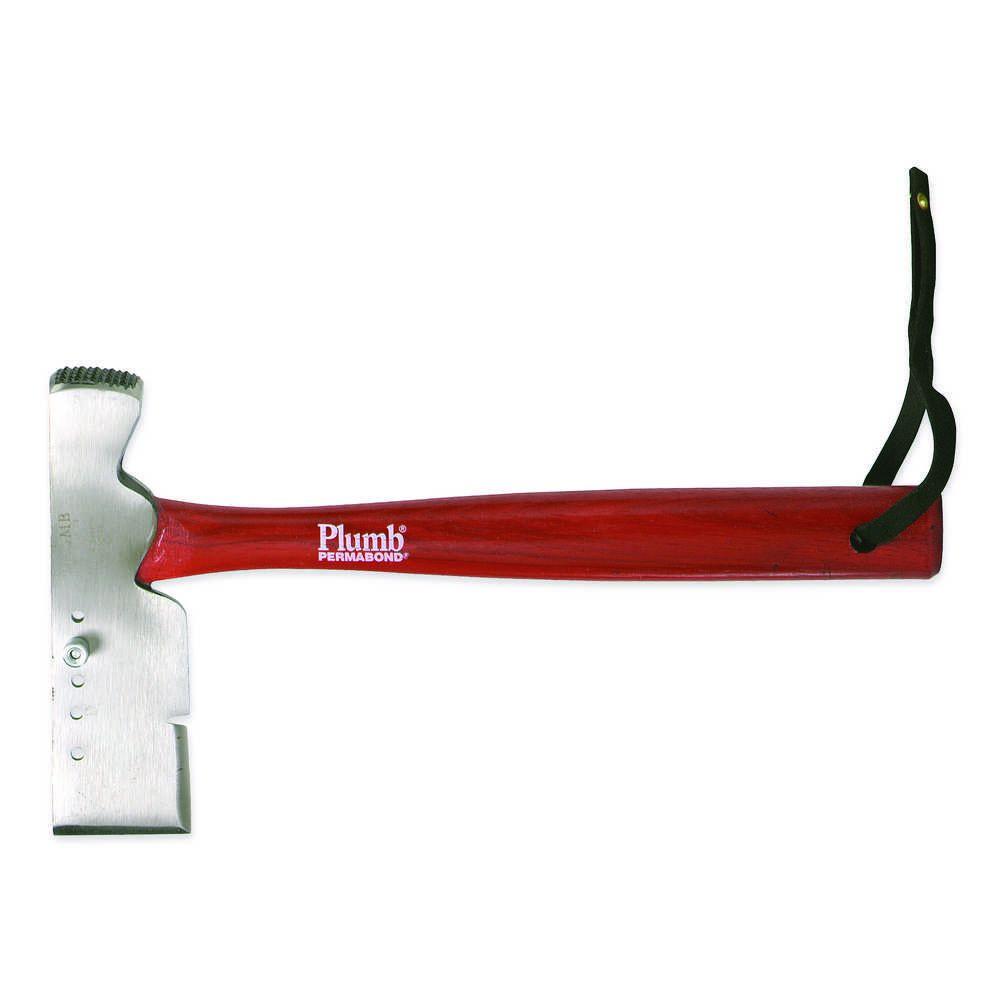
I've got a right-handed broad hatchet, which I've used some, in spite of being left-handed, and found useful for things like removing an inch from the edge of a board. I'm reluctant to cut off the perfectly good handle to change hands, and was pleased when, a while back, I picked up another one, a Plumb that weighs about 2-3/4 pounds, with a stub handle. I've been too busy to put a new handle on it as a left-handed tool, though.

In a recent garage cleanout, I scored yet another broad hatchet, this one set up left-handed and with a decent (not great, but decent) handle. It's noticeably thinner, smaller, and lighter, though, than either of the other two. It's also noticeably scruffier, so I haven't found the maker's name. It would require major work; it appears to have been used to trim concrete posts or elephant bones, and I'd have to regrind back 3/4" or so and establish a new bevel before I could begin to sharpen it.

My question today: what are the tradeoffs of weight in a broad hatchet? Is lighter or heavier better? If the heavier Plumb is what I should have, I won't waste time with the new one but will let some future buyer at the Habitat ReStore have that joy; but, obviously, if a lighter one has some virtues, it stays.

Re: Broad hatchets

#2

Re: Broad hatchets

Joe shelton

Although I'd not give up the heavy ones, I like light and very sharp. I don't hew timbers, but working the edge of thin stock or starting out on medium stock before changing over to a drawknife is a pleasant job with a light head, a beard and a sharp single-bevel.

Re: Broad hatchets

#3

Re: Broad hatchets

Bill Houghton, Sebastopol, CA

Well, I've got the beard, for some many years now, and I occasionally do get light-headed.

Thanks. I'll hold onto the new one for now; when I finally get the house to a point of stability (not, that is, with the backlog of remodels now on the list) and get into the shop for more furniture, I'll have to see what makes most sense for my work style.

Re: Broad hatchets

#4

Re: Broad hatchets

Joe shelton

How are you beveled?

Re: Broad hatchets

#5

Jack Guzman from Maine

Re: Broad hatchets

Jack Guzman from Maine

I love making handles. I'm set up for it though. I have a shaving horse and a bunch of very sharp drawknives.

I like a light hatchet better for initial shaping of blanks destined for chair parts. It will depend on what you will be using it for.

Re: Broad hatchets

#6

Rounded bevel - very rounded


Re: Broad hatchets

#7

Jack Guzman from Maine

Re: Rounded bevel - very rounded

Jack Guzman from Maine

I don't think I've ever seen a used axe or hatchet that was sharpened correctly. That goes for drawknives too. I suspect the reason is that a person who uses one and keeps it sharp would not get rid of it. Only after long disuse and/or lack of interest do tools like these get sold. I sharpen my hatchet like a bench chisel. Flat polished back and about a 30 degree bevel(I don't measure it,just eyeball the angle). It has to handle chopping forces. Too sharp a pitch and it will dull quickly. BTW--I'm no expert,I'm just starting to figure this stuff out. Anybody know more about hatchet angles?

Re: Broad hatchets

#8

I didn't make that clear

Bill Houghton, Sebastopol, CA

In saying "rounded bevel," I was referring to me, not the hatchet. Actually, both the right-handed and the future (once I put a handle on it) left-handed hatchet have nice sharp, straight bevels, roughly at the angle you describe. The new, lighter one, as I mentioned, has a truly destroyed edge, but it originally had a decent bevel, too.

Re: Broad hatchets

#9

Re: Broad hatchets

David Weaver

I use a hatchet only rarely on turning blanks, but do like a short handled heavier hatchet better. I've got two, one heavier than the other. I think someone surer of their strikes might like one a little bit lighter to save their shoulder, but closer to the head and heavier head with less need seems to me to be less threat of a misstrike.

Could just be perceived, though.

Re: Broad hatchets

#10

Re: Broad hatchets

TomD

I have never really understood the concept of broad hatchets. Broad axes are for finish hewing timbers, or maybe one step above a finished finish. Not the kind of work I see being done single handed with a hatchet. But as I say, never really got them.

In the hewing I have done with an axe, I like a relatively heavy head, because one is not getting overly kinetic with it, as one is making paring cuts, that the weight helps pull the head through on. For shaping with a hatchet, I prefer a lighter head, as one is making many cuts to develop a shape. One is always looking for what cut will take the best advantage of the piece and developing shape, so that often mean one does not need a broad head, as one is tryig to take a facet, not a planing cut.

It seems that pretty much anything can work with the right user. If you have ever seen the full range of Gransford hewing axes, there are some pretty strange axes in there with twisted shafts, and oddly angled ass-backwards heads. An option for every preference.

Re: Broad hatchets

#11

Re: Broad hatchets - what are they good for

TomD

Would you not know it, as soon as I said I didn't know what they were good for, I stumbled over a youtube video on "making roof shingles with hand tools". They are used for dressing the shingles. So that explains their ubiquity. I think the only time I saw anything on that it was Drew Langsner who did an article, and all I remember were froes, shaving horses and draw knives. But in the video the guy makes great use of the broad hatchet for dressing the boards after they are split.

Re: Broad hatchets

#12

Re: Broad hatchets - what are they good for

david weaver

The shingling hatchet types and presumably the later offshoots (hatchet, hammer and nail puller in one) are very common around here. Probably more common than a typical 2 1/2 or 3 pound plumb broad hatchet.

The later types here tend to have a pretty thin bit. Not sure how long ago they were still in use, or for what once roofs went primarily to steel or asphalt (lots of slate and tile, but no new slate or tile that I've seen).

Re: Broad hatchets

#13

Re: Broad hatchets - what are they good for

Bill Houghton, Sebastopol, CA

Gauging shingling hatchets are still the bee's knees for hand-nailing composition ("asphalt") shingles. Once you get the first course straight, you use the gauge to set the exposure on the next course; and, on that next course (and subsequent courses), once you've aligned the first shingle, you can align the later ones in the same course by matching exposure where the shingles touch and using the gauge to set the "free" end. Much, much faster than striking line after line on the roof to set your shingles.

And the hatchet end is used to score the back side of the shingles to cut them: score once (twice on some thicker "architectural" shingles), and bend the shingle, and it's ready to install. One tool in your hand for everything.


img

Re: Broad hatchets

#14

Re: that's what I'm used to seeing..

david weaver

...I live under a rock, but didn't know the plumb brand was still being marketed.

Re: Broad hatchets

#15

Re: Broad hatchets - what are they good for

William Duffield

Those were also used mid-century for hanging sheetrock (rock lath), which was a precursor to drywall, and a replacement for wooden laths as an underlayment for plaster walls and ceilings. The blade was used to score the paper covering to length, and the hammer end was used to nail it to the stud wall. The sheetrock came in 16" widths and was covered in coarse grey paper that the plaster stuck to. I still have my dad's lath hatchet.

Re: Broad hatchets

#16

Similar but slightly different

Bill Houghton, Sebastopol, CA

On a lot of sheetrock hammers, the handle has a noticeable slant relative to the head, permitting driving nails in corners without hitting the adjacent sheetrock. And the rock hammers I've seen didn't have the gauge.

Even before sheetrock, the (wooden) lath hammer drawings I've seen were, similarly, subtly different from shingle hammers.

It's always interesting to see how refined hammer designs were/are for the trade being practiced, particularly back when it was about the only way to drive nails - that is, before nail guns.