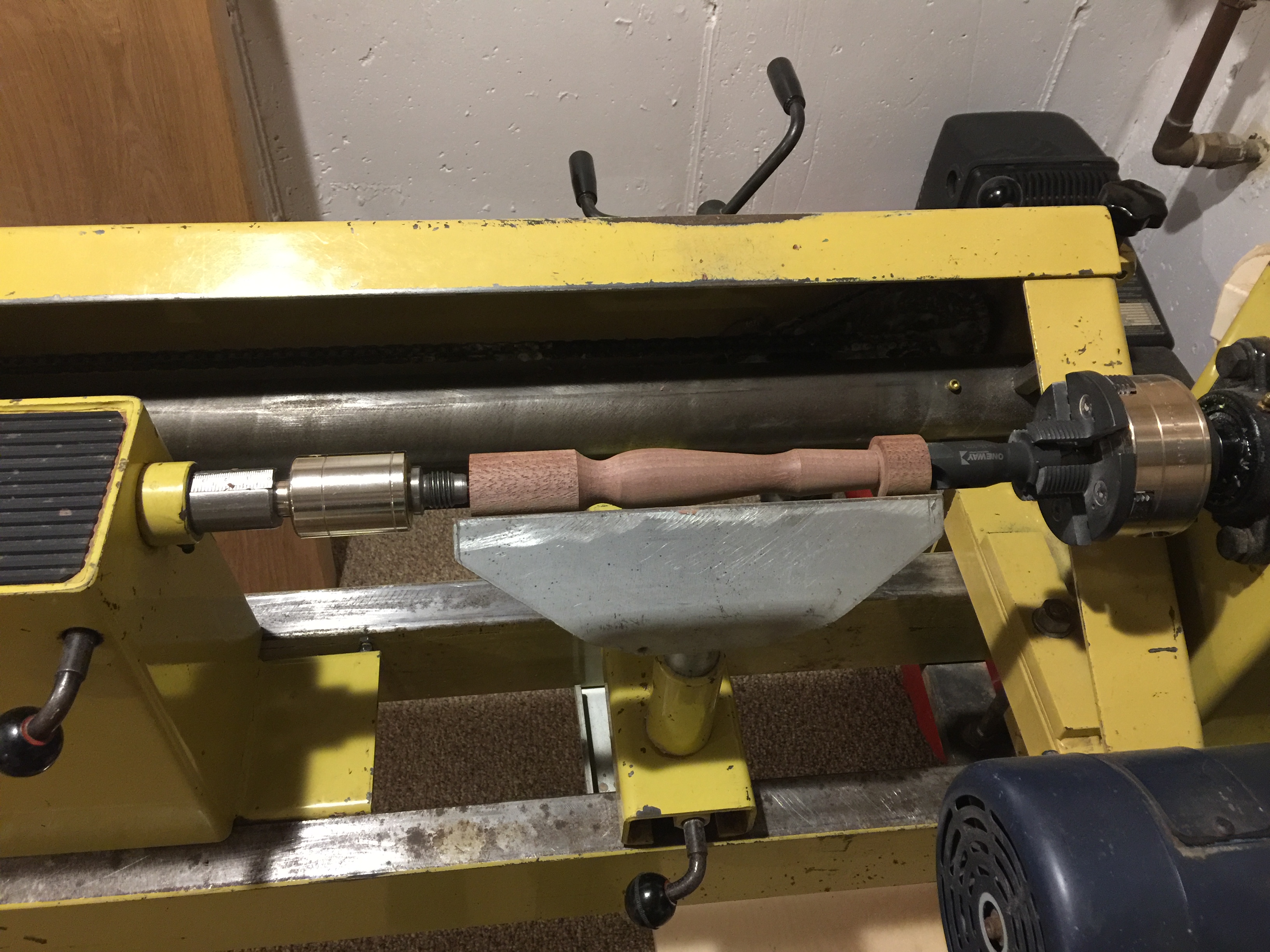
I’ll participate a bit in livening things up. I hate my coping saw handle, my hands are in pain after literal moments of using it. I’ve been tempted to make a more bulbous handle in the hopes that having a greater purchase will relieve this issue.
Any thoughts on the design?
I will likely model it after the handles John Aniano made for the draw knife, they’re a comfortable grip. But I thought to put this out there unless there is something specific to the motion of coping saws. The grip one takes is a little different.
It may not be the shape or size of the handle that is causing most of the discomfort, but instead the angle at which your work height forces you to hold your wrist, A.K.A., the "hang" angle.
Another way to look at your problem is to analyze the basic design of your saw. Here is the completely different design of what I use for a coping saw:
Yes, it could use a larger handle, but the additional mass would make it more difficult to maneuver. There are always tradeoffs.
I had a turning saw as well and it was the same, oddly enough the Japanese saws don’t cause this issue. It’s not so much a wrist pain or carpel tunnel, but right in the center of my palm. I have to stretch it back out after only a handful of moments, where I can saw with my nokogiri for a long while without that pain forming.
What a cute saw! Very nicely made! Is it of walnut or some other dark wood? Are the metal bits that hold the coping saw blade pinned ends made of steel or brass or some other metal?
Could you please bring this to the next Central Jersey Woodworking club meeting I can attend, which would be the April meeting. I have to miss the March meeting, but I'd really enjoy seeing this little saw in person.
I think the bulbous handle is a good idea. My suggestion is that you look at some historic examples. The link below shows the famous Millers Falls 42, which has a nice looking handle. There are others out there for the Googling.
Side rant: it is totally beyond my understanding why someone can't make a coping saw in the $50-100 range, something that looks like a normal coping saw (like the MF 42), but just has a better handle and a better tensioning/blade holding mechanism than the $12 Olsen POS. I see that someone is coming out with a saw that's north of $300 and has a similar (though scaled down) look as the Knew Concepts saw. I guess that's what some people are into, but I'd go for something a lot simpler and cheaper. There's gotta be a way for someone to do that and make a profit, I would think.
Sure, I can bring it again. I brought it to the November and January CJWA meetings.
The arms are walnut. If I were making another, I would use hickory instead.
The stretcher is bloodwood. I would recommend something lighter.
The handles are cherry.
The windlass is red oak. It needs a major redesign.
The pins are 3/16 ø round brass rod. They are epoxied into the handles. I cut the slots in the brass pins with an abrasive cutoff wheel in a Dremel.
The cord is waxed linen. I wonder where I got that?
Ray is seriously considering organizing a CJWA bowsaw group build. I've been lobbying him to include this coping saw, in addition to a more traditionally sized turning saw, into the working group process. I have plans, parts, templates, etc. for building a few more of them.
The handle was morticed for the tang and then simply epoxied on. I am not intending to change it again. However, should I need to do so, a little heat on the ferrule will soften the epoxy enough to remove it.
The large mahogany one shown is right on, that seems like the shape I want. Thank you!
I think the issue with making these is that once you begin bulking up the frame to handle tension it becomes heavy unless you make that sort of bridge (trestle) design from aluminum.
Outside of that, bent steel of welded steel gets heavy once you have the gauge needed.
Glad the linen cord is finding a good use! What did you base your saw's design on? Something you've seen before, or from a picture in a book? Or did you just wing it? In any case, it is very nice.
I have lobbied Ray W. to do a group build as well. I scaled the image he took of the bowsaw he bidded on at a CRAFTS auction. Glad to hear he might give it a go.
I've got some rosewood (originally scrap from the Disston factory!) that might be destined to become a bowsaw, or possibly a coping saw. But rosewood is so heavy, and you said you wished you'd have used some lighter wood for your version - maybe rosewood isn't practical. Of course, I could just use titanium for the metal rods, that should shave some weight off. Seriously, 99% titanium, which is easily bought from McMasterCarr, is not absolutely awful to work with. A real PITA to thread, but for blade holding in a coping saw, it would be fine. I could set up my little milling machine to do some thin slots for the pin ends, if hacksawing proves difficult. And for completeness, they sell titanium tubing for the handle ferrules...
Then again, I really don't need another saw. But a rosewood coping saw would rate very high on the cute factor, the most important feature of small woodworking tools.
I just shrunk the saw I made from BugBear's plans, and by intuition, figured out about what cross section I needed so it would be as strong as it needed to be.
Back in November I learned something the hard way. A one-ended windlass doesn't give you enough fine control of the string tension. I gauge the tension on the blade by plucking it and listening for the tone. While distracted by a very noisy environment, I gave it one rotation too much, and snapped an arm. It was easy enough to glue it back together, but I was a bit embarrassed, and so am updating my design parameters: First, I need to make the windlass in two pieces, with a shuttle to hold the string, and a sliding paddle that will engage the stretcher at either end. That will allow tightening it by half turns instead of by full turns. Second, I don't think I'll be using walnut for future arms; instead, I'm specifying hickory, osage orange, or ash, preferably riven.
A milling machine would be nice for cutting the blade holding slots, but I didn't find it necessary. I just used a Dremel tool freehand, with a 1/64" thick abrasive disc to cut the longitudinal slot that the blade drops into, and a 1/32" thick disc to cut the diagonal slot for the pin. Note, to provide a little extra strength I didn't cut the longitudinal slot all the way through, so the end of the slot is ramped. Since the end of the blades are made square, I had to grind a little off the end of the back side of the blade to allow it to drop into the slot.
I don't see any need for handle ferrules. Instead, I have been considering tapering the end of the handles and the holes through the ends of the arms with a peg reamer to counteract the tendency of the blade to turn unintentionally while sawing curved kerfs.
Rosewood would certainly add a touch of elegance. My first choice would be Dalbergia decipularis. Its density is similar to fast grown white oak, not nearly as dense as bloodwood.
I actually think the trestle frame is a solution in search of a problem. In my experience with the simple steel frames that have been used for at least a century, stiffness is never the problem; the problem is always that (1) the tensioning mechanism bottoms out before adequate tension is reached, and (2) the blade rotates or doesn't lock. Oh, and I almost forgot, the handle sucks!
I suspect this is because the makers feel they need to keep the price below $15. If the price target were say $60, it wouldn't be that hard to machine better mechanisms to hold the blade, and a nicer handle. Hell, if I had a mill and a lathe, I do it myself.
The plans are too big to post on WoodCentral, so if you want a copy, I'll need an e-mail address. I suppose I should mention that the plans and design are copyrighted, are made available for personal use only, not to be published or sold, and not for manufacture of bowsaws for sale.
If you want to use the plans to direct a working group build in your local woodworking guild or scout troop, etc., that's OK, and even highly encouraged. I just don't want to see Chinese knockoffs being sold by Horror Fright.
This one is in walnut, I've gone through more than my share of good exotics on poor handles, so starting small on this one. If it is a success I will make another.
Time to pick up some brass ferrules, aka plumbing fittings.
George has told me before (and I can't remember the number) about the price level where jewelry goes from being an impulse buy to a slow seller.
It seems like with saws and router planes and other relatively plain gadgets, woodworkers won't buy it below a certain price.
(or more specifically, if you made a good saw, but didn't try to turn it into the "best ever, improved over old" and tried to sell it for $100 without making it cosmetically perfect or blingy, then the $300 buyer would probably think they're too good for it).
I still like the $12 hardware store type, but in combination with a coarser bow saw for larger work. The thin handles bother my fingers and hands, though, like they do a lot of people. I guess I have mild arthritis, some things set it off, and some exercise makes it feel a little bit better (or at least feels like a good fatigue). Anything that involves closing the hand and squeezing becomes toxic while I'm not paying attention, and I end up using the coping saw two handed with the handle going between my index finger and middle finger on the right hand.
I've been floating the sides of my shooting plane with a vixen the last couple of days, just stabbed on a piece of wood, and no problem with the hands at all. No need for a tight grip.
Wow, I hadn't realized that your duplicating lathe's headstock/tailstock orientation was reversed! Seems so strange to see the drive center at the right. That said, a pole lathe usually doesn't have a "drive" center orientation either. It would take me a very long time to get used to your lathe!
Nice turning! A suggestion - do try to bring the workpiece closer to these two solid ends (head/tail stock) to reduce vibration. Looks like the walnut handle takes up about 1/3 of the distance between the head and tail stocks. I can see your setup for hand turning is a bit cobbled together, but try to keep the workpiece as supported as possible, and keep extensions (like the tailstock graduated spindle) as fully seated as practical.
Hah, it’s a bit weird, made the room layout completely different from how I expected as well.
Good thought, I can draw in that live center a bit. The chuck spur is handy but it does move the workholding pretty far out. I usually remove it after I make the piece round, I was a bit lazy on this one and just left it.
I’m guilty of this to a large extent, I’ve gotten better about it being that I have to be a bit thrifty now. One of my students brought over his saw which was a nice old vintage coping saw; if I were buying one again I’d likely hunt down one of those and not bother with these luxury saws.