Vice advice
Joe Piotrowski
I looking for a quick release front vice. What do you all have? Would you buy it again? Worth it's value?
Knowledge You Can Build On — Est. 1998
Vice advice
Joe Piotrowski
I looking for a quick release front vice. What do you all have? Would you buy it again? Worth it's value?
Re: Vice advice
Patrick Chase
When I saw the title I instinctively thought "hookers and coke", but if I'm being honest mine could be best described as "tools and sharpening stones that I don't absolutely need".
Here in the US we call that thing on your bench a "vise" :-)
Re: Vice advice
Hank Knight
I recently built a bench for my radial arm saw that serves as a supplemental work surface to my workbench. I added a front vise for convenience. I chose the Lee Valley (not Veritas) quick release front vise (ihttp://www.leevalley.com/us/Wood/page.aspx?p=54873&cat=1,41636,41637,41659,41661&ap=1) It is well built and the quick release feature works. I have a problem with it because the quick release feature is engaged by turning the handle counterclockwise a half turn or so. Doing this does not back the vise jaw off, it remains tightly engaged until you physically pull the handle back to release the pressure. I find this awkward because it is a coarse adjustment. Often it is convenient to barely release the vise grip to reposition the work. The act of pulling the handle back to withdraw the front jaw does not work well for fine repositioning. The vise is well built and relatively inexpensive. I bought it for these reasons (it was never intended to be my primary front vise), but I would not buy it again because of the release function.
My primary front vise is a Record 53 1/2 quick release vise. It is a traditional iron front vise and a work horse. It is no longer made by Record, but there are a number of clones on the market. I know nothing about them, but I would purchase my Record again in a heartbeat. It is a fine vise.
Oops. Meant vise
Re: Vice advice
David weaver
If you like quick release, I'd go with the one lv sells. I have the small version of that vise on the end of my bench, but a leg vise on the front with a wooden screw.
Re: Vice advice
TomD
This is a version of the Jorgensen vise which has the advantage of giving more room to access the jaws. The pro way of installing this is to mount a substantial wooden fore jaw, and bury the rear jaw in the bench. This is a good system used by a number of top makers. You need the largest one to carry that off fully.
http://www.leevalley.com/us/Wood/page.aspx?p=49980&cat=1,41636,41637,41659

As recomended, I have never liked these as they seem to have so little space for the work. Even the 350 dollar one.
http://www.leevalley.com/us/images/item/Woodworking/Clamps/05g3401s1.jpg
http://www.leevalley.com/us/images/item/woodworking/clamps/70g0805s1.jpg


My preferred cheaper option is the L vise, cut back so it doesn't project much as on the Klausz bench. Easy to make, but you need a bench that can carry a breadboard end. Probably the best overall front vise. I have one on my Frid bench. All you need is a screw, and they are only a few 20s. To stop the vise projecting too far, you can get the screw cut back a little. You can do this yourself even on a wood lathe.
 (image from net0
The metal vise I use the most, and the best metal vise I have seen is the Tucker vise. No longer made, and I don't know if it is easy to find.
http://www.leevalley.com/us/wood/page.aspx?p=31143&cat=1,41637,41652,31143

The horizontal tilt, and 360 are huge gamechangers. Ironically, I put it on my new bench which is 8 feet + long because I came to believe the right length is the height of your average ceiling. But the Tucker is so useful I rarely use the bench top. These vises don't look right to a lot of people, in which case there is the option of mounting them on a pedestal, and preserving the Rouboness of your bench, if you like, but get one if you can.
I also have this vise, which is as close as one can get to a Tucker on the cheap:

But the iron is brittle in it, so I would check out some reviews to check on quality still being there.
A proper Emmert, or Patternmakers vise is a real find at a reasonable price.
If I had to cut back to one vise it would be the Tucker or Emmert style. For cabinetmaking alone a case can be made for the L vise alone. It just doesn't do as good a job for the non-cabinet stuff.
My shop is pretty dust free, even so I find the quick release is often jammed. I think the Jorgensen style quick release is better at dropping dust out when activated. But my main point is I don't use the quick release all that much as it has to be a big jump in jaw opening before it is worth the trouble. The screw on all my vises work really well.
A number of clever people have tried to improve on classic vises and they have not succeeded. I have tried a lot of them and returned a few. The Tucker is the real stand out. I'd love to try the "new" LV tail vise, I had the earlier one, and it was nice, but the new one looks better.
If we're allowed to change
david weaver
...I'd "endorse" (not as if I'm getting paid) the leg vise screw kit from Lake Erie, if they're even still making it.
I didn't put a QR vise on the front of my bench, because there's too many metal tube sticking out across the bottom, and I can't get tall things into the vise with enough grip. I know there will be people who want to argue about that, but i'm talking about resawing boards with a frame saw. A leg vise will do that because it will grip against the entire leg, but nothing else will without supplementation.
Thus, I've got a leg vise on the front, and an inexpensive QR vise on the end.
The coarse thread of the large wooden threaded vises means they work relatively fast.
i'll allow it! lol
Joseph Piotrowski
there are so many options for vice and bench constructions.
there are some good points about all of them. some ideas i like better than others. i trying to get something better than i have up and running. my current bench is a harbor freight that i have been modify as i need. currently i hit a wall of sorts as i really want to take advantage of the traditional hold fasts especially using a doe's foot. the top is too thin and required blocking etc. also the vice is terrible.
so i opted for a cheap, simple solution that will get me a better top quickly. i now have (2) 6 foot long 2" thick slabs of wood about 9" wide. i'm going to reuse the base and just do a split top.
this will allow me to learn more for a cheap investments on what kind of "forever" bench i'll build in the future.
there seams to be 4 kinds of vices i can put on the front of the bench. and even those have some sub categories.
face vice(cabinet makers vice, metal jaw type, both have QR options. pattern makers vice.
shoulder vice(need to learn more about this type)
twin screw vice quick release, chain drive, 2 plain screws.
leg vice. quick release, wood screw with pin board, criss-cross. even a horizontal version
they each nave some pretty good merits to consider. some i'm more familiar with and in favor of and some i need to know more about.
a QR front vice isn't my top choice but it's one i can mount quickly and get to work on other projects and maybe learn more about the work i want to do and what i need. at the end of the day, the working space i have is driving some of my decisions. and that may or may not be a good thing.
tell me more..
Joseph Piotrowski
about the "L" shoulder vice you use. this is the one type that i know the least about.
what kind of operations favor it? how do you use it? any upgrades or wishes you would haves when making it?
Re: i'll allow it! lol
david weaver
The leg vises are pretty quick to mount if you get a kit with all of the hardware, but they do leave you looking for a 2 9/16" drill bit and a way to use it. I used a small bench top drill press and through 5 1/2 inches of ash (which required drilling from both sides), the drill press didn't really love it.
Other than that, you make a pin board out of just about anything, a chop out of just about anything and put all of the hardware together (the "nut" for the screw comes as part of the kit).
I don't know how small the legs can be, I have 5 1/2" square legs on my bench - nothing expensive, they're laminated. I don't have a "nice" bench, just a heavy one that doesn't move and stays flat, and was really easy to build because I didn't do anything "nice". I didn't even dovetail caps on the end, just lagged them in, which you'd read is a no-no, but i've got a friend who has made long benches and lagged everything together on the entire things (to build airplane wings) and he's never had any trouble.
Some people want a nice bench, and want to build it. Some people just want a bench. I just wanted a bench. One that I can beat up, do metal work on from time to time and scrape the surface and keep going.
no fancy lad stuff from me.
Joseph Piotrowski
I've been looking at workbenches in antique stores and have seen quite a few lag bolted for end caps, vase plates and anywhere else. they all were perfectly serviceable and older than me.
i agree about the bench. i admire the the guys that build benches made from walnut, maple, cherry and all kinds of awesome joinery built to last 1000 years. i already exhausted just thinking about how long it would take me to work to pay for the material, then how long it would take me to make it.
i rather that the shop stuff, benches, cabinets stands etc be fast to make,cheap and sturdy enough to the task at hand. this isn't an easy mental exercise for because i over engineer things. sometime this leads me to rush stuff because it isn't fancy and a few things get sloppy but at least my tool are not piled on top of each other anymore 
my new(yet to be mounted) benchtop is polar. the only reason its not 2x4's is that its too cold in my shop to glue anything. so its simple, cheap-ish 100 bucks. i can beat the heck out of it and feel good about it.
i want to try out something, change the top up, cut a try in it etc. maybe make a planning stop groove. screw into it to hold something . i can do anything on it and feel good. that just my preference.
Re: no fancy lad stuff from me.
Brian Holcombe
I have a shoulder vise, and I kinda hate it. 
As much as the Roubo has been popularized, I still think it is a wonderful bench design and next bench for me will certainly be a Roubo.
Re: no fancy lad stuff from me.
Joseph Piotrowski
i have taken notice of your bench before but don't recall any specific operations you used the the shoulder vise on. i have to watch your videos again .
the one thing i noticed is that you are one of the few woodworkers who uses or at least shows in use, the backside of your bench. that Schwartz guy:) advocates 3 dimension holding on all sides but even then all his videos use the same 2 sides.
anyway, back to the vise, its my least favorite design because i really don't know what its advantage is or how to use it properly. ignorance is bliss
I'd like to move my Tucker to a pedestal,
Chuck Nickerson
ideally with a bowling ball pivot (like the Kimball vise).
Do you know of anyone who's done something similar? I'm hoping for a photo before I get started.
Re: tell me more..
roger lance
The best known proponent of the L-vise is Frank Klausz. There are many videos on YouTube that feature Frank and his bench which he feels is the best bench design for making furniture.....other opinions may vary.
David hit upon something that is little discussed.....which is the effect the size/layout of your shop has on your bench design. My shop certainly effected the size and design of my bench.
If you are considering a L-vise, look very carefully at traffic flow around your bench.....what movements will you be making as you work in your shop. Having that protrusion of a vise out into your shop space could well be a potential problem if you are bumping into it as you try to get from place to place.
Re: no fancy lad stuff from me.
Brian Holcombe
Thanks Joe! I do use the back, works nicely to have a long built in shooting board.
I use it for dovetailing, sometimes. It could be easily replaced with a leg vise.
I do like a tail vise, it’s really handy but I could live without one if I had a good leg vise and would love to dump the bench dogs with exception to a handful of circumstances.
Re: tell me more..
Joseph Piotrowski
thanks for the input. my shop now is very small area and i don't think this will work. but i'll consider it the next shop
Some thoughts
Wiley Horne--So. Calif.
Hi Joe and all,
1. What I understand you have told us: This is not your last bench, or your last vise. You need something that works, or can be made to work for most applications, that is not a bear to install, that is not a major project in itself, that gets you going now with a reasonable outlay.
2. The ‘no regrets’ concept: Stepwise progress is practical, probably necessary, but throwing money away on something that will become useless at the next step will cause regret—as in, now I wish I hadn’t bought that earlier vise. A ‘no regrets’ vise is one that is likely not your ultimate solution, but is quality enough that you will always have a use for it, even after you upgrade. I suggest that the ‘no regrets’ test is one that your next purchase should pass.
3. The quick release face vise. Your original idea seems to me to be the most practical. The main issue with a face vise is that the best one ever made will rack when you clamp a piece vertically in it for dovetailing or tenoning. So you’ll need side support for the workpiece when you’re dovetailing for instance. Like a pipe clamp thrown across the bench top to hold the off side of the dovetail piece, or a shim on the other side of the vise when tenoning. This isn’t the end of the world, though—lots have done those very things, and prefer having quick release over other considerations.
4. Leg vise. A great idea, especially if it’s anangled leg vise, but you have to think about the bench construction also. A Roubo bench has a heavy-duty leg tenoned, often double-tenoned, hrough the benchtop. So when the leg vise is tensioned, that thick leg is taking the load all the way to the top. But if your bench has a top fastened down onto a base—and the legs are not tenoned through, and if the work piece is laid horizontal for edge-planing, say—then the leg vise is trying to shear the top and the base apart. And it very well might.
So think through the leg heft and connection to the top if you go this way. Also, if the leg vise is not angled, you still haven’t solved the problem of holding vertical pieces without racking, because the screw is in the way. IMO, the angled leg vise is the one to build. Warren has commented on this a few times, IIRC.
5. Twin screw. I love the LV twin-screw, and have three of them. However, it is complicated to install, particularly tapering the front jaw, if you don’t have a lunchbox planer. Also, there is a substantial argument that leaving out the chain drive is better. What you really need is two wooden screws about 2”diameter, with a 3-3/4”to 4”hub. The big fat hub is critical to forcing the front jaw tight against the work all the way to the top when you’re clamping a stick horizontally. Problem: these heavy duty maple screws with fat hubs are expensive.
Gotta runnow, but this is a start.
Wiley
that is spot on.
Joseph Piotrowski
glad you came up with that synopsis for my ramblings .
if money were no option i just get a lie Nelsen bench or the benchcrafted one and call it the day.
this looks interesting for a twin screw option: https://www.hovartercustomvise.com/product/face-vise-hardware-kit/
not sure it it could handle resawing without more investigation. i am however sold on their wagon vise. if i put a wagon vice in, that one is sweet. https://www.hovartercustomvise.com/product/vx20w-wagon-vise-hardware-kit/
the more i look into options the more i'm thinking of no vice. just clamp stuff until i build a better bench or buy one.
Re:... Monster Ball vise... *LINK*
John Aniano in Central NJ
Chuck,
Are you familiar with the Monster Ball vise (vice?)? I don't have one but I know of a few violin makers who have and like them...
Re: Vice advice
AZ in Colorado Springs
Four (!) years ago I built a Roubo-style bench, 7' long & 26" wide. Followed the plan in the first edition of Schwarz's work bench book. I tailored the dimensions to fit in my shop, as discussed in another reply. My only vise is a leg vise. I absolutely love the simplicity of this. You don't need the three dimensional work holding all the time, but when you do, there it is. I have a 36" squeeze clamp which I use to secure the far end of panels against the top when I need to (the 'far end' being the end opposite the leg vise). With a wooden planing stop, a sliding deadman, and a couple of holdfasts, I'm in business.
I have the parts to build a shoulder vise, but haven't installed it because I think it'd be in the way of moving around, also discussed previously. Maybe someday. (The bench is made of fir. When I glued up the top -- "strips" about 2" wide -- about three strips are drilled to allow for 5/16" threaded rod and there are two t-nuts buried in there, so I can add the shoulder vise later, if and when space permits.)
I think you recognize this, but the bench you have is an important consideration when selecting the vise. I had a lighter weight, more portable bench that worked well for nearly 30 years, but after I retired from the Air Force and could build a better workshop, I read up on benches and vises to see what would serve me better.
Good luck.
Re: that is spot on.
Jim Matthews
I like a permanently mounted Moxon vise on the Bench "face". Benchcraft offers (relatively) inexpensive hardware.
The instructions are straightforward for mounting.
Beware any vise that protrudes into your workspace, without warning lights or a proximity alarm.
The Wilton shown is easy to mount, and built to last.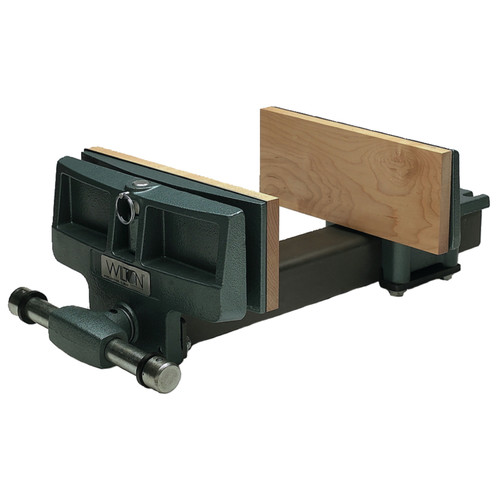
wilton
Joseph Piotrowski
do you have one of these? or used one? they seam to be in a bunch of "top" vises lists but i never see one in use or know anyone that has used it.
Re: wilton
Jim Matthews
I replaced mine with the Moxon hardware.
Long gone, I'm sorry to say.
Search David Barron "moxon" on YouTube for an overview.
It's been good for me, but might not suit you.
I also recommend Bob Roziaeski's videos showing a very simple bench design incorporating Nicholson designs.
His bench uses mostly holdfasts, battens and stops.
It was an eye opener.
Some of our regular contributors are too modest to promote their own excellent sites, including work holding methods.
moxon use
Joseph Piotrowski
it looks great at holding a piece vertically. can you clamp some wood horizontally and plane it ? does it work well?


