Home Articles Forums Gallery Marketplace Videos

WoodCentral Forums

Knowledge You Can Build On — Est. 1998

Planed vs. Sanded

Posts

Re: Planed vs. Sanded

#26

Re: My interpretation - let me know yours

TM Stock

I think you've already got some difference of opinion, so perhaps the scoring is a bit premature. I suspect that different finishes and different sanding schedules would produce further variation, so adding more data points here would be worth while.

Re: Planed vs. Sanded

#27

Re: My interpretation - let me know yours

David Weaver

I sort of made that joke about winning on criteria because the assertion was that you'd see no difference between a planet and wanted surface, and that's clearly not true.

The secondary points that come up are what someone's preference is, does it matter, or is it something someone would find economic value in, but those are a different matter.

What surprised me more is that I forgot how long it takes to properly hand sand something. It's incredibly slow.

Re: Planed vs. Sanded

#28

Re: My interpretation - let me know yours

TomD in Toronto

I'm going to need a program for this one: Which is the woodworking training, actuarial science, or psych?

Re: Planed vs. Sanded

#29

Re: Planed vs. Sanded

Sgian Dubh

"Of course by that measure a sheet of plastic would produce the best surface of all, and cost less too!"

I presume your comment was flippant, or tongue in cheek, and meant to be humorous. If not, explain please. Slainte.

Re: Planed vs. Sanded

#30

Re: My interpretation - let me know yours

David weaver

Which actuary published an article with a conclusion on this topic?

Re: Planed vs. Sanded

#31

Slowness

Patrick Chase

Keep in mind that each of us tends to be fastest (and best) at what we practice. I imagine that somebody who sands all the time will have found ways to optimize their process, just as you've found ways to optimize how you plane.

It's completely unsurprising to me that ROS people insist that sanding is far faster, while handplane people insist that planing is far faster. They're both right, but only in regard to their own skills (or lack thereof).

My personal, unproven opinion is that planing can be at least as fast at sanding for top-quality work, but that it takes a lot more skill to achieve.

Re: Planed vs. Sanded

#32

Re: Slowness

Brian Holcombe

I’ve done a fair bit of sanding with an ROS, mostly prior to moving to finish planing.

I don’t like the typical workflow when sanding as I’d rather finish the parts as I make them then to sand everything at the end of the project.

Re: Planed vs. Sanded

#33

Re: Slowness

David weaver

You can definitely sand faster than I did, but you can't outrun a plane with hand sanders, especially if you're looking for risk free. Sloppy machine sanding leaves fishhooks. Sloppy hand sanding leaves stray lines.

If I was to sand intentionally, the first step would be scraping instead of coarse sanding.

I've got dual mode (the biggest Bosch ros) plus a festool ets sander, and some quarter sheet Sanders. Sanding only is just a lost cause unless you get into stationary machinery.

Re: Planed vs. Sanded

#34

Re: Slowness

david weaver

Ditto that. One of the biggest draws to working by hand is the ability to work bit by bit on a piece and not to cut a whole bunch of things and hope they'll fit together and then do boring tasks over and over.

I make far fewer mistakes building as you're describing, and have far fewer times where it feels like just slogging through something.

Re: Planed vs. Sanded

#35

The new sanding and scraping

Derek Cohen (in Perth, Australia)

David, I am not a fan of sanding - not simply because it can round off details if one is not extra careful, but because I am wary of dust (which requires attention of its own). Nevertheless, there is a place for sanding, and it can be faster and easier today than yesterday.

The new "sandpaper" is by Abranet, and is actually a mesh.


I have this also for an old Festo (pre-Festool) ROS I have, which is now about 20 years old. This stuff lasts and lasts. Possibly about 10x longer than sandpaper.

Importantly, I find that one can jump grits: go from 120 to 240. This makes for quicker sanding.

I do not do much sanding. A sheet of Abranet can last me a year! I would rather scrape. For fast removing - with very good finish - my choice is the thick scraper I made from the rear of a 3/16"thick O1 plane blade. This is prepared in 15 seconds on an 80 grit CBN wheel on a grinder ..


You must try this if you have not done so before!

Regards from Perth

Derek

Re: Planed vs. Sanded

#36

Re: The new sanding and scraping

david weaver

I keep forgetting, but with asthma that seems to be triggered by a few woods (not surprisingly, I guess, the ones that I work the most), the hand gadget looks like a good idea.

Definitely looks like a worthy Christmas gift.

Re: Planed vs. Sanded

#37

Re: The new sanding and scraping

TM Stock

Abranet (dry) and Abralon (wet) machine sanding - great stuff, and lasts close to forever...a bargain. Abranet is brilliant stuff for hand-sanding as well - especially on the sort of sinuous contours I deal with on a routine basis. One of the few abrasives that - with a current gen Dyabrade ROS - will handle big density differences and still keep things flat. Dust collection is much more effective with net abrasives - the difference in the debris left after ROS sanding at 150 with Abranet and the Dynabrade (air) or Festool ROS and hand sanding is stark - inspection with a 10x shows that much of the junk that resides in pores or as ragged feathers of fiber on a hand sanded stick gets cleared by the ROS action and vacuum.

The difference between current tech abrasive and tools and the last gen stuff that remains in use is akin to the difference between those old white grinding wheels we used back in the last century and the CBN wheels that are replacing seeded gel stuff.

Still lots of planing and scraping in anything I build commercially, but without much of a tradition of parsing tasks by hand tool or power tool use as is prevalent in cabinetmaking and furniture work, luthiers (and boatbuilders) are more likely than not going to use whatever is at hand and can get the job done to standard.

I'll gladly trade money for time at my shop's hourly, but there is a cost associated with both tooling and consumables that should be considered - that point was well made and emphasizes the need to consider all costs...a Dynabrade with a good dust collection system and a compressor big enough to drive it is close to my daughter's monthly tuition bill. A good card scraper, a mill file, and a burnisher runs about what a 50 pack of abrasive disks runs. Without a revenue stream to tickle, it is tough to see any argument about time and money being meaningful, as there is no ROI which can be monetized.

Re: Planed vs. Sanded

#38

Re: Slowness

Sgian Dubh

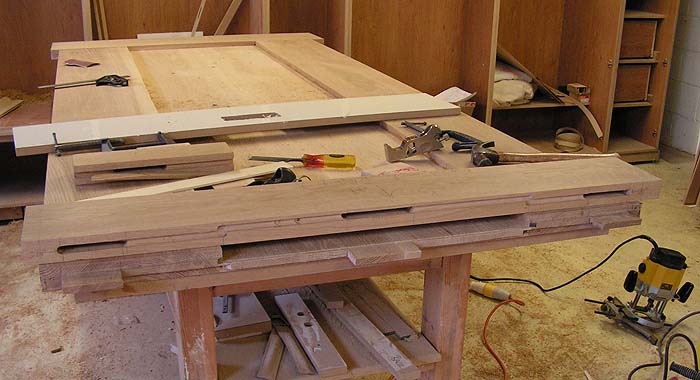
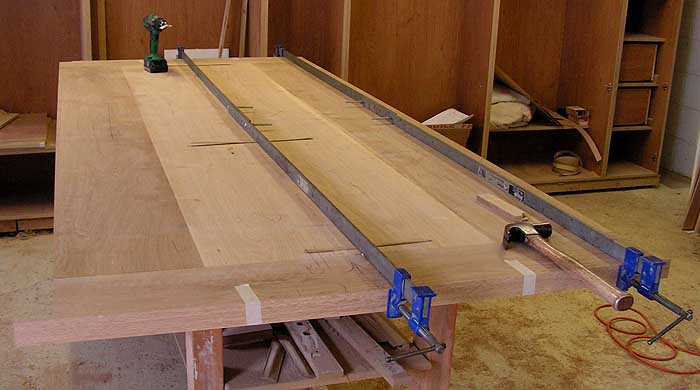
Patrick, I suspect many might struggle to keep up with me on a white oak piece like the one below currently under construction for a client using your advocated, or is it preferred(?) hand plane only approach.

The top is approximately 2550 mm X 1110 mm (100-1/2" X 43-1/4"). Now that it's assembled there are smallish undulations in both the length and the width that might challenge even a short plane (a No. 4 for instance) and a bit of stepping between the clamped ends and the main panel. The work it will get will be a bit of skimming with a handplane to knock off the steps, followed by a belt sander and finished off with a random orbital sander, and maybe a bit of hand sanding.

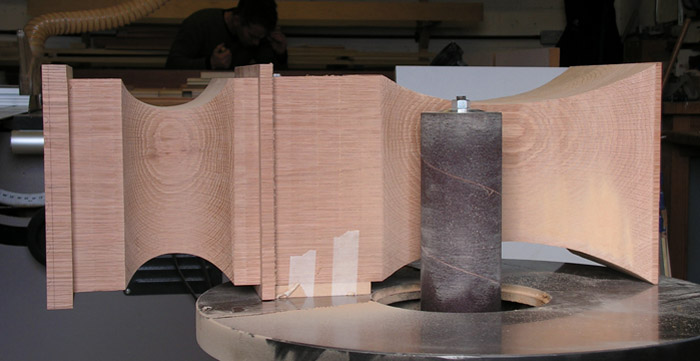
The last image is of one of the laminated pedestal legs, approximately 225 mm square (~9") prior to roughing out the curves and other details with a router and a bandsaw, with the feet and bearers yet to follow, both of which include curves and shaping one way or another. As you can see, my choice here to smooth out the bandsaw ripples and the routing steps is a bobbin sander. Planes simply aren't a practical option except for rounding the currently square bead running around the leg's perimeter just to the right of the tighter of the two arcs, and a shoulder plane will find a use here (plus some sanding).

Then we come to a philosophical point: if the pedestals, feet and bearers are to be sanded by machine and some hand sanding, then why would I consider hand planing the table top polish ready? It would create a different type of surface to that produced by sanding, and for those that reckon they can spot the difference between a planed and sanded surface under polish, that surely creates a bit of conundrum - the legset would end up with a different appearance to the table top. Is that acceptable?

In reality, for me, there's almost always a client expecting delivery by a deadline, this being no exception, and having been in the craft furniture business for a while I now usually have a pretty shrewd idea of how to tackle projects of this nature in a cost effective manner. Slainte.

Re: Planed vs. Sanded

#39

Re: Slowness

David weaver

If you were ever here, I think I could match your speed with planes and scrapers, with one modification: the strip around the base would be applied. While I expect your employees to be more competent than me about most things, I doubt they'd keep up with me planing than scraping. Other than turned items, the grain orientation of the base detail is a bit strange.

Re: Planed vs. Sanded

#40

Re: Slowness

Sgian Dubh

David, the base detail of the pedestal, assuming that's what you're talking about, is there primarily to provide two points of contact (that and the bead somewhat further along) on the same plane to register the piece either on machines, or for hand held power tools to register on them through spanning baseboards, e.g., a cross-cutting jig that carried the router as it excavated the fairly deep and smallish diameter cross grain flute.

I don't have any employees, and it's only my physical effort involved. I'm pretty nifty with planes, but in this case, a little preliminary planing of the table top to level off with power sanding to finish will be quicker. The end result will be smooth but with perhaps more undulations than might be achieved with planes. I wouldn't do it the way I plan if I thought or knew it was slower. My construction strategies are generally (but I admit not always) driven by turning jobs around as fast as I can. Slainte.

Re: Planed vs. Sanded

#41

Re: Slowness

David weaver

I'm confused, I thought last week's post mentioned managing a team.

Re: Planed vs. Sanded

#42

Re: Slowness

David weaver

Thanks for sharing the details, by the way.

Re: Planed vs. Sanded

#43

Re: Slowness

Sgian Dubh

David, nowadays I mostly work freelance. I used to be employed full-time in the Higher Education sector up until three years ago, but also designed and made furniture on a part-time basis for clients and for sale through exhibitions and galleries.

Nowadays, in my varied roles, forced on me through redundancy from my teaching role mentioned above, I have a contract three days a week as a joinery apprentice mentor, I do some part-time teaching on furniture/joinery courses as an employee, take on furniture/joinery making projects for local businesses in their workshops, do some occasional well paid consultancy work, and write for money (hopefully) on furniture related topics. I used to write articles for woodworking magazines, but gave that up because the remuneration was not especially rewarding, and some editors could really make a mess of a coherent manuscript, which I found especially annoying (e.g., whole paragraphs moved out of place so that the text made no sense.) Current writing exploits centre on a book it took me some ten or so years to create that a publisher is putting together as I type, with an aim to get the thing to the printer by the end of this year - the book is again in some way related to furniture and woodworking.

Does that help you get a picture of what I get up to? You could also have a bit of a scan of my website, if you haven't already done so. Slainte.

Re: Planed vs. Sanded

#44

Re: Slowness

david weaver

Thanks Richard. I've viewed your website a few times in the past. Sometimes when people have students as part of their regular work flow, it's hard for me to follow on the sites.

I'll go view again (I may have your site confused with others if your work is easier to parse from students. Pardon that if that's the case).

Re: Planed vs. Sanded

#45

Re: Planed vs. Sanded

Charlie

Yep.