Home Articles Forums Gallery Marketplace Videos

WoodCentral Forums

Knowledge You Can Build On — Est. 1998

Planed vs. Sanded

Posts

Planed vs. Sanded

#1

Planed vs. Sanded

david weaver

Can you tell which side (one side of the seam is planed, the other sanded straight through thoroughly through 220 by hand).

Also, for charlie, who always tells me that planed surfaces are full of lines - find them on either side.

Total time planing this panel to finish was about 30 seconds (it was already trued by a jointer, so not much to do). Total time sanding was a couple of minutes, and dusty.

I will switch sides sometime in the next week when I'm in the shop and not doing something, and then post the picture to see if the visuals flip flop.

https://s17.postimg.org/nxoljvm5r/ghee.jpg

https://s17.postimg.org/mvef1cirz/ghee2.jpg

https://s17.postimg.org/ozys2fs4f/ghee3.jpg

Re: Planed vs. Sanded

#2

Re: Planed vs. Sanded

david weaver

By the way, the white spots that look like they might be open grain are smooth to the touch after three padded coats of shellac (which is what I've been doing prior to lacquer on my kitchen cabinets).

The lightness of those spots is exacerbated by camera flash.

Sharpening process was washita stropped with blue shop rag (paper towels), my strop is set aside waiting to be scraped as there's something in it somewhere.

No funny business and not a trick question. I sanded VERY thoroughly with the final 3m 220 in the direction of the grain on the sanded side to and inspected the surface a few times to make sure there was no stray area left undone from coarser early steps.

Re: Planed vs. Sanded

#3

Re: Planed vs. Sanded

Patrick Chase

That's about what I see with similar (very thin shellac) finish, so I find your result credible, but I have one nit-pick:

To judge whether tracks are present we'd really need to see a shot straight down the piece with strong (single/small-source) raking light from the side. I know that you can produce work without tracking, mostly because I can and I don't have anything like your level of experience. These pictures don't tell me anything, though, because they wouldn't really expose tracking even if it were present (which I'm sure it isn't).

Re: Planed vs. Sanded

#4

Planed vs. Sanded vs Scraped

Derek Cohen (in Perth, Australia)

David, here is another example. This is taken from the time I was levelling up the bow-fronted drawers on the Lingerie Chest. The wood is figured Jarrah, with grain running all over the show.

I began by using a skew block plane across the brain, and a small high angle (60 degree) HNT Gordon palm smoother with the grain (The Gordon is about 4" long - a Stanley #3 was too long to use. I needed a short plane to maximise registration) ..


The smoother left tear out ...


I sanded this down with a succession of Abranet grits, starting with 120 and finishing with 400 grit. This is a Mirka hand sander, which is attached to a vacuum cleaner ...


400 grit .. good dust removal ... and the final surface was obtained with a cabinet scraper ...


You can clearly see the difference in the finish between sanded and scraped.

Regards from Perth

Derek

Re: Planed vs. Sanded

#5

Re: Planed vs. Sanded vs Scraped

TomD

Obviously there is a difference between sanded and planed, in the UNFINISHED SURFACES. When finished it won't exist one way or another. Except on stuff where the planed surface is the finished surface.

On stuff like pens where you can cut and sand and finish all in one operation, you can get some incredibly polished surfaces off say a skew, but the finish on sanded surfaces can be as good or better, simply because you can take it to any grit you like.

The deal with planes is you get the texture of the abrasive grossed up by the angles and the intersecting planes. You can go all abrasive, no gross up with sandpaper, but it takes far too long, or won't show up in most processes. With something like a knife, you can get the abrasive and no gross up for the angle, so it really shines.

Re: Planed vs. Sanded

#6

High grit

Patrick Chase

There is a common myth that you can "fix" the finish left by sandpaper by simply sanding to a higher grit. You can't.

Higher-grit sandpapers do indeed leave smooth surfaces (as measured by, say, surface profilometry) but they do so in a very different way than a plane. Fine-grit sandpapers still disrupt the living daylights out of the surface, but merely do so at finer scales. You still lose grain and pore definition, chatoyance, etc. This is all stuff that's easy to see if you really take the time to look.

This is closely related to why finishes don't adhere as well to surfaces that have been worked with high grit sandpaper, which is why we stop at #220 when finish-sanding the bare wood and reserve the finer grits for sanding the finish.

Re: Planed vs. Sanded

#7

Re: Planed vs. Sanded

David Weaver

Yeah, you're not really going to pick up ridges with a phone camera unless they're of the corner track types. The kind that I'll find are due to small nicks in the iron, and I find them more easily with fingertips. Avoiding plane tracks left by the corner of an iron is, itself, very easy.

Re: Planed vs. Sanded

#8

Re: High grit

David Weaver

High grit takes forever, too.

Re: Planed vs. Sanded

#9

Forever and mistakes

david weaver

In case charlie comes along and tells us that it's fast, I guess if you sand at 600 from 400, that's pretty quick.

This was a center (still is) door panel for my last door. Maybe I already said that. I had already planed it, so I had to go back to 100 grit to make sure I removed a layer of wood. I have no idea what's typical off of a planer, but vaguely recall hand sanding with 120 or some such thing and going up from there (I used to finish at 400, because it felt better, the surface felt better - if I was getting paid, I'd stop at 220, because it's quick).

We often hear from critics that you'll plane and leave marks (you can learn how to not do that), but you can also sand and leave marks. I know which process I'd rather be careful with.

You always end up with something after assembly if you're not careful or if your project gets stretched out and wood gets dirty or something. I usually scrape and burnish, scrape is two steps - once with a scraper that's cutting well, and once with one that's a bit dull, and then burnish with shavings. I can't see the difference in spots vs. planing. If you're lucky and the carcase you put together is both flat and rigid, you can just finish with a plane after assembly and before mouldings.

If not, the only marks I've ever left in pieces are unfound stray sanding marks when I first started woodworking - like the ones next to a moulding or detail where wood runs both ways. Scraping is more ideal for those spots, but beginners probably end up taping areas off and getting into all kinds of time wasters.

Re: Planed vs. Sanded

#10

Re: Planed vs. Sanded

TM Stock

I think Warren's comment on another thread is accurate - photos are problematic for this sort of stuff (but better than nothing, IMO). I applaud the effort, but even minor changes in lighting angle, etc. will skew the results. How to address?

A good test would be same wood, same lighting temp/, etc, in raw, oiled/padded, or other minimalist quick finish, unfilled film satin, filled film satin, and filled film gloss.

For hardwoods, plain figure flat, plain figure vertical, mild figure flat & vert, high figure flat/vert (not always available in same species). Def mix it up with some tropicals (plain and curly anigre, Tassie and african backwoods to get some acacias and rosewoods in the mix).

For softwoods, flat and vertical in some common furniture woods, plus sitka, salvaged redwood (David Maize), and both light and dark WRC would cover the range, plus perhaps some larch.

Probably 3-5 samples of each config from several different pieces of stock would be desirable to eliminate issues with consistency within configs and species.

Then mail out the coded samples and set up a rotation (sender pays postage) to circulate to a hundred or so folks to get a bit more of a sample.

Rate on a rank order scale.

A couple of issues - some woods like spruce are exceptionally sensitive to very minor grain orientation changes...within a degree of pure VG the wood looks markedly different from just off vertical. Some woods and figure patterns seem quite insensitive - curly maple can show that fiddleback figure on all surfaces, while mild figured stuff changes with orientation. Pine needs careful planing to show much depth on the flat sawn faces, while spruce can be sanded cross-grain (as it should be up to the final scrape or sanding) and still show huge detail and chatoyance if close to vertical grain.

Filler matters for filled finishes - paste wood filler tends to flatten open-pored woods like mahogany, while epoxy with a 1.50-1.55 index will bounce enough light around to make even plain-figured mahogany look much more interesting. 'Clear' latex based fillers are closer to translucent, and don't do much for apparent depth.

Re: Planed vs. Sanded

#11

Re: Planed vs. Sanded

david weaver

My shop doesn't have a lot of external lighting. I am just going to plane the opposite sides of the panel and take the same three pictures that I showed here. One from each end and then one from a distance.

The only thing I would speculate looking at the curl is that there are open pores on the light spots, but there are not.

Certainly, other people can do experiments and post them. I think that generally, most people *buying stuff* aren't going to care, but there will be some difference in how sanded vs. planed looks, and in this case, we're looking at cherry (if there is anything more typical of hand work and finish planing than cherry, I don't know what it is. It's moderately soft, easy to work by hand and not expensive).

I planed and then sanded a blotchy piece of cherry years ago and couldn't tell that much of a difference (it wasn't as desirable as this cheap cherry). It didn't look that great either way.

I'm not about to plane 20 samples, though. Years ago, I did a few tests like that and all it gets you is arguments from other people. Waste of time. One like this takes about 20 minutes total for both takes. I can tolerate it, because other than finding my sandpaper (which I generally use only on infill planes to shore any thousandth type gaps or to sand cocobolo, because the style with infills tends to be more rounded and less interesting, etc.), I didn't do anything out of the ordinary and didn't result to any absurd sharpening routine or multi thousand dollar plane to try to spike the method. Regardless of how this turns out, I'll continue to plane because it's faster.

In terms of something like Brian is talking about, it's not disputable that planing is better, but one could dispute whether or not there is a customer over here in the states who would care. I have no experience with that.

If I make a plane and then sell it to someone, I scrape the handles and I plane the sides of the plane and the top. No sanding anywhere on the plane except for truing the sole on a lap (and that's not necessary, I just do it because I'm lazy). The lack of sanding leaves a bit of bite on the handles for the next person to wear down, but it's not intentional. I just don't think sanding that out adds any benefit, but it does add a lot of time. To the . If I was making planes for pay as a business, I may run across people who desired everything to be completely rounded off and sanded, but that's one of the reasons that I don't generally make planes for pay. Makes no difference in the utility of the planes, all that stuff, I'm just stuck on it as a personal choice (if I'm making a plane, I will plane the surface).

Brian posted a fairly low light picture of one of my planes a couple of years ago and Warren instantly spotted that it hadn't been sanded, and referred to Larry Williams' planes as being sanded (which is true). I thought it was interesting how instantly Warren spotted it. I wouldn't have even been looking.

Re: Planed vs. Sanded

#12

Re: Planed vs. Sanded

TM Stock

Again, not knocking what you did or how you did it, David, but to actually answer the question (i.e., if it does matter, when does it matter?), more data are better. Not talking about whether a customer shelling out $8K for an instrument will notice or care, but whether there is a case to be made for all woods/all conditions/all finishes based on demonstrable criteria.

Re: Planed vs. Sanded

#13

Re: Planed vs. Sanded

david weaver

I don't think there's all anything (a case for all in any situation), but do think the plane is a time saver for someone making one off pieces. If the finish looks a little better, that's a bonus.

I think I could probably ramp up and sell a few planes if I wanted to (I don't generally), but couldn't tell you much about customers for anything else, because I don't make anything else at a level where I could sell it and get anything for my time. I think that kind of stuff is more of a relationship business, anyway. there's a shop here or there around here trying to sell stuff like cutting boards and G&G type furniture, or other sort of similar stuff. The ones that hang around are those that convince customers that something really routine is special, and it's more about shop atmosphere than it is the piece.

Re: Planed vs. Sanded

#14

back to the original topic

david weaver

Charlie asserted that you can't see the difference in finish after finish is applied.

I had forgotten that Warren quickly spotted that my plane was planed and not sanded, and nobody had to tell him. That's one where it certainly makes a difference.

Re: Planed vs. Sanded

#15

Re: Planed vs. Sanded

Don Stephan

A couple years ago I planed both sides of a nice piece of cherry, then sanded one half of each side with 220 grit as that is what most finishers today work to. After several padded coats of dewaxed shellac I haven't found anyone that can see a difference between planed and 220 sanded, which is disappointing and frustrating. Nevertheless I hand plane surfaces off the jointer and planer because it is so very much faster than sanding.

Re: Planed vs. Sanded

#16

More pictures - labeled

david weaver

https://s8.postimg.org/w48ojic3p/ghee.jpg

https://s8.postimg.org/6lgc6i7z9/ghee2.jpg

https://s8.postimg.org/68oy0bxf9/ghee4.jpg

https://s8.postimg.org/pds7a3rit/ghee5.jpg

I re-did the board with the opposite sides done. I didn't get a good distance photo tonight, so I took that one out (it was a bit far away, anyway).

I think the planed surface looks a little bit better. In each case, the method used to finishing is done to the glue line.

Re: Planed vs. Sanded

#17

I forgot...

david weaver

Just how much work it is to hand sand a board and remove every single mark that you can see, even when there are otherwise no surface defects.

The plane wins hands down and then some, even if the surfaces look the same.

The difference is subtle, I think. When the lighter side is planes, it's more figured than the other. When the other side is planed, they look similar in figure.

The figure also looks more colorful and less like a blotch on the planed side.

Re: Planed vs. Sanded

#18

My interpretation - let me know yours

david weaver

I looked at these in person, which is a bit of an advantage.

Here's what i notice from the plane:

* Charlie's right, it would be hard to find a customer who cares

* Charlie's not right. I can see the difference in the planed surfaces. The middle two pictures are face on. There is a bit more figure with the planed surface, but the color variation is wider. That may not be desirable for some people, but I find it to look like it's more lively

What I gather from the sanding (which really takes a while if you're going to remove every imperfection from the coarse sanding or planer!) is that it's like a one-way vibrato. The figure gets dark, but there is no light coloring. You can see on the right board that the area that's tending toward sap is more uniform in color when it's sanded, and the color between the curls is more uniform, and just either middle or dark. When planed, the color between the curls is brighter and the variation with the rubbed shellac is better.

It's easy to see these things, and easier in person, to tell that the planed side is a bit more "pretty". If the boards weren't right next to each other, it would be a lot harder.

I found it kind of funny that Charlie noted that the tester in FWW had a phD in psychology when he spends a large amount of his time harrassing another one. (pardon me, Derek, if it's in psychiatry). If the tester was an actuary, I'd still question the results, but an actuary wouldn't contend that the test was valid for anything more than the specific circumstances of the test (the woods, the finish, the process, the lighting...).

The time difference to achieve the level of surface finish so so stark, though, that I could plane four panels in the time that it takes to sand one, and if I set up my two ROS sanders as a one-two, maybe I could halve the sanding time, but you still have to stop and check for hooks. The replacement for that planing (once you get to my lofty nobody level!!) is that you need to run your fingers laterally across the board to make sure the plane iron hasn't picked up a nick. If you were doing this as a system and time mattered, you'd do every dirty panel with the smoother and a heavy shaving, sharpen the iron and then make one or two finish passes.

All surfaces are glass smooth, and surprisingly after something like four padded coats of sanding sealer, no perceptible standing grain that needs attention.

I spray these and don't sand between coats, but instead knock the nibs off of the final coat of lacquer with a small card scraper. It's just another step (sanding something commodity like this while finishing) that just doesn't seem to be good use of time. It's not enjoyable, you get hand prints of dust all over everything and the shellac gums everything up if you don't wet sand.

Warren 1, Charlie 0 in a close contest. If this was wrestling, it would've been won on criteria.
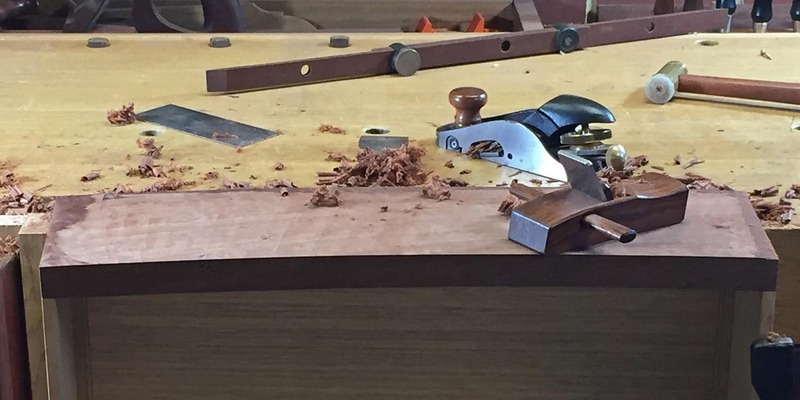
Re: Planed vs. Sanded

#19

Re: Planed vs. Sanded

david weaver

Be curious if you can spot any difference in mine (pictures in a thread above). If the wood had no figure, it would be less stark, and even so, it's subtle, and not the kind of thing I'd expect a random person to pick up on (just like I wouldn't expect a random person to understand why attaching a straight line to a quarter circle is not as good looking as a continuous gradual curve over the same area.

That said, I can usually drive off any people inquiring about furniture (it happens to me from time to time) when I describe material costs being equal to or greater than ikea's finished products. I don't have real customers, just people who think you might be interested in building something for them for next to nothing.

Re: Planed vs. Sanded

#20

Re: Planed vs. Sanded

Sgian Dubh

Interestingly David, in the second set of pictures upon which you've attached labels, it seems to me the sanded surface under the shellac finish provides a more even, richer (somewhat darker maybe?) and less blotchy appearance. I prefer it.

In your first set of images from your first post there appeared to be differences in appearance, but I couldn't tell which was planed only and which was sanded.

Admittedly, the quality of your images aren't great, and viewing photographs of even superb quality isn't a patch on looking at something for real, so it's possible I'm missing some subtle nuances, but there it is. Based on what I can make out in your 'challenge', sanding (presumably after some planing of that small sample) prior to polishing appears to yield a superior surface than one prepped using planing alone, and sanding would therefore seem to provide a surface that polish enhances better than planed only. Slainte.

Re: Planed vs. Sanded

#21

Re: Planed vs. Sanded

david weaver

I think someone desiring uniformity may like the sanded surface better, it definitely absorbs finish better. You're right on the photos, and that's complicated by camera phones, which decide what part of a picture they want and what part the software will eliminate (reflections are almost always eliminated, I'm sure the software determines them to be glare).

The sanded surface absorbs more shellac, thus the darker color. I think over time, it would make little difference in this cherry.

I like the brightness and variation (as long as it's not due to open areas from tearout or poor planing), which seems to be where our difference in opinion lies. I don't stain anything, and don't know anything about that aspect, but would presume most modern staining to prefer sanding unless it's done as a toner. Who knows?

Pretty much what you saw is it. It's a little bit more contrasted in person, but not enough to say that I'd plane if it took longer than sanding or cost more. For some reason, it's an irk to sand something when I end up with a pile of paper - I have nobody to pass that cost on to, and my old middle of Pennsylvania German sense is offended by using things that get thrown away when there is an alternative. To sand this panel appropriately one time (counting the half that I did each session), I worked through probably 50 cents of paper. No big deal, but avoidable.

Re: Planed vs. Sanded

#22

Re: My interpretation - let me know yours

TomD in Toronto

I think Psychs spend a huge amount of time making sure their experiments are set up with valid experimental premises. Social Psychs excepted.

Re: Planed vs. Sanded

#23

Re: My interpretation - let me know yours

david weaver

The validity of a study is far different when the person conducting it is an expert in the subject matter. We don't generally have an English major directing a study on pavement additives. It should be clear why that's the case.

Re: Planed vs. Sanded

#24

Re: Planed vs. Sanded

Patrick Chase

If your chief objective is uniformity, then you're absolutely right: Sanding produces "better" surfaces.

Of course by that measure a sheet of plastic would produce the best surface of all, and cost less too!

Re: Planed vs. Sanded

#25

Re: My interpretation - let me know yours

Patrick Chase

Nice dodge there with "social psychs excepted". If you hadn't said that I would have replied faster than you could say "Diederik Stapel".

I think that academic psychology's problems (as opposed to the actual practice of psychology, which can obviously be extremely beneficial) go far beyond his ilk though. Coding experiment results seems to me to be about as much of a black art as differentiating wood surfaces.