Home Articles Forums Gallery Marketplace Videos

WoodCentral Forums

Knowledge You Can Build On — Est. 1998

Sharpening Serrated Knives..OT

Posts

Sharpening Serrated Knives..OT

#1

Sharpening Serrated Knives..OT

david weaver

Something I thought I'd bring up since Warren mentioned sharpening knives for people.

People bring me knives, sometimes they bring chairs, sometimes they bring drawers. My wife, probably like a lot of us, will always tell someone "oh, my husband can fix it". As I've gotten older, if something is junk, instead of trying to be a hero, I either do something quick or tell whoever brought the junk that i'm not going to fix it.

One thing I get sometimes is serrated knives. I think the idea of bread knives and serrated knives is sort of goofy - I get the promise of them to the unskilled, but none cuts better than a properly sharpened knife, just as no fat bladed super steel 12 ounce monster knife outslices a cheap thin bladed knife.

Anyway, I'd like to hear what you guys do with serrated knives. I have a cheap HF buffer, a medium cotton buff and a giant block of not very precise al-ox compound that I got from mcmaster carr. It turns out to be spectacular, because it's a bit coarse. I run the serrated knives over the buffer until the edges meet each other over the entire surface. That's not necessary for them to work that well, but they do at least work and it doesn't take long for the buffer to remove metal with what is probably 9 or 10 micron alumina.

(everything other than that, I sharpen by hand on norton's IM 313 setup. No matter how modern and expensive of a diamond setup or stones that I've gotten, I cannot find anything better to sharpen knives than a long medium crystolon followed by a fine india and a hard ark. Nobody that I sharpen knives for would be safe with sharper than that, and even at that, I tell them if their knives are too sharp that they should quickly steel them - most people can ruin an edge like that quickly, so that takes the edge off).

What do you guys do for serrated knives? If you throw them away, I think that's entirely appropriate.
Re: Sharpening Serrated Knives..OT

#2

Re: Sharpening Serrated Knives..OT

TomD

I don't agree with the idea all serrations are worse than not. I am really close to that opinion, and particularly hate it when a knife I want can only be found in a half and half, which I really do find next to useless.

I would add, I find the high end serrations worse than the low end serrations for the most part.

There are at least three purposes to serrations all of which are legitimate.

1 There are certain tasks where serrations work better, some would say rough rope, bread crust, some meats. All knives are in effect serrated so the idea of matching the granularity to the task may not be useless. Saws are just serrations of a type optimized for wood.

2 Serrations basically are pointy things that when dull still cut, even if the cutting action is limited to the points, most people are useless at sharpening, so that has a place.

3 Serrations convert very thin bits of low quality steel into excellent knives. I have every sharpening device in the world, and every knife type ish, but the miracle blades still outshine all the others. They aren't all equally good, in the set, at least not for my needs, but I reach for them a lot.

4 Here is an extra one. Some uses like extreme corrosion say salt water, require very rust resistant steels that don't always sharpen well, serrations work there also.

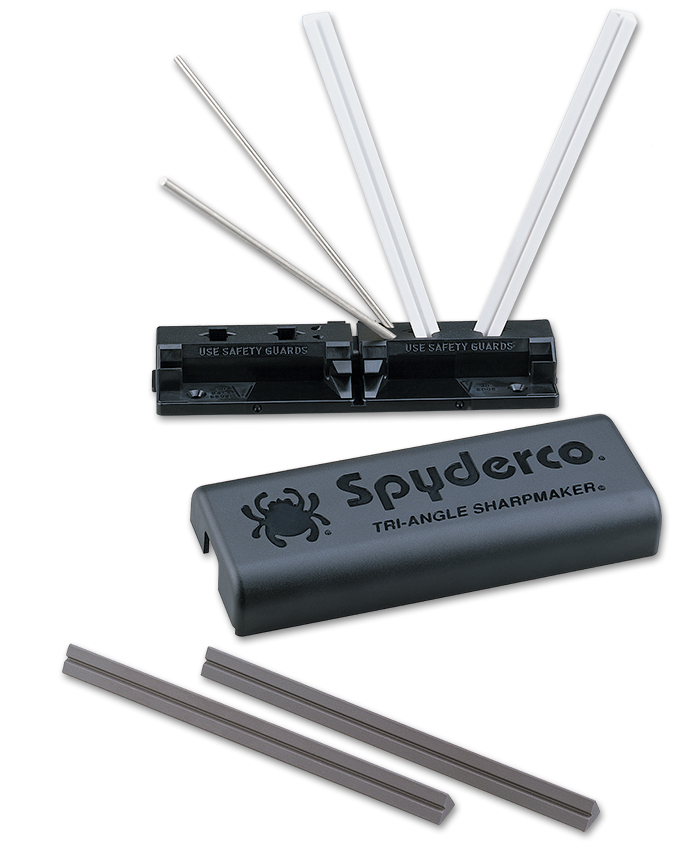
I don't have a complete answer, but Spyderco set the standard for the modern style in knife serrations, that largely look good and aren't that useful, their triangle hone set is very good at sharpening serrations, and in putting a fine edge on knives in general. I have one of the first generation, and I have no idea what current production is like. In my case I only have the fine, which is finer than the average white ceramic stick. This means it is very slow. So not something to sharpen the neighbours knives on. I believe Spyderco now has diamond and black ceramic. These hones work because the corners work into the serrations. You can also use the flats on regular knives, though I generally use the corners for everything.


There are some other triangle sharpeners out there like the Gatco Triceps. The Jewelstik 1-2-3 sharpener is probably a great option. I have a short two sided version, and it is good. The 1-2-3s are triangular, but the corner would either have no grit, or share two grits. A useful tool in any case, but whether it would work here, I don't know. They are a great field or kitchen sharpener, regardless.


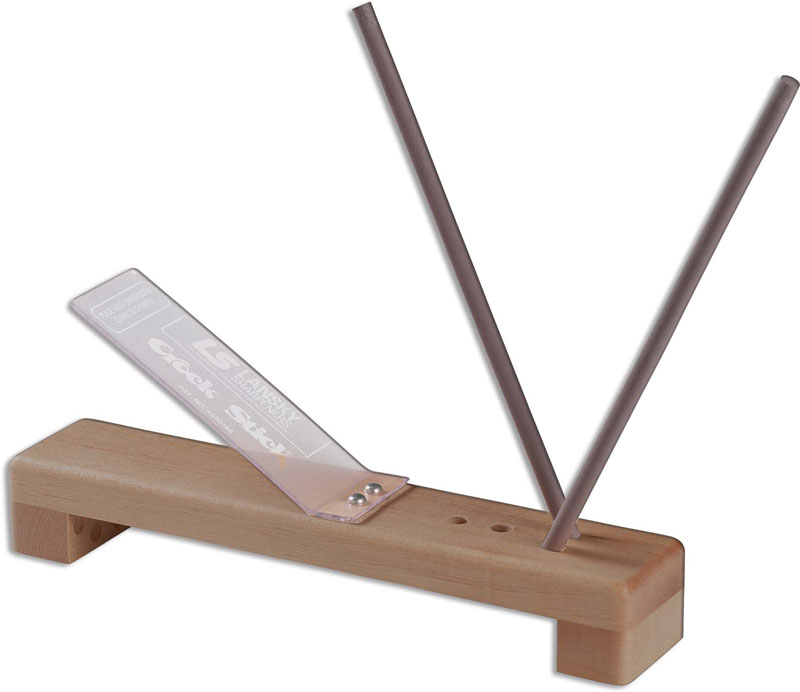
When forced to sharpen dull serrated knives I use my black ceramic rounds on my Gatco (Lansky now sells these). They only tune up the points, or the flats if there are those. But people bringing you their using knives have long since lost the factory sharpness, so they won't care. The knives will continue to serve after being sharpened on rods.


The key with one's own knives is to sharpen before the knives become dull, then these not so powerful options work well. Jewelstiks are fast cutting, and will put a rough razor edge on kitchen knives, and broadheads. Maybe youtube can answer whether they work well on serrations.

Re: Sharpening Serrated Knives..OT

#3

Perhaps the one sharpening thing I never bought..

david weaver

...is the various knife contraptions and rods.

I have a smooth steel (fairly inexpensive one) and that's about it. I believe you're right that they'd do decent with serrations, and agree on their ability to continue to cut when they're a little dull and the points rounded (and who knows what % of the population doesn't sharpen knives. My parents had a mechanical sharpener, and I still don't remember them ever using it. I remember when there was a wheel in the back of electric can openers, too).

Re: Sharpening Serrated Knives..OT

#4

My inclination is to toss them...

John in NM

But then my wife never really got on board with the concept of a well sharpened carbon steel knife for bread & tomatoes :D

Re: Sharpening Serrated Knives..OT

#5

Re: Perhaps the one sharpening thing I never bough

TomD

Probably anything that will touch the tops will help to some extent. The normal steels don't have the right cutting action to cut when one runs down them. But abrasive rounds or triangles do.

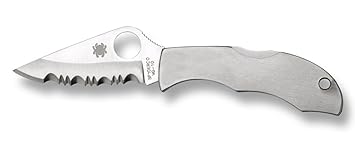
This is the Spyderco serration, and you can see how deep the small wheel cuts are. That is the challenge that the triangles are designed to fully meet. Most serrations I have dealt with are less acute.


I have used a variety of the stick sets, and made a few for others out of the parts LV sells. My favourite is the Spyderco for it's super fine rods, I prefer round rods overall as on the Lansky. The Lansky gets the most use, as I often get knives that someone has let go a little too much, the grey rods are just abrasive enough to make getting them back from dull to reasonably efficient. But these days there are a lot of providers out there. You can also buy the Lansky rods without the sharpener

Re: Sharpening Serrated Knives..OT

#6

Re: Sharpening Serrated Knives..OT

Wiley Horne--So. Calif.

David,

In serrated, I buy the cheaper Henckels ‘International’, which prolly means Made in China. Anyway, these things are serrated on only one side, and then have a flat side. What I do is to take the flat side—I think of it as the back side—to a fixed diamond stone in the 400 to 1200 range, and then to the nearest finishing or next-to-finishing water stone. In other words, I sharpen the ‘back’ side only, on diamond and then stones, and do not touch the serrated side except the tip which is not serrated. Then strop off any burr.

I always figured if you had to sharpen a knife serrated on both sides, you’d have to use a fine and small rat-tailed file or slip stone, and hit every valley on both sides in order to preserve the serrations....

Wiley

Re: Sharpening Serrated Knives..OT

#7

Re: Perhaps the one sharpening thing I never bough

david weaver

oh my! that knife!!

I went out to benchmade and noticed that they can make a $200+ version of the $70 USMC knife that ontario makes...also in the US.

I also noticed that they had a whole bunch of expensive knives with serrations like that, but not quite as severe.

I realize looking at what they're selling that I have no clue what the knife market is looking for. The strange thing about those serrations on all of them is that they're right in the wheelhouse where you'd cut. So I'd imagine they'd get dulled pretty quickly if you actually use the knife.

Re: Sharpening Serrated Knives..OT

#8

Marine knife?

Patrick Chase

The Ontario-made OKC-3S (the one they actually make for USMC) costs a lot more than $70. Are you talking about their Ka-Bar clone or the one they make for the Army?

Re: Sharpening Serrated Knives..OT

#9

Re: Marine knife?

david weaver

Well, I haven't kept up with all of them, but thinking more of the USMC ka bar and the mil spec (sp1) older designs (like the 498).

I went out and looked up the knife you mentioned - I think i'd rather have a ka bar USMC, but in reality don't have a use for a long fixed blade knife and don't have any of them.

Re: Sharpening Serrated Knives..OT

#10

bridger

Re: Sharpening Serrated Knives..OT

Bridger

My take on serrated kitchen knives is this: they are for cutting on plates, in frying pans and other surfaces that will kill the edge of a non serrated knife. The points are dulled, of course but the sharpness between the points continues to cut. These can benefit from honing, though making the points sharp is counterproductive.

A secondary use is bread knives, which need the points to stay sharp. They should be used only on a proper cutting board. These get a more careful sharpening, including the points.

Beyond these two, serrations appear to be a desperate attempt to allow for the use of inferior Steel in domestic cutlery. These get relegated to duty as gardening tools.

I'll not comment on combat knives, specialty marine or diver' s knives or the like, as these are beyond my experience or interest.

Re: Sharpening Serrated Knives..OT

#11

I like the concept that all edges are serrated

Chuck Nickerson

at some level, so in principle matching the granularity to the task could have value.

That is deep and potentially very useful thinking.

Re: Sharpening Serrated Knives..OT

#12

Re: I like the concept that all edges are serrated

david weaver

So far, regardless of having true 600x available, I have yet to find an edge that really is perfectly smooth.

And even beyond that, once something is used, or even stropped, it always gives up a little of its finish straightness.

But, boy does a properly sharpened knife cut bread well, even better than any serrated knife I've used. And the surface of cut fruit and vegetables is so smooth it looks like it's waxed, and it browns so much more slowly in open air.

Re: Sharpening Serrated Knives..OT

#13

Re: Sharpening Serrated Knives..OT

david weaver

You're exactly right. The best serrated knives are sharp at the point and have an edge on the whole serration. That part is difficult to restore. Otherwise, resetting the points is fairly easy if you can tolerate that they won't be quite as pointy. Just sharpen them like any other knife.

Unfortunately, most of the knives that are brought to me serrated are so cheap and so far gone that by the time I get to them (it's not uncommon for someone to bring me 20 knives at once, and the big ones, I will do entirely by hand because the result is better and in theory, more repeatable.), I just buff the crap out of them and avoid burning them. Works pretty well.

The strange serrated knives, to me, are the ones that are sort of like a negative of a bread knife. They have little rain drop shaped sharp bits sticking down - if that makes sense. You could pretty much take a bread knife with the same sized teeth and dovetail the edges together. They look terrible after the buffer, but they cut your fingers quickly if you question their sharpness too much. :\

Re: Sharpening Serrated Knives..OT

#14

Re: Sharpening Serrated Knives..OT

Sgian Dubh

"What do you guys do for serrated knives? If you throw them away, I think that's entirely appropriate. "
My serrated kitchen knives are simply drawn backwards (i.e., the back of the blade leads, cutting edge follows) on the smoother side of the blade only along the length of the steel. Half a dozen passes or so does the trick for cutting bread, vegetables and so on, so long as the knife hasn't been left too long between sharpenings.

No idea how you might sharpen that deeply serrated thing that appeared in one of the posts in this thread. Slainte.

Re: Sharpening Serrated Knives..OT

#15

Re: Sharpening Serrated Knives..OT

TomD

"No idea how you might sharpen that deeply serrated thing that appeared in one of the posts in this thread. Slainte."

We are in a world where knife guys send their knives back to the factory to be sharpened! They are also like us in that in many cases they are not users, or not users as in the time when the tool in question is the only thing one had to use. Imagine actually skinning Buff for a living. A lot of them think the main point of knife ownership is collecting, or repeating tests they see in the magazines. This can lead to early knife demise, in which case restoration is moot. Or alternatively not significant knife use, in which case the factory restore is OK. Plus they probably own enough knives that they don't run out of edge right away.

Re: Sharpening Serrated Knives..OT

#16

Re: Filing

TomD

"so in principle matching the granularity to the task could have value"

There is a whole category of knives that are sharpened with files, or steels (files on rods with the teeth applied like the stripes on a barber's pole), and this applies to broadheads also. There are tricks for drawing a file to create different granularities of tooth on the edge. These serrations are very sharp and aggressive, but they hurt when you get cut so the edge probably has width. The cuts heal faster than razor cuts due to the greater cell damage. So depending on what or whom you are cutting there are issues.

Another familiar approach is sharpening something like a plane. I normally freehand at a skew angle, just in order to get more stability. If the situation allows I will finish with strokes in line with the stone, this is one reasons why the race plane guys may use a guide since one can work the blade in line. This ensures the edge granularity is in line with the stroke. Seems to work.

I should have mentioned that when sharpening serrations, the normal way to sharpen a knife with sticks is to sweep it down and towards one, sorta a cutting action applied to the stick. With serrations you want to do that in both direction: Down and to one, and down and away. That way you get both sides of the point better.

Re: Sharpening Serrated Knives..OT

#17

Re: Sharpening Serrated Knives..OT

Michael Brady

I have a Spyderco serrated knife that gets used about 10X as much as the second place German knife set. It just gets the job done and is superior on softer food such as whole fruit and uncooked meats. I have cleaned up the edge a couple of times with a tapered diamond rod and got it back to original keenness. My wife is the primary user and just wants a knife that works, as opposed to us Neanderthals that sit around the fire and grunt about our tools.

Re: Sharpening Serrated Knives..OT

#18

No such thing as perfect smoothness

Patrick Chase

The title says it all.

There is always roughness on *some* scale, it's just a matter of how closely you have to look.

With that said the notion that "all edges are serrated" is really only relevant to cuts with a slicing component.

Re: Sharpening Serrated Knives..OT

#19

Re:I tried for it this morning

david weaver

....sharpened a kamisori on iron oxide on balsa (two coticule process down to chrome ox and then iron ox).

Nice shave, but I could still see the wire edge under the big scope. No pictures, as the big scope doesn't have a computer hooked to it, but I'll get one at some point just for my catalog of edges.

No matter how sharp something is, you can always see the edge either immediately after you use it or as soon as you strop it.

Didn't take a picture of a feather hi-stainless on my setup yet, but I think I may have challenged one for sharpness this morning.

Re: Sharpening Serrated Knives..OT

#20

Re:I tried for it this morning

David weaver

Too sharp! Razorburn.

There's a really nice level of sharpness where an edge easily catches hair, but doesn't cut the little bit of skin that stands up behind the hair in some shaving directions.

9 hundredths of a micron iron oxide is beyond that level of sharpness.

Re: Sharpening Serrated Knives..OT

#21

bridger

Re:I tried for it this morning

Bridger

Depends on the razor, I think. My most recent razor is a big old wedge shaped butcher that came to me with edge damage. After fixing that I tried several kinds of stones and couldn't get a decent edge on it. Finally went after it with .3 micron diamond lapping film and got a very nice edge indeed. I shaved with it last night. It's a pleasure to use now.

Re: Sharpening Serrated Knives..OT

#22

Re:I tried for it this morning

david weaver

0.3 micron diamond is a bit less sharp, but a little more toothy vs. chromium oxide (though that could vary from razor to razor a little bit). The edge still has a little bit of "crunch".

.09 micron iron oxide is smaller and shallower cutting than either of those, so you can get an "almost perfect" edge with it, at least in terms of a relative comparison - especially if you are gentle with the strop and don't burnish the edge off right away.

This is kremer pigment 110M (I think) in case you want to try it (you might have it already). I don't used diamonds on razors, but have heard some of the pro sharpeners say they go down to 0.25 micron and then follow that with chromium oxide pigments to remove the diamond tooth (there's debate on which of those two is sharper, but on a hard surface, probably 0.5 micron chrome ox powder in simple steels - maybe the opposite in high speed steels). I'm tinkering to see what I can get for an edge to get a reaction from people buying razors that I'm flipping, but this one is the first level past tasteful. I have been setting up kamisoris with either japanese stones or coticules (they don't like synthetics that much because of their hardness) and then following with chrome ox on balsa, and that seems to be a really good stopping point. i hate to admit it, but it's a better shave than natural stone only, and it's easy maintenance to hit the balsa once a week. People buying the regrind kamisoris that I have have been very complimentary.

FWIW, iwasaki's guide suggests 1 micron diamonds (which he used on a soft strop after a true japanese razor finisher), so this real push for the extreme must be a recent thing.

I tend to agree with iwasaki (not necessarily with diamonds, but the premise - I don't know that he had the array of at-your-fingertips abrasives in the 1960s. It probably wasn't even easy to get 1 micron diamonds back then unless you went through industry supply, and I'll bet they were expensive).

(I have talked to one person who liked this stuff, though. Chris Griggs. Chris is vegan and can't use a strop, so he has to chase edges to have as little of a wire edge as possible).

Re: Sharpening Serrated Knives..OT

#23

You're right, though - on depends on razor

david weaver

There are definitely some razors that probably wouldn't hold much different of an edge between .09 micron iron oxide and 0.5 chrome ox or 0.25 or thereabouts diamond.

Wedges are always a problem because the large bevel is counter to sharpening, and they're also usually a bit on the soft side compared to some of the later double hollow razors.

Razors have a reputation for being hard, but my guess from the steel is that very few are close to as hard as kamisoris are. Most are probably closer to Rc60, with the English razors usually being the softest, vintage american and solingen being next, and japanese razors following that (kamisoris being true 65 hardness, etc, when they're right and japanese western style razors a slight step down from that).

I think the pastes and such are more beneficial for wedges than anything else, because working through the large bevel makes it easy to get the bevel just right and the edge "meh", and even on balsa, the little bit of give is a really good way to get the last little bit. I do the same thing (I have two frioudur near wedges that never get all the way there off of the stones). In theory, you could spend 20 minutes honing one and checking on a scope, but it's not worth the trouble when doing what you describe is a lot easier and just as effective. They are stainless, and only about as hard as vintage sheffield wedges.

Re: Sharpening Serrated Knives..OT

#24

Re: Sharpening scissors

TomD

Speaking of sticks... Great system for sharpening scissors. I have used everything imaginable on scissors, but 99% of the time I am using sticks. The Spyderco unit has a an insert set for scissors. If I don't have the Spyderco around, or need a coarser cut I will often brace a typical stick set at about 45 degrees, and I normally get a good edge from the stick that is nearest horizontal. You do want to be careful you aren't messing up the angles anything two much, so a quick eyeballing will tell you whether you should run it.

Since scissors are always cutting at a specfic point, rather than using the whole edge at once. The fact that sticks can follow dips and points, and don't sort them out as a flat stone would, is not much of a problem.

Other maters relating to scissors tend come down to setting spring in the blades, on fine point units; dealing with uneven wear in the hinges, and peening or adjusting the screw.