Home Articles Forums Gallery Marketplace Videos

WoodCentral Forums

Knowledge You Can Build On — Est. 1998

Norris Vs. Stanley

Posts

Norris Vs. Stanley

#1

Norris Vs. Stanley

david weaver

I've been picking up some planes lately, usually I do something like that when I am looking for a plane to copy. I like spiers panel planes a little better than all but the oldest norris planes, but I haven't been able to find anything long in spiers that I think I'll be able to get back out from under when I'm done (translate, I want to be able to resell one for what I pay). So I've gotten three beech norris planes - one panel plane and two A5s. I'd rather have the older planes as their style is a little better, but they are priced to the moon.

I like to play with the planes, of course, to see if I can find what people really thought was wonderful about them. I've only received one of the smoothers so far, and I can't find any deficiency with it other than the adjuster - which would be a deficiency for all of them, and which I thought was a dud in a spiers copy that I made years ago.

I'm looking for tips for anyone who has really thought about fine adjustment on those planes. For coarse adjustment, I just loosen the lever cap and turn the adjuster. Leaving the cap tight creates several problems (above and beyond the fact that it's known that it can damage the adjuster eventually). When you loosen it, the adjustment changes slightly once you tighten it - not a big deal for coarse adjustment.

When you are doing fine adjustment, though, the only way I can get reliable small changes in the adjuster are to leave the lever cap tight, put a little bit of tension on the adjuster in the direction that I want to make the change (deeper or shallower cut), and then loosen the adjuster slightly to let the tension off and re-tighten it. I don't know if that makes sense, but it works. It's also about 40 times less handy than just tapping the top of an iron with a small hammer to adjust depth.

The vs. stanley part is that with the cap iron working and the depth set, I think it works about as well as a good stanley plane (with the cap iron set). The A5 that I have is 5 ounces heavier than my stanley, but I can't notice that much in use. There is more slack in the stanley adjuster, but it's something you don't actually notice in use because the fine adjustments can easily be made, anyway, whereas there is a little more trickery needed in coaxing the Norris to make fine adjustments.

When I copy these planes, two things come to mind - the handle shape will be a little bit more human and less machine, and I will not put an adjuster on the plane as it is a complete piece of cake to set feathery iron depth on an adjusterless plane by just loosening the lever cap while the plane is on a board, re-tightening it (at that point, it will just be pushing a little dust off the surface and almost cutting) and giving the iron one tap with a small hammer.

One other thing comes to mind, I think the stanley is more practical once one knows how to use the cap iron, both perform about the same. I'm sure that the norris planes may do better without the use of the cap iron unless one fiddles with things on the stanley that are otherwise a waste of time once you know how to use the cap. BUT, slowly getting to the point - the discussion for a novice plane buyer talks about how great the early Norris planes are, how great the norris type adjuster is, and how the late model norris planes are no good. The first statement is probably true - the shaping, cap iron screw, irons (when they were Ward), infill...those are all better on the early norris. The mouths are consistently tighter on the early ones. The rosewood probably leads to a more stable plane (the smoother I got needed significant lapping on the bottom to function as a smoother, it had twist as well as low spots that I didn't expect to find). But once both types would be cleaned up, I seriously doubt that the early norris planes are any better users than the late ones. The later ones with their fat handles tend to have less breaks and chips off of the handles, too.

I think the fascination with the adjusters is overblown, though the lateral adjustment is better on the originals than it is on the modern LV copies solely because the rod is much longer and the lateral adjustment less sensitive. Thus far, I'd conclude that the Norris adjuster is technically more interesting to look at and harder to make, but functionally inferior to stanley's adjuster design for an experienced planer.

All that said, if someone wants to buy me this heavily cleaned boat anchor to copy, I do take donations!! :)

http://www.ebay.co.uk/itm/VERY-RARE-24-1-2-NORRIS-No1-DOVETAILED-JOINTING-PLANE-PRE-WAR-/172626668218?hash=item283159eaba:g:tS0AAOSwpP9Y8hBQ

Re: Norris Vs. Stanley

#2

Re: Norris Vs. Stanley

joel moskowitz

The planes you have are about 60-80 years old. Many years ago friends and I took a whole raft of various models of Norris smoothers and compared them back to back at the same time in the same room.

This was before the Internet and the planes were in much better shape than your average ebay find.

The differences are subtle. but the consensus was that the pre-war Norris work and feel better than the post wars. YMMV

Re: Norris Vs. Stanley

#3

without..

david weaver

..the adjustments that I made to the sole of my plane, it would've been unusable, I will admit. Someone comparing old to new would definitely count that against it. How the sole was that bad is a real puzzler.

I was careful about condition and have gotten planes that are in better shape than the average newer norris on ebay (sole notwithstanding, you can't spot that on a picture - shown below - the sole even looks a little bit like it's been lapped here, but it has not and it was incredibly out of flat - maybe that had something to do with why it has so little wear - except that someone robbed the original norris iron from this one).

https://s23.postimg.org/iv1m9fyaz/s-l1600_1.jpg

https://s23.postimg.org/8m953ma97/s-l1600.jpg

At any rate, I did leave out one thing -I have a 15 1/2 inch rosewood infilled panel plane marked buck (made by norris) with rosewood infills, and I will give it credit - it was almost dead nuts flat when I got it despite the fact that it's clearly very old. A user who didn't want to do anything other than sharpening the iron (which is ward, of course) would be able to use it - it does need a little bit of tuning to adjust laterally properly, but that's minor and not critical.

At any rate, I am assuming that when you got a group of people together to try planes, they probably weren't versed in using the double iron. That is the factor that neutralizes any difference between the two - that and the ability to do a little bit of work.

Re: Norris Vs. Stanley

#4

Re: without..

joel moskowitz

What you have is the last generation of Norris A5, probably middle to late 1940's. I'm not sure if that last generation had the buttons on either side of the iron.

Re: Norris Vs. Stanley

#5

Re: without..

david weaver

Thanks for the info. I figured that was the last generation due to the retaining screw on the front infill. They probably learned the hard way that the beech needs that screw to stay in place in the long run.

I have one a bit older than that on the way, as well as a very new little used panel plane (that I intend to copy, soften the woodwork lines, omit the adjuster and use something other than beech for the infill).

Whatever the age of the most recent one I showed first, it is actually quite nice in use (with the cap iron properly set). Capable of smoothing anything (though, so is a stanley plane) and not heavy or bulky, even though the woodwork is a bit chunky on the back.

Re: Norris Vs. Stanley

#6

Re: without..

joel moskowitz

I would not make that assumption about double irons. And on my particular plane as on most pre-war Norris's - especially ones with the original iron, if you set the cap iron too low the plane clogs.

I know very few people who think the Norris adjuster is anything better than passable but the appeal of the plane to most people I know who use them regularly is not how well it cuts when the iron is perfectly sharp and everything is perfectly tuned. It's how well the plane feels naturally in your hand, the feedback you get, and most important how well it performs when getting dull. Unlike a Stanley they don't start tearing out - they just get harder to push.

Freshly sharpened and decently tuned I would suggest that pretty much every decently made plane works nearly identically well.

What I would guess from your pictures is that your plane was hardly used. Probably as you said it needed work before being usable, but also because it might have been one of the planes made when Norris was dumping inventory in the 50's as they liquidated.

Postwar Norris's used Sorby irons, Sometimes marked Norris but I don't think all the time. They don;'t have the fit and finishe of the earlier Norris irons, but they aren't bad. It would not surprise me if the replacement blade you have was stuck there because a previous owner wanted to swap blades for another plane - one that actually worked.

Re: Norris Vs. Stanley

#7

Re: without..

joel moskowitz

I have a 17 1/2" post war Norris panel plane which is really wonderful in use. I put a thicker iron in it to close up the mouth and it works wonderfully. It's also lighter than the rosewood versions and it you are milling stock it's nicer. So I think you might be pleasantly surpised when your panel plane shows up.

Re: Norris Vs. Stanley

#8

Re: without..

david weaver

FTR, I made the comment in my original post about some enthusiasts calling the later planes junk, but it definitely was not you that I have in mind (though I remember reading your site and seeing the comment about the performance of the planes once they dull).

With stanley planes, the key to having them work as the iron moves along the wear profile is keeping the cap iron set properly. They will stay in the cut without influence much further into the sharpening cycle with the double iron set.

I have made other infills with tight mouths, but I'm going a different direction now to some extent to make sure I can use the double iron (norris's double iron is a lovely design - just like the old ward cap irons).

I'm always interested in how the double iron has actually been used - the evidence for some of the older and tighter infills is that it may not have been used in those planes as there is a need to file the top side of the mouth to use the cap iron, and I don't think most users will be willing to do that (and some who are will do it in a sloppy way). That way, the cap can be used without opening the mouth, but both the filing and the shape of the cap iron have to agree with that (it takes a long shallow cap iron with a rounded front, like the ward design).

Agree on the later irons - they appear in pictures to be dropped on a rotary grinder with coarse marks left in them. This replacement iron is only about as hard as a stanley iron (no problem to me), I'll be curious to see what the later norris marked irons are like. The ward parallel iron in my earlier norris-made buck plane is a work of art - nicely finished and just at the upper edge of what someone using oilstones would tolerate. I'd like to have 10 of them for future planes, but each time I've seen one sell, they go for huge amounts (the taper irons can be had reasonable, often for $40 for a nice double iron set, but the parallel irons that I've seen - even with some damage - have gone over $100). It's not hard to make irons, though, I just think a ward iron looks nicer in a house-made plane than a plain iron that I'd cut and file out of O1 stock.

Re: Norris Vs. Stanley

#9

Re: without..

Warren in Lancaster, PA

If you get tear out with a Stanley plane, something is wrong.

Re: Norris Vs. Stanley

#10

Sounds like my kind of plane

Bill Tindall, E.Tn.

"most important how well it performs when getting dull".

I have one. I need to become more familiar with it.

Re: Norris Vs. Stanley

#11

Re: Norris Vs. Stanley

Derek Cohen (in Perth, Australia)

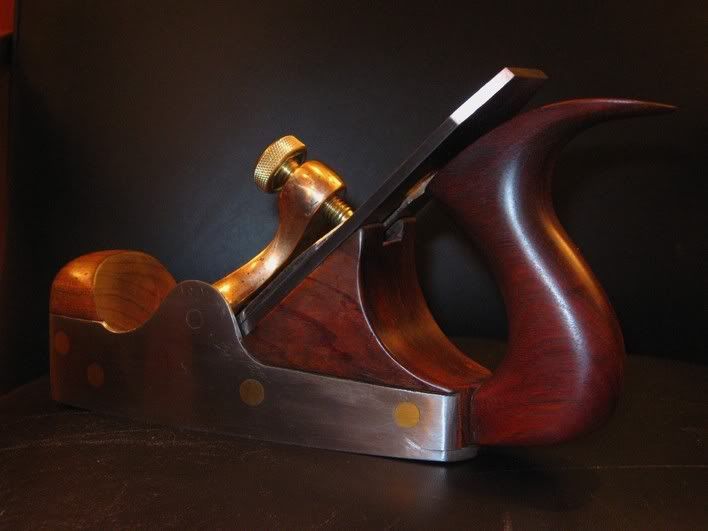
I'm looking for tips for anyone who has really thought about fine adjustment on those planes. For coarse adjustment, I just loosen the lever cap and turn the adjuster. Leaving the cap tight creates several problems (above and beyond the fact that it's known that it can damage the adjuster eventually). When you loosen it, the adjustment changes slightly once you tighten it - not a big deal for coarse adjustment.

Hi David

I do not have a Norris similar to yours; in fact, the closest I have is a Spier which I refurbished, and it comes without an adjuster. However, I was thinking about your issue with the Norris adjuster and lever cap. What I do have plenty experience with is the Norris-type adjusters on the Veritas BU and BD planes. As you noted, it is possible to damage the adjuster if the lever cap is tight. I find that with the Veritas planes there is a point when the lever cap is firm enough, yet adjustment is still possible. I think that many tighten too much when they start out with these planes. Can you use your Norris with less lever cap tension?

The second factor is one I discovered with the Spier smoother. When I restored it (literally from a shell, and building all the infills), it was a time pre-chipbreaker (for me). The mouth was tight with the thick replacement iron. The bed is exactly 47 1/2 degrees, as per the original. Still, it was just not capable of controlling tearout as I needed, and it wound u on the shelf. Years later, after I learned to use the chipbreaker, I returned to this plane to see if the new technique would ring improvements. I was concerned that the escapement would become blocked by the leading edge of the chipbreaker. Happily, all worked pretty well. Perhaps the escapement angle I built is not as steep as the original? All-in-all, this has turned out to be a nice smoother.


Regards from Perth

Derek

Re: Norris Vs. Stanley

#12

Re: Norris Vs. Stanley

david weaver

Hi Derek - I agree 100% on the planes. Eons ago when I built the spiers/shepherd kit, I had assumed that if I put a mouth of a hundredth on it, it would do good panel plane work (the cap iron they supplied really wasn't very good, and I didn't know how to use it). I set the plane aside, just as I have my JT Brown single iron jointer (a tight mouthed wooden plane, but it just doesn't last long in wood and it's not very capable with a single iron at 50 degrees. Not that you can't work wood with it - you can - it's just miles behind a slightly later plane with a double iron).

I had to refile the top of the mouth on the spiers kit in order to not open the mouth itself further (which I eventually did just a little) but make room for the cap iron. It was an entirely different plane after that - a hammer - any direction in anything, very easy to dimension with because the shaving stays together and is equivalent depth in all cuts - you can just take overlapping cuts and do little to threaten the flatness of a board (as opposed to no cap iron mode where there is moderate tearout - nothing major with a mouth of a hundredth, but the shavings are not coming off as consistently and the last-bit-of-thicknessing type of work that you would do with a panel plane or a jointer is less accurate). But with the norris type two screw adjuster - an extremely fast adjuster that ...I have no idea what they were thinking when they put it in planes. I won't build another plane with an adjuster.

The norris (as opposed to the spiers with the similar adjuster) that I have is fast, but not as fast as that one was. Still waiting on the other two planes to see how they compare - the panel plane's adjuster should have no traffic on it. I'm not getting to the point...

... the LV adjuster is fine and crisp, and it's very uniform metal on metal contact for all of the parts its moving, vs metal on wood for the bed of an infill. The norris adjusters are not as smooth to adjust as the LV and you can do the adjustment with the lever cap partially tensions and not damage them, but there is still some play in them that's not there in the LV planes. From what I can tell, it's better to have the lever cap tighter in use and just loosen it some to make adjustments. The trouble ends up being that once you retighten the lever cap, it moves just a little. If it was slower and all contact surfaces were metal and more predictable, it would probably work better and move around less when tightened.

Setting an adjusterless plane for a fine shaving is just so much less trouble.

Re: Norris Vs. Stanley

#13

You may have said before

david weaver

But what type of wood is it in that plane? It's handsomely done, of course.

The route you took is probably the sensible route for anyone wanting a good performing infill on the cheap - I see basket cases with decent metal parts for about $100 on ebay sometimes, and you can pretty quickly sink $100 into the metal on a plane if you use tool steel and brass, and a guy with no ability to knurl will not make a tasteful cap iron screw, even though you can make a brass screw with a wood lathe. Much more sensible to buy the metal parts.

I'm struggling a little bit right now to find a good infill material for a *good* plane. I realize there are a lot of acceptable materials, but I intend to build the plane I should've built when I started making infills, and I don't want to put vinyl seats in a mercedes.

Re: Norris Vs. Stanley

#14

The wood ..

Derek Cohen (in Perth, Australia)

Hi David

The shell ...


The handle is Jarrah, while the bed and front infill is Tasmanian Blackwood. Don't ask me why I did this (I think that I decided on Jarrah for the handle as it was so much more durable, and I was concerned that a handle may not last as it did not have any internal reinforcing) - over the years the colours have become very similar and the different shades have largely disappeared.

Regards from Perth

Derek

Re: Norris Vs. Stanley

#15

Re: The wood ..

david weaver

No worries, Derek. In my browsing of norris planes, I have seen modern planes that have some beech and some walnut or mahogany in the same plane. One had a walnut handle in the rear embedded in a beech infill.

Thanks for the info on the woods.

I'm scouting indian rosewood here, it will look like a classic plane, but it's not necessarily that easy to find a large blank and a board big enough for handles both in one place.

I have a walnut gunstock blank that George was generous enough to track down from his Gunsmith/blackmith friend Jon and send to me, but I'm on the fence about whether or not walnut is "enough" for a plane that may take 150 hours to make. It's not a turkish walnut claro blank or anything, just american walnut.

We are not blessed with the pore free hardwoods that you have there, except for the fruitwoods. Beech would work well for an infill, but it's not really the right thing. Apple would be fantastic, but if one could find an apple blank large enough, it would be almost impossible to dry crack free and it would cost a mint.

Re: Norris Vs. Stanley

#16

I expected...

david weaver

.. that there is something I don't know about the norris type adjuster, but double posting this discussion on the UK forum shows that not many there have much regard for it, either.

Interesting, for anyone who doesn't travel over there, that in the land of expensively made tools (a norris apparently cost a trade worker three weeks' wages at one point), they are quite a bit more frugal about what they'll buy than we generally are here, and would prefer an american stanley or an English record plane. Just as I suppose most of us do. The expensive stuff that sells on ebay-uk, though, ends up coming to the states. Items that are UK -only shipping sell for much less, and quite often, the sellers don't care (as in, I can't convince them to open their sales to global shipping on ebay even though it doesn't require them to do anything extra, they just don't care).

Re: Norris Vs. Stanley

#17

Re: Pre-war vs. Post-war

david weaver

I managed to pick up a reasonable looking (appears to be refinished, though) Norris No 2 this week. Also waiting for that in the mail.

That'll give me two pre-war planes to look at vs. the post war planes. The pre-war buck-branded norris-made panel plane that I have is quite nice, but it needs a bit of tuning as the lever cap favors tightening one side more than the other, which creates adjustment problems.

I also managed to find enough indian rosewood to make two panel planes for about $150, which is very favorable, I think.

The late model A5 that I have is in such good shape with no need for tuning beyond sole flattening, that I doubt any other planes will outperform it except if I moved the chipbreaker back a fair distance from the edge (I wouldn't do that in the first place).

The notion that I've seen from other folks is that they mention that their pre-war planes do better with difficult grain. Which just tells me they should learn to use the cap iron.

Re: Norris Vs. Stanley

#18

Re: Pre-war vs. Post-war

david weaver

Two more arrived last night. A pre-war #2 and another post-war A5.

Both were flat, unlike the other post-war A5 that was so out of flat that it couldn't effectively be used as a smoother. I always check flatness on the lap and then just work the bottom of a plane if there is mouth erosion, etc.

There is more care in making the 2. I was worried that the open handle would seem flimsy, but it's got a rod in it and is very strong (it did take a while to find a reasonable-priced pre-war plane with good metal, an original iron and an unbroken rosewood handle.

That said, I think they are functionally all the same. I like ward irons better than Sorby, who made the later Norris irons, but it doesn't matter that much. You can sharpen them all.

I'd like the A5s a little more if they were 2 1/4" wide instead of 2 1/8". Don't know why that is given the stanley 4 is 2, I think the adjustment on the stanley is just a little more accurate.

Cap iron works fine on both (as in, there's room on the 2 - but I'd make room by filing the top of the mouth inside if there wasn't room).

Re: Norris Vs. Stanley

#19

Re: Pre-war vs. Post-war

Wiley Horne--So. Calif.

Hi David,

I'm much enjoying your report. Just a couple of questions:

1. What is the bedding angle of these planes? 45, 47=1/2, 50?

2. I think I know that A1 is a panel plane, A5 is a smooth plane. What is A2?

3. Do you adjust by fully loosening the screw, or do you try to loosen it to some Goldilocks amount?

4. At some point, a class picture would be a lot of fun. Or maybe you were gonna do before and after, at a later date.....

Wiley

Re: Norris Vs. Stanley

#20

Re: Oops

david weaver

Apologies for the A2 - my understanding is that norris did make an A2, but what I have is, I believe, a norris #2.

It's a coffin shaped smoother with an open rear handle. Rosewood infill, no adjuster.

Admittedly, i'm talking about this more to entertain myself, but also partially because when I build another infill or 3, I want them same thing to be true as has been with woodies - I want to build at least as good of a plane as I can buy, which I can never do without trying out some examples and determining what makes them nice.

Sometimes when you're just airing your thoughts, it's helpful to put them out so people can bounce other opinions around.

Still convinced that the later A5 with beech infills, when cared for, would be the equal in function to the earlier smoother for anyone who knows how to use cap irons. The two that I bought averaged a little less than $300 in price, which is not cheap, but not expensive for what they actually are (the metalwork is quite nice). since I have two a5's now, I will see if I can take the adjuster out of one (haven't looked yet).

Re: Norris Vs. Stanley

#21

Re: The #2

david weaver

I have had prior dealings with this seller (I got a nice old buck branded norris 15 1/2 inch panel smoother from him in the past), which means I can get a hold of him outside of ebay, where he will work on price - this one was only slightly more than the A5s by the time we were done dickering.

http://www.ebay.com/itm/SUPERB-NORRIS-2-DOVETAILED-SOLE-ROSEWOOD-INFILL-SMOOTH-PLANE-INV-T3154-/311852140942?ul_noapp=true&nma=true&si=h8ZrPIhc%252B4dfGW9gHBFeFqSm0oU%253D&orig_cvip=true&rt=nc&_trksid=p2047675.l2557

By the way, on the bed angles, I'll check those tonight or tomorrow night, I'm not sure what they are. I'll admit that the advent of the double iron use has made me indifferent about small differences, and I try at this point to just not buy anything that's bedded above 50 degrees. I think these are all shy of that, they feel common pitch, but I understand that they were often bedded at 47 or something around there.

I know little about "proper" adjustment of these aside from the old shepherd spiers pattern panel plane kit I made (which I can't find a picture of), and these two norrises. I leave a little tension on when I adjust the irons, but not much - I guess that's goldilocks. I dumped the spiers kit ultimately because I didn't like the adjuster.

I'll take a picture of the planes, as well as the other few that I have, once the A1 panel plane arrives.

Re: Norris Vs. Stanley

#22

Re: Pictures of Most of Them

david weaver

My suspicions are confirmed regarding the norris adjusters: They're crap. The no 2 with no adjuster blows the two A5s away in terms of being able to get it set to smooth quickly. All work well with the cap iron once set. The no 2 is just a delight all around, only needing to be used some to get the lever cap to loosen up and move a little more freely - something important for setting it.

I guess I lucked out to some extent - I got both types of norris adjusters in the two A5s - the one with a solid threaded rod as well as the telescoping type. I would have to say the one with the solid threaded rod is like having a car with 75 horsepower and a 40 mile an hour first gear, and the telescoping one is like having a car with 75 horsepower and a 60 mile an hour first gear. They are both just painfully awkward, and better used to get the iron close and tapping adjustments with full tension on.

No way that I'll keep both of them - they are identical in size and I need only one of them for measurements.

Still missing the modern norris panel plane, but It's no pearl other than having little use. It's later styled with very bulky cheap beech infills.

https://s11.postimg.org/bpkam89kz/P1100058.jpg

https://s11.postimg.org/yfjff7ssj/P1100059.jpg

The rest of the planes i posted, I guess in case there is any discussion to be had on infills. The two A5s are on the right. next to them is a rosewood filled Buck branded panel plane (it is also made by norris). Don't know what happened to the bun, but what's left of it is reshaped into something functional, which is good, because it's front-heavy.

To the left of it are a norris shoulder and slater shoulder. I can't remember the number of the norris - 21 or 18 or something. Slater, no clue. I almost never use them because a chisel is faster, but I sold off a LN large shoulder plane to get the norris, which was only slightly more expensive and has miles more personality.

To the left of them is an infill smoother that I made pre-cap iron (second infill that I made). It's pretty much a theft of Ron Brese's design of his early planes, but dovetailed and not nearly as well finished. The infill is bois de rose. What a waste of a nice billet of wood that was - I didn't know any better. It was a deep red when I first made it, but it has aged to brown. If any of you remember clint jones, he had run across that billet somewhere for $75. It was full of bug holes and cracks but there was plenty left to get a front and rear infill - but it's such a rare wood that I should've passed it to someone with more skill. The cap iron and iron came from Ron Brese. Of course, I asked him if I could dead copy the plane design he was selling at the time and he was fine with that (it's no threat to his clean work, that's for sure). He gave me some pointers, which were helpful. It is a one-trick pony, single iron 55 degrees with a mouth a little less than 4 thousandths. It's almost too small, but it keeps you out of trouble. Not very practical following a try plane - more than 2 thousandths shaving thickness and you can feel the restriction of the mouth.

To the left of that smoother is a cast infill that I got last year from a tool dealer in england for around $200 or a little less. It is the nicest panel plane (in terms of using) I've ever used. No clue who made it, if it was from catalog parts or what, but I could tell in the sale pictures from it that someone had a dead-on idea of what the handle orientation should be. Unlike most panel planes, the handle is in tight under the iron and it does not feel front heavy at all in use. It is the sweetest adjusting plane I've used - the lever cap moves freely and if you loosen it wherever it sits, it gets a zero set instantly and keeps exactly that when you tighten the cap. One light tap with a hammer and it makes tissuey shavings, one more firm one and it's taking half a hundredth and leaving a finished surface that really doesn't need much of anything. You can adjust it in a flash with no thinking. Theoretically not the quality of the norris made panel plane, but the mathieson parallel iron is about as hard as a ward (surprisingly) and it's definitely nicer to use - one of the few infills that I've used that is not awkward in any way.

somewhere I missed the slater bullnose plane. An english friend's dad used it (he was a joiner/carpenter) and it had no iron when he brought it to me. The friend wanted to throw it out - as well as wanting to pitch a record 5 1/2. I kept both - he's definitely not a sentimental guy! I made an iron for the bullnose it's everything that a stanley 75 isn't. Works great and can take a pretty bold shaving in a stopped rabbet without getting flustered, and also does well with fine shavings.

To the left of all of that is the norris 2. The ward iron has seen some rust in the past, but not at the business end and I suppose minor enough that it doesn't show up in the picture. The cap is a wonderful design (don't know if it's ward) like the old ward wooden plane caps. You set it and it is perfectly behaved as you tighten it - it does not change its set at all when you tighten it down like some sprung caps will do. I am keeping it no matter what.

The last plane is a pitiful little straight plane that I made from scratch as my very first infill plane. Same idea as the brese plane, but with a mouth that's about twice as large. 55 degrees. The cross pin is so crooked (not sure if I marked wrong or what) that the lever cap sits somewhat diagonally, but it works. It's horribly heavy but i find a use for it once in a while on really small things that are hard, like planing boxing strips.

If I could only have three of these planes, I'd have the norris shoulder, the #2, and the unknown cast panel plane. Despite being a fan of wooden planes for most things, and a fan of the never-exceeded stanley #4, I could use them without being put out or without fiddling.

Next order of business with the A5s will be taking the adjuster out of one of them probably will do that to the ugly one. I think it will be a better plane, but it still has a flaw that the depth of cut goes deeper with more cap iron tension - that also makes it a pain with the adjuster. Just when you think you have it where you like it, a little more tension on the lever cap and then it's cutting way too deep. I haven't checked the iron bedding yet, but maybe the changing depth setting us due to the iron not bedding in the right places. I hope that's it, because I can fix that pretty easily.

(I forgot to measure the bed angle when I was downstairs - hopefully, I'll remember it next time).

Re: Norris Vs. Stanley

#23

Re: Pictures of Most of Them

Derek Cohen (in Perth, Australia)

To the left of them is an infill smoother that I made pre-cap iron (second infill that I made). It's pretty much a theft of Ron Brese's design of his early planes, but dovetailed and not nearly as well finished.

Actually, Ron copied the design of Holtey, who produced this first. And it was dovetailed (where Ron's is pinned).

The Holtey 11-S ..


I also made one of these, from a kit sold by Ron at the time (basic steel, lever cap and blade. Screw it together an add your own infill). Ron's work is excellent. Mine was a one-off with a 60 degree bed (hey, this was pre-chipbreaker knowledge). It works well, but is rarely used as it is not particularly ergonomic - the 60 degree bed does not help matters.

Ebony infill ...


Regards from Perth

Derek

Re: Norris Vs. Stanley

#24

Nice set!


Re: Norris Vs. Stanley

#25

Re: Pictures of Most of Them

David weaver

Hi Derek- I probably didn't write that class clearly. The brese ripoff is the large smoother third or fourth from left, depending on whether or not you are counting the norris 2.

I did also copy the