Home Articles Forums Gallery Marketplace Videos

WoodCentral Forums

Knowledge You Can Build On — Est. 1998

Brace and old bits - Worth the trouble?

Posts

Brace and old bits - Worth the trouble?

#1

Brace and old bits - Worth the trouble?

Denis Chenard in Ottawa

Ladies and gentlemen,

I dug out today a brace and a bunch of drill bits, some coming from my late great-grandfather, the rest from my father-in-law (or his father, at age 90 he can't remember).

First time I tried the brace and bits, and the result was not that great. I looked around on the 'net, where I found out that I have an assortment of Irwin and Jennings bits. I discovered that using Irwin bits on hardwood wasn't a good idea, even after sharpening the (rusty) bits. And Jennings bits do not lead to clean holes, even in hardwood. At least the ones I have.

I like the idea of using a brace and bits, but is it worth getting new bits or should I try fixing the old drill bits? Right now it doesn't seem worth the trouble. Advice, opinions?

Thnx,

DC

Re: Brace and old bits - Worth the trouble?

#2

Absolutely!

Derek Cohen (in Perth, Australia)

I like the idea of using a brace and bits, but is it worth getting new bits or should I try fixing the old drill bits? Right now it doesn't seem worth the trouble. Advice, opinions?

Hi Denis

The average 10" brace has more torque than a power drill. I find mine to be invaluable and a great adjunct to a battery drill (I have 3 or 4 braces that get used fairly frequently).

Here is a 3/4" bit going through 3 1/2" of European Oak bench top ..


The first rule is that the bits need to be sharp and the screw threads intact. Bits are easy to sharpen with a safe file. Lee Valley sell them.

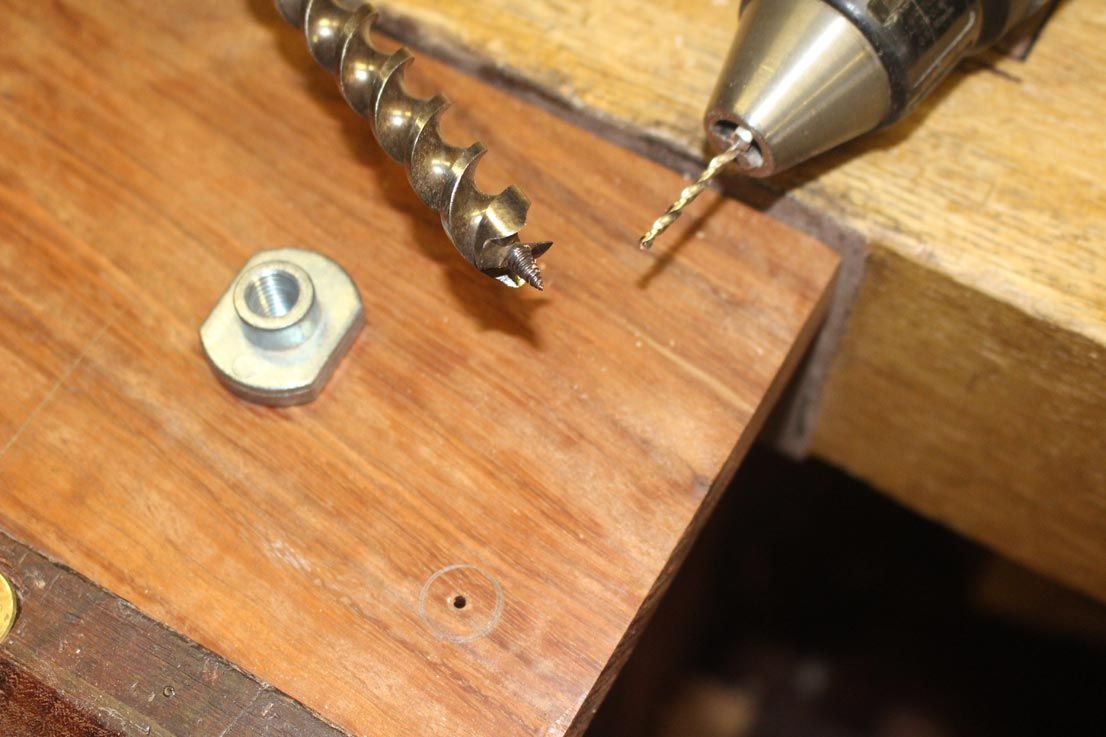
The second tip is one I recently discovered - or, more accurately, adapted from the tip of a fellow Aussie woodworker. He had recommended drilling a pilot hole if one wanted to use a forstner bit in a brace (this works well). I decided to do the same for larger bits when working in hard woods (such as the Jarrah below). The pilot hole needs to be a little narrower than the leading screw ...


This works a treat. The screw can bite into the wood much more easily, and this pulls the bit along.

Regards from Perth

Derek

Re: Brace and old bits - Worth the trouble?

#3

Re: Brace and old bits - Worth the trouble?

steve voigt

The old saw about Irwin-pattern bits not working in hardwood is definitely not true. I don't know about exotics, but I've drilled many holes in white oak, beech, and other domestic hardwoods with my old Irwin augurs, no problem. I would check to make sure the bit is sharpened well.

Personally, I love using a brace, and I get cleaner, straighter, more accurate holes than with an electric drill. I definitely encourage you to keep at it!

Re: Brace and old bits - Worth the trouble?

#4

alternative view

Bill Tindall, E.Tn.

There is no practical reason to own a brace and bit if you have an electric drill and various wood bits for it. The pricy 3/32" to 1/2" set from Lee Valley is a purchase I don't regret. The common sizes of screw lead bits for farm work are inexpensive and drill fast. For some occasions the compactness of the electric alternative is essential. Try drilling a hole in a floor joist on 12" centers with a brace and bit for example.

I used to use a brace for drilling holes on the farm remote from electricity. About 15 years ago I bought a battery operated half inch drill and have not had any desire or need to use the brace since, for drilling holes. A screw lead drill for an electric drill is times faster in a fence post. A lipped/spur wood bit in an electric drill is again times faster and leaves a smooth hole with no chip-out on the entry or exit.

On the other hand if you just like using tools that don't involve electricity go for it. We can't make that decision for you. New shiny inexpensive brace bits can be found readily at old tool sources because they are not in high demand.

Now for precise control driving or undriving square head screws, the brace is tops.

Re: Brace and old bits - Worth the trouble?

#5

Re: alternative view

Derek Cohen (in Perth, Australia)

Hi Bill

Once you move to greater than 1/2" bits, especially around the 3/4" and larger widths, the brace will out torque a power drill. I attempted to drill the 3/4" dog holes with a corded drill, and it bogged down. A 12" brace (pictured above) powered through with little effort.

I agree with you about how great a brace is when used for driving screws.

Regards from Perth

Derek

Re: Brace and old bits - Worth the trouble?

#6

different experience

Bill Tindall, E.Tn.

I drilled effortless 3/4 x 3" deep dog holes in my bench with a high quality 3/4" (Greenlee I think) spur bit and 18V Ridgid drill. There is a German bit I have seen demonstrated at IWF that drilled this size hole through many inches of lumber, don't remember what kind, or the drill name.

I have the Lee Valley set through 1/2" supplemented several larger sizes up to 15/16" and then Forstner for bigger than that up to 2 7/8". I power them all with a half inch electric drill of one brand or another. I have installed many lock sets in hardwood doors with these drills and a Forstner bit.

I was drilling a 4" hole in a house plate. It caught and threw me off the ladder.

Re: Brace and old bits - Worth the trouble?

#7

Re: Brace and old bits - Worth the trouble?

Wiley Horne--So. Calif.

Hi Denis,

New bits are a real pleasure. This includes LV's brad-point bits. And I have a couple of German made metric bits that will just about cut you if you run your finger along an arris. I have Yankee braces that will accommodate straight shank as well as tapered shank bits.

Like Bill, if it's a job down in a crawl space or between joists, I want two right-angle Milwaukee's, one for drills and the other for driver. But I will point out one thing Bill said, "I was drilling a 4" hole in a house plate. It caught and threw me off the ladder." Yes, a corded 1/2" drill will power through whatever. But if it catches, you won't be ready for it, and it will try to wrap you around the axle, as Bill says.

That's why if you're drilling a long hole, like down through a thick bench, or in my case, down through a 7" deep apron of a bench, I want a 10" or 12" brace with the tapered long 3/4" auger in it. Why? That same auger in a Milwaukee 1/2" drill--and you need the 1/2" model's torque--is a good bet to catch and try to sprain your wrist.

I use brace/bit as drivers. A lot. 8" and 10" braces. The reason is touch. You have the same 'feel' as with a screw-driver, but lots of easy power--easy meaning you're not clenching up and tightening your jaw. Much less chance of munging up the screw than with an electric drill, because you can feel and test whether the driver has a good square grip.

Suggest: New bits. What kind of brace did you inherit?

Wiley

Re: Brace and old bits - Worth the trouble?

#8

Re: Brace and old bits - Worth the trouble?

Denis Chenard in Ottawa

Hi Wiley,

I inherited a Millers Falls 1710, and I acquired (I believe at a local WW association meeting, it's been a while) a J.A. Chapman (I believe, marking is a bit faint) No. 60-10 (for $5). Both are 10 in. swing, a bit rusty but work well.

I looked a bit (!) for new bit sets, and Amazon has a set of Irwin pattern (by Irwin, 13 bits, 1/4 - 1" by 16ths) for CAD $217, and TFWW carries Jennings bits for a much higher price (but they do look like better quality). I'd rather go for Jennings, which mean I'll have to save up first...

Cheers,

DC

Re: Brace and old bits - Worth the trouble?

#9

Which new bits?

Joe shelton

Wiley, I'd like to hear more about the bits you recommend. I use a variety now, and have even used some 1" bits from the borg, so I know my braces include some with rather catholic chucks...

Re: Brace and old bits - Worth the trouble?

#10

Re: Which new bits?

Wiley Horne--So. Calif.

Hi Joe and all,

Not an expert. Not an expert. Not an expert. That said, here's my opinions:

1. Braces

Hard to talk about bit choices without starting with braces. Some braces will only work well with tapered shank bits. There are other braces which have universal chucks and will close well on round shank bits, as well as tapered shank. These universal chuck braces include all the North Bros. and Stanley 'Yankees', Millers Falls 772 Lion chuck; Peck, Stowe & Wilcox 'Samson' chuck; and I seem to recall a Stanley 813G with the same property. I have had all of these at one time or other, and eventually began sorta collecting North Bros. and North Bros., Division of Stanley--all made in Philadelphia.

Every brace conversation I ever saw drew a number of those swearing by Fray Spofford braces. I like them too when I have perfectly open working space. But like if you're building a bench or are hunched up in some kitchen cabinetry, you can wind up in some d_mnable places and wish you had a ratchet brace.

Braces make great drivers. Whenever I can use a square-drive screw I do, Robertson screws or the ones McFeelys sells. A brace + square drive screw is wonderful. Doesn't cam out on you. Of course, furniture hinges don't lend themselves to these screws on an aesthetic basis, or so it is said, and so I think.

2. Drills

a. These LV lipped brad point drills are as good as money can buy, in my experience:

http://www.leevalley.com/us/Wood/page.aspx?p=42247&cat=1,180,42240

b. For piloting screws in hinges, I need numbered drills, the small range.

c. For augers, I've only used Jennings pattern. They come in two styles. The ones for dry hardwood are the No. 100 series--they have a pilot thread which is double--has two headings. The ones for carpentry are No. 101--they have a single lead screw. I bought on that auction site--at the time a nice set of 1/4"-1" would run about $100-$125. I haven't checked prices in 10 years though.

Here is an interesting piece by Mike Siemsen where he talks about all things auger, including Jennings pattern vs. Irwin:

http://schoolofwood.com/node/74

I'll follow up with a link to those German bits.....l

Wiley

Re: Brace and old bits - Worth the trouble?

#11

A little more

Wiley Horne--So. Calif.

I mentioned number drills. The ones I needed were the small range, numbered 1 through 60. They come in two different point grind angles, plus imported vs. USA made, and in a range of coatings. I got either these very ones, or similar black-coated US made by another maker:

https://www.amazon.com/Chicago-Latrobe-High-Speed-Conventional-60-piece/dp/B001VY3D76?SubscriptionId=AKIAJ2F6RDUSIYCWQMFQ&tag=sa-sym-20&linkCode=xm2&camp=2025&creative=165953&creativeASIN=B001VY3D76

I couldn't find the German drills. They were sold by Traditional Woodworker, which seems to have disappeared from internet sales.

Wiley

Re: Brace and old bits - Worth the trouble?

#12

Agree

Bill Tindall, E.Tn.

"These LV lipped brad point drills are as good as money can buy"

I saw them made at the LV factory, then went home and bought the set. I have this kind of bit made by various manufacturers- Greelee etc. The LV bits are best because they are very sharp. If careful I can drill clean through hardwood and not splinter out the back. To my surprise I have used more than half the sizes in the set.

Number and letter drills are essential for drilling pilot holes of perfect size.

I still can't think of the German lipped drills but what was good about them is how fast they could drill and to great depth. In one demo they drilled through a large log.