has anyone made a Raamtang?
Joseph Piotrowski
just saw a picture of this workbench appliance and i was wondering if anyone has ever made or used one?
i can see it being useful for me if it actually works.
Knowledge You Can Build On — Est. 1998
has anyone made a Raamtang?
Joseph Piotrowski
just saw a picture of this workbench appliance and i was wondering if anyone has ever made or used one?
i can see it being useful for me if it actually works.
Re: has anyone made a Raamtang?
Bill Houghton, Sebastopol, CA
I haven't, but it looks like I should. And it looks simple enough to knock together pretty quickly. I'll look forward to your reports on its uses.
Re: has anyone made a Raamtang? *LINK*
rob lee
Hi -
I found a good video (link below), for those interested....
Cheers,
Popular Wooworking Oct '15
Neal in SC
Issue #220, still available thru their website: popularwoodworking.com
Re: Why has anyone made a Raamtang?
William Duffield
I'm afraid I don't understand the advantages of this complicated gizmo vs. a much more versatile Moxon vise.
Re: Why has anyone made a Raamtang?
Joseph Piotrowski
i was thinking it could be nice to joint edges of short narrow boards
but you might be right a proper moxon vise would probably work. i'll have to try it and see if that working height is an issue or not.
so far every step of the process is a huge learning experience.
Re: Why has anyone made a Raamtang?
William Duffield
Maybe that's why Moxon shows it attached to the front of his bench, instead of on top. His vise attaches as easily to either the front or top of the bench, even though many modern versions are not as versatile. My dovetailing vise is attached too high to make it convenient for running moldings, but I also have a sticking board with an adjustable height fence that works marginally for edge planing moldings.
Re: Why has anyone made a Raamtang?
TomD
It didn't look useful to me. There is a simple stop wedge that works just as well, and uses the planing force to hold the board. The Youtube video I used to learn what the thing is, was well produced, but the guy already had a bench with dogs capable of making the same cuts, that he used in making the Raamtang.
One of the appeals of hand tool woodworking for me was that you could easily skirt the tendency to have piles of jigs to make everything. But after Chris started unearthing every know primitive hand tool woodworking gizmo, one can be just as awash in junk as a jig worker, without even the production advantages of the jigs.
My Tucker vice is so useful, I hardly need anything else. Add a stool, and I wouldn't need anything else.
tucker vice?
Joseph Piotrowski
so many toys to learn about.
Re: tucker vise?
Wiley Horne--So. Calif.
It is a patternmakers' vise. No longer available. Lee Valley offered them at one time. Asked a reasonable price for what it was, but didn't get enough takers. There was screaming when the maker decided not to make any more of them, and they were discontinued.
Vintage patternmakers' vises (like the Emmert, say) are megabucks now.
Tom should show a photo of his Tucker, if he can.
Wiley
Re: tucker vise?
Bruce, a MN Galoot
One sold two years ago, NIB, for $2800 on eBay.
Moxon vise
Warren in Lancaster, PA
Joseph Moxon was trained as a printer in Rotterdam. His father printed religious material and moved to Holland to escape persecution. Moxon later owned a publishing business when he wrote Mechanicks Exercises. The part on printing was probably the most accurate; I doubt he ever worked a stick of wood.
What Moxon calls a VISE is an iron leg vise as blacksmith would use.
What Moxon calls a BENCH SCREW is crochet attached to the front left of the bench with a single wooden screw going through the cheek to hold a board for edge planing etc. This configuration is illustrated by Moxon on the bench and also by Randle Holme who was a contemporary.
Moxon uses the term DOUBLE SCREW for both a clamp with two cheeks and for a vise attached to the front of the bench. He illustrates the double screw with two cheeks attached to the front of the bench. I think he is confused here. Most double screws, when used as vises, have a single cheek and the screws thread into the work bench. It would hardly work to have both the inner cheek and the bench threaded.
The double screw used as a clamp can be attached to the bench top with a holdfast or two as Moxon suggests. I have used this configuration in a great variety of situations for about 40 years. However Moxon says nothing about using the thing for raising up the work the way they are often used today. Dovetailing can be done efficiently at bench top level if the worker can avoid trying to saw at eye level. Sawing with one's nose right next to the saw causes a very cramped arm, shoulder, and neck. And poor posture.
my back disagrees
Joseph Piotrowski
maybe 30 years ago! but this desk jockey's back really likes cutting at higher elevation.
Re: my back disagrees
Warren in Lancaster, PA
Here is a picture of Chris Schwarz making dovetails. He has raised the work five inches above the bench and has the board well above the vise. Does this look like a comfortable working position? He is still way bent over and awkward as all get out. The problem is that he wants to work next to his nose.
Agree
Bill Tindall, E.Tn.
I find myself in the unusual position of agreeing with Warren on this point. (BTW Chris holds a chisel by the blade when dovetailing, as I do, so we aren't in total agreement about dovetailing). I might momentarily stoop during a cut, but mostly it can be done in a comfortable standing position.
I find it best to look down on what I am sawing. If you saw tails first it matters not whether the dovetail angle is accurate to the arc second. It is, however, critical that the cut be orthogonal to the face of the board. I find it easiest to ensure this cut is accurate by sawing with the piece below me. Plus, it becomes easy to see that the saw stops at the back scribe line.
That said, who saws dovetails all day, whatever the position! Dovetailing will occupy about 1% of the time I am spending on the display cabinet (one drawer). I doubt I spent 5 minutes actually sawing the drawer. How long does it take to saw eight 3/4" long kerfs? Chiseling is another matter.
In the end it is what you get used to doing. I have no doubt that I could saw dovetails in a "Moxon" vice. But it is a piece of shop furniture I don't find I need to take the time to build.
Re: my back disagrees
Joseph Piotrowski
how tall is he? when you have back issue a few degrees of bend makes all the difference in the world. enjoy the way you do them and i will enjoy the comfort of my dovetail work.
Re: Agree
Joseph Piotrowski
i glad you don't need anything extra. no need to waste time with things you don't need.
granted, i have cut very few dovetails by hand but i find the extra height works great for my body and the angle it creates with my Japanese dovetail saw. the saw works great when pulled in a downward motion from the face closest to you causing even more bending to lower the arm.
thanks,
Joe P.
Re: my back disagrees
Joseph Piotrowski
he is also removing waste, probably trying to maintain a close even line in the waste side so a paring chisel can be used. maybe you can do that without getting a better eye level view but not me.
Agree
Wiley Horne--So. Calif.
Hi all,
Agree with Warren absolutely about standing up to saw joinery, though I don't think there is a bone to pick about how high the work is, so long as you're upright and in relaxed poise. I saw with a Japanese rip saw.
Seeing the marked lines up real close is not the point. Cause you can see the lines perfectly in front of your nose, and still start the saw in the wrong plane. The point is to see the plane, and you can visualize the plane better if you have some perspective, and are not down with your nose in the work. Say you're sawing the tails board first and have it set up and marked--maybe ganged with the other drawer side. Suppose you've marked the near face and the end grain. There is only one plane that passes through both those two marks. You want your saw to lie on that plane.
Standing up, there is better perspective on the horizontal and vertical planes of the tails board, and then at an angle to vertical, the plane you want the saw in. And as Warren says, you're not cramped.
Incidentally, it looks to me like Chris Schwarz in the picture is sawing the waste with a fret saw (rather than sawing the tails), and I find I have to get down level with the cut once in a while to see exactly where the saw is cutting.
I don't think anything above contradicts what Joe is saying, but I do agree with Warren about standing up and having the perspective of the whole picture.
Wiley
Lots of ways to skin a cat
Bill Tindall, E.Tn.
....though I have no personal experience 
I am reminded of a story Jeff Headley told (3rd generation Period Furniture reproduction shop). He was at a LN affair where he tried out a dovetail saw. He caught the attention of the LN demonstrator who advised him that he was sawing the dovetail all wrong. Apparently there is more than one right way.
If you are starting out I would advise to begin sawing with what you have at hand. Then improve where improvement is needed. If a Moxon fixtures gets built before this learning has started there may be strong motivation to use it whether it adds benefit or not. I doubt it will shorten the learning curve. The time to build the fixture might be better spent practicing, or not, depending, or the $investment spent on a good saw.
BTW, I am getting ever more attached to the inexpensive LV saws. I find myself subconsciously reaching for them rather than traditional saws.
Re: Lots of ways to skin a cat
Joseph Piotrowski
thanks for the tip on the LV saws. I made one carcass of dovetails and it killed my back. so i made a moxon- ish vice with spare stuff around the shop( other than carriage bolts).
it was about 1 hr to make. everything is sized as it was so no fancy plans were used . it easily tossed back in the scarp bin
Re: Moxon vise
Derek Cohen (in Perth, Australia)
The double screw used as a clamp can be attached to the bench top with a holdfast or two as Moxon suggests. I have used this configuration in a great variety of situations for about 40 years. However Moxon says nothing about using the thing for raising up the work the way they are often used today. Dovetailing can be done efficiently at bench top level if the worker can avoid trying to saw at eye level. Sawing with one's nose right next to the saw causes a very cramped arm, shoulder, and neck. And poor posture.
Hi Warren
I agree with your last sentence here - that one needs to stand back from the work a little and be aware of body posture. Sawing, like planing, is all about body posture and the associated biomechanics.
Chris Schwarz has had an indelible influence on the bench design of many of the current generation of woodworkers. He certainly influenced me to build a Roubo-style bench. However, my bench is not super low as his is.
He also influenced me to build a Moxon-style vise for dovetailing - having said this, I have used a double screw vise for this specific purpose for about a decade longer before his writings were published on this area (I built one into the skirt of the bench).
I value two components of the Moxon: it holds the work extremely well, and it does so at a helpful height. The bench (at 32") is comfortable for planing, where down force is used. The extra 6" the Moxon vise adds is helpful at raising the boards to a height where sawing is as ergonomic as is planing. This places the work about 6" below my elbow.

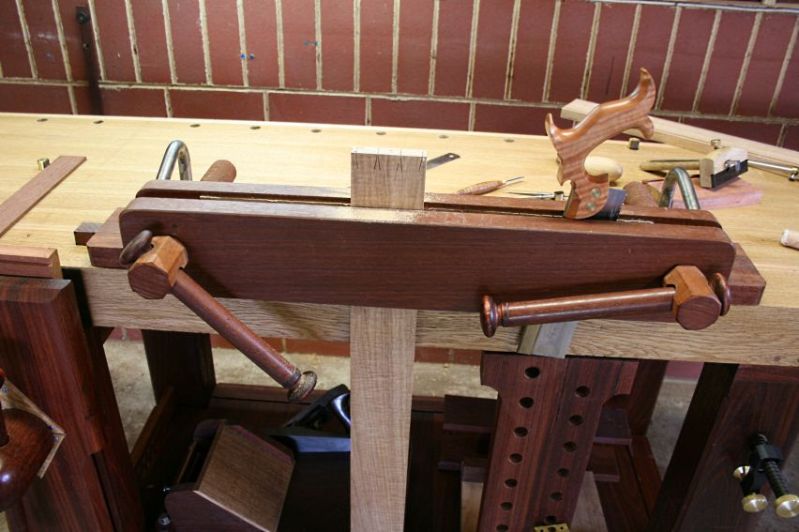

Planing works on a lower bench as one bends the knees to accommodate this. Sawing cannot work comfortably for me on a too low bench as, for example, I like to saw two lines simultaneously on the tail board. This would cause the wrist to fatigue (below is my previous bench, with my double screw vise in the skirt ...) ...

This is where the Moxon vise adds just enough extra height to make the wrist action more comfortable. It is about the same height above the bench as when I clamp a board in the leg vise to saw a tenon ...

Regards from Perth
Derek
Interesting metrics
Bill Tindall, E.Tn.
I hand plane as little as I can get by with so my bench height is optimized for the rest of one's woodworking. Planing and sawing is a small part of the time I spend at the bench. Curious, I stuck a piece of wood in my vice as though I was getting ready to saw dovetails and measured the height of the top of the piece.....38". This height was determined without aid of a ruler by what was comfortable after gaining some experience.
I'm 5'7". If the bench vise was only 32" off the floor I would be figuring out some way to saw higher than a 32" bench vise allowed.
However, my advice would be to not let lack of the optimum sawing environment prevent one from making stuff, or practicing. It is possible that the optimum environment can not be determined until one gets some experience nor can it be determined by others.
last paragraph= perfect advice
Joseph Piotrowski
that is wrapped up nicely in that last paragraph.
as you know, i just dived into hand tools. as much as reading, videos, etc helped me kick off the journey, nothing beat the actual task of putting tools to wood.
ever single action teaches so much more.
Re: Moxon vise
William Duffield
I wince every time I see a picture or video of Chris Schwarz sawing. If I did it like that, it's the last woodworking operation I would be able to accomplish all day.
The only problem I have with your dovetailing setup is the extension of the work above the top of the vise. It's not a problem for 3/4" thick boards and a sharp saw, but there is too much vibration when cutting thinner wood. I therefore prefer a higher Moxon vise. Mine also incorporates a chamfer in the front top edge for clearance for sawing half blind sockets.
It appears that you have replaced your L-N DT saw, shown in the older pictures, with a Veritas, as you are using in the more recent pics. Can you make any comparisons of the two saws? I'm still using the L-N DT saw, but have upgraded my tenon saw from a Disston to the Veritas and am quite pleased with it.


