New WoodChat!
Home Articles Forums Gallery Marketplace Videos

WoodCentral Forums

Knowledge You Can Build On — Est. 1998

Identify and use hundreds of woods

How whould pins be shaped on a mortise gauge

Posts

How whould pins be shaped on a mortise gauge

#1

How whould pins be shaped on a mortise gauge

Bill Tindall, E.Tn.

/l l\ or l\ /l ?

I can come up with an argument for each configuration but someone must have figured out was is best. The gauge I picked up somewhere years ago is /l /l which doesn't seem right.

I misposted this question on the main board.

Re: How whould pins be shaped on a mortise gauge

#2

Re: How whould pins be shaped on a mortise gauge

William Duffield

Too late. What's done is done. I guess those Normites will get let in on another of our secrets. :D

I guess you'll have to return to the Messages messageboard if you want to read or discuss my responses.

Re: How whould pins be shaped on a mortise gauge

#3

Re: How whould pins be shaped on a mortise gauge

Wiley Horne--So. Calif.

Bevels to the inside, which is what Sir Wm said on the main board.

The highly regarded Jim Blauvelt said years ago, that you also want the outside knife ever so slightly longer in the tooth than the inside knife. The reason is that the outside knife is pulling the gauge fence up against the work, whereas the inside knife is trying to push the fence away from the work. So you want the outside knife to dominate just a little, to keep the gauge pulling into the work and staying on track.

Wiley

Re: How whould pins be shaped on a mortise gauge

#4

Why the other way might make sense

Bill Tindall, E.Tn.

If the flat faces are on the inside one can just slide the pins together against the mortise chisel to set the width.

What is the disadvantage of slopes on the outside? Curios minds wonder........

Re: How whould pins be shaped on a mortise gauge

#5

Re: Why the other way might make sense

Wiley Horne--So. Calif.

For me, it's to get a visually clearer and more precise registration of the chisel in the initial cut when you begin chopping. Aesthetically, the cut will also look cleaner than if it has ragging around the edge, but to me that is secondary to the chisel registration. The chisel is sort of self-registering against the sharp walls of the gauged lines (I like to gauge deep for mortises).

Some people mortise thin and then use the gauge lines for final paring. I don't, but for them the 'bevel inside' approach has that advantage.

Wiley

Re: How whould pins be shaped on a mortise gauge

#6

not following your reply

Bill Tindall, E.Tn.

"The chisel is sort of self-registering against the sharp walls of the gauged lines"

The chisel is orthogonal to the scribed line. I don't understand the registration statement .......and the ragged edge, or not ragged edge, gets covered up by the tenon shoulder so looks is irrelevant unless it is a through mortise.

Re: How whould pins be shaped on a mortise gauge

#7

Re: not following your reply

Wiley Horne--So. Calif.

Hi Bill,

Caveat 1...this is just me, not holding myself out as an authority

Caveat 2...I use methods that help my eyes, which ain't what they were

Caveat 3...I notice your mortises are always very sharp-edged :)

When I knife in the mortise, I go down maybe 1/16" each cheek side. Knife edge is outside, thereby defining the mortise; bevel depression is inside, to be removed in the first course of excavation.

First course: I go down the length of the mortise, making the first course of vertical strikes maybe 3/16" to 1/4" deep (never measured). Space strikes every 1/8" to 3/16" or so. Starting the second or third strike, each strike will bring up a chunk of waste; however, because the perimeter is knifed in deeply, there will be no ragging or splintering across the mortise boundary--the mortise definition will remain sharp to my old eye. Also, and this is what I meant by 'registering' in previous post, I can position the chisel by braille almost, doesn't require precision eyeballing to stay in a clean line.

I've never tried doing this with the knife inside and the bevel outside,but I am imagining that after the first course, I would end up with kind of a no man's land of indefiniteness around the perimeter, rather than a sharply defined mortise perimeter. Caveat 4: I won't argue a word with anyone who says they do it this way and what I say ain't so--but it's what I imagine, never having tried it.

Bottom line: In my hands, starting with a cleanly knifed perimeter with deep vertical sides makes it easier to maintain a precise mortise as I excavate. But if there is any fuzziness in the boundary, such as bevel dents along the perimeter, I fear that will translate into physical play to some degree, even if small, as I excavate (see Caveat 4). Caveat 5: The above is about my hands and my eyes, and I'm not imposing these notions on anyone else :) .

Hope that helps.

Wiley

Re: How whould pins be shaped on a mortise gauge

#8

Re: How should pins be shaped on a mortise gauge

Derek Cohen (in Perth, Australia)

Bill

Bevels are on the inside, with flats to the outside.

This ensures a defined outer boundary for the mortice or the tenon. For the mortice one must retain a boundary mark when chopping out. If the knives were in the opposite direction, you will be left with an undefined chamfered line to work with.

Similarly, one saws to a defined mark in the case of forming a tenon cheek.

This goes for both fixed- or adjustable mortice gauges.

Regards from Perth

Derek

Re: How whould pins be shaped on a mortise gauge

#9

Interesting and a scribing question

Bill Tindall, E.Tn.

Having never been "taught" mortising with a chisel I do what I do and don't know any better.

Question to all.....Does everyone scribe mortises deeply so as to define the initial mortise side, or just scribe to make a mark to indicate where the mortise will be?

1. My marking lines are not nearly as deep as yours. It never occurred to me that the marking gauge could or should wind up defining the side boundary. I need to think about that possibility.

2. Indeed, my boundary is created by whatever splinters out of the excavation. It is not as crisp as a knifed line, especially in stringy oak. (however I am proceeding in small steps, see below) However, unless I am making a through mortise, of which I have only ever made a total of 4 , the shoulders of the tenon cover up the boundary edge. It never occurred to me to worry about this edge.

3. I take smaller, deeper chops. I move along about 1/16" per chop and drive to the maximum mortise depth as quick as I can. To aid getting deep quick, I drill an undersized pilot hole at the start and end of the mortise to the target depth. The hole provides chip clearance and a depth target.

A general knifing comment. I reach for a double beveled knife about as often as a single bevel marking knife for marking. Chip carving knives make dandy marking knives. But I make shallow lines so it doesn't matter.....I think. Is everyone making deeply? I can't get a wheel gauge to go deeply.

Re: How whould pins be shaped on a mortise gauge

#10

Re: Interesting and a scribing question

Derek Cohen (in Perth, Australia)

Bill, as Wiley suggests, I also score deeply ...


... and then excavate the top layer to define the boundaries ...


The only chopping direction is straight down. No attempt is made to lever out waste. The waste is being forced into the (drilled) hole.


Regards from Perth

Derek

Re: How whould pins be shaped on a mortise gauge

#11

Terminology issue

Wiley Horne--So. Calif.

Bill,

From your initial drawing, I thought you were talking about filing the gauge pins to a knife shape. I am using a Japanese mortise gauge with knives--these things make a cut, not a scratch.

If yours is a scratch-type gauge, then all my comments are likely inapplicable to your situation.

We probably should clarify this.

Wiley

Re: How whould pins be shaped on a mortise gauge

#12

Re: Interesting and a scribing question

TomD

Even if you don't scribe deeply you will still get a cleaner line bevel to the inside. On some woods you don't need to mark deeply simple to see the line, but you may on woods like oak.

Many gauges with pins are just sharp pins, the bevels are virtually not there, and the question does not seem to come up. With knives it probably should. All the gauges I use have knives. I think, Bill, you are getting a knives answer to what I recall was a pins answer, though some sharpen pins like knives.

Charlesworth had an interesting take on single blade/bevel gauges. He pointed out that with knives an innie and an outie were worth having. Because depending on situation you want to define, the line will be much more evident as you plane or cut to it if you are indexing to a squared line. I buy that, though I have never felt compelled to bother with it, and don't see gauges built that way, except that mortise gauges do take it into account as per discussion here.

Re: How whould pins be shaped on a mortise gauge

#13

I'm confused

Bill Tindall, E.Tn.

The gauge I have is a Marples and it has pins that have been filed on one side to be more or less perpendicular to the shaft of the gauge. They stick down at most 1/16". Unsure if they "scratch" or not. I have never tried to dig them into the wood deep enough to make much of a definition for the side of a mortise. Maybe I am using them incorrectly, or they are filed incorrectly.

I had to look up what a Japanese gauge looked like. I bought one from Lee Valley with off-set "knives" and sent it back. Marking mortises with one knife trailing the other by a cm was too difficult for me to deal with.

Re: How whould pins be shaped on a mortise gauge

#14

question

Bill Tindall, E.Tn.

Why is your first pass so shallow> Not knowing any better I deepen the mortise as quickly as the wood will allow. The relief hole enables deepening quickly. After about 3-4 whacks I am at full mortise depth as I proceed down the mortise.

Re: How whould pins be shaped on a mortise gauge

#15

Re: not following your reply

William Duffield

Thanks for that lucid explanation, Wiley. It matches my understanding and experience exactly.

I think the technique as you describe it, is essential for clean through mortises, for example those made in the rear legs of Philadelphia Chippendale chairs, and in A&C furniture.

Re: How whould pins be shaped on a mortise gauge

#16

Re: Why the other way might make sense

William Duffield

As a side note, the Veritas dual gauge I recommended in another post allows you to set the mortise width directly from the mortise chisel, but it does it via a trick: The distance between the knife edges and the far ends of the rods is the same, so you can set it using the square back ends of the rods instead of taking a chance on dulling your knives. From Lee Valley's web site:


This photo is for illustration only. To set the gauge, you do not need to bring the mortise chisel edge directly against the rods. Just set the chisel on its side on a flat surface, and bring the end of one rod against the flat surface and the end of the other against the side of the chisel. To set it for cutting the tenon, use the same procedure, just reversing the extensions of the rods.


Re: How whould pins be shaped on a mortise gauge

#17

Re: Why the other way might make sense

Derek Cohen (in Perth, Australia)

In practice, William, wheel gauges score such a shallow and narrow line. So-much-so that it makes little apparent difference which way round they face.

This is also fortunate since I prefer to use the same setting for both mortice and for tenon.

Regards from Perth

Derek

Re: How whould pins be shaped on a mortise gauge

#18

Help me overcome my aversion to this device

Bill Tindall, E.Tn.

I bought the LV Japanese style gauge and promptly returned it. One gauged line stops, or starts, distant from the other, that is to say the marks of the two cutters, or wheels in this case, is off set by the rod spacing. I found this off-set an intolerable nuisance in marking the mortise.

And....I find the wheel gauge doesn't make very deep scribe lines in my hands. I assume that two wheels would scribe half as deep.

Re: How whould pins be shaped on a mortise gauge

#19

Re: Why the other way might make sense

William Duffield

In that case, maybe we should try to convince Rob Lee to manufacture a dual gauge with real knives instead of wheels. :D

The necessity for deep gauge lines is much less if you are using hard, even grained woods, but with something soft like walnut (or pine :( ), it becomes more important. Not all Oz woods are as well behaved as your jarrah or other eucalypts. I'm sure you've worked with she oak and silky oak, with their drastic density differences.

Re: How whould pins be shaped on a mortise gauge

#20

Re: Help me overcome my aversion to this device

William Duffield

Those are real problems with wheel gauges and dual blade gauges of any ilk. All I can suggest is a little more patience, and making multiple scribe marks and cutting with one blade at a time, instead of trying to get it all done at once. The more uneven the grain the more important it is that the first scribe is very light so the blade has much less tendency to follow the grain instead of its fence.

Re: How whould pins be shaped on a mortise gauge

#21

Re: Why the other way might make sense

Derek Cohen (in Perth, Australia)

In that case, maybe we should try to convince Rob Lee to manufacture a dual gauge with real knives instead of wheels. :D

Hi William

I have the Veritas dual gauge. The way I use it is as a dual single gauge. That is, I score one line, then score the other - not both at the same time. The wheel gauges are excellent across the grain, but leave a fine and rather faint line on end grain hardwood. They may do better on softwood, but I do not work with it much.

The best gauge I have used is a Kinshiro (which was a kind gift from Wiley several years ago) ..
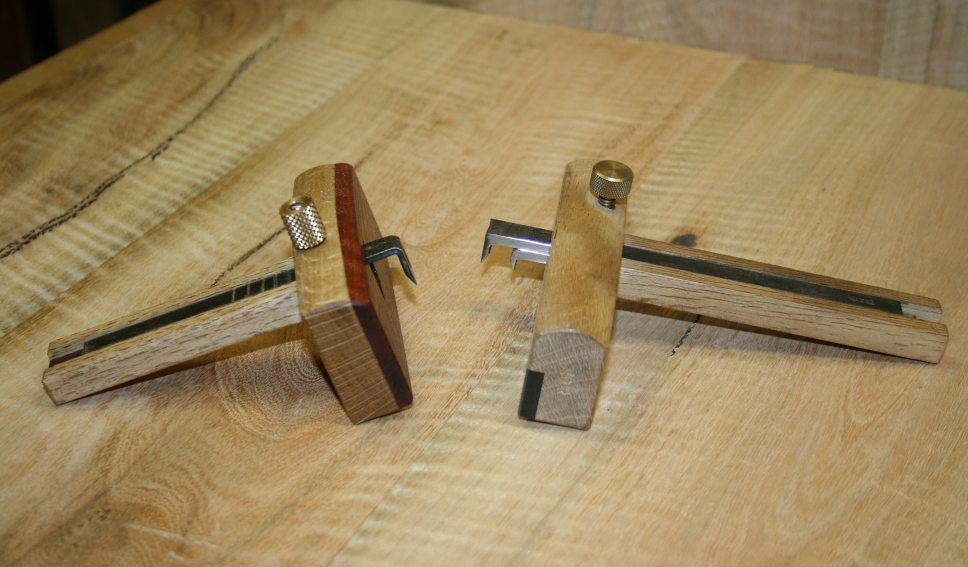

(Kinshiro on the right)

You can see the opposing bevels. This gauge cuts a thin, deep line.

The downside of the Kinshiro is that it is difficult to adjust for a matching offset mortice. The blades cannot be secured while the fence is moved.

The Veritas dual gauge is capable of doing this ... but the lines are too faint in the hardwoods I use. I think that the pin type gauges are actually better for this task.

To overcome this, I built a mortice gauge that uses knives (with opposing bevels) along the lines of a Kinshiro, but where the fence could be moved without losing a setting. The basis of this was a set of fixed knives that could be changed for a specific mortice chisel (1/4", 5/16", 3/8").
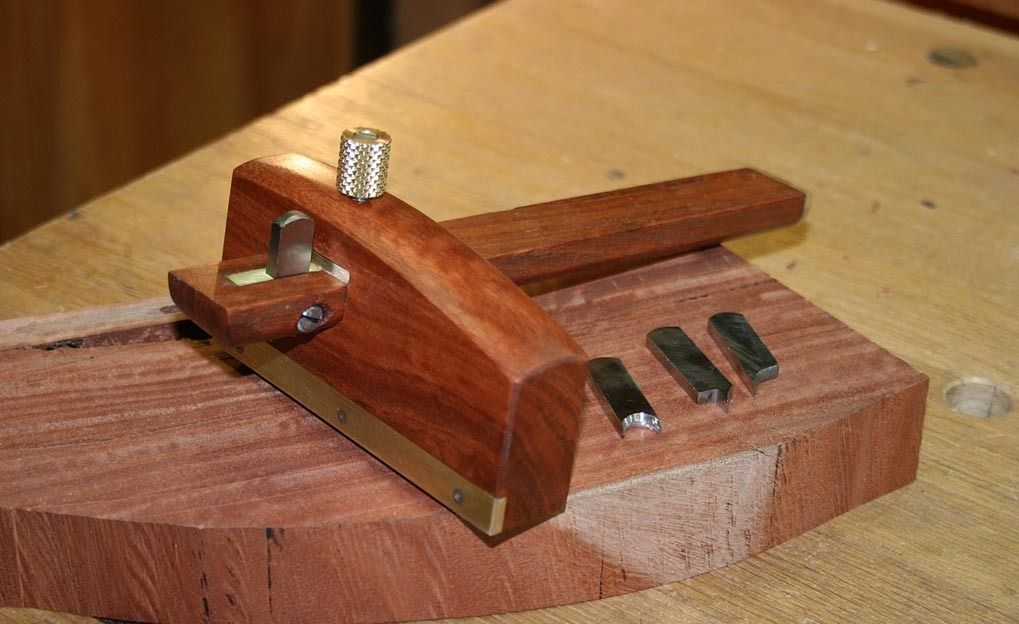

The knives sit in a cassette like this ...
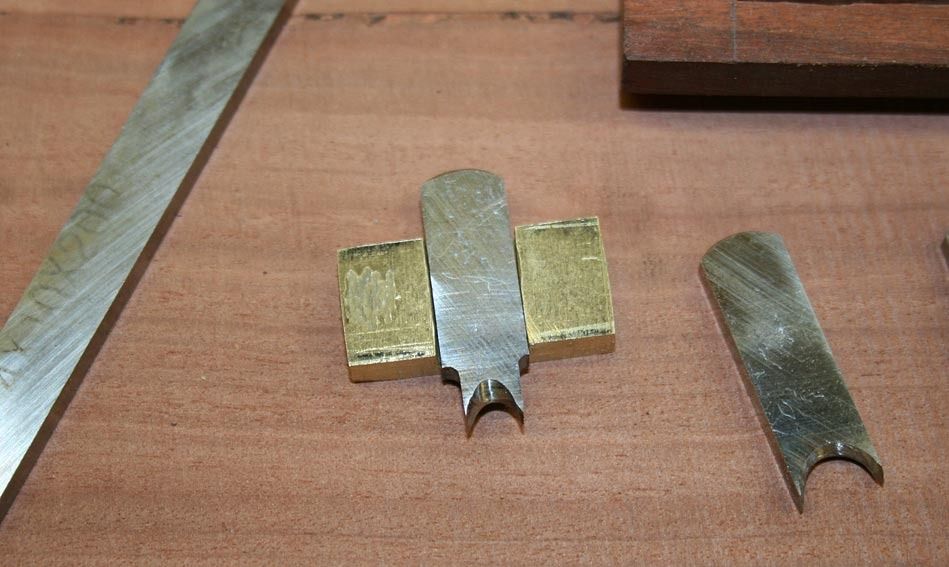

Do you like I could interest Lee Valley in this? :)

The necessity for deep gauge lines is much less if you are using hard, even grained woods, but with something soft like walnut (or pine :( ), it becomes more important. Not all Oz woods are as well behaved as your jarrah or other eucalypts. I'm sure you've worked with she oak and silky oak, with their drastic density differences.

I am not following you .. since that is the opposite to what I experience. The woods I use are hard: Jarrah is hard (and some examples are harder than others) and She-Oak is harder still. The wheel gauge lines hardly show up on the endgrain. A cutting gauge is essential.

Regards from Perth

Derek

Re: How whould pins be shaped on a mortise gauge

#22

Re: I'm confused

Derek Cohen (in Perth, Australia)

Bill, what you describe is a pin gauge that has been converted to a cutting gauge. These are no longer pins, but knives.

Many of us make gauges and use knives like these, made from rods. I use HSS rod or old HSS drill bits.


The cutters have a flat back and a rounded bevel.

Regards from Perth

Derek

Re: How whould pins be shaped on a mortise gauge

#23

Simple fix

Bill Tindall, E.Tn.

"The blades cannot be secured while the fence is moved. " I have pondered this shortcoming of the kind of mortise gauge and thought I could just add a second element to the post to independently lock down the adjustable blade leaving the main fence movable while the blades stayed locked in place.

Re: How whould pins be shaped on a mortise gauge

#24

Re: Simple fix

Wiley Horne--So. Calif.

I use the infamous uber-neanderthal 'finger pinch' method :) . Once the blades are set to the chisel, I pinch the two blades with my fingers on the sides (not top and bottom). It's natural to hold them in fixed relation to each other in order to set the distance from fence--this is how I routinely use the gauge anyway.

Wiley