New WoodChat!
Home Articles Forums Gallery Marketplace Videos

WoodCentral Forums

Knowledge You Can Build On — Est. 1998

ADVERTISE HERE - FREE TRIAL

Discussion-Engineering the bottom of case goods

Posts

Discussion-Engineering the bottom of case goods

#1

Discussion-Engineering the bottom of case goods

Bill Tindall, E.Tn.

I hope this post results in some comments from others that build case pieces.


In a typical case piece like a chest of drawers there is a traditional way to construct the base and feet. As shown in the sketch, drawn by our Sgian Dubh, the case is assembled with a panel dovetailed into the top and bottom of the case sides to make a box. A frame is assembled that becomes the interface between this box and the feet, both of which are screwed to the frame.


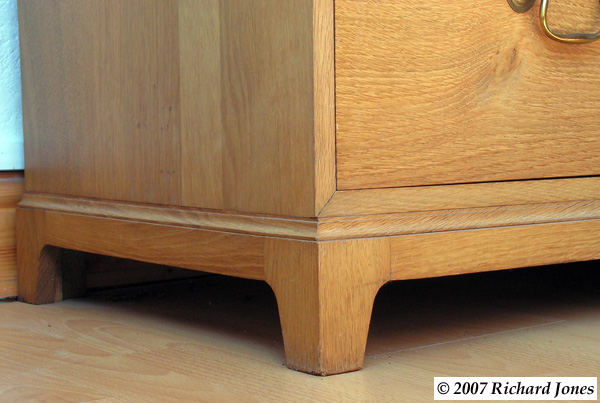
This construction is shown in real life in this cherry chest of drawers. The frame and bottom trim are in the foreground and the case with its dovetailed bottom panel is in the background. I can think of two advantages of this construction. The panel dovetailed into the case top and bottom restrains the case sides to keep them flat. The grain of the feet and trim molding runs parallel to the grain of the frame. The only cross grain issue to contend with is the joint between the case sides and frame. Are there other advantages for this construction?


A second approach is to extend the case sides to the floor and wrap the trim around this base. The advantage of this construction is that it is easier to accomplish and the integral feet are stronger. Gluing the side trim to the front of the case and nailing it to the back accommodates changes in the case side with humidity changes. A disadvantage is that nothing holds the bottom of the case sides flat.

I have made case pieces both ways and remain unsettled what to do with future pieces. Anybody have some experience to add to the discussion?

Re: Discussion-Engineering the bottom of case goods

#2

Re: Discussion-Engineering the bottom of case good

Warren in Lancaster, PA

Here in Pennsylvania we like to have support from the floor up, directly under the carcass, not offset support like shown in the drawing. I don't think I have ever seen traditional work where the carcass was hanging on screws like you show.

Re: Discussion-Engineering the bottom of case goods

#3

Re: Discussion-Engineering the bottom of case good

Bill Tindall, E.Tn.

Where the molding allows for it, and it did on my cherry piece, the frame sits in a rabbit on the feet. This construction is typical of pieces with bracket feet. Additionally, there are corner blocks which extend past the bottom of the feet a small amount. The case sides are therefore supported to the floor through the frame and corner blocks. The feet, bracket or otherwise in my case, do not hold the case up .


One can just see the a corner block in the back left.

Re: Discussion-Engineering the bottom of case goods

#4

Re: Discussion-Engineering the bottom of case good

Brian Holcombe

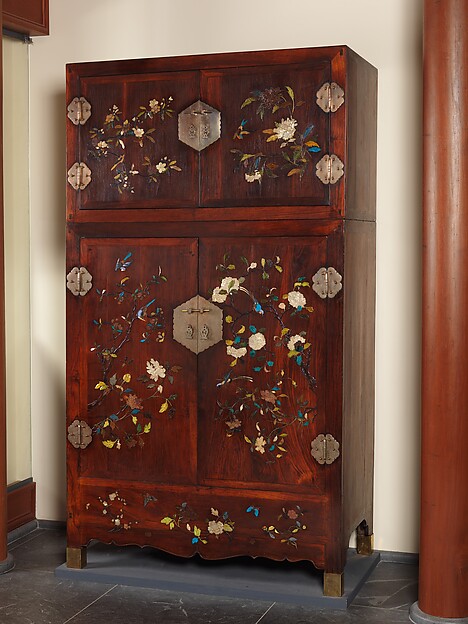
Here is a Ming wardrobe, the framing members extend to become the feet. They're tied together with through tenon joinery.


These have lasted something like 400 years and are relatively simple in outside appearance, so I look to them fairly often for inspiration.

Re: Discussion-Engineering the bottom of case goods

#5

Re: Discussion-Engineering the bottom of case good

David Charlesworth

A method we used here, was to support the carcase on a rebate in the plinth.

Buttons used to fix, and to allow movement.

David Charlesworth

Re: Discussion-Engineering the bottom of case goods

#6

Re: Discussions?

William Duffield

I know you meant to start a discussion, but in posting the question and diagrams on both the Hand Tool and Messages forum, you have started two separate, but unequal, discussions. I responded on the other forum, where my ideas may well not be seen and considered by Warren Mickley, Brian Holcombe or David Charlesworth. I think that ends up being a loss to the whole community, even if totally inadvertent. I know you have suggested in the past that we might not need a hand tool forum anymore, but some participants in this forum appreciate it because discussions are less obscured by issues which are less pertinent to actual hands-on practice.

Several options are open: Should I just leave my response over there, post another copy of it over here, or remove it from the other forum and repost it here? Does anyone care? Did anyone even notice?

Re: Discussion-Engineering the bottom of case goods

#7

Re: Discussion-Engineering the bottom of case good

William Duffield

Although most everything else about them is different, structurally, your Oriental examples are equivalent to a Eighteenth Century Chippendale chest on frame (highboy).

Re: Discussion-Engineering the bottom of case goods

#8

Re: Discussions?

Wiley Horne--So. Calif.

William,

I (and am sure I'm one of many!) read all your posts without fail. But only read Hand Tools. Could you please repost on this side?

Thanks,

Wiley

Re: Discussion-Engineering the bottom of case goods

#9

a painful reminder

Bill Tindall, E.Tn.

I call that construction "post and panel", not sure if that is an accepted name or not. I am currently making two bedside chests of drawers of that design, sort of. Daughter sent me a blurry picture of an example she liked that is "enhanced" Danish Modern. It seemed to be post and panel except the posts didn't extend to the earth. A base had been added that provided a bunch of possibly interesting shadow lines at the base. I had finished the upper part before her recent visit and was puzzling and fretting over the base construction. Seeing the piece in person she decided the posts and legs should be the same size.

Fulfilling that desire would have rendered the construction trivial at the start by simply extended the legs to the floor, but maybe impossible at this stage. There simply isn't enough meat in a 1 1/4" Danish post feet to accommodate two orthogonal tenons strong enough to secure the feet.

I have not detailed the construction of this piece because nobody should build it the way I did. Danish post and panel needs to be made with Danish post and panel technique not 1690 frame and panel technique. It became the project from Hell. I have learned an important lesson to use engineering designed to support a style.

I have accepted a fix for my situation which will baffle anyone studying the construction at some time in the future. Changing horses in the middle of the stream leads to fixes that would make no sense without knowing of the horse change. If it looks ok in the end I'll post the result with no revelation of how I got there. The panels do look nice.

Re: Discussion-Engineering the bottom of case goods

#10

Re: Discussions?

Bill Tindall, E.Tn.

You will also need my reply.....

Speaking and speculating for Sgain I think the drawing was to illustrate in its barest elements the frame and feet approach to holding up a case. In any case that was my intended use of the illustration. Seeing the concept illustrated was intended to make the example clearer to understand. As you pointed out, and what is illustrated in the example, there are details of this construction that were not included in the drawing.

My hope was to get some experienced comment on the two alternative ways of putting feet on a case. Are there advantages/disadvantages of one approach vs the other that people have found through experience implementing this or that construction?

Re: Discussion-Engineering the bottom of case goods

#11

Re: Discussion-Engineering the bottom of case good

Brian Holcombe

Indeed very similar. I always find it interesting how so many cultures, seemingly separate came to very similar conclusions on how to build things.

Re: Discussion-Engineering the bottom of case goods

#12

Re: a painful reminder

Brian Holcombe

I end up using dimensions you may find slightly odd, which end up being 1-7/8" because I can use two 3/8" tenons and space 3/8" between them and 3/8" shoulders.

Shoji frames are made up at 10 bu x 10 bu which converts to 1.20" or 30~mm, and they fit twin tenons which are 2 bu or just shy of 1/4".

It's worth looking at Tansu and Sashimono when utilizing small dimension frame and panel (post and panel).

The architects behind the Arts and Crafts movement were heavily influenced by Japanese construction and the Danish were influenced by Ming dynasty amongst others, so it is work looking at the source.

Re: Discussion-Engineering the bottom of case goods

#13

Re: Discussions?

William Duffield

That's scary.

Here's my comment:

In the drawing, [Bill or Richard shows] the grain of the bracket feet running vertically. It should run horizontally. The mitered front brackets should, at minimum, be splined. Much better would be full blind mitered dovetails. Your rear brackets are half missing. They need to wrap around the back of the case, even if they are not molded or shaped (because they are not seen if the case is kept against a wall) to provide side-to-side support. They should be half blind dovetailed (tails in the back, pins in the sides). The brackets themselves should not touch the floor. There should be a series of glue blocks inside each foot, with the grain of every other block running front to back and the grain of the other blocks running side to side. The lowermost blocks should extend below the brackets by about an eighth of an inch or so.

Re: Discussion-Engineering the bottom of case goods

#14

Re: a painful reminder

William Duffield

I once saw a Shoji demonstration by Toshio Odate, where he was chopping double mortises with a double mortise chisel. It looked kind of like it had been made from a tuning fork. After each chop, he plunged the tips into a bamboo cup that was stuffed with fibers and oil or wax, for lubrication. This was long before Veritas invented this for sawing the tenons.

http://www.leevalley.com/US/wood/page.aspx?p=62708&cat=1,42884

Re: Discussion-Engineering the bottom of case goods

#15

Tuning fork mortising chisel - bamboo cup

Brian Holcombe

I've seen this in his book, but have never seen one in the wild. I can't imagine there are too many people using them in the states, and even he seems to go back and forth.

The bamboo oil pot;

I recently made this after Stanley Covington's post on it. It beats the heck out of a block of wax, so far.


Re: Discussion-Engineering the bottom of case goods

#16

Re: Discussions?

Bill Tindall, E.Tn.

"In the drawing, [Bill or Richard shows] the grain of the bracket feet running vertically." In the Cherry example the grain obviously runs horizontal, but for effect I can see the possibility of running the grain vertical.

"The mitered front brackets should, at minimum, be splined." That's debatable. The corner blocking keeps the miter together.

"Much better would be full blind mitered dovetails." Not worth the effort and I'll bet rarely done in Period Furniture.

" Your rear brackets are half missing." My rear partial feet are most assuredly not missing. Had it been relevant to the question posed I would have included a picture of them.

"The brackets themselves should not touch the floor." Mine don't

"There should be a series of glue blocks inside each foot." As stated in an earlier post the picture shows a rear block and the rest are there but not visible in the picture.

Had the objective of my post been to describe how to make a bracket foot I would have included these details. Rather, I included just enough detail to describe the alternative ways of sitting a case piece on the floor in the hope that someone would engage in a discussion of the relative merits of each possibility and not nit pick details extraneous to the hoped for discussion.

Re: Discussion-Engineering the bottom of case goods

#17

Re: a painful reminder

Bill Tindall, E.Tn.

Had I proceeded I would have needed to create a base from 4" tall by 1 1/4" leg and 1 1/4" stretcher. Draw it out with a double tenon and there just isn't enough surface to make a strong leg, or at least not a situation I was satisfied with. Had daughter specified a 1 1/4" leg to begin with the leg would have just been an extension of the panel post and no porblem. The panel frame is assembled with double tenons as you described. No problem there. It was setting a box on a separate base that created the problems, which became impossible to solve with a small leg.

Re: Discussion-Engineering the bottom of case goods

#18

Re: a painful reminder

Brian Holcombe

Ahh, I see. I understand now why the small legs were not enough.

Re: Discussion-Engineering the bottom of case goods

#19

Re: Discussions?

Sgian Dubh

"In the drawing ... shows the grain of the bracket feet running vertically. It should run horizontally."

William, I disagree with your final sentence in the quotation above. Better, in my opinion, would have been to say something like: "it's not always appropriate for the grain of the feet to run vertically." I say that because running the grain of a cabinet's feet horizontally may also not be the right choice (in my opinion).

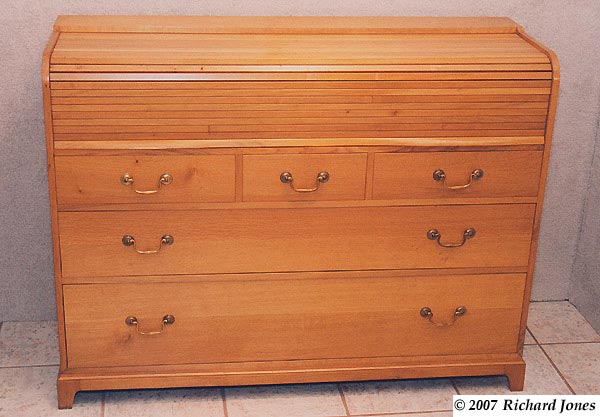
Take the cabinet below which I designed and made many moons ago. It was both an aesthetic and technical choice to make a separate plinth, similar to the plinth style I sketched and Bill used in his opening post. I justified the choice through the desire to make a separate and independently strong plinth, that could be removed from the cabinet and remade or repaired in the event of calamities of one sort or another, e.g., flooding damage. I wanted a base wider than the main cabinet with the vertical grain orientation of the feet at the corner as 'posts', visually reinforcing the 'supporting' element - something that would be less visually supporting if the grain of the feet ran horizontally. It's perhaps a small point this grain orientation dilemma, but small or not, or right or wrong in anybody else's opinion, it was a considered choice on my part.

Of course, you may disagree with my choices and my justification of them, but that's the nature of a design exercise - the designer has to make choices based on the brief, and be willing to stand by those choices. Slainte.


Re: Discussion-Engineering the bottom of case goods

#20

nice feet and a question

Bill Tindall, E.Tn.

I fret over trim molding every piece I build. If there are rules I have not found them. :)

The base molding is a cove. Would you comment on the merits of a cove at this base vs. a quarter round of some variation of it, in this particular piece or in general? I might learn something......

Re: Discussion-Engineering the bottom of case goods

#21

Re: nice feet and a question

Sgian Dubh

Bill, the choice of a cove here rather than an ovolo (quarter round) was determined by following the general idea that support structures tend to be wider at the bottom and narrowing with height. I suppose a pyramid, tree trunks at the ground/air intersection, and a pile of sand roughly represent the concept: there are, of course, many exceptions where objects don't follow this tendency, e.g., buildings with horizontal cantilevered elements, jutting balconies, overhanging floors above narrower bases, etc, and many other examples in both designed products and nature. In this case, the arcing sweep of the cove replicated that general idea of 'growth'.

It just seemed to be almost automatically the right choice. I suppose I could have gone the ovolo route, but I remember considering it and rejecting it quickly - I wanted an inward upward sweep rather than an outward one.

As to a generalisation for other pieces, I don't have one. The designer has to consider the desired effect and make choices. On the other hand, if the job is an exact copy of a piece, the maker will most likely do whatever the original designer and/or maker did - there aren't new design issues to consider, although an inquisitive maker will almost certainly ponder the design motifs exhibited. Slainte.

Re: Discussion-Engineering the bottom of case goods

#22

Re: nice feet and a question

William Duffield

There are "rules of thumb". Practice has varied with changes of style over the centuries. Your first consideration should be what does it look like, in terms of highlights and shadows, in situ from eye view. Obviously, one would not place a crown molding facing upwards, or a base molding facing downwards. Crown moldings are viewed from below, while base moldings are viewed from above, and chair moldings are viewed from slightly above, but mostly face on.

For a vast, historical record of moldings that have been used over the centuries, my first reference is Furniture Mouldings: Full Size Sections of Moulded Details on English Furniture from 1574 to 1820, by E. J. Warne.

https://www.amazon.com/Furniture-Mouldings-Sections-Moulded-Details/dp/0941936333

Since it is out of copyright protection, it is also available in .pdf format (37 MB) from several places on the web. I have carried an electronic version on my iPad or MacBook for a few years. I usually also carry copies of Roubo, Sheraton, Moxon and I. Page's A Guide for Drawing the Acanthus.

Re: Discussion-Engineering the bottom of case goods

#23

Re: Discussions?

William Duffield

Yes, that would have been a much better way to say it. I still don't think I would choose to use your construction. That practice went out with William and Mary. While it works for tables, it resulted in the destruction of many pieces of older furniture. When you move a table, it is easy to put your hands under the aprons and lift it, but with the aprons all the way down at the floor level it is just too tempting to push it around instead of bending over and lifting it.

Note that the feet on Brian's tansu examples are bound in brass. for additional strength.

Re: Discussion-Engineering the bottom of case goods

#24

Re: nice feet and a question

Sgian Dubh

"Your first consideration should be what does it look like, in terms of highlights and shadows, in situ from eye view."

In this case William, that sums up the design procedure I followed then, and to this day, still follow. It's also pretty much a standard designer's mantra, coupled with the product's function, along with such factors, where relevant, as cost of production, saleability, etc, whether that be furniture, toasters, televisions, buildings, etc.

Regarding the moulding profile source you mentioned, that's one I'd not come across before, and might a useful resource. It's perhaps surprising, but I know that many designers pay little heed to historical precedent or examples, many being largely ignorant of anything earlier than perhaps Bauhaus, Arts and Crafts or Art Nouveau, ha, ha. Slainte.

Re: Discussion-Engineering the bottom of case goods

#25

Re: Discussions?

Sgian Dubh

"That practice went out with William and Mary."

I guess the validity of that statement depends upon the interests you have in furniture. As far as I'm aware there have always been a range of methods to create a link between the floor and the furniture sitting on it, whether that be tables, chairs, cabinets, etc. So, in this case, I think it would be incorrect to say the practice went out with William and Mary. That might be so in the case of the high end or better furniture, but probably not entirely true of lesser items. Slainte.