New WoodChat!
Home Articles Forums Gallery Marketplace Videos

WoodCentral Forums

Knowledge You Can Build On — Est. 1998

Exotic Hardwood, Personally Sourced Worldwide. Inspected at Origin. Shop Rare Stock.

The Butler's Desk - Drawer Building

Posts

The Butler's Desk - Drawer Building

#1

The Butler's Desk - Drawer Building

Brian Holcombe

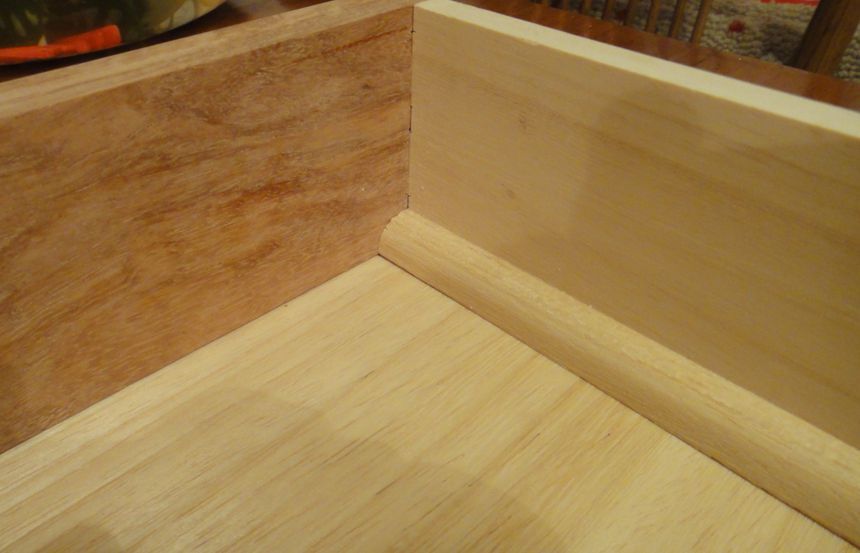
Good morning! Now that the case is complete, I've been building the drawers. These are 'Piston Fit' Drawers, fitting tightly to the case. In a deviation from previous builds I've broken up with plywood drawer bottoms and used QS white

oak.

https://brianholcombewoodworker.com/2016/06/30/the-butlers-desk-drawer-building/

Click the above link to see the full story :D


Re: The Butler's Desk - Drawer Building

#2

I do one more step......

Bill Tindall, E.Tn.

and that is set the piece somewhere humid for a few days. It is not uncommon that one or more of my perfectly fit drawers in fact are not in the situation where the humidity becomes high.

Of course I have other questions but daughters and granddaughters are coming today and its our anniversary and we are going on a date at noon and probable the two pregnant cows need water.......so later.

Re: The Butler's Desk - Drawer Building

#3

Re: I do one more step......

Brian Holcombe

That's a good point, and I try to avoid building drawers over the winter. It's been humid here for a few weeks, and it's been a few more weeks since I've built them, so they are still nice and tight but not sticking.

Re: The Butler's Desk - Drawer Building

#4

Slips

Derek Cohen (in Perth, Australia)

Thanks for the progress reports, Brian.

With regard the slips, I see that you are not building them flush with the drawer bottom but letting them stand high at the sides. Is there a reason you went this route?

Flush fit and beaded slips (from my current build) ...


Raised slips (one of Richard Jones') ...


Regards from Perth

Derek

Re: The Butler's Desk - Drawer Building

#5

Preference

Brian Holcombe

While I do like the look of those slips being flush, I'm less keen on a chamfered corner meeting up flush with a 90 degree edge.

I've been working on my continuous chamfers so in other parts of the build there are raised areas to support (aesthetically) chamfers.

Re: The Butler's Desk - Drawer Building

#6

I have a reason.....

Bill Tindall, E.Tn.

Drawers with the Jones slips are much easier to build.

Re: The Butler's Desk - Drawer Building

#7

miters

Bill Tindall, E.Tn.

You mentioned mitering the slips. There are two pieces of slip material per drawer. What is there to miter?

Re: The Butler's Desk - Drawer Building

#8

Re: miters

Brian Holcombe

Three pieces for me :D

You know I never do things normally.

Re: The Butler's Desk - Drawer Building

#9

Re: miters

Derek Cohen (in Perth, Australia)

Brian, are you continuing to add a slip to the rear of the drawer front?

I do not consider this to be sound construction. As with using raised slips, it is the easier method. Raised slips affect the way a drawer may be used. A front slip reduced the strength in a drawer construction. Ideally we have the drawer bottom being reinforced at the front (by a groove in the drawer front) and the back (by a screw or screws).

To be fair, I did the front slip thing once, and had my knuckles wrapped for this. Plus, only relatively recently (past few years) began making flush slips. They are more work, but they are aesthetically and practically much nicer in a drawer than raised slips.

Regards from Perth

Derek

Re: The Butler's Desk - Drawer Building

#10

Re: miters

Brian Holcombe

I'd rather the slips be the sacrificial piece than the drawer front or sides. If someone decides to put the drawer on the floor then stand on the drawer bottom it will make it easier for me to repair.

Outside of abuse, I'm not sure how they would fail.

Also it would seem that Chris Scwartz would disagree with you on that point.

I remain unconvinced about the superiority of flush slips, which require a heavier drawer bottom and leave a groove for crud to accumulate in. A heavier drawer bottom puts the weight of overloading onto the other drawer parts.

Re: The Butler's Desk - Drawer Building

#11

continuing drawer construction

Bill Tindall, E.Tn.

Brian, mend your ways...but more on that later........

First a disclaimer for the benefit of the onlookers. My drawers are made to a functional standard of significantly less refinement than you all. They are no more than an soundly constructed place to store socks. that said...


Slips were invented to provide a broader bearing surface for the unusual habit of using skinny white oak sides on classic English furniture. Otherwise these abrasive sides would saw their way into the soft mahogany dividers and the wounds would show. In modern times this functional feature has found other application.

I use slips, often when not needed, because they lead to quicker drawer construction. I make slip stock "by the mile" and I have stock at hand whenever making drawers. The alignment block shown in the picture is stored with my drawer making stuff to be available when the slips are glued on. It becomes a trivial task to wind up with grooves aligned to where the bottom slides in smoothly.

I do agree that for some application a flat bottom drawer would be best and I suspect that the desk is one of these applications, as well as the Derek piece. For my sock drawer, not an important consideration.

Given the over the top details of the rest of the desk, the effort of making a flat bottom would not be excessive. But, for that matter, slips on these small drawers are not necessary in the first place.

I have learned to be wary about making creative departures from classic furniture engineering. Cabinet makers optimized construction to be most easily executed and long lasting. Modern tools, materials and techniques can make departures free of risk if they only impact how the piece is made. Occasionally they can have unexpected impact on long lasting. The bottom line is to study how furniture is made and learn from it, as described by Steve Latta in the recent Fine WW article. (disclaimer-Steve is my woodworking hero )

A side note, people tend to make drawer bottoms ridiculously thick which leads to excessively heavy drawers. If someone stands in a drawer, not an anticipation I would devote any engineering effort to mitigate, the bottom should fail, not the sides or front. Even a 1/4" bottom captured on three sides and screwed on the 4th is robust in a medium sized drawer. Bottoms are trivial to fix.

Re: The Butler's Desk - Drawer Building

#12

Re: miters

Derek Cohen (in Perth, Australia)

Brian, it will be interesting to see if any others have an opinion here - I suspect that (relatively speaking) there are not many in the US that use slips. Perhaps David Charlesworth or Richard Jones will respond.

We did discuss some of this on WC 6 years ago (the only time I used a slip at the rear of a drawer front - I was a slip-newbie at the time. Richard had a few disparaging words about this). The link is here:

http://www.inthewoodshop.com/Furniture/DrawerDesignandDrawerBottoms.html

Regards from Perth

Derek

Re: The Butler's Desk - Drawer Building

#13

Re: miters

Derek Cohen (in Perth, Australia)

I remain unconvinced about the superiority of flush slips, which require a heavier drawer bottom and leave a groove for crud to accumulate in. A heavier drawer bottom puts the weight of overloading onto the other drawer parts.

What would you consider to be a "proper" thickness? The widest drawers in my chest are 18 1/2" across, and the Tasmanian Oak drawer bottoms are about 3/8" thick and sit on a 3/16" groove. The upper rebate is 1/8". All hand planed. This Tasmanian Oak is quite a medium hard but light wood, similar to white oak I suspect.

Reference: http://www.inthewoodshop.com/Furniture/BuildingTheDrawers.html

Regards from Perth

Derek

Re: The Butler's Desk - Drawer Building

#14

Re: continuing drawer construction

Kees

Slips? Grooves? Why not nail those bottoms? (I'm in a 17th century mood).

Re: The Butler's Desk - Drawer Building

#15

drawer construction comments

Brian Holcombe

Thank you both for these comments, they're much appreciated.

I will take them strongly into consideration in future builds. Richard's comments in the post that Derek links, in my interpretation seem to suggest not that the slip will fail in use but that it makes for a more complicated assembly....which is a fair point it does make it more complicated. My logic, in this case was that placing the groove into the drawer front required me to raise the drawer bottom further than I had planned.

I'm using 5/16"~ drawer bottoms and agree with Bill's comments, I'd rather the drawer bottom fail before anything else. That's not a high consideration in desk drawers, however, which will not likely ever need to hold significant weight.

My slips are flush with the bottom of the drawer side, providing additional bearing surface.

The point of wearing is a good one and brings up a more logical reason for not using a front drawer slip....if the drawer sides wear into the runners then the drawer won't close without bumping into the drawer blade......so, with that in mind I will eliminate the front slip in the future, but I think we're fine for quite a number of decades here as I have 1" wide oak engaging with the walnut drawer runners that are long grain.

Thanks again for an insightful discussion.

Re: The Butler's Desk - Drawer Building

#16

Re: miters

Brian Holcombe

I was reading 1/2", 5/8" and 3/4" mentioned in your link. I think 5/16" or 3/8" that you used on your recent cabinet is a good thickness. I used 5/16" because I wanted it thicker than the groove so that I could fine tune the fit.

All things considered, literal failure is not a high consideration in these chests which will be used lightly. The consideration is for a light construction which I think lends itself to lighter use, which is a good thing.

Re: The Butler's Desk - Drawer Building

#17

Nails!!!!

Brian Holcombe

:D :D :D

I no longer turn my nose up at nails, truly, but have yet to really consider their use.

Re: The Butler's Desk - Drawer Building

#18

question

Bill Tindall, E.Tn.

"My logic, in this case was that placing the groove into the drawer front required me to raise the drawer bottom further than I had planned. "

I do not understand this statement. I don't understand whether to slip or groove the drawer front affects where the drawer bottom Is located.

Re: The Butler's Desk - Drawer Building

#19

Re: question

Brian Holcombe

The groove needs to be hidden by the dovetail, so the position of the dovetail somewhat dictates the lowest possible position of the groove.

Re: The Butler's Desk - Drawer Building

#20

Re: question

Derek Cohen (in Perth, Australia)

Brian, like Bill (and probably you as well), I made my slips before hand. As the Tasmanian Oak is not as hard wearing as Jarrah, I added a lamination of Jarrah.

Like yourself, the drawers would over lay the drawer blades, creating a lower wide section to the drawer front. The positioning of the lower most dovetail socket would be critical in determining where the groove would go - if using through grooves.

Creating a groove is usually made with a plough, however in my case - bowed drawer fronts - I needed to chisel and use a router plane. Consequently, if the socket was a little heigher than budgeted for with the pre-made slips, it did not really matter ... I just went ahead and made a stopped groove. The only extra work was chopping a shallow mortice at the start and end of the groove.

While the router plane is not efficient as the plough, it is a way to position the groove where ever you wish. Slips make this possible since the groove ends will have more clearance for stopping.

Not a illustration of stopped grooves, per se, but a link to building drawer #1 ...

Building the Drawers (link): http://www.inthewoodshop.com/Furniture/BuildingTheDrawers.html

Regards from Perth

Derek

Re: The Butler's Desk - Drawer Building

#21

Now I understand, however.......

Bill Tindall, E.Tn.

........, drawers have been made with grooved fronts for centuries. I have never seen one not grooved. It works out handily that the ideal distance of the groove up from the bottom leaves room for a half pin on the bottom of the drawer. No new engineering to develop. Just do what has been done for centuries.

When I lay out a drawer the variable that all dovetail spacing depends on is the distance of the groove from the drawer bottom. I pencil in this groove and then draw a half tail to accommodate it. Repeat this half pin on top. Then fill in pins in between. Making the groove location the independent variable results in everything working out favorably.

Re: The Butler's Desk - Drawer Building

#22

On the other hand...

Wiley Horne--So. Calif.

Hi Bill and all,

I hear ya, but I'm kinda sympathetic to Brian here. I make the high point of the lower pin to be about 3/8". He has 5/16" drawer bottoms. And perhaps he would want to clear the lower pin by 1/8". That would place the top of the drawer bottom 13/16" up the drawer side. And he might like the way the 3/8"(+ or -) pin looks. I do. And 13/16" might be 1/3 to 1/4 of the total drawer volume. I fretted over that kind of thing myself.

His approach of 3 slips would allow for much more usable volume in the drawer--the arithmetic is easily done.

What you say is sensible, but Brian really does have a good point IMO :) .

Wiley

Re: The Butler's Desk - Drawer Building

#23

Re: Cheapness

TomD

There are obvious reasons why things are done in the way they are done. The standard dovetail drawer, even as it was found in very fancy furniture in the past, is still not the apex of construction. There are many details that can be added or features that can be developed. I find this pile on thread ads little to the project, and doesn't encourage novel, or far that mater other existing solutions. The focus is narrowly on low level construction of a short period in western cabinetmaking.

It is bad manners to go poking around in people drawers, and part of the reason may be that people would spend more of their budget on the appearances, and less on execution, which would have been obvious in a very class conscious time. I have seen surviving antiques of great external refinement, that were hardly as well constructed as a cigar box. But they survived the many cuts, and live on as examples of some interesting things, if not refined construction.

Re: The Butler's Desk - Drawer Building

#24

New Math

Bill Tindall, E.Tn.

We asked Steve Hamilton from the Headley shop to do a drawer demonstration. This would be a drawer for a typical case piece- dresser and the like. I have the result to use as a guide, and do. The groove starts 7/16 up from the bottom (less for a smaller drawer) and it is 1/4" wide for a total of 11/16, not 13/16". If the bottom is thicker than 1/4 the edge is tapered. There is no need to clear the lower pin by any more than 0.0001". If the total drawer height is only 2" this is not the drawer construction to be using.

The bottom line is that whatever is a structurally safe distance from bottom to top of groove for a slip, this same distance can be accommodated without a slip. And if that takes up to much room, then different construction is called for, such as a rebated bottom, like I use on Jewelry box drawers.

Re: The Butler's Desk - Drawer Building

#25

PS   Never.....

Bill Tindall, E.Tn.

.....let design preferences, especially design novelty, trump good engineering. Well, maybe not never. It seems to be an ok thing to do in Studio Furniture where the objective often seems to be art work for display and not furniture to use.