New WoodChat!
Home Articles Forums Gallery Marketplace Videos

WoodCentral Forums

Knowledge You Can Build On — Est. 1998

A natural, durable finish with minimal coats and fuss popular among woodworkers, flooring professionals, and furniture makers

A few tape measures

Posts

A few tape measures

#1

A few tape measures

Derek Cohen (in Perth, Australia)

I'm trying out a new camera, so took a few shots of a couple of tape measures I have.

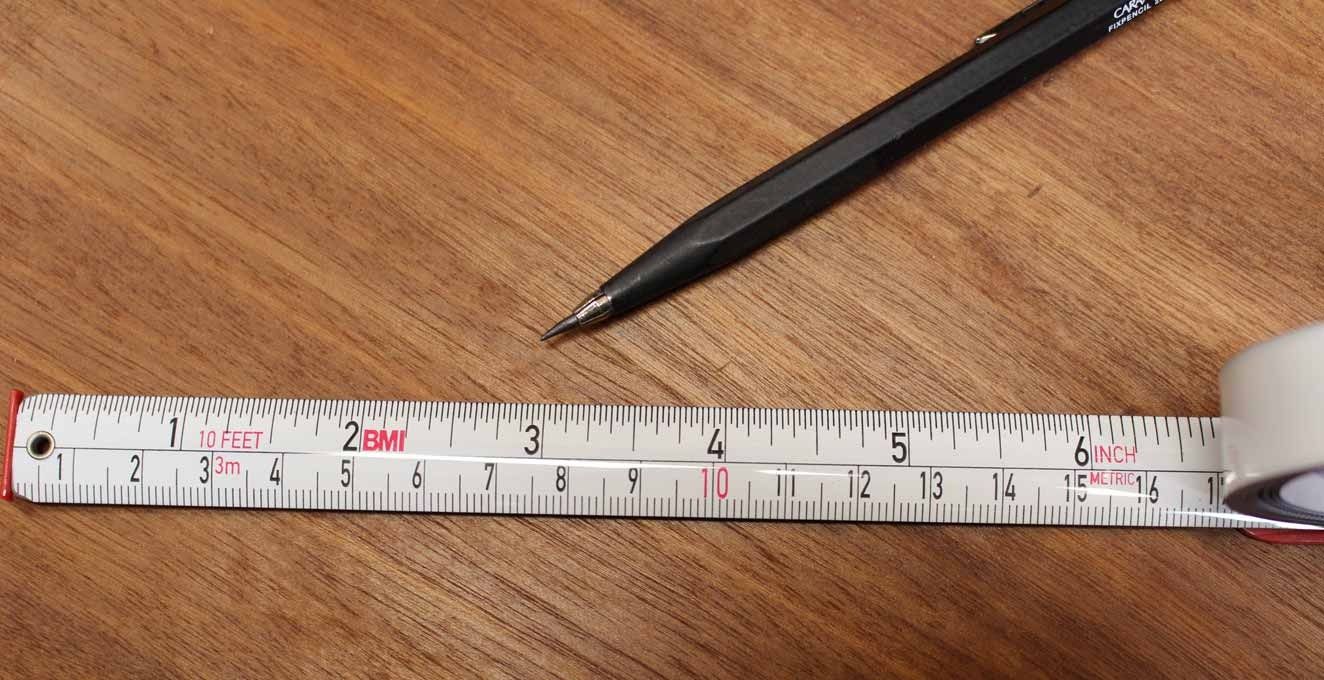
The red one is a BMImeter. The green one is made by Festool. Both are 3m in length and German-made. Both are Metric-Imperial, which I switch between.


The Festool is a nice compact tape that will fit in a pocket easily. It is dead on accurate.


The BMI is interesting. I've just received this and it is taking a little time to get used to - mainly because pressing the plunger (inside the body) causes the tape to shoot out (not retract). The main area of interest is that it can double as a ruler. All tapes curl up at the sides, making it difficult to mark accurately. The BMI curls down, which places the edges flat on the work surface. The tape is stiff enough to run a pencil line against the edge.

Now here's a tape measure that I doubt others have. It is designed by Carol Boyes in South Africa, and built in pewter. I only know of two - this one and another I gave to Rob Lee (if you want to know what Rob uses to measure the length of planes).


Inside is a Stanley tape measure ...


Regards from Perth

Derek

Re: A few tape measures

#2

Re: A few tape measures

TomD

Neat show and tell, Derek. The BMI is similar to the one LV sells, the one downside of which (now that I see yours) being it does not sit upright on the work. But without having a a lever it does shoot out almost like a bolt of lightning if there are pesky kids around, or it can be locked, or it can be used as a rule, however it is still curled steel so a rule remains better.

I hate dual scale rules, see little benefit to them other than the idea of economy, which is obviously not present in this thread. I have always used whichever hand was more convenient for the task, and about half the time the scale one wants to use will be on the wrong side of a dual tape.

In general I now try to use inches though most of my life has been under the metric system I am tired of using both, and owning double sets of tools for everything, and other ludicrous consequences of metrication. Being so close to the US I have reverted to Imperial, but occasionally have to use the old metric system also. Really neither is all that relevant in a digitized world. As a simple example, even without CNC I use a fret layout tool to lay out frets, one of the more accurate layout tasks I am called upon to do, that isn't just ticked off. I just print the custom tape for the instrument I am making. Numbers and measurements don't come into it. Or for that mater there are fret rules. Post war metrication is the transitional plane, or the caplock firearm of it's time. A seeming improvement that just muddied the waters until the real world revealed itself.

Does anyone make any digital tools for furniture making, I am not thinking of Sketchup type stuff, but a tool that would layout dovetails, you could choose say carpenter, cabinet, or Krenov, etc... enter board thickness and width, and it would make a tape. Or design tools for bio metrics. Other fields even as seemingly low tech as archery have tools like these, and tools for frets, or parametrics for guitar shapes.

Re: A few tape measures

#3

best furniture design metric

Robin Corell

I see too much bad design done from metrics. The best metric for furniture design is the one you already own...your eye. let go of standard size materials, optimizing yield, stock router bits, and just design full scale by eye.

As an example take a piece of writing paper and by eye place a dot on the exact center, don't use any rules, straight edges or other tricks or devices. just put your pencil don by eye and make a dot without thinking too much. now fold the paper in half both ways and unfold it to see how you did. chances are you are very close left to right but about 90% of people place the dot in the top half by more than just a bit.

Neat trick what does that mean? well what it means is that if you want something to look like its in the middle your better off to eyeball it because if you get all obsessive and measurey it will most likely look a bit off. The same idea holds for graduated draw widths, trim sizes, aprons on tables, round overs on edges,etc what looks right not some tick mark on a rule will always make for a more pleasing finished design.

Re: A few tape measures

#4

Re: best furniture design metric

Derek Cohen (in Perth, Australia)

Robin, I agree.

The Carol Boyes is just a bit of fun. It lives on an end table alongside the couch I usually sit on in the livingroom. But it is handy when one needs to measure something and you do not want to walk out to the shop.

All these tapes are complete overkill for the times when I measure in the shop. Generally I just use a big old Starrett tape for roughing out. I was curious about these and felt a little extragent at the time.

Most measurements are gauged by "feel". There is an intuitive sense when it is right. I may measure it later (with a steel rule) to record the dimension. Thereafter, marking gauges are used for transfer dimensions. The very last tool in the shop that I would rely on is a tape measure.

Regards from Perth

Derek

Re: A few tape measures

#5

Re: A few tape measures

Derek Cohen (in Perth, Australia)

I hate dual scale rules, see little benefit to them other than the idea of economy, which is obviously not present in this thread. I have always used whichever hand was more convenient for the task, and about half the time the scale one wants to use will be on the wrong side of a dual tape.

Hi Tom

I have grown up with both systems and am comfortable measuring in either. Often I just choose the one that is convenient, that is, has a whole number closest to the size I am looking for. As a result, my plans contain a mix of both scales :) For myself, it is handy to have a dual tape.

Why not discard one system? Metric is just so much easier for small measurements. On the other hand, many of my hand tools are Imperial, such where slaving is involved. Board thickness is often dictated in Metric by the digital gauge on my Hammer thickness-planer.

Regards from Perth

Derek

Re: A few tape measures

#6

Agree with Tom

Bill Tindall, E.Tn.

Derek, I think you missed the point of the contrary opinion on dual rules. I find the same limitation(annoyance) as Tom finds. I have been rid of all mine for this reason. My tapes are close at hand so that I can fetch which ever is needed.

I have both English and metric rules at hand to be used when each makes the most sense to use.

Re: A few tape measures

#7

Doesn't work in my shop

Bill Tindall, E.Tn.

Anybody eyeballing dimensions is building different furniture than what I am building. Measuring is an integral part of my building. For example, if I am building two side by side top drawers in a chest of drawers I want them identical so that making the parts and fitting the parts is straightforward. I am not about to eyeball the middle of the opening. (I will probably measure it in metric to enable easy halving.) I could get by with less measuring by employing sticks and geometry but I find a ruler handier and use the ruler when I find it handier.

One can argue that "transfers" of dimensions are best done with sticks or the part itself, but my tiny Starret ruler is often easier to carry around.

I scale draw projects before building to get the proportions "right", again employing rulers.

I have numerous measuring devices and they remain close at hand. Beginning at one extreme I have a digital caliper (and a set of number drills to compliment it), for when I need to know something's size to great accuracy.

I keep a 4" square in my pocket or on the bench to be mostly used for measuring, and occasionally squaring.

Most measuring of parts is done with a 12' x 1/2" Starrett tape measure. It is a handy size to keep in a pocket or in the hand.

Also often used is a 12 " ruler with a hook on its end. Less used but close at hand is a "yard stick", one in meters and the other English.

A large 20' x 3/4" tape is used for layout on rough lumber. I like its stiffness when extended. In fact I have several of these inexpensive tapes scattered around the work area and lumber storage area to be at hand when needed.

There is no denying I could get along with less measuring devices but I have them because I find them useful.

Re: A few tape measures

#8

Re: Agree with Tom

Derek Cohen (in Perth, Australia)

Did I miss something, Bill? I was simply responding to Tom's viewpoint with my viewpoint. I accept that others, such as you and Tom, do not share my preference for dual scale tapes (and rules - I could add those as well).

I can add another observation, following your comment about a wide tape measure's stability - with which I agree ... my mainstay for many years has been a 8m/25' Starrett, which is 3/4" wide.

I decided that the wide tapes are invaluable if you are measuring up a room or long boards. However, to obtain such stiffness, they need to have a wide cross section and a deep camber. This is not ideal when measuring shorter boards, such as during the course of a build. Shorter tapes (such as 3m) have a narrow cross section, and are floppy. However, they appear to be easier to read measurements without errors of parallax. That was my motivation to get a shorter, flatter tape. It does not replace the longer, wider Starrett. They just do different duties.

Regards from Perth

Derek

Re: A few tape measures

#9

Re: Agree with Tom

Bill Tindall, E.Tn.

It seemed to me that you responded with a defense of dual measurement systems-English, Metric. Personally I use what ever system best meets the need so we have no disagreement there.

Tom's, and my, response is that we don't like dual ruled tapes because the "wrong" scale is on the side we need to use too often.

And I have another dislike, rules ruled in a uselessly(for woodworking) fine scale, like 1/64, or even 1/32. Just like the English/Metric side of the dual tape is often on the "wrong" side, the uselessly fine scale seems to be often (could it be 50%) be on the side of the rule I need to use.

Re: A few tape measures

#10

Same here...

John in NM

I don't find dual scale rules to be such a big deal - have a bunch of them on combo squares and machinist's rules. Never had one on a tape measure that I can recall, but I can't see hating that either. Maybe I have to try one to get it. The only tapes that kind of annoy me are the ones with the fractions labeled - that shouldn't even bother me but for some reason I hate to see people substitute a crutch for practice.

I prefer small tapes in the shop - I usually buy 12' if I can find them rather than those 32', 1 1/4" wide monstrosities that the seem to be the bulk of the stock at HD. Lately I've been buying these at Lowes:


I've yet to see a tape that doesn't wear out, so I stick to the $5 ones and treat myself to a new one often. Even if the hook is made to read correctly both ways, they tend to gain a bit in tension over time, and even if they prevent that with larger rivets, the markings wear off with use.

EDIT:

I still don't get the whole metric/SAE thing.

Sure, metric is easy for arithmetic. Fraction inches are easy to figure in one's head since its all based on division by 2 rather than 10. Depends on if you have a math brain or a visual brain I guess.

Re: A few tape measures

#11

Re: Agree with Tom

Curt Putnam

I call those long 25 - 30' x 3/4" tapes contractor tapes - I have multiples. For in the shop, my two favorites are both Fastcaps (IIRC): one lies absolutely flat (no camber) and the other is a reads left & right so I can get a reliable number no matter which side I hook it. That all being said, I'm still trying to teach myself to gauge everything that can be.

Re: A few tape measures

#12

Re: A few tape measures

William Duffield

The only thing I find metric at all useful for in my shop is measuring the length, width and thickness of Festool Dominos. For that purpose, either a dual scale 6" steel rule or a digital multi-scale dial caliper serves the purpose well enough. The more practice I get with that conversion, the less I need that crutch. Most of the time, the Dominoes themselves function as their own measuring devises.

The only function for which I find decimal fractions of inches of much use is if I need to measure a thickness with a (vernier) micrometer.

If somebody provides me with metric measurements (e.g., on a plan) I convert all of them to fractions of inches using a calculator before I ever pick up a measuring stick. I made an amusing observation several years ago when I built a reproduction of a bowsaw from BugBear's plans.

http://tooltrip.com/tooltrip9/woodworking/bowsaw1.pdf

These provided all the measurements in millimeters that he had taken from an old saw, so the first thing I needed to do was to convert them to inches. All the seemingly random metric measurements were a lot more rational once they had been reverse engineered back to the original imperial system. The graduations on the rule of the woodworker who made it were incontrovertible.

Decimal is a cruel joke, the result of a random mutation about 375 million years ago in the genome of a fish that wanted to be an amphibian. If we'd developed one more or one less finger on each hand, a lot fewer people would develop an aversion to math.

Re: A few tape measures

#13

Yes

Derek Cohen (in Perth, Australia)

And I have another dislike, rules ruled in a uselessly(for woodworking) fine scale, like 1/64, or even 1/32.

Yep, those itsy-bitsy lines look like a blur to me. Absolutely useless when bunched like that ... and always at the start of the rule, just where one might want to read a short measurement. That is where metric rules - typically nothing smaller than a mm.

1/16" is about as small as I need in Imperial.

Regards from Perth

Derek

Re: A few tape measures

#14

even IF you can see them.....A LV opportunity

Bill Tindall, E.Tn.

......just how many 64th is that near by 3/4? Let's see, the big mark is 3/4 and it three marks past that. What is 3/4 in 64th....let me calculate, then add 3 and try to remember the result. Useless!(this all presumes one can sill see 1/64 marks)

Whitechappel sells rules ruled in 1/12". I have a tape. It has its merits for woodworking.

I would use my 12" hook rule much more if it was ruled on all sides in 1/16. Why can't we buy squares ruled all around in 1/16" too?

Re: A few tape measures

#15

Disagree

Bill Tindall, E.Tn.

I find it much easier to divide space in metric units, what is 1/3 of some length, for example.

I always measure diagonals when squaring with a metric tape. Easier to remember the number and the mm is just the right precision for this operation.

I use metric often enough to own a good tape and a meter stick.

Re: A few tape measures

#16

Re: even IF you can see them.....A LV opportunity

Brian Holcombe

I dont mind it on sliding rules to have 1/32" (1/64 is useless to me in woodworking).

I have a sashigane which is metric on one side and imperial on the other and it drives me nuts.

Re: A few tape measures

#17

That's what I was saying...

John in NM

I have a visual brain, I remember pictures rather than words or numbers. I find doing arithmetic in my head vastly easier with fractions, because they make perfect sense visually.

Metric and decimal inches have their uses, but ease of quick calculation is not one of them for me (obviously, other people are wired differently). If its a decimal, I have to write it down to be sure I get the arithmetic right - too easy to drop a significant figure otherwise.

Having worked some with machine tools, metric and decimal inch really seem one in the same to me. You can do the work with either kind of machine so long as everything gets converted on the plans first. I'd never use either in woodworking though - 44 1/4" is vastly easier for me to remember than 1123.95 mm (too many significant figures you see). I'm better with decimal inches, but usually only if I round it to a multiple of a 16th :D

Re: A few tape measures

#18

The mixture is the problem

Bill Tindall, E.Tn.

One would not build something with a dimension of 1123.95 mm if working largely in metric. It would be designed 1100 or 1120.

Turning your argument around.....

When I build a chest of drawers I set an outside dimension at something integral- 32" for example. And say I design the top drawer opening to be divided equally. The available space then becomes 32" minus (the side thicknesses plus the divider thickness. This number invariably turns out some fraction not readily divisible by 2, 29 13/16 for example. Whatever it is in mm is easily divisible by 2 to yield a decimal fraction and this decimal fraction can be readily estimated in mm close enough. A division by 3 is even more compelling in metric.

Similar divisions are encountered in hardware positioning. And similarly, these divisions are easier in metric.

These examples, division, are about the only cases I often use metric. I would never convert a plan from one system to the other for the reason you illustrated. And I can't recall an occasion where I mixed units in a build.

One can make a case that adding is easier in metric too, but I don't encounter this case often enough that I can think of an example where I employed metric for the task.

Re: A few tape measures

#19

Combination squares for woodworkers & other stuff

Bill Houghton, Sebastopol, CA

"Why can't we buy squares ruled all around in 1/16" too?"

A lot of the Stanley combination squares are ruled in 8ths, 16ths twice, and 32nds - not too far off. But the heads are generally aluminum and plastic, not trustworthy for square.

Millers-Falls made a lovely combination square, the No. 1200, with a cast iron head and that same set of increments. It even has a little notch out of the center of each end, designed to put a pencil point in when using it as a marking (pencil) gauge. They show up on eBay from time to time, which is where I found mine, at reasonable prices.

Now that I'm post-cataract-surgery, I mind the 64ths less; and a quick-reading rule, with the little numbers above milestones in the march of 64ths toward an inch mark, helps a lot. But for carpentry particularly, I wanted the grosser measurements.

As to the little marks at the beginning of a tape measure, I don't trust tapes for anything in the shop but longish rough measurements. For short measurements from an edge, I use a hook rule (these also have the frustration of invariably having the 64ths visible when I go to measure).

Re: A few tape measures

#20

Re: The mixture is the problem

John in NM

Ah, but 29 13/16 is readily divisible by two. 14 1/2 + 13/32 is 14 29/32 - just 1/32 over 7/8 - easy, at least it's easy for me. Perhaps dividing 758 by two is easier for you. I think it comes down to what you're used to, and what the desired tolerance is.

I've not found that rounding to the nearest 32nd causes any problems - you won't notice if the hardware is 1/32" lower than the ideal position by whatever means you've divined it - what matters is that it is all done the same (drawer pulls for example).

The other way to avoid this problem, at least with division by two, is to skip the math entirely. Need to divide 29 13/16 - say to find the center of a table top. Lay your rule or tape on the top with an easily divisible number roughly spanning the top - say 32 inches. Then move the tape so that the the middle of that is roughly centered and the distance from 0 to the edge and 32 to the other edge are equal (slightly less than 1 1/8" in this case). You don't need to know the numbers, just eyeball the tick's past 1" or whatever. Once done, mark at 16" - that will be the center.

All that sounds clunky as hell when written out, but it is quick and easy to do visually. Intuitive center finding with a tape, no math involved.

Re: A few tape measures

#21

I think the moral here is.... *LINK*

John in NM

Don't buy machinist's tools! :D

Most combination squares have standard size rules - so stick the Stanley rule in a Starrett head!

Lee Valley has some nice hook rules with 1/8 & 1/16 on one side and those fussy little ant poop measurements on the other. Hooks on both edges, I just don't see the problem with using those - easy enough to flip it to the side you want.


http://www.leevalley.com/US/wood/page.aspx?cat=1,43513&p=40923

Re: A few tape measures

#22

Important criteria

GolfSteve in Calgary

I'm replacing the wood trim and doors in my house, so am currently measuring a few things that I don't usually measure, particularly inside dimensions, such as the height of a door jamb.

I also dropped my favourite tape on a concrete floor and the spring busted, so I had to buy a new tape.

Criteria:

1. The body dimension should allow for inside measurements (ie. the body should be square and the distance from the outside of the body to the tape should be a round number that is easy to add - i.e. you place the tape in the corner, and read the length off the tape then add the width of the tape measure body.

My old tape was stupid - the body was 2-5/8"! Who can add 2-5/8 to 76-3/16 quickly and without error every time?

My new tape has a body 3" wide. There were a number of tapes with a body size of 2-3/4", which I rejected because it is much easier to add 3 to your measurement.

2. The body should be squarish so that you can do the ID measurement easily. Most tapes were round and did not allow for accurate placement of the corner of the tape against the wall. The Festool that Derek posted looks perfect and much better than what I bought - but mine only cost $15.

3. I like the fractions to be labelled.

4. Even for small work, I like a wide tape that doesn't kink just as you're about to extend the tape far enough.

5. The tape should be fluorescent orange, with pink stripes, flashing LED's, a beeper, a retractable lanyard, and a geolocator tag so that I can find the dang thing 13 seconds after I just put it down.

Re: A few tape measures

#23

Festool top window for inside measurements

GolfSteve in Calgary

Derek, the Festool tape has a top window that supposedly gives you an inside measurement from the end of the tape body.

Do you find that this is accurate? Does it exactly correspond to the same measurement you get using the normal method?

Re: A few tape measures

#24

Re: Festool top window for inside measurements

Derek Cohen (in Perth, Australia)

I have not used this feature yet, but reviews are very positive about the tape's high level of accuracy.

The Festool tape can also be used to draw circles and arcs.

Regards from Perth

Derek

Re: A few tape measures

#25

"...stick the Stanley rule in a Starrett head!"

Bill Houghton, Sebastopol, CA

The rules on machinist's squares are significantly thicker than those on Stanley and other carpenter's squares (apparently, the care that machinists lavish on their layout tools requires the extra thickness, while the thinner rules can handle the rough and tumble of a jobsite just fine).

But I'll have to try that as an experiment, if I can find a Stanley rule.