Strop question
Ron Harper
I have used strops for years. Recently I have seen a couple of articles saying that you should strop with the rough side of the leather, not the smooth side.
What say ye?
Note this is not a sharpening thread starter. 😎
Knowledge You Can Build On — Est. 1998
Strop question
Ron Harper
I have used strops for years. Recently I have seen a couple of articles saying that you should strop with the rough side of the leather, not the smooth side.
What say ye?
Note this is not a sharpening thread starter. 😎
Re: Strop question
david weaver
i doubt it matters with woodworking tools, though it's a lot easier to tell if there is a foreign particle on the smooth side (I always use the smooth side).
On razors, where it counts, it is smooth and nothing else. Suede leathers are used for deburring a razor if needed (like a linen, except they dull the edge a little and a linen doesn't), but smooth leather with no defects is the only thing for razors.
Regardless, you can try both and find out what you like on tools.
(the other benefit to the smooth side of a strop, especially if it's oiled, is that if there is a defect in the edge, it shows up on the strop)
The best strop for plane and chisel blades
Derek Cohen (in Perth, Australia)
Hi Ron
I have used leather strops for many years. The horse butt sold by Joel at TFWW are very good ... good because they are hard and do not "give" much. I would use then with the smooth side up.
Having said this, I no longer use a leather strop. Instead I use a planed hardwood board about the same size as a sharpening stone. This has Veritas green compound rubbed over it.
Technically, I would not call this a strop, but a sharpening wood with a grit of 0.5 micron. But I use it in the same way as I used a leather strop before: to ensure that the wire edge is removed. It, additionally, smooths the edge very significantly. And it does so without any threat of dubbing the edge.
Below are the stones I use: a worn Eze-lap Fine (600 grit) diamond stone or 1000 grit Shapton Pro to start; followed by Medium and Ultra Fine Spyderco ceramic stones, and then the green compound strop.
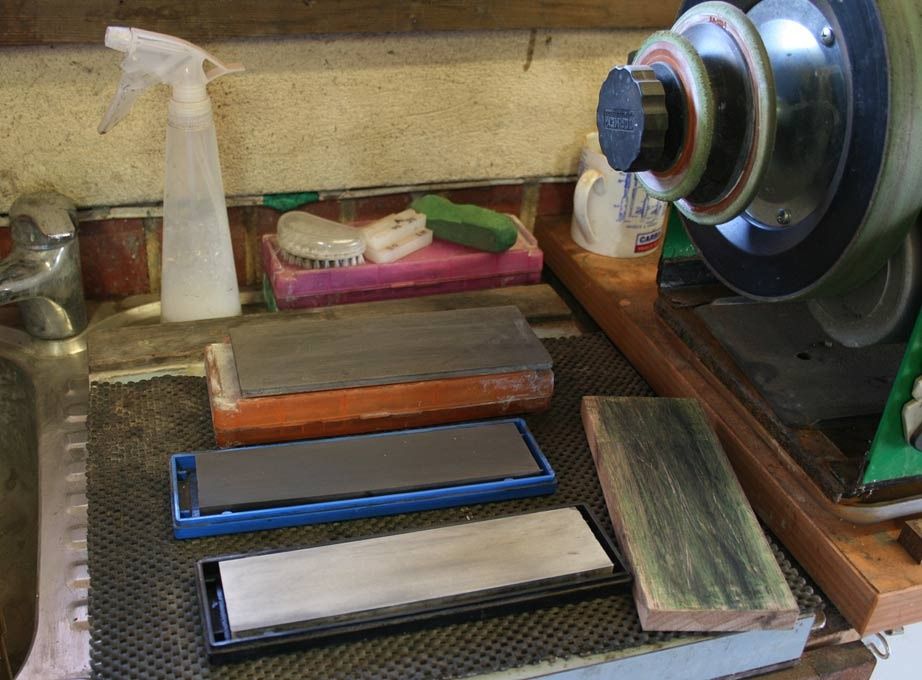
The great thing about this system is that it requires minimal maintenance. The Spyderco are better than oil stones in terms of maintaining flatness, and the strop can get tossed/replaced if worn or damaged.
With the strop, I first run the back of the blade over the compound. This gets rid of any clumps of wax. then I work the bevel. Just a few strokes are enough.
Regards from Perth
Derek
Re: The best strop for plane and chisel blades
TomD
I use the smooth side, if nothing else you will loose a ton of stuff in the nap. And I like to keep the amount I use spare. I have some old 6 oz leather on a mahog board that I have used for decades, it is really hard leather, probably similar to the cordovan referred to. I use diamond and try to sharpen before I need to drop down to any stones. Once it warms up I don't mind the whole simplified waterstone dance, but it is too cold for that nonsense at this point.
Re: Stropping - two different things
david weaver
When people talk about stropping, there are two different things.
1) using a strop as a micro-hone with a tiny abrasive
2) using a strop with no abrasive at all, intending only to remove the wire edge but not refine
#1 is really popular. I don't know how popular #2 is, as it's not as useful with synthetic stones as it is with natural.
if I were using synthetics, I'd use method #1 with a hard surface or hard leather. If using natural stones, I like #2 better, but #2 with a softer leather and oiled so you can tell if the edge is totally clear of defects at the same time you're stropping. (softer as in bovine).
The dictionary isn't of much help in describing stropping beyond wiping a razor on strips of leather.
To me, #1 is more honing than stropping. Not that there's anything wrong with it being honing, but I believe it's honing.
Re: Stropping - two different things
Derek Cohen (in Perth, Australia)
David, I agree. But what use would you put a bare leather strop to? I've had both, and now use a "strop" that adds to the smoothness of the edge. I see only a win here .... in the context of my system. What are the negatives, even with a natural waterstone?
Regards from Perth
Derek
Re: Stropping - two different things
david weaver
I only have anecdotal thoughts about it, but I think the edge durability off of an oilstone with bare leather is a little better than the edge durability off of a hardboard strop with compound where the hardboard strop follows the oilstone.
I don't know why that is.
The longevity between the two is similar for the type of planing I'm usually doing (most shavings are thicker than smoother shavings), though absolute initial sharpness may yield a little bit more longevity if taking only what most thing of as smoother shavings.
There's some truth to the fact that a hardboard strop with compound will make thin smoother shavings easier (less resistance) to take than something like a washita and bare leather, but when the shavings get a little thicker than that, there doesn't seem to be much difference.
So, anyway, I think the bare leather provides a little bit more uniformity when planing, but I don't have anything other than anecdotal preference (it's also easier for me to tell that it's clean).
Re: Stropping - two different things
Warren in Lancaster, PA
Stropping is done on a leather strop. Putting abrasive in wax and rubbing it on wood is more akin to sandpaper sharpening: you have abrasive grit, a binder, and a flat surface.
I use strops for razors, knives, gouges, plane irons and others.
Re: Stropping - two different things
david weaver
Warren, I knew you'd have the same preference that I do.
It's hard to explain the subtleties of what bare leather does to an oilstoned edge, but I really like it a lot, and the few times I've experimented with stepping on the edge a little bit with a honing compound, I didn't like it as much.
The submicron compounds can provide an edge that is superficially sharper (in a cutting paper type of way), but that is very transient. Same as it is with a razor (those same compounds are popular with straight razor users, but in my opinion, the edge suffers a change in quality that's not nice).
Agree - end grain of Western Red Cedar or similar
Andrew F in Australia
Hi All,
I've used end grain of western red cedar - I use a buffing compound on it as well.
These days, I just use an old newspaper.
What you do need to worry about in my experience is that *if* you've got buffing compound on something soft, it will create a rounded edge where you don't want one.
Re: Stropping - two different things
TomD
No harm in it, but I think we are wandering here. Who has all the same stones, blades, shaving tools and skin here, to find some commonality. With something like my head knife, there is a performance envelope which is the number of cuts you get between stropping, before the knife makes a noise cutting leather. The strop is the bridge between the non-performing and performing modes. It's quantifiable. All I know is I get non-annoying time in the shop, cutting really well, with a dab of compound I haven't renewed in a few years. When a sewing machine needle starts punching, a few drags on the strop and it is as if it came out of the pack. When an Olfa type knife gets dull a few drags has it cutting again, and I mostly don't snap off blades any more. All the walking in the woods with the daisies stuff is legitimate, but is it really getting us anywhere in a thread about which side of the leather to use.
Most of the sharpening I do does not produce a visible wire so I have no use for removing it.
Re: Stropping - two different things
david weaver
I don't think any of it is walking in the woods daisies stuff.
Warren doesn't do this, but I do - that is, sharpen with a single stone and strop with leather.
It's quick. I had to get over the idea that the initial slippery sharpness wasn't going to be there, but something close is.
For shaving, there isn't much of anything going on other than stropping daily and using a linen once a week (for me). I've got a vintage barber hone that I've experimented using once every several months, but that's (barber hone use) beyond the scope of this forum as it involves sharpening something without sharpening all the way to the edge.
When I use compound, I have more work to do on the washita the next time.
Re: The best strop for plane and chisel blades
Bruce Mack
Thanks, Derek, for the suggestion of the hardwood board with chromium oxide. I tried it today and feel I get a better edge than with a leather strop or a substrate of MDF or hardboard. The latter 2 may have an abrasive property that results in a less refined edge.

Re: Strop question
Clint Searl
I have used a traditional horse butt and waxed linen strop since the late '60s, but never on the rough leather side.
Re: Stropping - two different things
Derek Cohen (in Perth, Australia)
Warren, my thoughts are that all leather is processed with chemicals, and that the surface of "bare" leather is not actually so. I did use (still have) a bare horse butt strop. It works better than no strop, but the green compound leaves a sharper, silkier feel.
Regards from Perth
Derek
Re: The best strop for plane and chisel blades
Derek Cohen (in Perth, Australia)
Hi Bruce
I hesitated to comment about the qualities of MDF since we may have different products in our respective countries. What I find herein Perth is that one can get a MDF sheet with a shiny surface.More commonly, however, it is bare MDF, which feels abrasive to my touch. Another reason I do not use it.
Regards from Perth
Derek
Re: Stropping - two different things
Warren in Lancaster, PA
So you are suggesting that the razor strop which I have used since 1969 (my grandfather bought it around 1950) only works because of the "chemicals" from tanning? Do you have knowledge of these chemicals or is this just fantasy?
What is it about "clean strop" that you don't understand?
Re: Stropping - two different things
Derek Cohen (in Perth, Australia)
I wrote:
Warren, my thoughts are that all leather is processed with chemicals, and that the surface of "bare" leather is not actually so. I did use (still have) a bare horse butt strop. It works better than no strop, but the green compound leaves a sharper, silkier feel.
Warren replied: What is it about "clean strop" that you don't understand?
So you are suggesting that the razor strop which I have used since 1969 (my grandfather bought it around 1950) only works because of the "chemicals" from tanning? Do you have knowledge of these chemicals or is this just fantasy?
What I find so perplexing at times, Warren, is your attitude. Either you are compulsively defensive or aggressive - you always appear to reply in a hostile manner to me. Would it not be more congenial to simply write, "Derek, I have some knowledge of chemistry, and the chemicals used are not abrasive". Or, "Derek, my experience suggests otherwise". There really is no need to get on your high horse. My comment was a hypothesis, not a statement of certainty. This is a discussion. Nothing more.
Regards from Perth
Derek
Re: The best strop for plane and chisel blades
david weaver
In the past, edge chasing, I used MDF. There is definitely some break-in time with it to burnish the surface (at least what's sold here).
The same is true of horse butt, unless the surface was burnished in treatment, has a fair amount of silica in it. Not that it's related, but when I first cut my horse butt strop and hung it up, I had to use it for a month before it was suitable for a razor (by that, I mean I stropped my good razor daily on another strop, and stropped a razor I wasn't using on the horse butt. After a month of that, it was about even with a cowhide strop, but has since gotten much better. I've been using it now for about 5 years, and it's got a glassy surface on it - something valuable for razors but for tools, you can't keep the strop clean enough to attain that).
Re: Stropping - two different things
david weaver
I'm not warren, but I gather most people use compound because they're looking for absolute initial sharpness.
No clue what warren is looking for, and i hesitate to even post what i'm about to post.....
.. sometimes uniformity is nice, beyond initial sharpness (except for things like paring).
Bare leather seems to impart an edge that stays the same for a very long time.
Re: Stropping - two different things
AlanWS
I certainly did not read what Derek wrote as saying that abrasion was caused by chemical contaminants.
However, chrome tanning was common at that time. Wikipedia cites a 1928 book as saying chromium sulfate is "the most efficient and effective tanning agent." This is not the toxic chromium +6, by the way. In the leather, this chromium binds to proteins, but it is very plausible that some of it forms the oxide as the pH is raised during tanning. This chromium +3 oxide is the green substance sometimes used in honing and for the abrasive version of stropping.
I'd call it a very reasonable hypothesis, though not proven either way. I suspect leather from 1950 is more likely to have chromium oxide in it than more recent, or much older samples.
Re: Stropping - two different things
david weaver
Most of us are using leather that was vegetable tanned. I don't know about warren's older leather, but the seller of my horse butt leather claimed it was chrome tanned.
There's a pretty easy test to tell if leather is really abrasive (regardless of the condition), and that is to clean it off and use it on something that is clean (and not bringing stone swarf or dirt to the leather).
If it's abrasive, it will get black. If not, it won't. In five years of using my razor strop, it got black when it was brand new (horse butt has a lot of silica), but not since then.
Stropping chemistry
Bill Tindall, E.Tn.
I don't know what the bare leather does. The knife people claim edge straightening and burr removal. (http://www.zknives.com/knives/articles/wssteeling.shtml)
In any case bare leather can't be a very effective abrasive, in the sense of penetrating the metal with a harder than the metal particle and shaving off the metal surface. The tanning chemicals will not form an abrasive either. Any chromium becoming chromium hydroxide is not going to become an abrasive under the mild leather processing conditions. It takes high heat to convert chromium hydroxide into the proper crystalline form of abrasive chromium oxide.
Leather, or anything else, coated with the green stick is most certainly an abrasive in the above sense. The sticks are in fact a mixture of aluminum oxide and chromium oxide. Chromium oxide is not quite as hard as aluminum oxide but never the less it will penetrate and cut steel. I could not find why the mixture is "better" in some way than just aluminum oxide for abrading stuff. If anyone knows I would like to learn.
On leather, the abrasive will conform to the shape the edge, which I suppose could be an advantage in some cases. For a tool with a flat edge (chisel or plane blade) it is unclear to me when abrading on abrasive coated leather is better than abrading with a similarly fine flat stone.
a question of data and conclusions
Bill Tindall, E.Tn.
I am skeptical that leather has silica in concentrations sufficient to become an abrasive. I can't imagine any chemistry to get silica to an animal's hide. Is there any analytical data available on the SiO2 content of leather? (I presume we are not talking about dirt in leather)
Rubbing leather on steel and the leather turning black is not necessarily a sign that iron was removed abrasively, or that a significant amount of metal was removed to effect sharpening. All steel will be coated by a layer of iron oxide. This layer could be readily removed by the leather chemistry (dissolved) and the result would be black leather.
Re: a question of data and conclusions
david weaver
I'm guessing on the silica. Someone once told me that it has some silica in it, but I can't remember who.
When I was breaking in my horse butt strop, it scratched up the bevel of the razor that I used, and damaged the edge some. Once it was broken in, that stopped and now it leaves the metal bright and polished.
I'm not attached to silica being the issue, I'd settle for anything, but I do know that it's abrasive for a short period of time until the surface is burnished.


