New WoodChat!
Home Articles Forums Gallery Marketplace Videos

WoodCentral Forums

Knowledge You Can Build On — Est. 1998

Rare Exotic & Domestic Hardwoods, Milled In-House in Oregon. Browse Unique Stock.

Tips for double or twin tenons?

Posts

Tips for double or twin tenons?

#1

Tips for double or twin tenons?

Bill Tindall, E.Tn.

I have on the schedule three pieces that involve post and panel construction. The 1 1/4" posts will be joined one to the other with a double or twin tenon (side by side 1/4" x 1"tenons). Never lay out such a tenon before and haven't found a layout procedure in any reference I have. I have enough trouble with single tenons getting them fit right and in their proper place. I expect I am looking at double trouble? One of them Festools gizmos would be grand but I'm not paying a grand$ for one.

Re: Tips for double or twin tenons?

#2

Clint Searl

What's the point/purpose of double or twin tenons?


Re: Tips for double or twin tenons?

#4

Clint Searl

Overkill


Re: Tips for double or twin tenons?

#5

Re: Tips for double or twin tenons?

Brian Holcombe

Bill,

I do these by setting up two marking gauges but using the same reference face. That way if one part is slightly different than the other part it will not affect the fit.

Twin tenons are great. :D

Re: Tips for double or twin tenons?

#6

Re: Tips for double or twin tenons?

Bruce, a MN Galoot

I used twin tenons on a fairly large wine cabinet. The frame was 5/4". The tenons were 1/4" thick with 1/4" between them and a 1/4" shoulder on the outsides. It's very rigid.

Re: Tips for double or twin tenons?

#7

Re: Tips for double or twin tenons?

David Charlesworth

Through and wedged, they can be a very attractive and strong detail.

Much used by Alan Peters in his work.

David

Re: Tips for double or twin tenons?

#8

I worried that would be the answer

Bill Tindall, E.Tn.

"I do these by setting up two marking gauges"

I think I may be able to borrow a second gauge. I could mark the first mortise with a single gauge then move it. But I know I would need to remake something and then need to replicate the single gauge setting.

Re: Tips for double or twin tenons?

#9

Re: I worried that would be the answer

Brian Holcombe

If you mark all of them, sure.

Re: Tips for double or twin tenons?

#10

Re: Tips for double or twin tenons?

Hank Knight

Bill,

I am building a chest of deawers with post and panel construction and double mortise and tenons joining the posts. Like you, I had never done this before and I was a little intimidated and worried about getting the fit correct. I used the method Brian suggested above: two gauges and always reference from the same face. It worked great. A little work with a float or a coarse file on the tenons and they slid together with light coaxing. I cut the mortises with a mortising machine and the tenons on my tablesaw. For the tenons, I cut he shoulders first and then wasted out the interior and sides with a 1/4" dado blade using a tenoning jig. I set the dado just shy of the shoulders and pared to the shoulder lines with a chisel. It's a little more tricky than single mortise and tenons, but not much. I was pleasantly surprised.

Hank

Re: Tips for double or twin tenons?

#11

P.S.

Hank Knight

You might be able to get by with a single gauge, but I wouldn't want to risk it. I left both gauges set through the whole process, until I had everything cut and fitted, just in case.

Re: Tips for double or twin tenons?

#12

One cannot have enough gauges.

Derek Cohen (in Perth, Australia)

Bill, as much as you hate using shop time for anything other than building furniture, either take a few hours off to make a few gauges, or buy a couple of wheel gauges (my preference).

I cannot fathom having only a single gauge! I have 6 that I can call upon, and usually have at least three in use at once. They are left set up and ready to transfer marks from one part to another. I assumed that everyone works like this when using handtools. It is the equivalent to doing a production run with power tools.

Regards from Perth

Derek

Re: Tips for double or twin tenons?

#13

Re: One cannot have enough gauges.

Warren in Lancaster, PA

I have used a single mortising gauge for my entire career, thousands of mortises. I think having just one gauge forces one to work in an orderly and disciplined fashion, which is kind of what serious woodworking is all about. In the case that Bill faces, I would mark all the posts (mortises) and all the rails (tenons) with the first setting, then change the fence and mark everything again. As Brian mentioned, it is important to mark a face side and to gauge everything from that side. Incidentally it is helpful to clamp all the posts together and mark the ends of the mortises with knife and square, all at once, for uniformity. The same goes for the rails.

If I were to have multiple mortising gauges, I would certainly go in the 18th century direction, that is having a fixed pin gauge for each chisel. This would save time and increase precision.

Re: Tips for double or twin tenons?

#14

Just one *LINK*

Clifton C

But...If you can only have one marking gauge...


Dodeca-Gauge

Re: Tips for double or twin tenons?

#15

Re: Just one

Tony

Sad thing is I liked a few of their AFD tools and would have ordered a couple ;)

Re: Tips for double or twin tenons?

#16

Re: One cannot have enough gauges.

Derek Cohen (in Perth, Australia)

I have used a single mortising gauge for my entire career, thousands of mortises. I think having just one gauge forces one to work in an orderly and disciplined fashion, which is kind of what serious woodworking is all about. In the case that Bill faces, I would mark all the posts (mortises) and all the rails (tenons) with the first setting, then change the fence and mark everything again. As Brian mentioned, it is important to mark a face side and to gauge everything from that side. Incidentally it is helpful to clamp all the posts together and mark the ends of the mortises with knife and square, all at once, for uniformity. The same goes for the rails.

If I were to have multiple mortising gauges, I would certainly go in the 18th century direction, that is having a fixed pin gauge for each chisel. This would save time and increase precision.

Warren, Brian did not refer to using a mortice gauge. He referred to using two marking gauges. When Bill stated that he had but one marking gauge, I responded that I have several since they are used to transfer marks, and are left set up for each transfer (some times one wants to return and check a mark).

I agree that the ideal mortice gauge is one set up for a specific chisel. One of my favourite mortice gauges (good for marking single lines as well) is the Kinshiro (on the right, alongside a single blade version I built by modifying a cheapie) ..
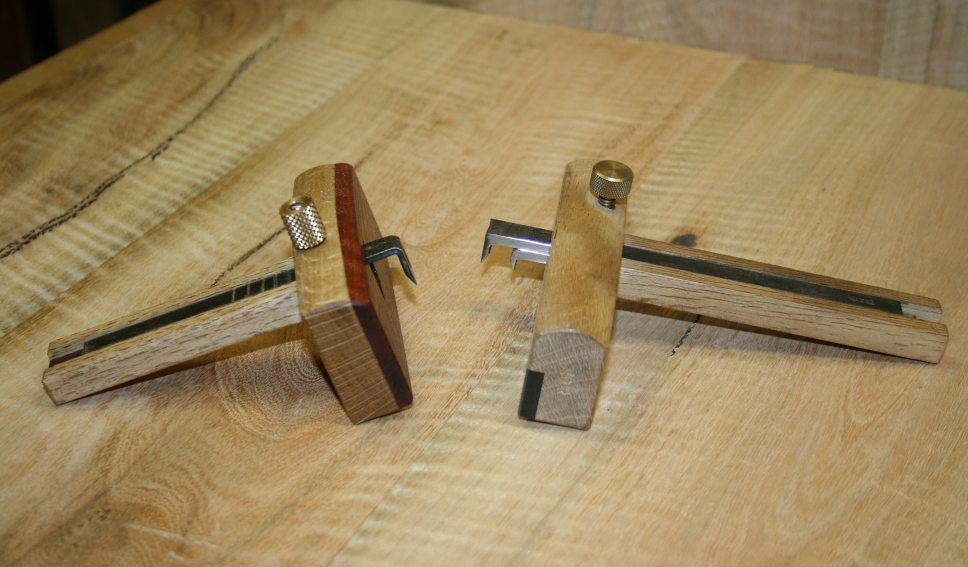

But the downside of this is that the setting may only be used for the same reference distance. In other words, one cannot mark tenon cheeks for an inset mortice, such a stretcher fitting an inset mortice on a table leg. Only a mortice gauge capable of a fixed blade setting can do that.

Still, we really should be discussing marking gauges. And there is a benefit is having more than one. I would be surprised if you use but one. I would imagine that most on this forum have a few (see Hank's comment, below). For combination with- and cross grain marking, there is much to be said for cutting gauges (wheel or knife).

Regards from Perth

Derek

Re: Tips for double or twin tenons?

#17

sticks

Mark Hennebury

Dress a stick with steps the height of each line of your tenons.

In your case it would be the easiest to dress a single stick 1" wide x 20" long 1/4" thick then cut it to lengths of 2" 4" 6" 8"

stack & Glue then as in the sketch and use the steps to lay out your lines using a marking knife with the flat edge on each step.

Lay both the leg and the marking stick on a flat surface like your table saw to mark them. and as several have mentioned, mark reference faces and edges so that everything is referenced from the same face as should be standard procedure.

Extremely accurate, fast and repeatable and savable reference for the next time you build a similar one.


Re: Tips for double or twin tenons?

#18

Return on Investment

Bob Lang

I'm a machine guy when it comes to stock preparation, because using material with all surfaces flat and square makes everything that follows more predictable. But even if you only have one reference edge and face, if you can consistently lay things out, set your gauge to what exists and mark one part from the other you can do just about anything.

What I would recommend is analyzing the benefits from doubling the tenons versus the time it will take. You mentioned more glue surface. The double tenon may be theoretically stronger, but a single 1/2" thick tenon should be strong enough. If you're concerned about glue failure, pin the assembly with a dowel. I'd go with a single tenon, unless I wanted to see what making a double tenon was like.

Bob Lang

Re: Tips for double or twin tenons?

#19

Re: One cannot have enough gauges.

Brian Holcombe

I made mention of using the same reference face, that applies to using one gauge or multiple gauges.

You could mark all of your parts, then reset your gauge.

Re: Tips for double or twin tenons?

#21

Re: One cannot have enough gauges.

Brian Holcombe

Indeed, and I thought it worthwhile to point out that practice to those reading who may not be aware.

Re: Tips for double or twin tenons?

#22

engineering question

Bill Tindall, E.Tn.

I expect that you join a lot of posts making Arts and Crafts Furniture (if that is what it is called, I like looking at it but not making or owning it). So I trust your experience on assembling posts. However, in my case I will not have a multitude of posts as is the case in some A&C pieces. Case will be simple 4 sided frames. see pic of REV 1 drawing , sizes of elements to be modified in REV 2.

The posts I will be using for the post and panels will be small- 1 1/8 for the bedside units and 1 1/4 in the case of the china cabinet. Joining a vertical post to two right angle horizontal posts so as to make the frame of a case side (for example) will necessitate short tenons that are also not very tall. I have not done the engineering in detail but a guess would be a single tenon 5/8" deep x 1" tall at most. That size doesn't seem enough to hold a case together. Hence, the expected need to use double tenons. What are your thoughts?

Re: Tips for double or twin tenons?

#23

Re: Just one

Hank Knight

Ha! That would be the one! :D

Re: Tips for double or twin tenons?

#24

Re: engineering question

Brian Holcombe

Bill, are you building this with a base frame? I'm wondering about the base, why the legs are larger at that point.

Re: Tips for double or twin tenons?

#25

Re: engineering question

Hank Knight

Bill,

To address your concern about short tenons, I used tenons of unequal length. I made the outboard tenon longer and mitered the short inboard one to mate with its 90 degree counterpart. This gave me the greatest tenon length I could squeeze out of the limited space. My frame members are 1 3/4", a little larger than yours, but I think the concept would work for you. Here are photos of my practice pieces:

[URL=http://s50.photobucket.com/user/hankknight/media/Maple%20Chest%20of%20Drawers/image_zpsfon4neqh.jpeg.html][/URL]

[URL=http://s50.photobucket.com/user/hankknight/media/Maple%20Chest%20of%20Drawers/image_zpshznu7xnm.jpeg.html][/URL]

Hank