New WoodChat!
Home Articles Forums Gallery Marketplace Videos

WoodCentral Forums

Knowledge You Can Build On — Est. 1998

Have a question? Ask Woody!

Another dovetailing aid.

Posts

Another dovetailing aid.

#1

Another dovetailing aid.

Derek Cohen (in Perth, Australia)

Bill recently posted an aid to dovetails when sawing. Here is one to aid in transferring tails to pins. No, not blue tape ... I've done that one already! :)

This is such a simple aid that I hesitated posting it before. It should take a few minutes to make, at most. What it is intended for is to ensure that drawer sides (box sides too, I guess) are aligned for square. We take this for granted, but mainly we hope and pray that our marks are true.

Beginning with a tail board ...
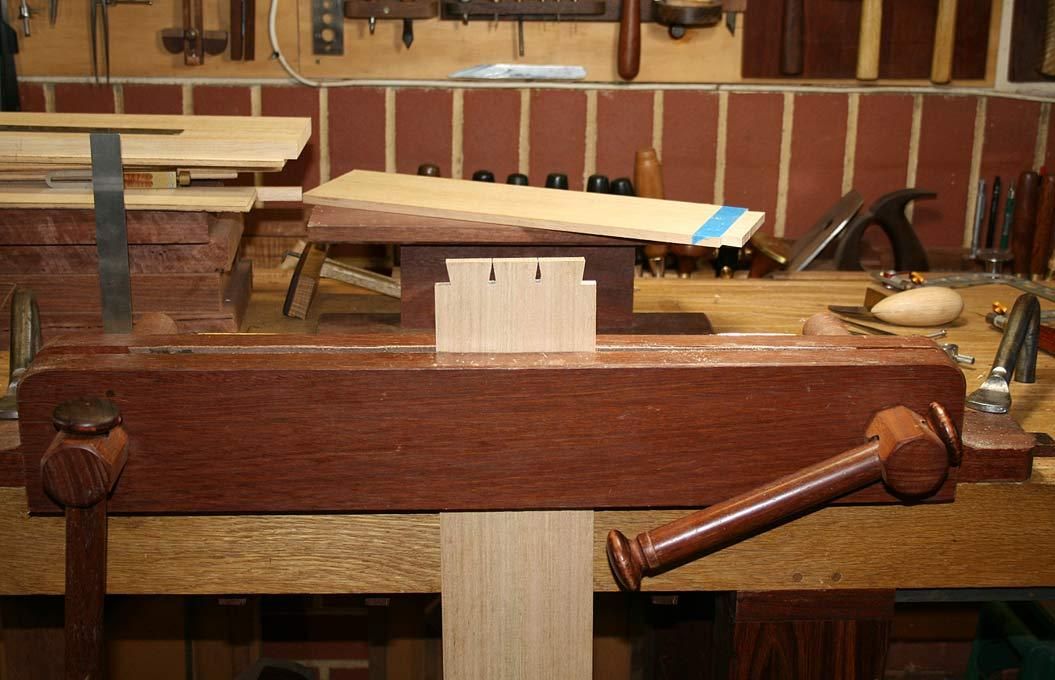

It came time to transfer the tails to the pin board ...
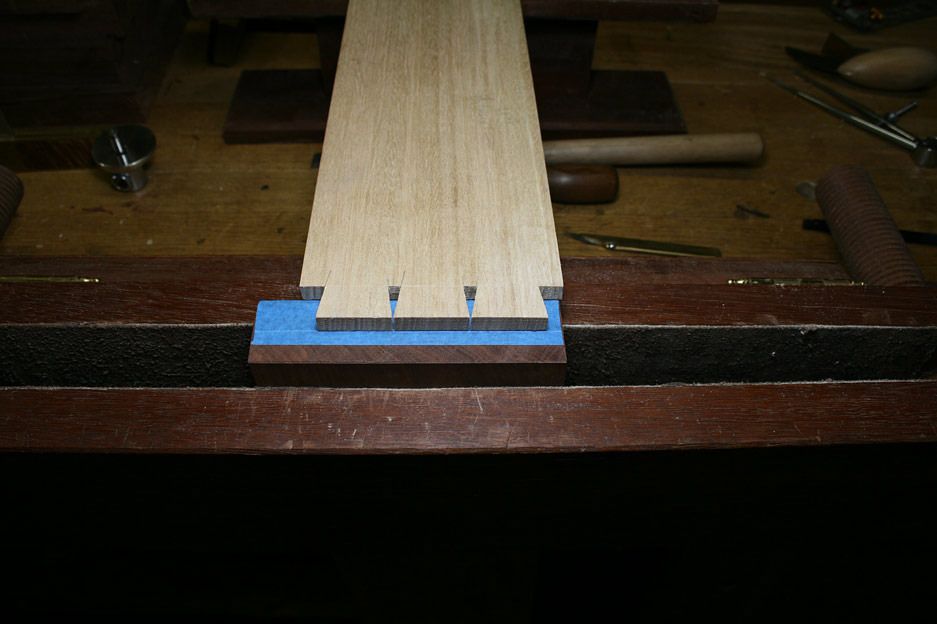

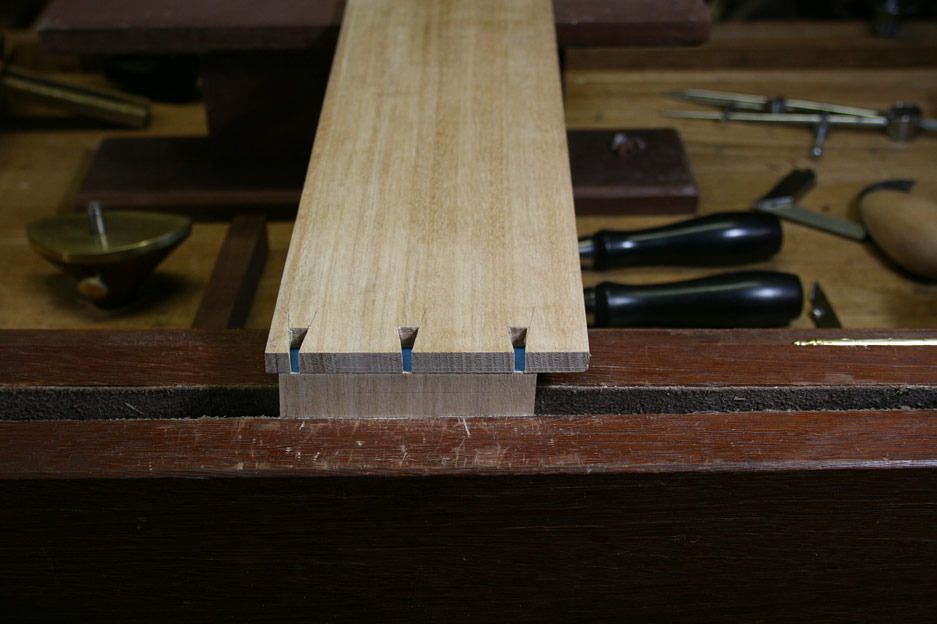
What you see here is a bow drawer front which will have half-blind sockets (the area in blue). The remainder will be sawn away (into a bow front) once the dovetails have been completed. This is done later, rather than earlier, so as to retain a reference side.

As mentioned earlier, the issue here is to ensure that the drawer sides are square with the drawer front before transferring dovetails.

All one needs is a simple rectangle that is about 3/4" - 1" high. It must be square on the inside.
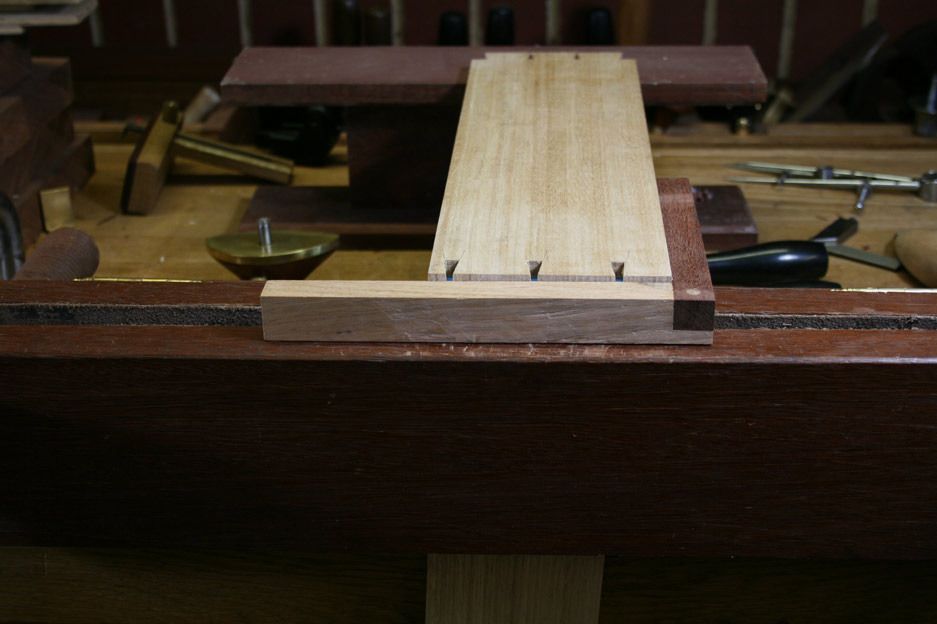

(I was asked why the square was not dovetailed. Well it was ... and then I decided to trim it down ... and cut off the wrong side! Kept it as a reminder to check next time!) :\

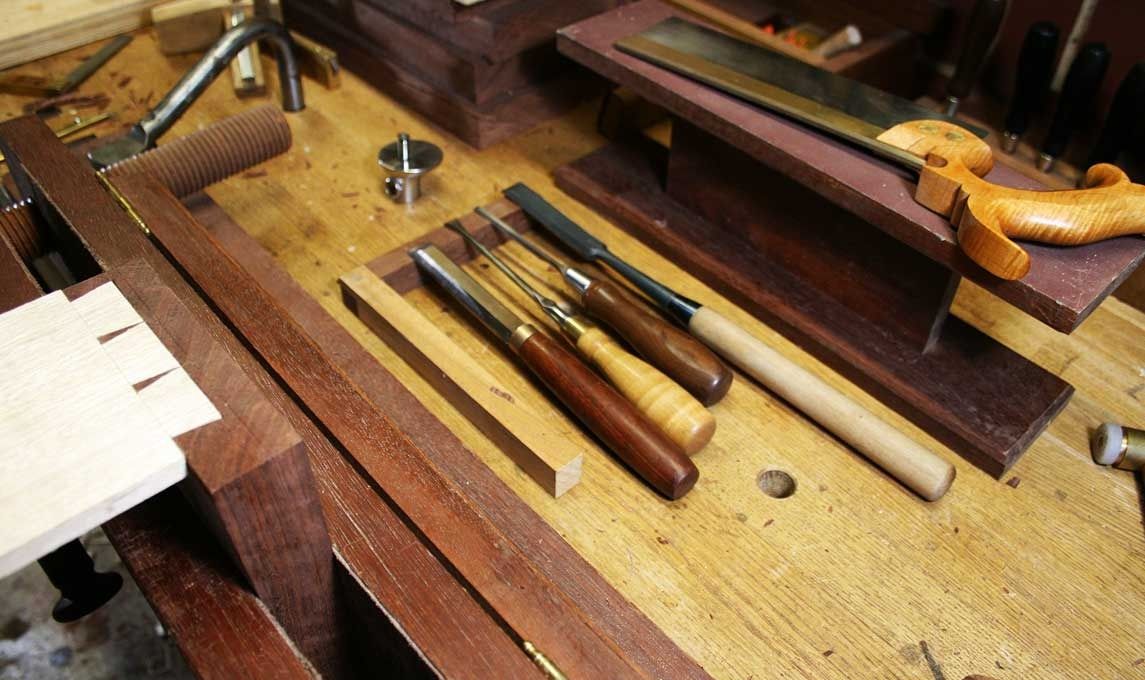
Once done, use the square as a rest for your chisels ...

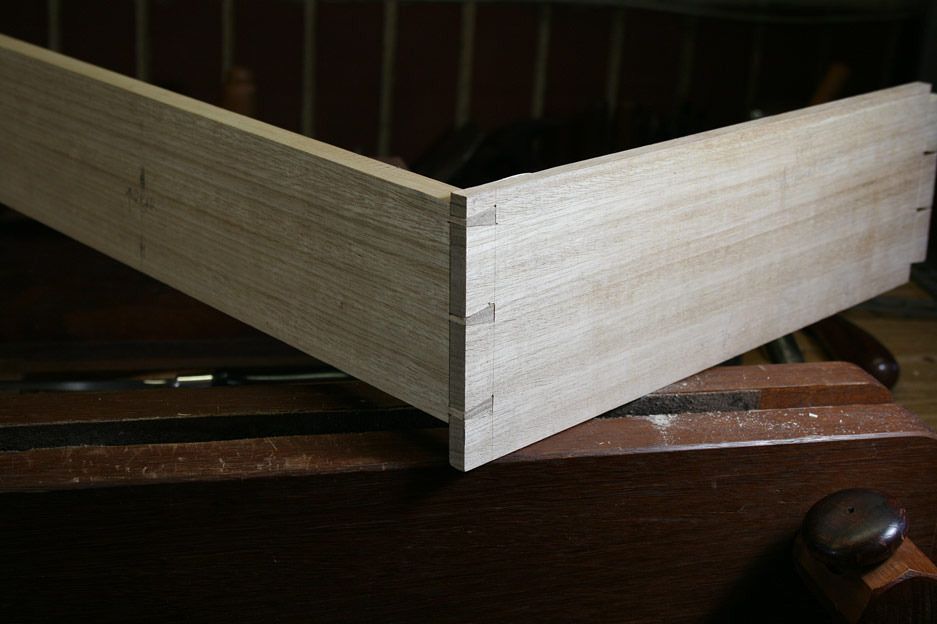
Just for good measure, here is a through dovetail I did as well. This enables the back to be aligned as well as the sides be squared ...

As you can see, these parts are a little more of a challenge to align ..


Rear of drawers ..

Regards from Perth

Derek

Re: Another dovetailing aid.

#2

And yet another

Bill Tindall, E.Tn.


At least in my case you are so right that getting the drawer sides, front and back in the same plane is a challenge, especially for a drawer that isn't very tall. It comes down to accurate marking. Holding the parts secure while marking also has been a struggle for me. The aid shown in the picture solves both problems for me.

I am going to make a claim that the aid shown above is easier to use.

Re: Another dovetailing aid.

#3

Re: And yet another

Derek Cohen (in Perth, Australia)

.... and yet you will still require a second tool (board/guide/rule) to level the ends.

Can you do irregular sides on it? Can you rest chisels on it! :)

All written as a tease - David Barron did come up with a good jig in that alignment board.

Regards from Perth

Re: Another dovetailing aid.

#4

Easier to use, tougher to store.

Chuck Nickerson

Some days I think a couple other woodworkers are also storing stuff in my garage shop.

Re: Another dovetailing aid.

#5

Re: Easier to use, tougher to store.

TomD

That is why I use fingertips to align things no problems.

Derek, do you have a room of furniture that is completed, with a whole Derek made theme to it? I would love to see photos. (Shop doesn't count)

Re: Another dovetailing aid.

#6

Re: Easier to use, tougher to store.

Derek Cohen (in Perth, Australia)

Hi Tom

I have several rooms like that. Most, if not all the rooms in the house, have a significant amount of work that has come out of the workshop. I'll post pictures if others do the same. :)

On a related topic, while we would expect that there will be many individual differences in furniture style - simply because individual tastes will differ - but I also wonder if there are National differences. I recall a conversation with a furniture maker in the UK, who mentioned that "European" and "American" tastes differed. Do you believe this to be so? And, if so, how?

Regards from Perth

Derek

Re: Another dovetailing aid.

#7

Re: Easier to use, tougher to store.

TomD

The tastes thing would be a pretty vast topic. I would imagine that Milanese and Bavarian tastes would vary. Scandi vs UK also. America is a little different because it welcomes everything to some extent, while having indigenous semi-styles like Shaker, or Lazy Boy. You would need a very sophisticated algorithm to sort it all out.

Re: Another dovetailing aid.

#8

Re: Easier to use, tougher to store.

Sgian Dubh

"I recall a conversation with a furniture maker in the UK, who mentioned that "European" and "American" tastes differed.

My observations, having lived in both the USA and the UK (UK based now again of course) is there are differences. I was particularly struck, on first living in the USA twenty odd years ago, how different 'typical' old or antique American furniture was to British styles.

Wood choices for old furniture were obvious differences, and still are to a significant extent - red oak, white oak, cherry in the US, whereas the UK used European oak (white) walnut, elm, ash, etc. Similarities covered tropical hardwoods such as mahogany, rosewood, etc. Construction and style are different - drawer construction tends to thicker sides in the USA, and thinner sides with slips in the UK. I think there are also greater regional variations in the US, not surprising really given the size of the country compared to the UK, and the number of immigrants, mostly from Europe 200 or 300 years ago, bringing with them there own tastes - the Hill Country of Texas for example, is strongly Germanic in style: architecture, furniture, art, etc, and this lives on.

This is a topic that could generate a large thesis, and I realise this short post paints a very poor picture of comparison. But, looking briefly at contemporary differences, I think they still exist at the one-off craft level, but much less so in the mass produced furniture market. IKEA sells stuff all over the place, for example, and their product line is much the same or similar the world over. At the one-off craft level, I think the Americans tend to be a bit more 'out there' and making it up as they go along, whereas the British tend to hark back a bit more to 'craft', tradition, and hand skills. Again, a very broad brush opinion on my part, and a far from accurate summation of the true situation, missing, as it does, a deeper analysis of a wide ranging examination of the influences, necessities, and drivers that cause furniture designers and makers to produce what the do! Slainte.

Re: Another dovetailing aid.

#9

Studio Furniture in the US

Bill Tindall, E.Tn.

A lot of it seems to me to be art projects with furniture/wood as the medium rather than clay, stone, etc. Function followed form.

Re: Another dovetailing aid.

#10

Re: Easier to use, tougher to store.

david weaver

There is definitely a craft show vibe in some places here that is pretty low end and the stuff at those tends to offend folks who are more educated on design, etc - folk arty stuff.

My mother has been selling such stuff for 35 years now, and continues in her retirement. Those are the shows that have fairly low rent and lower priced things. AS you get to the urban areas, the shows and the turnings and such are more like what you're probably used to seeing over there, but the booths cost several times as much and the item prices are things I can't comprehend (small turnings for $2500, etc - "looking for the right buyer")

Studio furniture is confined to wealthy areas here, at least permanent displays of it, and it does seem (as bill says) to go through a relative amount of tastelessness. There was a display of stuff (I won't say what town on the off chance that someone would know who made it) in a wealthy rural area near here that was 100% curly maple and purpleheart. Artsy, but not precisely made - and I don't think the maker lasted more than a couple of years.

There are a few industrial designers and other such folks making furniture and cabinets and tables for clients, but I don't know any of them (except I sold my cabinet tablesaw to one guy making a go of it) and they don't have a shop in the traditional sense.

Re: Another dovetailing aid.

#11

Re: And yet another

Michael Brady

I transitioned away from mainstream woodworking partially because of the relative simplicity of hand tools. I like the emphasis on skills rather the complication of devices, particularly single purpose devices. In following this thread, I see several ideas that involve making devices rather than utilizing basic skills and tools.

When marking out dovetails, I use what is at hand as much as possible; in this case, a square, and hold-fast, and my front vise. Not needed are a purpose built device for squaring, tape (although the tape method is not a bad idea), a moxon vise, or a sawing guide. All I have to do is check for square and tighten the hold-fast. I now have both hands free to mark the tails onto the pin board.[URL=http://s234.photobucket.com/user/finefettle/media/IMG_0440_zps4x6bj0by.jpg.html][/URL][URL=http://s234.photobucket.com/user/finefettle/media/IMG_0441_zpsiwutrja4.jpg.html][/URL]

I have woodworking friends that are proficient with hand tools but can't cut a dovetail because their brains are still calibrated in 1/1000's from the power tool days. They also are fascinated by jiggery. I tell them to make dovetails like the practice ones shown above, every week, until they develop the muscle memory. They won't be perfect, like the ones above where a missed my line by a pencil mark width. But they learn from every try.

Re: Another dovetailing aid.

#12

Re: Studio Furniture in the US

TomD

Not sure where you are Bill, but the Furniture Society which tends in the direction of studio stuff is in NC.

I have seen what you all are talking about many times, there is an art college in downtown TO, with a furniture program, and folks come out of that blaze off a piece, often pretty good, then disappear. The flip side though is the best work that there arguably is.

The hint is in the name that I take to mean you have your own studio. That suggests the idea of some kind of following, business, design business. Of course one can talk about a studio, meaning the parent's garage. But if you had a space in NY downtown, and it was a hub of design and production, that wouldn't be nothing. The advanced practitioner is making stuff for the most demanding clients, is doing his own designs, and is producing them to the highest quality. That is a 3 out of 3 where the average guy from the woodworking crafts, or the factories is lucky to be there with 1 out of 3.

I tend to think of Michael Fortune, who does it from most angles from supporting factories, to making videos for amateurs. And he has a signature piece. But a studio like Eames at one time would be the idea.