New WoodChat!
Home Articles Forums Gallery Marketplace Videos

WoodCentral Forums

Knowledge You Can Build On — Est. 1998

Super Resolution Thermal Imaging Camera

Housed dovetails for case construction

Posts

Housed dovetails for case construction

#1

Housed dovetails for case construction

Bill Tindall, E.Tn.

"Housed dovetails" is a name Will Neptune uses for what others may call sliding dovetails. It does seem to be a more accurate descriptive term.

Whatever you call them, they are a preferred means for holding case goods together, for example a chest of drawers. Unlike a mortise and tenon for the drawer divider(blade) the dovetail can't separate over time as the case moves with age.

But they can be intimidating to consider until one is shown a reliable way to execute this joint. When I was in the Headley shop learning case goods construction techniques we were confronted with making this joint. Jeff went about setting up a router to make the dovetail cut in the case side. Steve was available and we asked him how it was done with hand tools. He rummaged in his bench drawer and produced a guide block as shown in the picture. In less time than was taken setting up the router we had the female part of the joint chopped out of the case sides for the single drawer divider. I like quick and reliable and became smitten with this joint and its use in case goods.

As one learns to judge the optimum shaving depth to cut with the chisel it becomes at most a 2 minute task to make the female part of this joint. I have a way of precisely making the male joint in seconds. It is so easy to make these joints that I even use them on the back drawer dividers where mortise and tenon might more conventionally be used.

I am dashing out a bedside night stand with three drawers for my granddaughter. It is a break between some more challenging projects. The details of how to do this joint can vary. I used to saw the perpendicular side, then rough saw the sloped side, add the guide block and pare to fit the dovetail of the divider. I am experimenting with plowing a dado across the case side which establishes the flat side of the dovetail joint and provides a housing for the drawer runner which is simply nailed in later.

It will be noted that I use a half tail with the flat side of the dovetail at the bottom of the drawer opening. . It makes fitting the joint trivial. I position the guide black to ensure any error paring is on the too tight side. If the dovetail is too tight it is a trivial task to just plane a whisker off the flat side of the dovetail.

Re: Housed dovetails for case construction

#2

Re: Housed dovetails for case construction

Brian Holcombe

Thanks for posting this up Bill, I thoroughly enjoy these joints. I found them next to impossible when I used to cut them with a router, and find them fairly easy with hand tools.

Re: Housed dovetails for case construction

#3

Re: Housed dovetails for case construction

Joe in a Cleveland suburb

"I have a way of precisely making the male joint in seconds."

Can you tell us about this?

Thanks.

Joe

(zero woodworking in CLE :( )

Re: Housed dovetails for case construction

#4

Re: Housed dovetails for case construction

Derek Cohen (in Perth, Australia)

Hi Bill and all

There are several techniques that speed up sliding/housed dovetails. I used a few of these in my Lingerie Chest build, which is held together with sliding dovetails (still busily making drawers for this piece).

One method was the same as Will's method you show. This was when creating stopped sliding/housed dovetails at the base of the cabinet ..

Mark and saw ..


Zip out as much of the waste as possible ...


.. clean up the sides and finish off with a chisel and router plane ...


With through sliding dovetails, again saw a housing or dado, and zip the waste ..


... and then plane the sides to shape with a dovetail plane ..


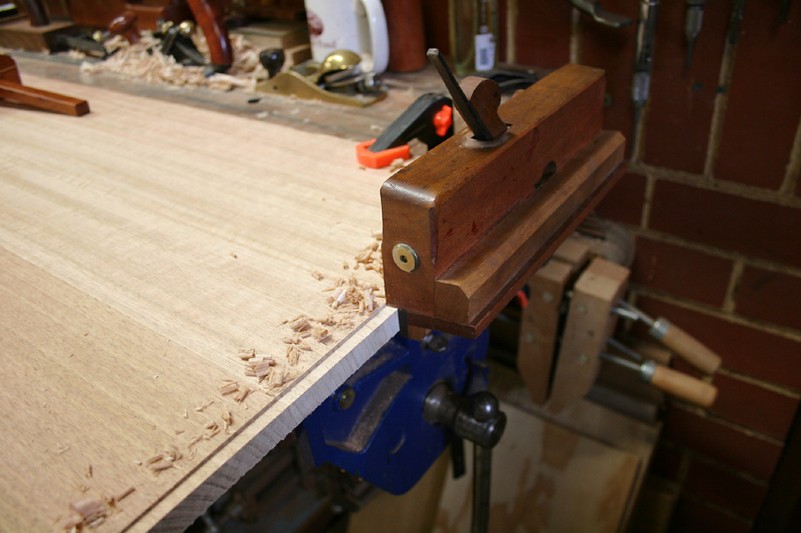
The plane is a modified Stanley #79. Here is is making the male section. Saw the rebate first, then ..


Long sliding dovetails may be quickly made using a dado plane, such as this one by HNT Gordon, in conjunction with a sliding dovetail plane ..


It is much quicker to plane away waste that pare it with a chisel. A few years ago I built this dovetail plane specifically for the housing side ..


Regards from Perth

Derek

Re: Housed dovetails for case construction

#5

hand tool purists, don't look

Bill Tindall, E.Tn.

This jig makes precise dovetails regardless of variance of stock thickness. Hence, they are all the same to 0.001" (about ). If the male parts for a bunch are identical it becomes an easy task to get the female part right for a perfect fit.

Re: Housed dovetails for case construction

#6

Power toolers, don't look

Derek Cohen (in Perth, Australia)

Bill

I bet I could do it faster with this plane I built 10 years ago ..


I recently upgraded it ...


What if you need to dovetail a long board? And when it comes to a tapered sliding dovetail, all I do is plane to the lines I mark. How do you do that with a router? :)

Regards from Perth

Derek

Re: Housed dovetails for case construction

#7

Re: Power toolers, don't look

roger lance

You do that with a router by setting the fence the router rides against to the desired taper angle.

Re: Housed dovetails for case construction

#8

Re: Power toolers, don't look

Derek Cohen (in Perth, Australia)

You do that with a router by setting the fence the router rides against to the desired taper angle.

Yes, Roger, but can Bill do that on his jig? It looks awfully tricky from here. :)

Regards from Perth

Derek

Re: Housed dovetails for case construction

#9

Re: Power toolers, don't look

roger lance

Then, we agree that tapered sliding dovetails can be produced with a power router by setting the fence to the desired taper.

Can Bill do it with this jig? Yes, to make long tapers, he will (possibly) make some alteration to the opening in the jig......but, he's got a clever solution there.

Re: Housed dovetails for case construction

#10

Re: Power toolers, don't look

AlanWS

All he needs to do is to shim a bit between one edge of the stock and the fence of the jig. The shim thickness is the taper amount. The only time it's tricky is when the part is wide and cupped, so you need to clamp to a straightedge to take out the cup while cutting the joint. Then you need to shim behind the straightedge.

There are effective methods for both hand and power approaches.

Re: Housed dovetails for case construction

#11

Joe, next time I will reply by email

Bill Tindall, E.Tn.

In the past few years I have made 5 large and one small chests of drawers, with orders for 3 more large units. That's a lot of housed dovetail drawer dividers. I have no shame for searching for a quick, reliable way to make this joint. It takes less than 10 seconds to mount and cut the male joint and every part will be identical to a tiny fraction of an inch because lumber thickness is not a factor.

With these parts identical it is vastly faster and more reliable making a well fit female part with hand tools, which task I posted on this Hand Tool Forum.

The topic(until it went off the rails) is making drawer dividers(blades). No, my jig will not make a housed dovetail for the bottom of a case, for example. The jig is singly minded to do narrow stock for drawer dividers- quickly and precisely. Precision drove me to this jig, not speed.

Dove tailing the end of a panel is trivial on a router table with a fence, but that is not a topic for this forum. The operation is noisy and chips go everywhere unless the loud multi HP vacuum is sucking most of them up the hose.

I took a class with Will Neptune who demonstrated a remarkably quick and reliable means to a housed dovetail on the end of a shelf, for example. He tapered the female part. I took pictures, but what turned out to be useless notes. I didn't practice the joint when I got home and have now forgotten what he did. I would use it if I knew it, but not for drawer dividers.

Re: Housed dovetails for case construction

#12

I'm sorry Bill...     


Re: Housed dovetails for case construction

#13

Re: Joe, next time I will reply by email

Brian Holcombe

I'm building some sliding dovetail battens today, so I will post up my process today or tomorrow.

Re: Housed dovetails for case construction

#14

Re: Joe, next time I will reply by email

Derek Cohen (in Perth, Australia)

In the past few years I have made 5 large and one small chests of drawers, with orders for 3 more large units. That's a lot of housed dovetail drawer dividers.

Bill that is a large number of sliding dovetails, and if I were building pieces day-in-and-day-out I would also look at a mechanised way to reduced time and labour. That is the professional way, and you do not need to apologise for doing so.

The chest I am building contains 36 sliding dovetails, 4 of which were blind and the remainder through housings (and the latter number were halved by ganging up, so really 20 in all). They were few enough and short enough to do by hand. After all, this is a pleasant diversion for me. I do not feel under a time constraint (although the methods I use go very quickly).

I hope that you do not feel I was criticising your approach by posting a handtool version. It is horses for courses.

Regards from Perth

Derek

Re: Housed dovetails for case construction

#15

Come on Bill, you do that to others all the time.

Chuck Nickerson

Why use hide glue? Why use milk paint? Why not trust kiln drying? Etc.

Re: Housed dovetails for case construction

#16

Re: Come on Bill, you do that to others all the ti

TomD

Yeah, I don't even see what prompted that in the thread. Thought bill posted some pretty interestig stuff as usual. I don't have space for jigs like that, given all the lutherie clutter I have. But I can see where it world come into play for the volume Bill is churning out?

Re: Housed dovetails for case construction

#17

Bill posts LOTS of useful information.

Chuck Nickerson

He's got a question on the general message board about squaring a case that hadn't occurred to me. And it has gathered some well thought-out responses.

Re: Housed dovetails for case construction

#18

It's OK

Bill Tindall, E.Tn.

"I hope that you do not feel I was criticizing your approach "

I was exasperated that the responses began to head in the direction of my router is better than your hand plane, etc. and then it went even further off the rails with personal criticism. I was hoping to avoid these distractions to the original post with its hand tool content which is why I avoided divulging the jig in the original post.

BTW, I just glued up a case with hide glue, and was about to paint a family Windsor chair with Milk Paint until Curtis Buchannan examined it, told me it was a "high end chair" from about 1800 and to leave it alone. I pick and choose from all the centuries of woodworking according to the situation.