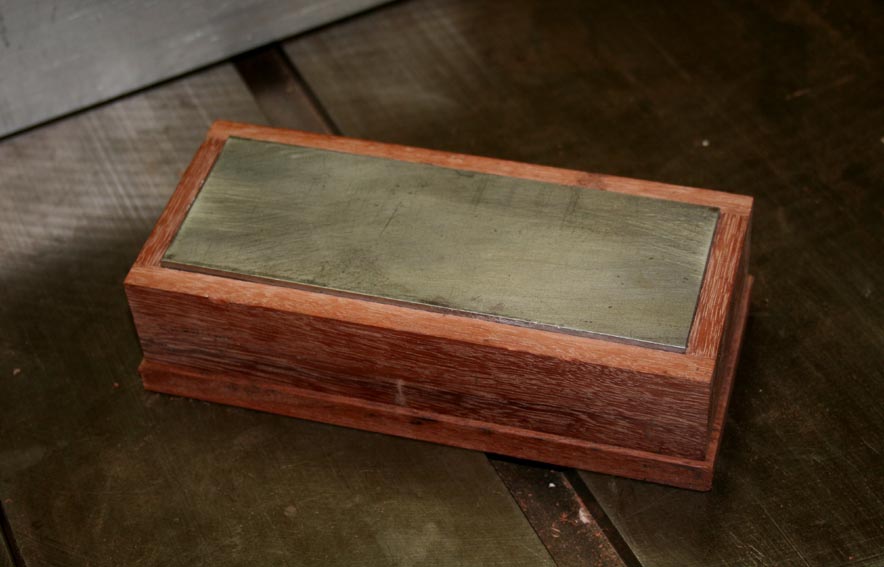
The ultimate grinding/sharpening set up?
Derek Cohen (in Perth, Australia)
By way of introduction, I work with hollow grinds. I believe that the way to the quickest, most efficiently created, and sharpest edge is via a hollow grind that leaves the minimum amount of steel to hone. Honing on a minimum amount of steel is also more friendly to the honing media - less effort is required as there is less surface area, and it is possible to use less sophisticated honing media.
A hollow grind is also economic of the steel. Minimal blade length is removed since the steel is wasted from the hollow - that is "inside out". As I shall demonstrate, there is the ability to create the ultimate micro bevel.
For the first time in some years I have reorganised my grinding/sharpening system. For the past 5 or 6 years I have been using a Tormek 2000 (10" wheel) and Shapton (1000 grit)/Sigma (6000 and 13000 grit) ceramic waterstones. The combination is excellent, but I wanted something that did not make as much mess with water - the paste created dries out my hands and I live with painful cracks.
I have also done the diamond paste thing. Done it for several years. It is also messy - stains hands and I would worry about contaminating the wood via touch. I am not interested in oilstones. I use steels like A2, D2, HSS, PM-V11, M4. Most of these are beyond oilstones.
I decided to base the system around my half-speed 8" dry grinder. This has been used in the past with 46 grit Norton 3X and 46 white wheels. I long ago stopped using the 3X as it sheds so much grit into the air, which I do not wish to breath in. The white wheel is nearly as bad.
What I wanted was a dry honing and dustless grinding set up that was fast and efficient. Not much to ask!
Several weeks ago I took possession of two ceramic Spyderco (2"x8" Medium and Ultra Fine).The Spydercos are hard and retain their flatness like oilstones, but are worked dry. Spyderco do not say what the grits are, but they are reputed to be 1500-2000 and 6000-8000, respectively (it would not surprise me if the Ultra Fine is about 10000 as it leaves a mirror finish). After a little flattening of the Spyderco stones on diamond plates, they will not need to be flattened again, just cleaned with a scrubbing brush occasionally. In many ways, the Syderco are a ceramic version of an oilstone.
The search then was on for a new grinding wheel. About 2 months ago I took possession of a 180 grit 1 1/2" wide CBN (Cubic Boron Nitride) wheel with 1/4" side radii.
There were two wheel grits at the time (there are finer grits now available - up to 350 grit, but I do not see these as relevant to anyone but a turner). The 80 grit is indicated for heavy work. From what I could determine, the 180 grit is nearly as fast and provides a smoother finish.
I got mine from D-way in the USA. I liked their presentation and reputation, and Dave Schweitzer answered all my emails promptly and thoroughly. You can find a few of his videos on Youtube. I went for the radius edge as I thought it may be more useful, not only for lathe chisels (as they demonstrate), but also for entering and exiting on straight edges. I have since used the radius edges for grinding in-channel gouges, and they did a fantastic job.
David assured me that the CBN wheel will grind all hard steels, not just HSS (and he is correct). With regard laminated blades where there is soft steel, he mentioned that a second grind on hard steel will remove any loading, if this occurs.
The beauty of the CBN wheel is that they last a long, long time, possibly forever - unlike diamond wheels which are unsuited to grinding carbon steel (diamond is absorbed by the carbon in the steel). The CBN wheels remain flat, require no upkeep, and this means that settings do not change. They grind relatively cool and can do so to the edge of a blade, just like the Tormek. Less steel to hone means a quicker hone. A straighter hollow means less work to do, which - of course - means faster sharpening. Sounds good.
Installing the wheel is a simple affair. D-way sell a beautifully machined bushing that slipped over the 5/8" arbor on my half-speed grinder. The grinder has a 1 h.p. motor, so is powerful enough to easily push this heavy wheel. It is so well balanced, however, that I imagine a less powerful machine may need a manual spin to start it along.
The CBN wheel replaced the 3X wheel. The guards were removed - the CBN wheel is solid steel and is not going to blow up! I use the Tormek BGM-100 set up, which is identical to that used on the Tormek wet grinder. A huge advantage of this is that one can set up precise angles - which makes for easy repeating of grind angles. For more info, go here: http://www.inthewoodshop.com/WoodworkTechniques/GrindingNirvana.html
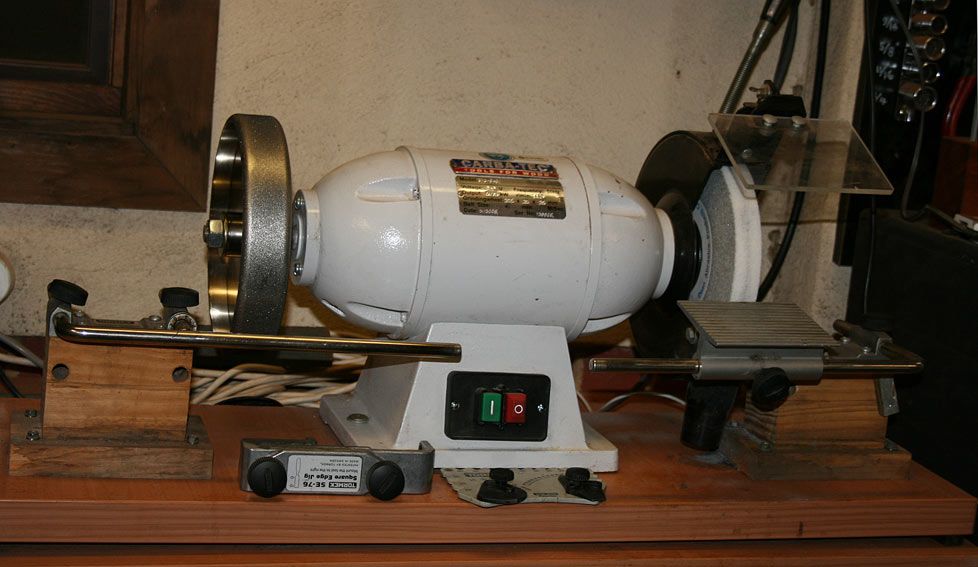
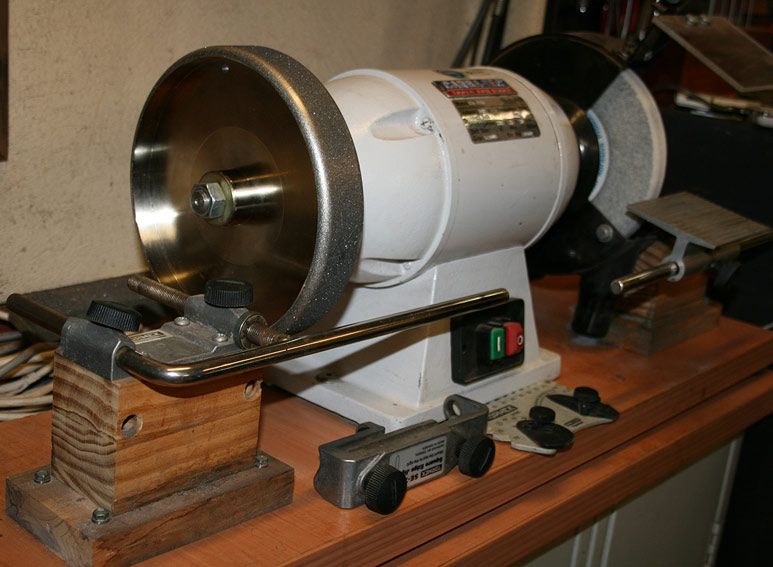
Is it cost effective? Does it cost too much? Decide for yourself what you can afford. There are lots of ways to spend money on sharpening systems, some of them in my opinion are a waste of time and money, and some of mine are no doubt for others a waste of time and money!
On average I can grind a blade and hone it in just a few minutes. It probably takes me less time to grind and hone than most take to grind alone. More importantly, re-sharpening takes under one minute.
Step #1 - CBN wheel for grinding - to the edge of the blade. It is warmer than a Tormek, but cool enough to hold in the hand, and much much faster in the grind. The final hollow is slightly deeper (8" radius vs 10" radius), and the upside of this is that a honing will last slightly longer. It is very important that the edge is smooth and the hollow grind is straight. This means much less work to do in terms of preparing the edge with a coarse stone. The CBN result is in a totally different class - universe - to that off a white wheel.
Step #2 - I freehand on the hollow and, after the CBN, shape in a camber on a broken-in Eze-lap Fine grit. I've had this stone over 10 years now. Magic! This is followed by the Medium Spyderco, which raises a very fine microbevel in about 8 strokes. On a PM-Vll blade it is so small that one must look carefully to see it. Five strokes on a Ultra Fine Spyderco, and I could call it done. A few strokes on either Veritas green compound on planed hardwood or, my preference, the 0.5 micron diamond mesh (from LV), and the blade is very, very sharp.
No water. No mess. I can focus on the important part of woodworking - working the wood.
The irony is that the CBN wheel creates a perfect hollow and the Spydercos remove so little steel that the hollow looks like it will last a long time ... and grinding will be done so infrequently!
Here are images of the edges created on a 1" PM-Vll chisel blade. Firstly off the 180 grit CBN wheel ...
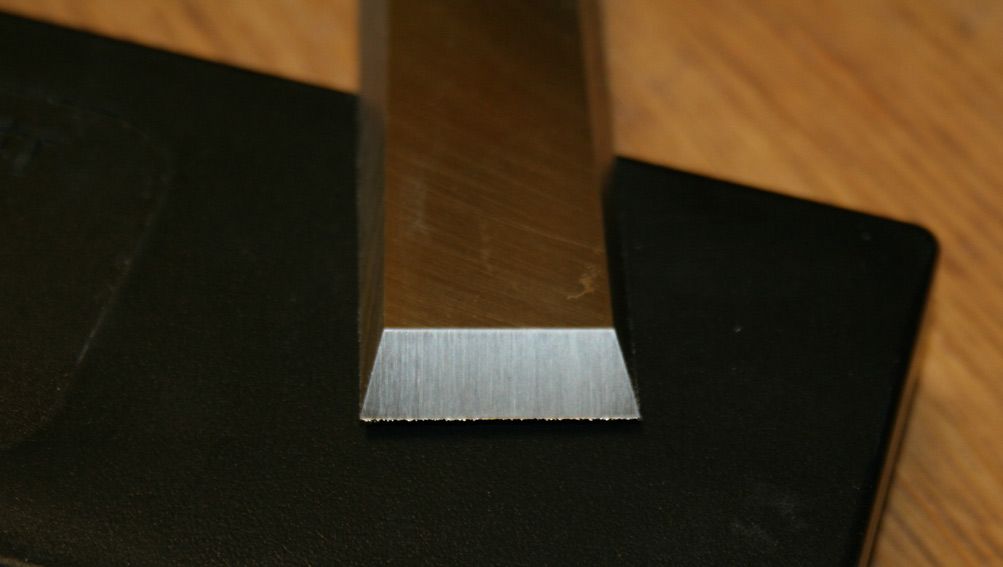
You can see the wire here. It is not typically ragged like that off the Tormek. It may be that the CBN wheel is new and still wearing in. It may also be (more likely) that I ground a little further than I would usually as the wheel on the dry grinder is set up fractionally off the line of the Tormek, and it was necessary to grind fractionally further to square the edge, plus the PM-Vll steel holds the wire a little more tenaciously.
Secondly, the Medium Spyderco ...
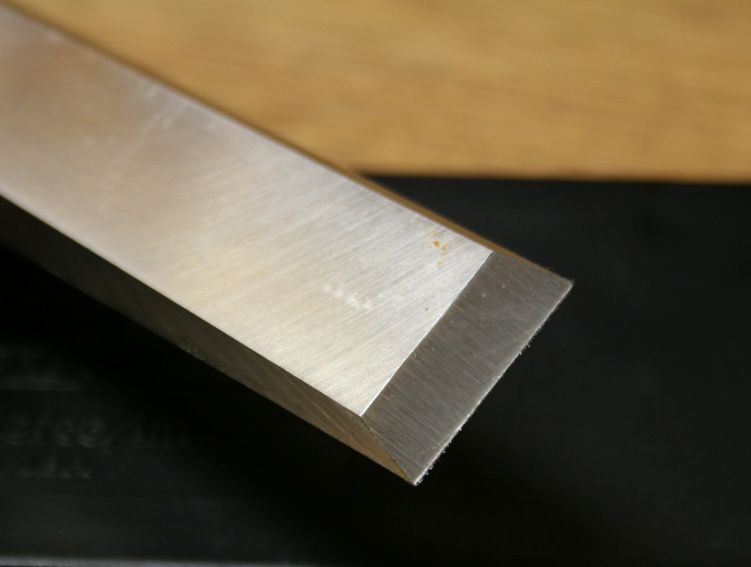
Then the Ultra Fine Spyderco ...
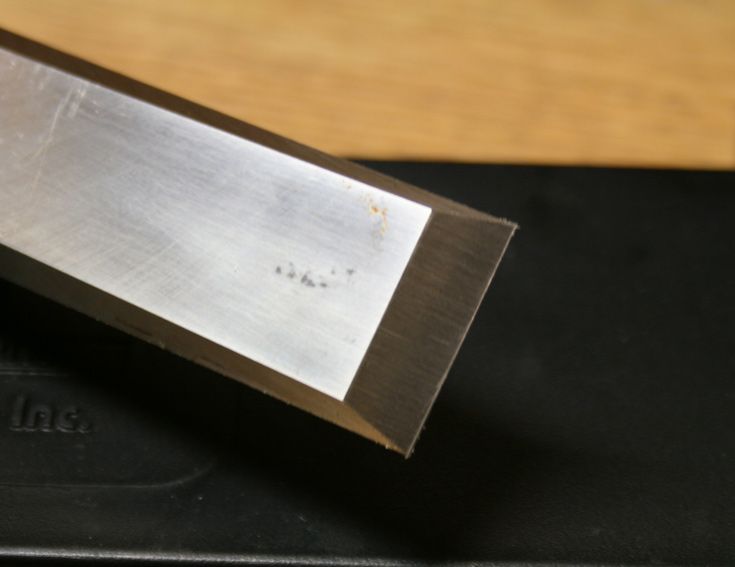
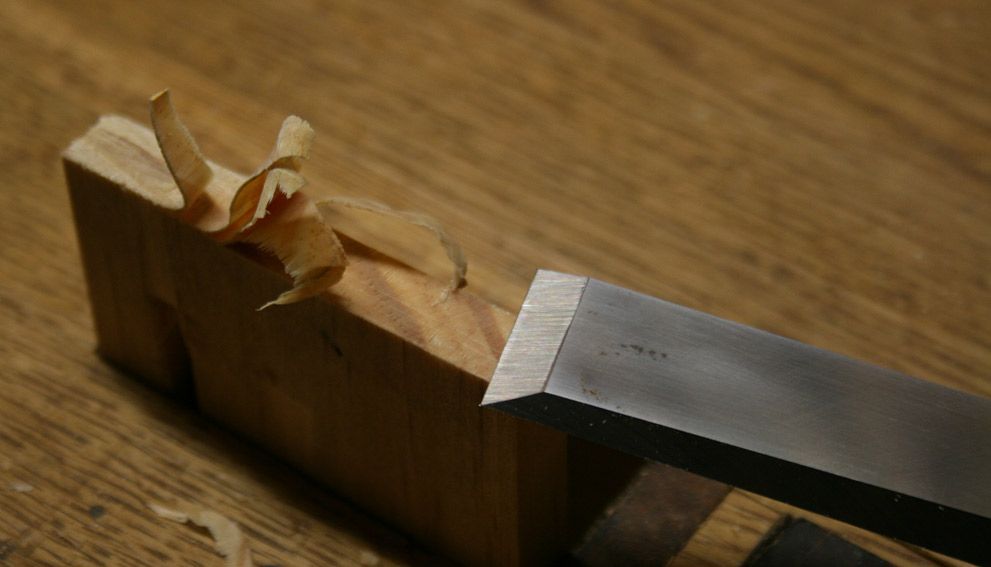
Finally, a few strokes on a 0.5 diamond mesh to add a final polish and ensure the wire edge is gone. And demonstrating that edge on soft Radiata Pine ...
The stones: Medium, Ultra Fine Spydercos, Diamond mesh (on perspex on hardwood), and Fine Eze-lap.
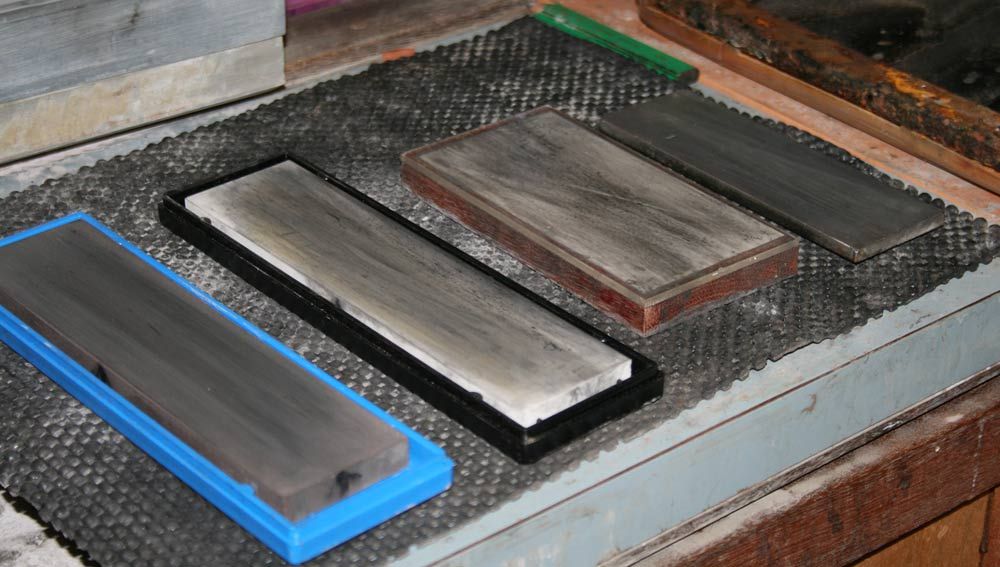
P.S I am currently installing an 80 grit CBN wheel, which will be used for heavier grinding. I would call this system "done".
Regards from Perth
Derek