New WoodChat!
Home Articles Forums Gallery Marketplace Videos

WoodCentral Forums

Knowledge You Can Build On — Est. 1998

Abingdon, VA – Tree Cutting & Portable Sawmill

Abstract. Chipbreakers and high angles

Posts

Re: Abstract. Chipbreakers and high angles

#26

Re: A point missed

Derek Cohen (in Perth, Australia)

They could have made it easier for a more beginning user, or an advanced user who isn't yet aware of this feature. Put a 40 degree bevel on the capiron like Hock does. That at least makes it possible to use the capiron without further fine tuning. Then add some usefull text in the manual that explains how to use it.

Using a high angle frog is easy and well described in the documentation. The capiron needs a bit more education which is lacking now in the manual or on the website.

Hi Kees

I disagree with a generic 40 degree bevel being offered. I think that 25 degree is just right - alter all, if you have a 60-65 degree frog, you would not want a 40 degree bevel .... I have a LN #3 with a 55 degree frog. Good plane but it still benefits from the chip breaker closed up on highly interlocked grain. Would you suggest 40 degrees for this? The wide range of possible frog angles makes the use of a generic 40 degree chip breaker difficult to recommend.

On the other hand I do agree that there needs to be some information in the instructions about preparing the chip breaker (I have not read them so am not aware if they are/are not already included).

Is the new user of a high angle plane any better informed than the new user of a chip breaker?

Regards from Perth

Derek

Re: Abstract. Chipbreakers and high angles

#27

Re: A point missed

Kees

That would be a total angle of 95 degrees. Doesn't seem too extreme, but I have no experience with a setup like that, so I'd better shut up. ;)

Re: Abstract. Chipbreakers and high angles

#28

cap iron angle- why?

Bill Tindall, E.Tn.

If I have followed this conversation correctly the new planes have a cap iron ground at 25 degrees.?. Given that the vast majority of planes will be sold bedded at 45 degrees it would seem that offering the cap iron ground at an angle greatly less than what Kato and Kawai typically used (50 degrees) could be setting up the new novice user to failure if they should try employing the cap iron effect.

An explanation of why an angle greatly different from 50 degrees was chosen could be revealing.

Re: Abstract. Chipbreakers and high angles

#30

Re: A point missed

William Duffield, on the Cohansey

I have no argument with your points. However, these planes were not "right out of the box." They were set up to be used by potential customers. As such, the blades had been honed and all the other adjustments had been made for optimum performance. I didn't check, but I suspect the soles had been waxed, which would have been a reasonable step in the setup process. They were not preloaded with 65° frogs, either, but were set for close to optimal performance on the samples of wood that they provided, which is a completely reasonable strategy. I figure there is no sense in setting up the demonstration to make the planes any harder to push than necessary, while not jarring the sensibilities of the unwashed masses who would not be expecting a visible and tactile discontinuity between the top surfaces of the blade and chip breaker.

Re: Abstract. Chipbreakers and high angles

#31

Re: cap iron angle- why?

William Duffield, on the Cohansey

Now I wish I had a bevel gauge with me. I'll report back next week with a measurement when my sample arrives. I think that neither 40° nor 25° is a good estimate. I could be way out in left field, but to me it looked more in the 15° to 20° range.

Re: Abstract. Chipbreakers and high angles

#32

Re: A point missed

Derek Cohen (in Perth, Australia)

... these planes were not "right out of the box." They were set up to be used by potential customers. As such, the blades had been honed and all the other adjustments had been made for optimum performance.

Hi William

The criticism you made is valid. However this should be aimed at the workmen and not the tools.

Alternately, the chip breakers may have been absolutely fine for the wood that was used. Not every instance requires a close set chip breaker.

Regards from Perth

Derek

Re: Abstract. Chipbreakers and high angles

#33

Re: cap iron angle- why?

Warren in Lancaster, PA

When you look at their cap irons, when you read their catalogue, when you watch their videos, it is obvious that the people at Lee Valley don't have much experience actually using a plane. All this research and development is dampened by their failure to understand 18th century technology.

Re: Abstract. Chipbreakers and high angles

#34

Fuel to the Cap Iron fire- data

Bill Tindall, E.Tn.

Professors Kato and Kawai were/are teachers at what appears to be a trade school or something similar. They wrote a tutorial to be used by their students on how to set the cap iron in a double iron plane. Presumably they thought knowing how to set the cap iron offered some benefit to students worth describing in a tutorial.

Their research and the scientific papers resulting from this research supported development of the SuperSurfacer planing machine. This machine employs a close set cap iron which made studying its effects worth funding and reporting. I am led to believe that a close set cap iron is a typical set up for this machine.

I am not a planing enthusiast. I do it when it is easier than a machine operation, primarily fitting. In my hands the close set cap iron has made an ordinary Stanley plane tear-out free for the grain situations I encounter in fitting furniture parts made from N. Am. hardwoods. I plane now more than I ever did before because now it is reliable and not fiddly.

For even more data supporting the efficacy of the cap iron read the introduction to Kees' recent research report.

Re: Abstract. Chipbreakers and high angles

#35

Re: A point missed

Derek Cohen (in Perth, Australia)

That would be a total angle of 95 degrees. Doesn't seem too extreme, but I have no experience with a setup like that, so I'd better shut up. ;)

Hi Kees

Previously, the result was poor when I have used a 45 degree secondary bevel on the leading edge of a LN chip breaker on a #3 with a 55 degree frog. The shavings were shaped like a concertina, and the surface was rough. Pulling the chip breaker back did not work well enough - I suspect that the leeway for doing so was too small at this angle.

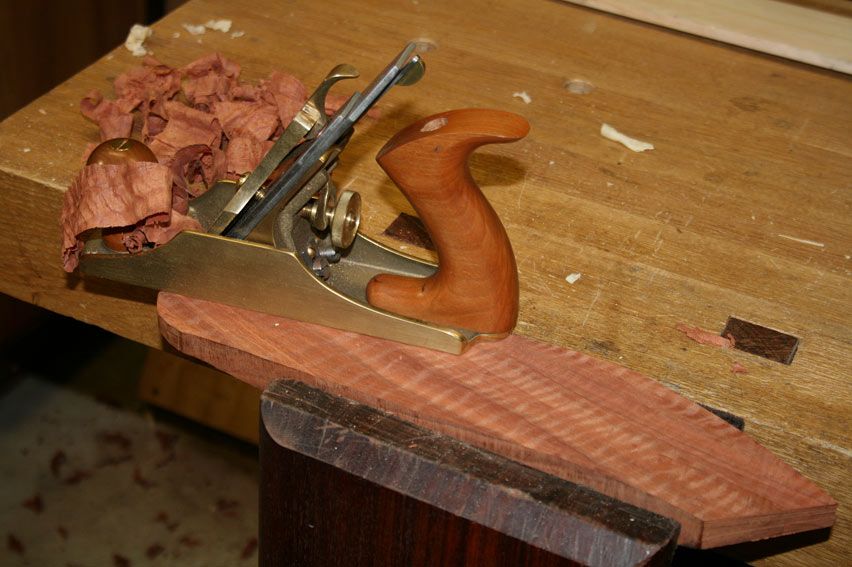
I took a couple of photos for you today with the same plane and a 30 degree leading edge. These photos were taken on the spur of the moment, so it is not intended as an experiment. Still, you can see the result. The chip breaker was set close (I did not measure it).

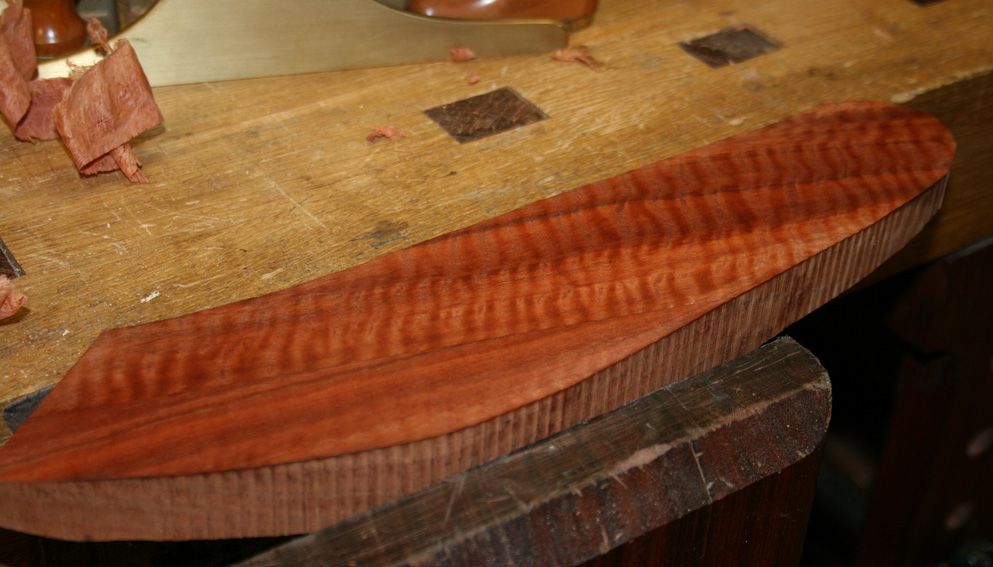
The wood used is a scrap of Fiddleback Jarrah from my chair build. This stuff just tore out with the spokeshaves in my build, which forced me to use rasps. Here I am using it with the LN #3 planing into the grain (look at the side), just to make it more difficult. :)


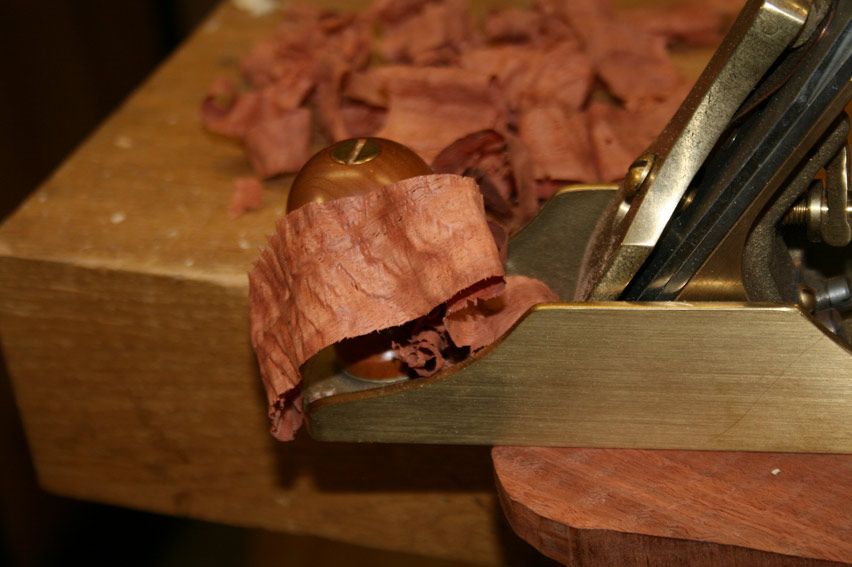
Here is a close up of the shavings - pretty typical straight shavings when the chip breaker is working ...


And here is the result with wax rubbed into the top (note that the board is reversed, so the grain is now going forward) ...


It's a very nice performance from this LN set up this way.

Regards from Perth

Derek

Re: Abstract. Chipbreakers and high angles

#36

Kato and Kawai and Concertina shavings

Bill Tindall, E.Tn.

In the Kato and Kawai teaching tutorial on adjusting the cap iron for optimum performance they used shaving compression as metric for setting the cap iron distance. Ideally, the force on the shaving applied by the cap iron resisting the flow of shavings up the plane bade will compress the saving along its length a small amount. Over a small change in cap iron distance the shaving goes from a bit compressed to "concertina". What is happening is that the compression forces along the wood fiber axis exceed the strength of the shaving in this direction and the fibers fail and fold. The point just before this failure is where the maximum force is exerted by the shaving to resist lifting of the fibers ahead of the blade tip. It is this lifting of fibers ahead of the blade tip that can result in tear-out and it is the force exerted by the shaving that resists tear-out.

With this information in mind, Kato and Kawai recommended that their students reduce the cap iron to blade tip distance until they got fiber failure ( concertina shavings) and then back this distance off a small amount. At this setting the optimum cap iron effect (downward force on the shaving) is achieved.

That said, in practical planing optimizing the cap iron effect may not need to be achieved. Some cap iron effect may be "good enough". On the contrary, concertina shavings resulting from wood fiber failure means there is little or no cap iron effect achieved and this situation must be avoided.

It follows that the optimum cap iron setting will vary with the strength of the wood along it fiber axis and the shaving thickness, which leads to what Warren has been telling us all along. The cap iron must be set for the task at hand if optimum performance is needed. Fortunately, "good enough" works in many cases and diddling with this adjustment is not as fiddly at its detractors claim. It works for me and I have a low tolerance for fiddly.

Re: Abstract. Chipbreakers and high angles

#37

Re: A point missed

Kees

That's a nice bit of wood Derek!

I've also had good results with a very low angle in a 45 degree plane (not fiddleback jatoba though!). You just have to set it very close to the edge. Steep bevel angles like the 80 degree in the Kato video have the disadvantage that it can easilly be too much, like Bill describes in the other reply. Another sign of too much capiron effect is marked increase in pushing force.

So, now you have to plane that piece of wood with a 40 degree angle on the capiron, and report back. ;-)

I think the most interesting part of my article was about the two different mechanisms of tearout prevention. We now have at least an idea HOW they both work. And because they are both totally different, you can combine them and increase the effect, being carefull of course not to increase the effect too much.

A tight mouth would be the third method that could be added to the mix, IF you manange to create a really tight mouth without jammed shavings.

Re: Abstract. Chipbreakers and high angles

#38

Re: A point missed

TomD

The one thing is that LV actually does provide their planes sharp to use out of the box. There might be slightly less leeway to serially regrind a breaker so that might determine something. Unlike a frog it is fairly user adjustable.

I don't believe for a moment that LV doesn't get it. They are well plugged into what is being discussed, right up to the executive. If it is still useful to produce articles on this info, and to lavish praise on those who do, presumably it is because the word has yet to reach some woodworkers. Until it does there isn't much point in basing a marketing campaign on something there isn't much demand for. LV has hitherto sold planes with on the fly adjustable chip breakers, and they didn't sell well enough to be kept in the catalog.

Re: Abstract. Chipbreakers and high angles

#39

Re: Fuel to the Cap Iron fire- data

TomD

"Professors Kato and Kawai were/are teachers at what appears to be a trade school or something similar. They wrote a tutorial to be used by their students on how to set the cap iron in a double iron plane. Presumably they thought knowing how to set the cap iron offered some benefit to students worth describing in a tutorial."

Japanese carpenters used to learn the craft through apprenticeship, which seems to be an ongoing reality at some level. Do we know whether K&K went through apprenticeships? Are they part of the continuity, of further examples of people getting off a current British air flight to the US and planting a flag for king and country.

"Their research and the scientific papers resulting from this research supported development of the SuperSurfacer planing machine. This machine employs a close set cap iron which made studying its effects worth funding and reporting. I am led to believe that a close set cap iron is a typical set up for this machine."

Exactly how did they support the development of this machine. It must be at least 45 years old. Examples were widely advertised in US hobby magazines in the 70s and 80s. I have seen them in use. Do they hold patents on parts of the machine?

If the machine already employs a close set cap iron, in what sense was it worth studying what had already been refined to the point of production? Can I get a grant to develop the I-phone? Not to mention the obvious point that it was derived from an existing hand plane, that allowed blade adjustment on the fly.

If you look at the SS, and I am just generalizing, the kinds of thing that look like novel technologies are: the means by which the wood is pushed through the machine. The fact the wood moves but the plane does not combined with the fact that the plane cuts to the bottom and ejects to the top. The technology to adjust the blade angle, and the chip breaker angle also. The means by which the sub blade is adjusted. There are quite a few novel features, the one thing that does not appear to be novel is the distance from the edge that the breaker is adjusted to.