New WoodChat!
Home Articles Forums Gallery Marketplace Videos

WoodCentral Forums

Knowledge You Can Build On — Est. 1998

Premium Domestic, Figured & Live Edge Hardwoods in Stock. Best Prices for Serious Woodworkers.

A mallet for morticing

Posts

A mallet for morticing

#1

A mallet for morticing

Derek Cohen (in Perth, Australia)

Over the years I have used a number of different mallets to pound a mortice chisel. The search may have ended.

Until about a year ago I was using one of Dave Jeske's (Blue Spruce Tools) ...
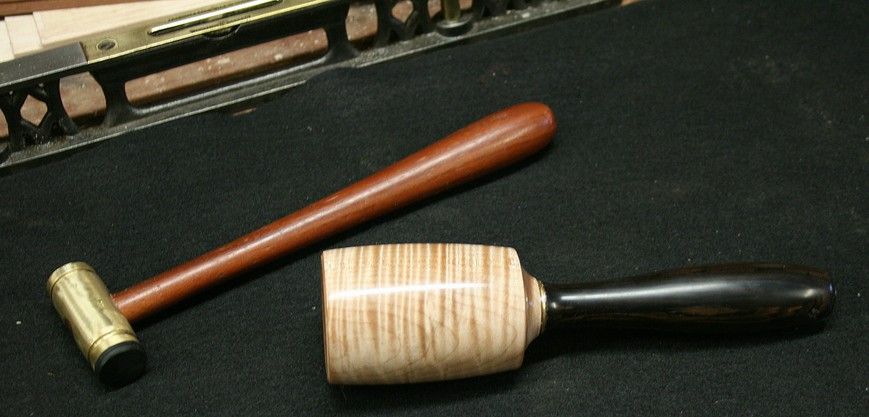

This is beautiful to look at, beautifully made (as is everything he makes), is a pleasure to use with bench chisels, however at 16 oz it is too light for a mortice chisel into hard woods.

For morticing I preferred either a Thor (about 20 oz) or the Veritas (19 oz). While not significantly heavier, they focus the downforce and this is more efficient.

Here are the Thor and Veritas alongside a long-discarded Marples (only 14 oz).
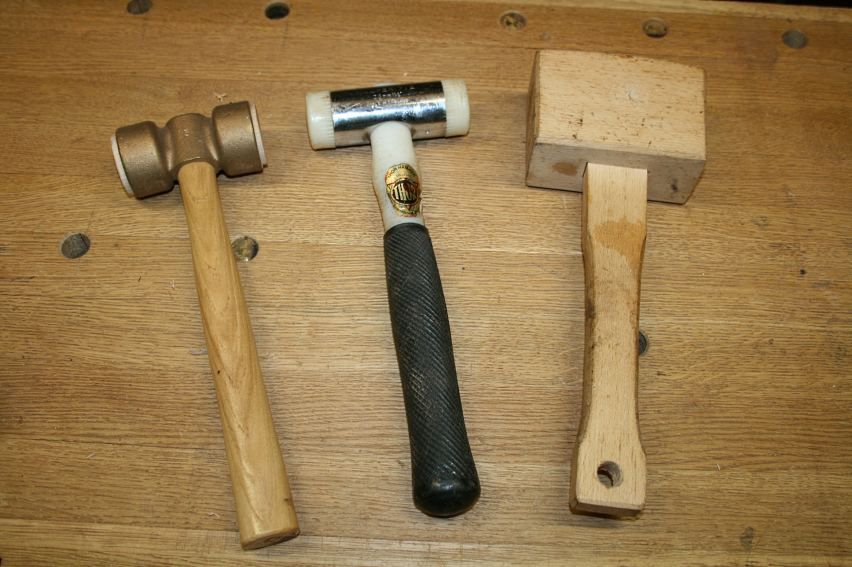

The Thor is a great mallet. I purchased it for convincing furniture parts to get closer together with each other, however it makes a great mallet for chisel work when wanting to work quietly or reducing vibration. The downside it that it looks like something that a motor mechanic would use .. which is where the Veritas comes in. The Veritas is a good design. My only gripe (easily fixed) is that the handle is a little too slim for my hand. I want this to be longer as well, but that probably reflects the mass/downforce limitation. It would be great to see a 2 lb version of this hammer produced for morticing. Rob, are you listening ...?

What I want in a mallet for morticing is something that has about 32 - 38 oz, is relatively compact for this weight, and will not damage the unhooped wooden handles of a Western mortice chisel. This would not be an issue if I used Japanese mortice chisels as I have a few gennou, including one that is 375 gm (13 oz). Interestingly, this lighter hammer seems to have more downforce, possibly because it is focused on a small area? The problem, however, with steel-headed hammers is that they destroy wooden handles. I'd rather replace the mallet than the chisel handles.

What brought matters to a head this weekend was the recent release by Blue Spruce of a 24 oz Joiner's Mallet in infused acrylic (which should make it indestructible).


It has been given two thumbs up by Chris Schwarz ..

http://www.popularwoodworking.com/tools/woodworking-hand-tools/highly-recommended-blue-spruce-joiners-mallet

So why didn't I just order one? Well I am still waiting for The Chair to arrive so I may complete my measurements and start building one (hopefully tomorrow!), and I had time on my hands and a plan in my head ...

Put me in front of a bench with spokeshaves, rasps and a few scrapers, and I am as Happy as Larry (translation: http://www.phrases.org.uk/meanings/as-happy-as-larry.html).
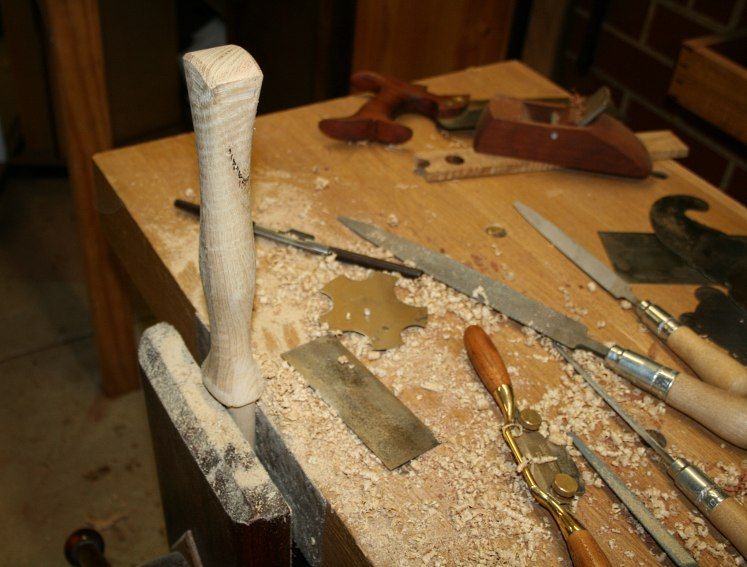

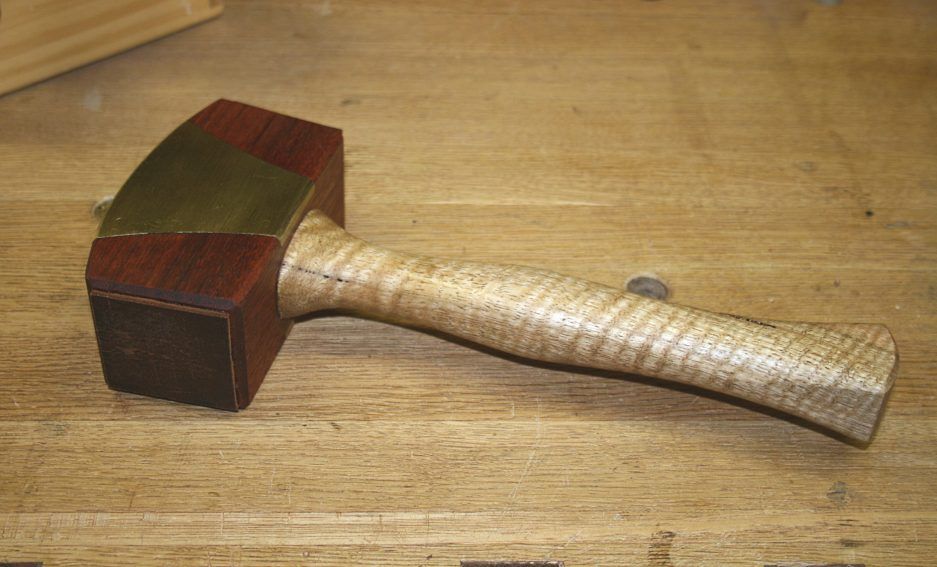
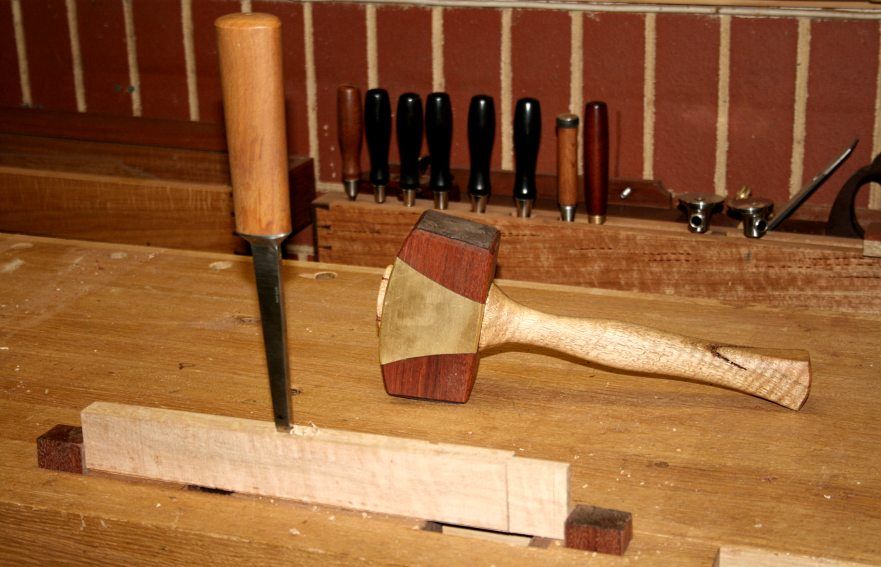
A bit of Karri for the head (heavier and more interlocked than Jarrah) and Curly Marri for the handle (softer, "chewy", I think will absord vibration well), and bit of brass ... This is what I came up with ...
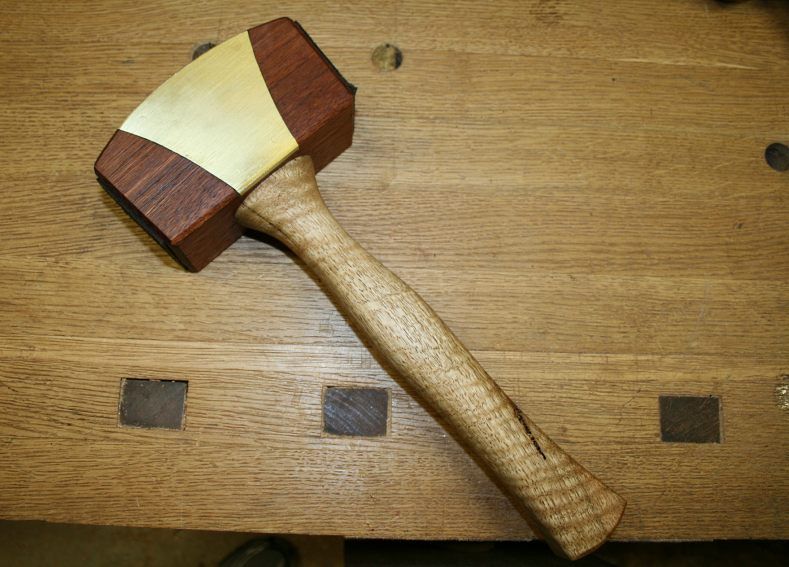

The faces have leather for cushioning the chisel handes. The mallet handle is oval in cross section, approximately 1 1/2" x 1" and 10" long. The head is approximately 5" long x 3 " high and 2 3/8" wide.
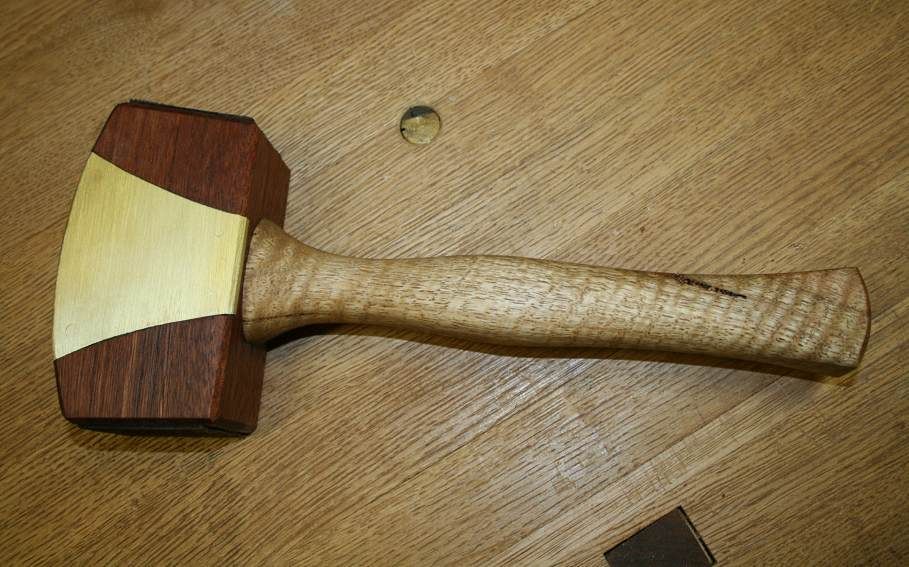

The overall weight of this mallet came in at a little over 38 oz. How did it manage this in a relatively small head? It is down to the 1/4" thick brass plate that was added (peened) to each side ..
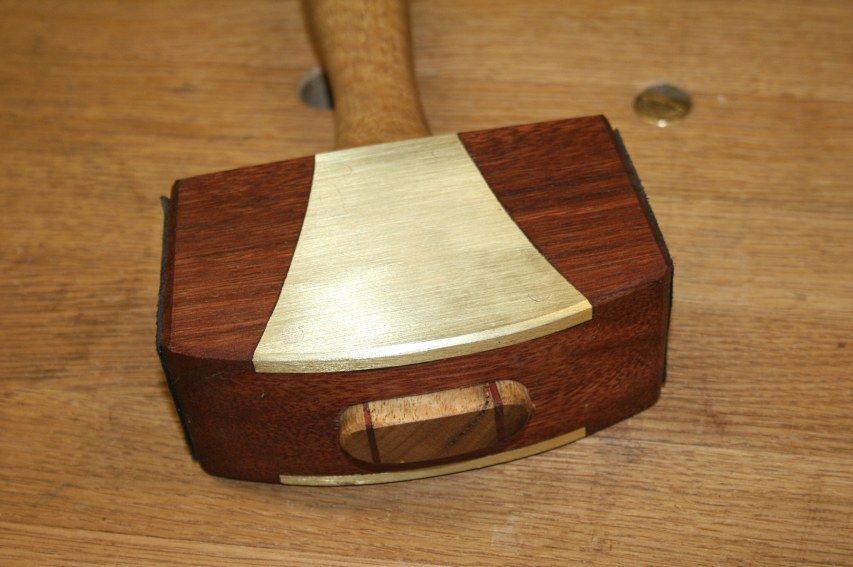

In use this mallet is in a different class to the others for morticing. It certainly helps in punching the chisel through hardwoods ...

Regards from Perth

Derek

Re: A mallet for morticing

#2

Re: A mallet for morticing

Steve Voigt

Hi Derek,

Looks good--a very striking design, and the handle looks quite comfortable. I think I would find 38 oz too heavy--you must have forearms like Popeye!

Re: A mallet for morticing

#3

Re: A mallet for morticing

Derek Cohen (in Perth, Australia)

Thanks Steve. Keep in mind that this mallet is only 3 oz heavier than the one owned by Chris Schwarz. That's not much. The mallet is reserved for morticing. I would not use it for general use - which is why both faces are covered in leather.

Regards from Perth

Popeye

Re: A mallet for morticing

#4

Nice! where do I put in my order?


Re: A mallet for morticing

#5

There you go again......

roger lance

and just when I think I've made something on the ole master.....you strike.....beautiful tool!!

Re: A mallet for morticing

#6

Re: A mallet for morticing

dave jeske

Beautiful work Derek. At 38 ounces you will be able to drive even the widest of chisels, even timber framing to some extent. Your handle looks perfectly shaped. I choose to go a little more angular as it tends to not want to rotate in the grip quite so much and gives a bit of orientation feedback. No denying that beautiful curves work though!

Re: A mallet for morticing

#7

Re: A mallet for morticing

Derek Cohen (in Perth, Australia)

Thanks Dave, you set the bar very high with all your tools. Thanks for the inspiration here.

This handle remains quite directional although the edges have been softened - this comes from the oval shape, while the lowermost end has straighter edges for a little feedback.

Regards from Perth

Derek

Re: A mallet for morticing

#8

Re: A mallet for morticing

Patrick Gibbons

I have thought of using leather on the striking faces of a mallet. To limit damage done to a chisel handle, the mallet should be softer than the handle. To achieve adequate weight, a harder wood of greater mass is needed. Using leather allows the use of harder, heavier wood. Does the leather reduce the impact of your mallet?

Re: A mallet for morticing

#9

Re: A mallet for morticing

Derek Cohen (in Perth, Australia)

Hi Patrick

I assume that the leather does cushion some of the impact. What I would like to find is some of the polyethylene as used in cutting boards. I suspect that this would have the idea blend of transferring impact and protection of the surface (as I have found with the Thor). I'm going to look around.

Regards from Perth

Derek

Re: A mallet for morticing

#10

The leather faces.

Derek Cohen (in Perth, Australia)

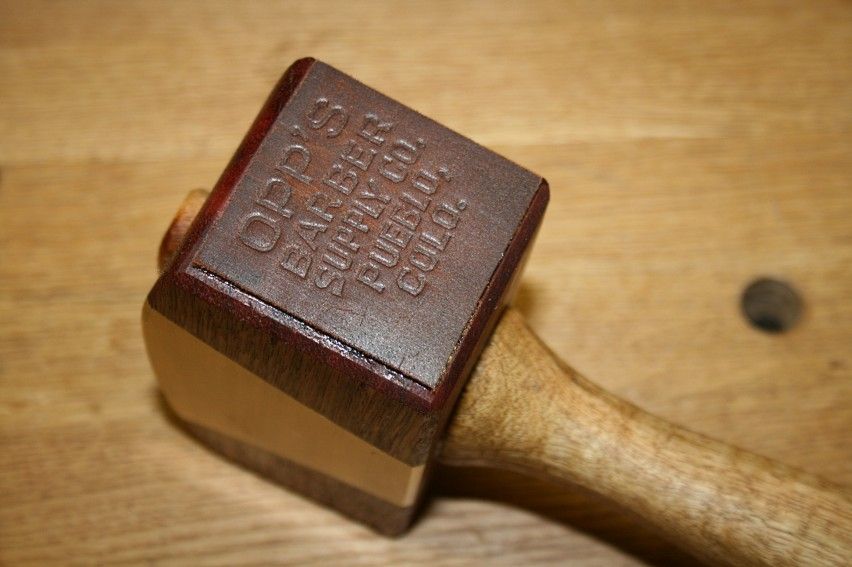
I replaced the leather on the mallet heads with pieces off an old horse butt strop. This is about 1/8" thick and firm. It is attached with hide glue, of course :)


Regards from Perth

Derek

Re: A mallet for morticing

#11

Re: The leather faces.

Patrick Gibbons

A very good idea to use horse butt. The mallet is well thought out. It's funny how something so deceptively simple is greatly improved with attention to materials. I like how you used the brass for both decorative and utilitarian purposes. For the plastic, furniture gliders could be shaped and repurposed. I've seen them in large squares. Here in the U.S. one can purchase sheets. I would imagine it's available in your neighborhood too.

Re: A mallet for morticing

#12

Re: Handle Question for Dave and Derek

William Duffield

Why do you put the bulge in the center of the handle, instead of farther from the head? It seems to me that you would want to grip it at its widest point, and would also want a longer radius for maximum effect when driving mortise chisels. The configuration of both of your handles appears to waste about 3 inches of handle. The shape of the Blue Spruce carver's mallet handle would seem to be a better design, but with just enough extra length to attach a lanyard. Note that I have no issue with the octagonal or elliptical cross sections. They make perfect sense for a mallet with a square face.

Re: A mallet for morticing

#13

Re: Handle Question for Dave and Derek

dave jeske

William, Thanks for the question. I like to add the bulge because it divides the handle into two areas of use. The area near the end is for harder hitting activities such as driving mortise chisels. The flare at the end helps to keep the mallet from sliding out of your hands. I leave enough room to slide up the handle a bit for lighter blows. The bulge and narrower section towards the head forms a second grip area that nestles around your hand and allows for more controlled, lighter force hitting. It gives the mallet a second life as a more detailed oriented mallet such as chopping dovetails, hitting carving tools, etc.

Re: A mallet for morticing

#14

Re: Handle Question for Dave and Derek

Derek Cohen (in Perth, Australia)

Why do you put the bulge in the center of the handle, instead of farther from the head? It seems to me that you would want to grip it at its widest point, and would also want a longer radius for maximum effect when driving mortise chisels.

Hi William

Dave no doubt will have additional thoughts. However the reason for the bulge is that the handle does double-duty. there are two grips, not one. The handle may be held at the end, and it may also be held in a "choked" position, that is, closer to the mallet head.

The shape of the Blue Spruce carver's mallet handle would seem to be a better design ..

It is horses for courses. The oval (in my case) and the rectangle (in Dave's case) serve to direct the hand towards the mallet head. This is not necessary in a round, carvers type mallet, where it does not matter where you point the hand to find the face.

Dave has a rectangular section all the way through. I have placed a small rectangle at the lower end of the handle.


What is needed in a handle is an increased thickness at the end, rather than a constant thickness throughout. It is this that prevents the handle flying out of your hand. This is the reason I plan to add a new handle to the Veritas mallet - it is too straight and slippery. It feels too slim in the hand. The mallet head, on the other hand, is a terrific design for bench chisels (angles, replaceable inserts, weight).


Regards from Perth

Derek

Re: A mallet for morticing

#15

Gorgeous!

John in NM

Derek, that mallet is almost too pretty to bash stuff with! :D

Re: A mallet for morticing

#16

Re: A mallet for morticing

Warren in Lancaster, PA

I can't imagine what problems could arise from using a hard mallet. I have used a dogwood mallet, Cornus florida for mortising since 1979. Many people use lignum vitae mallet with chisel handles made from ash or beech.

Re: A mallet for morticing

#17

Re: A mallet for morticing

Chris K in MD

Beautiful work Derek!!!

how long did it take you?

Re: A mallet for morticing

#18

Re: A mallet for morticing

Derek Cohen (in Perth, Australia)

Thanks Chris.

All up it took a day, but I was in-and-out of the workshop - with summer starting in Perth, there are garden duties as well.

There were a few power tools used to speed the process: tablesaw to saw the head to shape, a drill press to mortice for the handle, and a belt sander to fllatten the brass. All else was by hand. In fact, I began two handles, the other in Jarrah. I preferred the contrasting woods, so kept the Curly Marri. The leather ends went on the next day.

Regards from Perth

Derek

Re: A mallet for morticing

#19

Re: A mallet for morticing

Patrick Gibbons

I made two mallets, one from dogwood and one from persimmon. My AI chisels with bubinga handles have not been damaged by them. I have always heard, and it makes sense to me, that your mallet should be softer than your chisel handles to avoid damaging them. I wonder about others experience with this.

Re: A mallet for morticing

#20

Re: Handle Question for Dave and Derek

William Duffield

I forgot to say how much I like your design, and Derek's as well, in joiner's mallets. I would have liked to have had the opportunity to use the one you brought to WIA, where we had a short conversation.

I completely agree with your concept of dividing the handle into two areas of use, and have been more or less successful at doing this in the turned carver's mallets I make. I just shape them differently.

I prefer to have the widest part of the handle in the center of my palm, instead of on both sides. I think it gives me a stronger grip, with more control, and its less tiring for full forearm swings at a heavy chisel. When I need to "choke up" for delivering precisely controlled taps, I prefer a ring that I can wrap my thumb and one finger around. I use a different finger for different strength taps. The rest of the fingers wrap around either the head or the handle. The design I use is for turned mallets, and therefore may not be as adaptable to square headed or barrel headed joiner's mallets.

Here are some examples, some more successful than the others. From top to bottom: dogwood (Cornus florida), cocobolo (Dalbergia retusa), black locust (Robinia pseudoacacia), purpleheart (Peltogyne sp.), Chinese bitter orange (Poncirus trifoliata), and hophornbeam (Ostrya virginiana).


I prefer the handle shapes of the ones I made from dogwood and hophornbeam, but their large diameter ring would not fit well to a square headed mallet. The handle of the cocobolo might work better. The ring on the locust maul (or beetle) is dysfuntional, because the head is too heavy and unwieldy to use for anything more subtle than bashing a froe. The purpleheart is not a good choice for a mallet, because the face grain surfaces have a tendency to splinter, especially if they contact a striking ring. The bitter orange blank I started with wass too short, and its grip is not comfortable. It has been ebonized. Otherwise it would be nearly as lightly colored as the dogwood.

I almost always use the hophornbeam one.

Note that my mallet design is not original. I started with a pattern I found in an early issue of Shop Notes. The plans didn't explain why it was shaped the way it was, but it worked, and I figured out why much later.

Re: A mallet for morticing

#21

Re: Handle Question for Dave and Derek

dave jeske

Nice work Bill. Looks like you have mallets for all occasions! The hophornbeam one seems especially well proportioned and would be a delight to use. The cove detail is both visually pleasing and functional. Nice.