New WoodChat!
Home Articles Forums Gallery Marketplace Videos

WoodCentral Forums

Knowledge You Can Build On — Est. 1998

Urban Salvaged Hardwood Slabs, Milled In-House from Rare Trees. Shop Unique Walnut Stock.

Single iron fore plane

Posts

Single iron fore plane

#1

Single iron fore plane

Steve Voigt

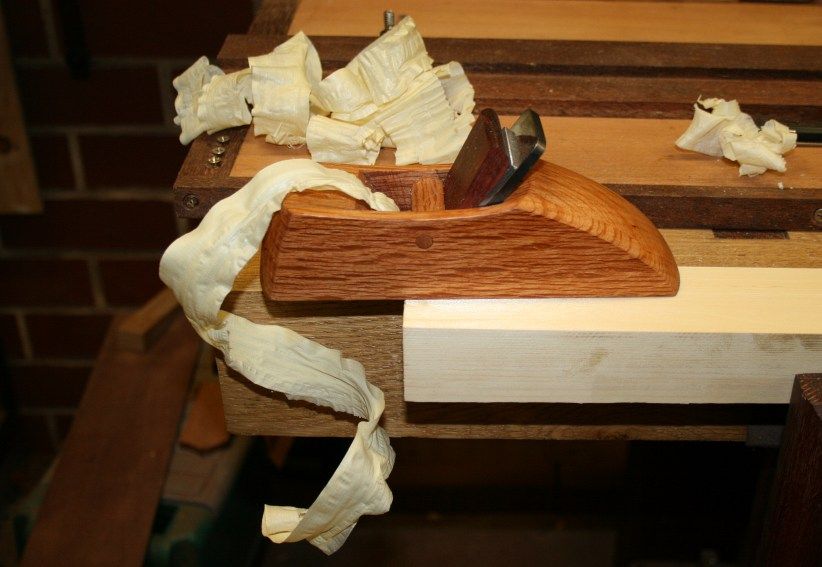
A couple months ago, I asked for, and received, some good advice on building on building a single iron fore. So, here are a couple pics of the finished plane. Thanks to everyone who chimed in, especially to Wiley, who provided some crucial measurements from his Old Street/C&W collection.

The plane is rift-sawn padauk, with a jatoba handle and a Tropical Mystery Wood wedge. The blade is an old single iron I got off ebay. I didn't really set out to use exotics; it just turned out to be easier to obtain than beech. The padauk is pretty coarse, and it probably wouldn't be a good choice for a tight-mouthed plane, but for a fore it's excellent.

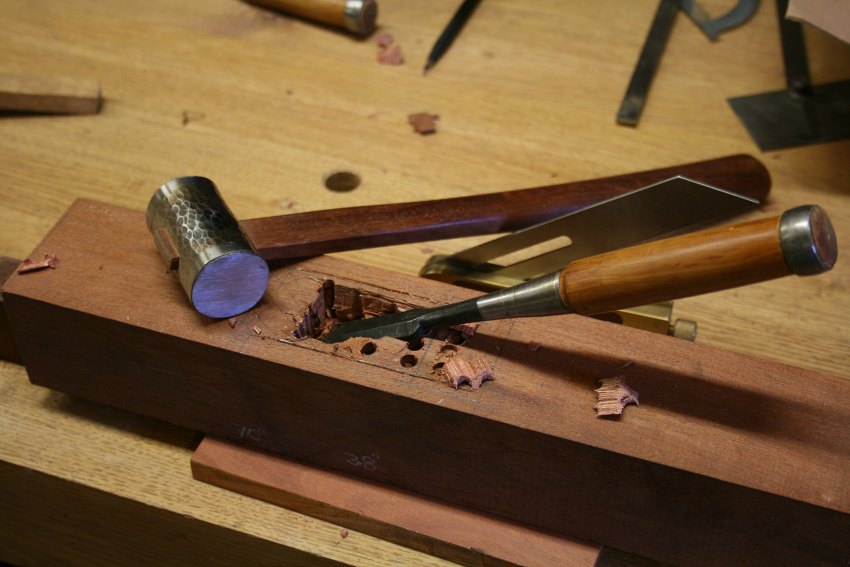
I've made a number of planes, but this was my first try at an unlaminated, traditionally-made plane. I'm very happy with how it turned out, and mortising out a solid block wasn't as difficult as I feared. It was also much more of a skill-building exercise than a Krenov style, and very enjoyable to make.

Anyway, enjoy, and thanks for looking!


Re: Single iron fore plane

#2

Re: Single iron fore plane

Derek Cohen (in Perth, Australia)

Good work Steve. I saw some of your build documentation over at SMC. It is worth detailing it again here as a pictorial - I am sure that many would enjoy the progression, and be motivated by it to build their own version.

Regards from Perth

Derek

Re: Single iron fore plane

#3

Re: Single iron fore plane

Steve Voigt

Thanks, Derek. I admit I don't have the energy to reload all that documentation a second time! It should be easy to find though, if anyone's interested.

I did mean to include this pic, though, and somehow it got left off.


Re: Single iron fore plane

#4

Re: Single iron fore plane

Patrick Gibbons

You stated that mortising out a block wasn't as difficult as you assumed. I think it depends on the wood. I have a half-finished plane of dogwood that's been on hold because of the difficulty of chopping out the mortise. You did a very good job. I'm impressed. Are you pleased with its performance? Also, exotic woods can be heavy. Is this a factor with your new plane? I have a long billet of wood that is heavier than the metal plane it would replace. It makes for another good reason to use beech, the lighter weight.

Re: Single iron fore plane

#5

Re: Single iron fore plane

Steve Voigt

Hi Patrick,

The plane works great, thanks for asking. I can take very heavy cuts, the wedge never loosens, and chip clearance is terrific, all as I had hoped.

I completely agree with you about the relative difficulty of mortising. The padauk was not too hard to work.

Regarding weight, padauk is virtually the same weight as beech, but harder and more stable (at least according to Wood Database, which I found to be a reliable source). Its only drawback, as I mentioned, is that it has quite coarse grain, but that is not really an issue in a fore plane, which doesn't require a fine mouth.

Re: Single iron fore plane

#6

Re: Single iron fore plane

Wiley Horne--So. Calif.

Steve,

Great job!! Tote is really nice. Can you tell us just the basics--length, blade width, camber...

Thanks,

Wiley

Re: Single iron fore plane

#7

Re: Single iron fore plane

Steve Voigt

Hi Wiley,

Glad you like it, and thanks again for the help.

The dimensions are a pretty close copy of Old Street's fore. Length = 18", the block is approx 2-3/4" square, the A.C Bartletts tapered iron (probably late 19th/early 20th c.) is 2.1 wide", camber is about 50 thousandths, I'm guessing, but I haven't actually measured. As on the plane you measured for me, the rear of the throat is 6-3/4" from the toe (measured on the sole). Bed angle is 50 degrees.

Re: Single iron fore plane

#8

Comparison To A Krenov Style Plane

Tom Colligan

Really nice work, Steve.

Can you discern a difference in performance between this plane and your earlier laminated planes? I often wonder if the added work to making a plane the traditional way yields better performance over the Krenov style plane.

Anyone else have an opinion?

Re: Single iron fore plane

#9

Re: Comparison To A Krenov Style Plane

Steve Voigt

Hi Tom,

Thanks for the kind words. Compared to Krenov style, I do notice two differences. First, the wedge holds better. I know some will disagree with that statement, but that has been my experience; even with a perfectly fitting crossbar and wedge, the Krenov style tends to loosen under heavy use. It makes sense; in theory, the locking power of a wedge should be determined by length, not the width, of the mating surfaces.

Second, on Krenov planes, chip ejection has always been a problem, at least for me--the crossbar tends to get in the way. On this plane however, the chip ejection is wonderful.

-Steve

Re: Single iron fore plane

#10

Re: Comparison To A Krenov Style Plane

Tom

I think those are both fair points, but:

1) One important point when fitting the wedge on the Krenov planes is the spring and bite of the materials. People who make these planes often use glassy hard and slick materials. Just a shaving of a softer material between the blade and wedge is all it takes to hold things in place, of course more sympathic materials from the outset also work.

2) Fair point on the clearancing issue. This can be helped by good design, the cross pin can be slimmed down, and it's placement is critical. The old wedge and abutment system looks particularly good where less than full width shavings are passing through, as they sail past the constriction in the abutments. So curved blade planes will function really well. Advantages are less pronounced on finishing designs, or others that use a flatter bit. Japanese blade retention is far cleaner, and works fine on western planes, though all the systems are perfectly usable.

Re: Single iron fore plane

#11

Re: Comparison To A Krenov Style Plane

Kees

For me there is another point. My Krenov style plane isn't the most comfy in the long run. I feel that I have to pinch to hard, which gets tyring, even leading to handcramps in the long run. With a handled plane, or even with a coffin style, I can hold the plane with far less pinching pressure.

Re: Single iron fore plane

#12

Re: Comparison To A Krenov Style Plane

Derek Cohen (in Perth, Australia)

For me there is another point. My Krenov style plane isn't the most comfy in the long run. I feel that I have to pinch to hard, which gets tyring, even leading to handcramps in the long run. With a handled plane, or even with a coffin style, I can hold the plane with far less pinching pressure.

Hi Kees

This just goes to show how much we prefer is down to what we are used to. For a Perth LN Handtool Event earlier this year, where I was asked to present demonstrations on plane building, I prepared both traditional laminated Krenov-style and traditional solid body coffin smoothers.


Both were roughly the same length (the Krenov at 7" and the coffin at 6 3/4") and bed angle (55 degrees) with a 1 3/4" wide blade.

I much preferred the Krenov for the low centre of effort - one simply needed to push forward. It was comfortable to hold. Indeed, the grip felt natural. By comparison, the coffin felt too high, and tippy unless firm downforce was applied (I must add that it was not really tippy, but just felt this way).

I'm not saying that this is the way it will be for others - just the way it feels to me.

Regards from Perth

Derek

Re: Single iron fore plane

#13

Off topic question.....

roger lance

Derek....I don't want to distract from the subject....but, do representatives of LN come from Maine to Australia for their handtool events?

Re: Single iron fore plane

#14

Re: Off topic question.....

Derek Cohen (in Perth, Australia)

Derek....I don't want to distract from the subject....but, do representatives of LN come from Maine to Australia for their handtool events?

Hi Roger

The Perth LN Handtool Events are no doubt the same format as in the USA.

I've been invited to present at these shows every year for as long as they have run in Perth. I guess that they can't get anyone else. :)

Here is a poster from 2011 ..


This is David Eckert, the agent for LN in Australia, setting up the familiar LN stand ..


Great guy. He does LN proud.

Regards from Perth

Derek

Re: Single iron fore plane

#15

Re: Comparison To A Krenov Style Plane

Kees

I'm sure "getting used to" plays a major part in these things.

Re: Single iron fore plane

#16

Single iron fore plane

Tom Colligan

Would anyone know of there being plans for making a plane the traditional way as Steve has done here? Steve, did you just wing it on your own?

There are a number of resources explaining how to make the Krenov style, which I've done, but I'd like to step up to this way of making a plane.

But I don't recall seeing any write-ups explaining how to do it.

Also, would a double iron be the way to go?

Thanks to all,

Re: Single iron fore plane

#18

Re: Single iron fore plane

Steve Voigt

Tom, a couple ideas. I did a pretty detailed three part pictorial over at sawmill creek of my plane build. I assume I'm not allowed to post a link, but if you google "single iron fore plane," you'll find it.

The two sources that helped me the most were John Whelan's "Making Traditional Wooden Planes," which has some drawings and dimensions, and Derek Cohen's pictorial (on his website) on building a strike block plane. And, as Lars mentioned, Caleb James has a bunch of very nice measured drawings on his site.

Regarding the double iron, well that's a very controversial subject. A ton of ink has been spilled here and at SMC over the last couple years, arguing about it. There are good arguments on both sides, and I don't want to open up that can of worms again. I used a single iron on my fore plane because (1) tearout control is not as crucial on a roughing plane, (2) with a cambered iron and a heavy cut, the chip breaker is not helping all that much, and (3) the down-time for sharpening is noticeably less, because I don't have to disassemble and reassemble the double iron. But for any finishing plane (smoother, try, jointer) I prefer the double iron. But again, that's just my choice, and there are plenty of people who prefer a single iron with a high angle (50-60 degrees) and a tight mouth to control tearout.

-Steve

Re: Single iron fore plane

#19

Re: Single iron fore plane *LINK*

Patrick Gibbons

Check out, How to Make Woodwork Tools at Toolemera. It's a PDF of a book by Hayward and has plans for a number of planes. It would be worth a look to anyone interested in making their own tools.


http://toolemera.com/Books%20%26%20Booklets/booksplans.html

Re: Single iron fore plane

#20

Articles on building planes

Derek Cohen (in Perth, Australia)

Hi Tom

There are several articles on my website about building a plane. The pictorial that Steve followed demonstrated methods to aid in building a solid body strike block plane. I posted this because, at the time, there were few other comparable articles.


Link: http://www.inthewoodshop.com/ShopMadeTools/BuildingaStrikeBlockPlane.html

A second article of possible interest is building a traditional jack plane with a laminated technique (not the same as a Krenov plane).


Link: http://www.inthewoodshop.com/ShopMadeTools/BuildingAJackPlane.html

Hope this helps.

Regards from Perth

Derek