Re: Fishtail chisels and such
Wiley Horne--So. Calif.
Hi Joe and all,
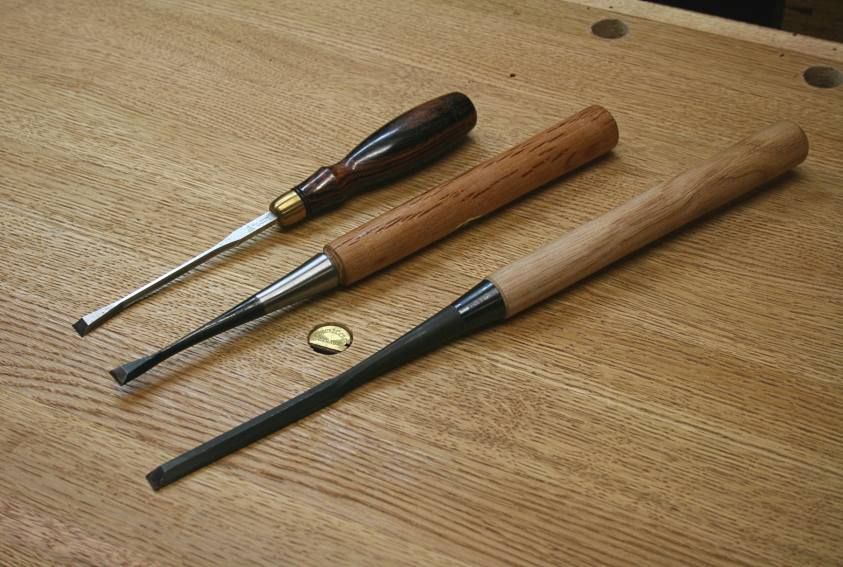
The Blue Spruce will take at least light hammering. With a steel hammer, so I'm sure a mallet would be fine. Here's the business end of three 3/8" chisels:
http://www.flickr.com/photos/78661951@N07/10087112024/lightbox/
Blue Spruce dovetail chisel at top; then an Imai fishtail; then an Imai shinogi (triangular section) slick at bottom.
Derek has covered the handles very well, and I find myself not even thinking about handles as long as it has one, so am not a good source on comparing them.
I like fishtail chisels--gouges too--but not especially because you need them to get into corners. The thing that differentiates fishtails for me is that, with the blade taper and the low bevel angle appropriate to a paring chisel, you have great line of sight to exactly where the tip of the chisel is cutting. I'm not guessing, I really can see that last fiber next to the wall getting sliced.
For dovetails, I ordinarily use what I have in my hand, a 1/4" or 3/16", even though there are skews and fishtails within reach. But I'd just as soon use what's in my hand already. In a dovetail socket corner, like the ones you have on drawer fronts, there are three approaches into the corner--vertically down from the top, vertically in along the side wall, and horizontally along the floor and side wall. Now the last of these three is where people want fishtails. But you have three entries, and the first two entries are square to the chisel, and a small chisel can be wiggled or stabbed into a back corner horizontally to get very nearly the last little bit, and you can easily rake out the remainder from the other two directions. So I use the one in my hand. That's just me, though, every one enjoy your skews in good health; there's room for everyone and every preference  .
Anyway, I find the fishtails are ones-you-reach-for detail chisels because of the clear line of sight they offer.
Yes, the Blue Spruce can be struck, though maybe it's a question of how much. i've used the one in the photo recently, at times giving it light to moderate taps with a steel hammer, and it didn't mind that. I find it entirely believable that Dave Jeske was malleting away on his. I don't think of a hammer so much as a bashing tool, as a controlled force tool. You can apply a very light sharp hit with a hammer that is hard to replicate with progressive hand force.
One reason I showed the longer slick is that it offers a way to apply controlled force, by putting the gripping hand under your jaw and leaning on the chisel--there's more control using body weight than straight arm force. Very useful paring end grain at the scribe line.
Wiley