We value your privacy.
We use cookies to enhance your browsing experience, analyse site traffic, and personalise content.
By clicking “Accept all”, you consent to our use of cookies. You can also choose
“Essential only” or learn more.
I have owned several scrub planes but I sold or traded them away as I seldom use them. The question is has anyone seen scrub plane marks on the flat surface of a board? I have heard that scrub planes were only used on the edges of boards to reduce width.
I have never seen scrub plane marks on old furniture, only heavily cambered fore or jack plane marks.
First off it is an honor to speak to you; I have enjoyed your articles for years and years. Obviously there is nothing much I can add of value that you don't already know from first hand experience.
A personal experience I can relate is that when working my tables of purple heart and bubinga I found the wood was so dense and labor intensive that my LN scrub was a life savor over say a jack with a very radiused edge.
Even then I was working the wood with a wipe of water and of coarse planing cross or diagonal depending on which tore out the least. The narrower but deep cut helped get the surface leveled faster than the jack and the blade on a jack just goes for ever without resharpening as compared to the jack; bevel up or down.
In the final inalises I may have taken more strokes but less effort per srtoke and with a far lighter plane.
Anyway that is the way it worked out for me.
As far as finding scrub monster tracks I would sugjest looking at the silly hard woods; rosewood and the ones I mentioned etc.
Are we discussing the Stanley #40 scrub plane, or a generic scrub concept?
How can you know whether the planing was done with a scrub with an atypically large radius camber, or by a jack with an atypically small radius camber?
When I bought my Stanley #40 from Patrick Leach, the blade was ground straight across, no camber at all. Of course, the first thing I did was to fix it. Then I replaced the totally beat up handles.
Does a scrub plane have a maximum blade width or a maximum camber diameter? For example, the #40 has a 1-1/4" blade, but the #40-1/2 has a 1-1/2" wide blade. With that one, and the work of a skillful craftsman, you might mistake the marks it leaves for the marks of a jack plane.
Are you referring to the operation of scrubbing instead of a "scrub plane?" Does the angle of the troughs with respect to the grain direction determine "Scrubbing?"
The reason I ask is because I have a very coarsely made vernacular walnut secretary at home whose surfaces were all planed 90° to the grain, and most of the tracks are not much more than an inch wide. It sure could have been done with a scrub plane, depending on the definition you are using.
I think Winton made a real good try at showing what a scrubbed surface looks like.
But in an old hand-tools-based cabinet shop, what would you use a scrub plane for? If I try to put myself in that situation, I could only imagine it would be for preliminary roughing, to get a board ready for cross-cutting and ripping into furniture parts--rather than being part of the furniture-making process proper. Course, I've been wrong plenty of times, and maybe this is wrong too. I can imagine wasting a quarter inch off the edge of a board, but I have a harder time imagining a shop owner having a quarter inch scrubbed off the face of a board for thicknessing--wouldn't he resaw it, and keep the offcut for something else?
In a somewhat related question, what kinds of roughing planes do we find in the few preserved cabinetry shops of yore? For example, is there a plane inventory for the Dominy shop, which has now been relocated to the Winterthur Museum? I suppose the olde cabinet shops in Germany had their shropphobels, but what about France, England, Netherlands, and early US?
We may be looking in the wrong country. Like you, Stephen, I have seen very little old work that looks like it might have come from what we call a scrub plane today. The evidence from old literature, catalogues, furniture and old tools all suggests that this tool was not used here until late 19th century. The Pennsylvania Dutch seem to have used the longer jack plane also. I think the term scrub plane originated with Stanley, roughly translating the German schrupphobel.
My Merriam Webster unabridged from 1886 lists fore plane and jack plane, but not scrub plane.
I think we would be more likely to find old "scrub planes" in Scandinavia, Germany, maybe eastern Europe. It would be interesting to look for old work in these areas that shows the use of this plane.
>wouldn't he resaw it, and keep the offcut for something else?<
Thasss axtly what I did.
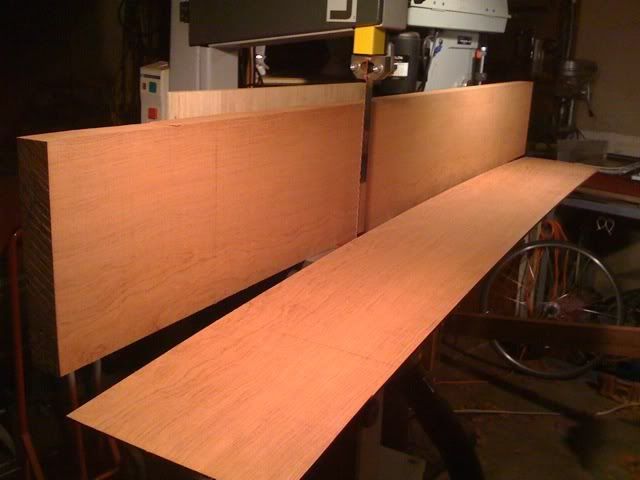
Once she was glued up of planks that were planed flat it still took some energetic hand tool work to bring everything into one plane. It is , for me, a large surface. Taking just an eighth of an inch off this stuff here and there is serious work.
It is very flat now and has remained so.
I tried many planes including #7s and the LN scrub was the cat's meow.
PS: you are looking at the underside in the second photo. The one board that stands out was thinner than the rest because it was slightly bowed and I planed the one side flat (the ends were thick as the rest) .
I use my pseudo scrub (heavily cambered, post-war #5) all the time. I get all my lumber rough sawn and depend on the scrub to get it flat before I run it through a planer. No scrub marks would ever survive to any final product.
There are nine planes in the Dominy collection with lengths between 15 1/8 and 17. The three illustrated in Hummel (two single iron, 40 and 45 degrees, one double, 40) are all made by the family and probably the other six are also. There were three benches in the shop. Hummel suggests some of these planes are worn out and others are replacements. Perhaps there is or was variation in camber also.
The Seaton chest had one single iron jack, one double iron jack, (both 14", 47.5 deg) and a double iron fore plane (missing). Neither of these collections have a scrub type.
No , i am no athority on antiques, but I understand the under sides and insides where the eye won't often look are going to be left pretty rough by the prepower planer people. There, on the noncritical surfaces, may well the elusive track of the cambered edge lurk.
Those elusive tracks might exist on the bottom sides of stuff, but I often don't decide which surface is going to be the bottom side until the piece is pretty well ready to put together. That means it's nigh unto done before that decision is made and ready to finish. Scrub marks just won't do. I don't know how things were done in antiquity, and sometimes I just don't care. I make furniture for pretty much one person, and she cares deeply how things look, even drawer sides, undersides of tables, etc. Her vote counts more than historical tradition
(Disclaimer: I am by NO means an authority) What I remember reading some time ago was that the Stanley "scrub" plane was intended for homebuilders to use for rough dimensioning of the timbers and joists used to build the framework and "foundation" of houses. They then would use a jack to bring them to final dimension as they started to assemble the house or building.
Of course, my wife says my memory is severely deficient :-)
I'm doubtful that Stanley developed their scrub in a vacuum without any knowledge of the European scrub or its general usefulness. They do fill several needs in general carpentry (at least they did in the days of white-overall carpentry) as well as in furnituremaking.
They are a tool that will remove a lot of wood in a hurry. So, use one when you need to remove a lot of wood in a hurry for whatever reason. Seems pretty simple to this Simpleton.
Although looking at the tooling marks on old pieces of furniture tells a lot in terms of the methods of construction, it should be kept in mind that there is a possibility of a false negative. The lack of marks indicating scrub plane usage does not preclude the possibility that they were used in the preparation of the stock, any more than the lack of sawmill marks on the boards indicates that the board must have been riven from a log.
I know about the dangers of assumption given a lack of primary data. In this case, the principle of it being easier to hog off wood with a plane with a narrower blade and more pronounced camber than a jack plane is universal enough that it's hard for me to believe that no woodworker ever used such a plane, even if Moxon or Nicholson didn't write about it.
Having said that, I also think that if you need a plane with more camber than a typical jack plane to prep your stock, then what you really need is a new lumber supplier.
An aggressive tool to remove stock quickly can be handy when making flat panels for doors, thin panels for the backs of small cabinets, etc. These are just two examples of when it's just plain easier to lay waste to a thicker glue-up rather than to glue thin boards which one probably would have had to resaw anyway. A little wasteful, yes, but the last time I checked wood grows on trees. I don't know how many sawmills saw to produce half inch boards; if you buy half inch stock from your supplier you can bet that a bunch of wood got left on the floor to produce it and it's priced to reflect this as well.
And as you've pointed out it is perfectly possible to use a scrub and leave behind virtually no evidence of it.
I have thought about your post for the last few days, Wilbur. You suggest that just because Moxon and Nicholson do not mention a scrub plane, does not mean that is was not used in historical work. But besides the two sources you mention, we have thousands of other sources from the period 1650-1880. They mention jack plane or fore plane, but there are no references to scrub plane in this period (or before). We don't see scrub plane anywhere except in other languages like schropphobel or skrubbhyfvel. Nor do we find short roughing planes in the many thousands of historic planes that have survived. And in a post just last week, Marc Waldbillig suggested that Germans did not use short roughing planes until the 19th century. I personally find the longer plane much less tiring over hours of work.
Here is a reference from Croker (1774)
Here is an advertisement from the Maryland Gazette by a famous cabinetmaker that mentions the jack plane. I have known about this ad for forty years. The jack plane reference is trivial, but this ad is famous because it is the first known reference to a sash fillister. If some reference to a scrub plane turned up from the 17th or 18th centuries, it would be famous as well.
Late to the conversation as usual, I'm going to theorize that the old furnituremakers were well aware of the principles of the subtractive side of their craft, and if they had a twisted or bowed board that needed flattening, they would have opted for *some* plane with a large mouth and a heavy camber to gnaw away those high corners or ends. Maybe they didn't have a name for it, and maybe the sole was more in the jack plane length range than what we think of as a proper scrub plane length, but they would have made the shortest possible work of getting those boards within the range of more refined planes, which would subsequently remove traces of the rough plane. I've also seen furniture backs and drawer bottoms with scalloped surfaces that probably weren't deemed important enough to refine any further -- either that or the craftsmen (or the customer) preferred the look and feel of that surface.


 [/URL]
 [/URL]
 [/URL]


