New WoodChat!
Home Articles Forums Gallery Marketplace Videos

WoodCentral Forums

Knowledge You Can Build On — Est. 1998

A natural, durable finish with minimal coats and fuss popular among woodworkers, flooring professionals, and furniture makers

Roubo bouvet, 10th tool

Posts

Roubo bouvet, 10th tool

#1

Roubo bouvet, 10th tool

Warren in Lancaster, PA

There were some discussions recently about minimum tool kits. I checked out Paul Sellers' 10 tools, but it looks like he means 10 hand tools to complement power tools, not ten tools altogether. For example, there is only one saw, a back saw, no way to rip a board.

There was a time when I really did work with about 10 tools. I have a candle box of figured cherry that I made in that era which I would not be ashamed to show today. I don't recommend this, but I used my one saw to resaw the cherry, rip, crosscut, and dovetail. The dovetails were not Perth style dovetails, but very neat and handsome nonetheless. I had several chisels, one bench plane.

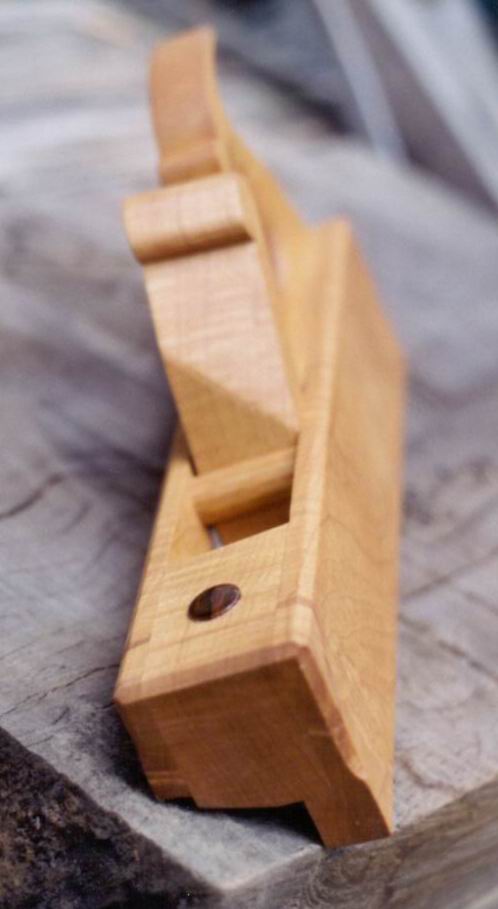
To make grooves, I made a Roubo style bouvet (plough), which was pretty easy to make with my spare kit. It has an open mortise. I well remember my reaction when I made the first groove: I could not believe how clean and crisp it was. This type of tool generally makes a cleaner groove than a universal plough or a table saw or router. Here is Roubo.


Re: Roubo bouvet, 10th tool

#2

Re: Roubo bouvet, 10th tool

david weaver

Warren, what is the composition of the applied side (which presumably becomes a skate). Is it metallic or is it wood?

Re: Roubo bouvet, 10th tool

#3

Re: Roubo bouvet, 10th tool

Warren in Lancaster, PA

The drawing is a little misleading. The body of the plane is one piece and the mortise is cut into the side. The dotted line you see in the front view is just the bottom of the mortise, hidden from the front. The mortise is the same depth as the cutter is wide . A universal plough has an iron skate because to accommodate a 1/8 cutter, it needs to be thin.

The reason this type of plane works well is because the "skate" portion is very nearly the same width as the cutter, so it really hugs the groove. Also there is a full width mouth ahead of the cutter so it works a little more like a moulding plane.

Re: Roubo bouvet, 10th tool

#4

Re: Roubo bouvet, 10th tool

Bruce, a MN Galoot

very neat. That looks like an invitation to make one. It would be handy to have a plough plane dedicated to something like grooves in drawer sides.

Re: Roubo bouvet, 10th tool

#5

Curious about your toolkit, Warren

Bill Houghton, Sebastopol, CA

Do you recall what your toolkit was in those simpler days? It would be an interesting conversation.

Re: Roubo bouvet, 10th tool

#6

Re: Roubo bouvet, 10th tool

Wiley Horne--So. Calif.

Warren,

Thank you for posting that image from Roubo! I have never seen that tool or that image before. Has anyone else? Isn't someone working on a Roubo translation? I am thinking Chris Schwarz and company.

I believe the French also had fenced ploughs at that time--Moxon's fenced plough is said (in Schwarz' book) to be identical with Felibien's from the late 1600's or so.

Moxon's plough has an iron skate, which he describes as being 'almost of the same thickness that the breadth of the plough iron is', which is similar to the point you made about the bouvet sole. And 'Joiners have several plows for several widths of grooves'.

Great post!

Wiley

Re: Roubo bouvet, 10th tool

#7

Stephen Shepherd

Re: Roubo bouvet, 10th tool

Stephen Shepherd

A number of years ago I made a long French pattern rabbet plane with the side wedge. It worked great, but I did loosen the wedge regularly so as not to warp the long body of the plane.

Do you loosen the wedge after use?

Stephen

Re: Roubo bouvet, 10th tool

#8

Re: Roubo bouvet, 10th tool

david weaver

Thanks Warren. It seems a plane that anyone should make if they do a fair number of drawer bottoms, especially given that the sole is sized for the iron.

Re: Roubo bouvet, 10th tool

#9

Felibien plough

Warren in Lancaster, PA

Wiley, I know you like plough planes. Here is the famous Felibien Bouvet.


The French ploughs usually have arms fixed to the stock, running through the fence. This one has open mortise, iron skate.

Here is a Roubo "two piece plough" with movable fence, single width iron. The wedges go completely through the fence stock. Roubo also shows iron skates.


Re: Roubo bouvet, 10th tool

#10

Re: Felibien plough

Wiley Horne--So. Calif.

Warren,

Those are very interesting drawings, which kinda point to the evolution of the plough from a simple direct tool to the more elaborate presentation-pieces of the 19th century. They express a perfect directness; nothing is extra to what is required.

The Felibien bouvet is the 'right-handed' version of Moxon's (which is shown 'left-handed'), so Moxon's printing process may have created a mirror image of the Felibien because the one is a dead ringer for the other. One thing I can't figure from the Felibien drawing is how the fence can be set close to the iron; on the Roubo, the fence is designed to snug right up as close to the iron as you want. I expect in real life, the Felibien fence would have been similar, with an L-shape at the bottom, allowing the iron to get close to the fence. Or maybe I'm missing something in the drawing.

Wedges. Moxon says that the Felibien-type operates on a friction fit of the arms through the fence stock, and that if the friction fit is too loose to hold your setting, you stick wedges in there to tighten it up. Perhaps the wedges evolved by necessity from the friction fit wallowing out over time. On the Roubo, I wonder how you loosen the wedges once they're tapped down to fix the arms.

Thank you for those great images! I do like ploughs a lot; dunno exactly why, but I like the forthright way they show their workmanship and purpose. I know, blah, blah, but that's as close as I can get :) .

Wiley

Re: Roubo bouvet, 10th tool

#11

Re: Roubo bouvet, 10th tool

Derek Cohen (in Perth, Australia)

Interesting Warren. Thanks for posting the pics and information.

There have been a couple of modern reincarnations of this design, although I do not think that the authors drew on Roubo for their inspiration :)

Rob Cosman demonstrated his plane several years ago and offers it for sale ...


Matt Kinney refers to these as grooving planes in a FWW magazine article, with instructions for building it ...


Neither offer the simplicity in construction of the Roubo, which would make them less daunting for many. I have built something similar (dovetail plane), and it really speeded up the process and remained solid in use.

Regards from Perth

Derek

p.s. apologies for overwhelming you with my dovetails :)

Re: Roubo bouvet, 10th tool

#12

Re: Curious about your toolkit, Warren

Warren in Lancaster, PA

Bill, here is a rough list of the tool kit I had before I made a jack plane, which was a big help.

8 p saw, rip

13 p sash saw

#4 plane

1/4,3/8,1/2,1 chisels

square

spokeshave

marking gauge

plough plane

rabbet plane

mallet

awl

knife

Re: Roubo bouvet, 10th tool

#13

Re: Roubo bouvet, 10th tool

wilbur

Very cool, Warren!

Here's a Japanese version, which adds an adjustable fence and nickers. It cuts a 1/4"x1/4" groove.


Here I used it to make one half of tongue and groove joints.


Re: Roubo bouvet, 10th tool

#14

Re: Roubo bouvet, 10th tool

Kees

Nice Warren. I have never taken these French planes very seriously because of this open mortice. Later the French nailed or screwed a batten to the side, not really improving the looks, but maybe making it a bit stronger.

However, I'm glad you brought it up. Do you think it makes better grooves then the ploughs with a skate?

Something to make grooves really needs to be in the basic kit. One of my first woodworking projects was a small jointed chest and I had to borrow an electric router because I had no idea how to make a groove otherwise.

Re: Roubo bouvet, 10th tool

#16

And a newer French plane

Kees

Here's a picture of a newer french moulding plane with the additional batten attached to the side, closing the open mortice.


img

Re: Roubo bouvet, 10th tool

#17

Re: Roubo bouvet, 10th tool

Warren in Lancaster, PA

Yes, both of these planes, Kenney and Cosman, are examples of fixed fence ploughs. This type of plane seems to have died out in the 19th century. Nicholson (London, 1812) writes "There are two types of plows, one in which the fence and stop are immoveable, and other which is universal. He then describes and illustrates the universal plough only. There is a fixed fence plough in the Dominy collection made by Nathaniel Dominy V in 1797. (East Hampton, N.Y.)

I talked with Asa Christiana at Williamsburg a few years ago and he encouraged me to look at the Hand Tool column in his magazine. The Kenney article was the next that appeared. My first reaction was does he not know that a right and left plough are unnecessary? A 45 plane can be switched to cut left handed, but who does this? If you are going make two planes, why not make a 3/16 and a 1/4 and increase versatility?

The more sobering issue was that the whole design was made for power tools and almost all the steps were done with power tools. In the one hand tool column. I realize that a lot of the readers are power tool users. However, the message seems to be that if you want to learn hand work, you must first accumulate machinery and learn to do precise work with it.

Re: Roubo bouvet, 10th tool

#18

Re: Roubo bouvet, 10th tool

Kees

I see what you mean, making handtools with a powertool aproach is weird. But most readers of such magazines allready have all the neccessary powertools, and no handtool experience yet. So it's kind of logical.

The same applies for Krenov planes.

Re: Roubo bouvet, 10th tool

#19

Re: Roubo bouvet, 10th tool

Derek Cohen (in Perth, Australia)

Hi Warren

Yes, it is a curious contradiction that hand planes are frequently made with power tools. As far as I can tell, most of the well-known wooden hand planes are largely made with power tools today: Old Street, HNT Gordon ... all use power to create the bed. The exceptions are tools from the East: China and Japan. And I may be mistaken there as well.

I imagine that the attraction of a laminated plane, such as the Krenov-type, lies in the use of a table saw to obtain accuracy.

Returning to the fixed-fence planes ...

Outside of a panel raising plane (this one is by Brian Buckner) ...


... and a mini version I have from Phil Edwards (UK) ....


But there are not many fixed-fence planes around today with a closed mouth.

There are fixed fence planes with open mouths, such as this half of a match plane I used as a drawer groover for a while ..


The disadvantage of groove-making fixed-fence planes is that they require one to have several planes, not only in blade width, but also in depth of the fence. You may groove all your drawers at the same distance, but I wonder how many do this. I know I do not - the groove width and distance depends on the size of the drawer, the weight it will carry, etc.

Using a #45 into the grain? I cannot see a problem working a plough into the grain as long as the outer lines of the groove are knifed.

I am curious to know whether you have more that one fixed-fence plane?

Regards from Perth (yes, home! :) )

Derek

Re: Roubo bouvet, 10th tool

#20

Re: Roubo, To Make as Perfectly as Possible

William Duffield

Yes, it is being published by Chris Schwarz at Lost Art Press. You can read about their progress in Chris's blog:

http://blog.lostartpress.com/2013/07/09/in-the-store-now-roubo-deluxe-edition/

You can order the Deluxe Edition now from this page:

https://www.lostartpress.com/ProductDetails.asp?ProductCode=BK-ROUBO-DELUXE

The Trade Edition, which will be much less expensive, will come along later this fall. Chris provides a lot more information on the two books of Roubo that they are translating and publishing here:

http://blog.lostartpress.com/2012/12/31/faq-to-make-as-perfectly-as-possible/

Several other posts on the same subject can be accessed if you look down the right side of the page to Categories, Books in the Works, and select "To Make as Perfectly…"

Re: Roubo bouvet, 10th tool

#21

And note the nickers

Wiley Horne--So. Calif.

Japanese ploughs are unique so far as I know, in having nickers. Sticking out the top of Wilbur's plane are two separate irons, with the appropriate wood spacer between them, which slice the fibers ahead of the plough iron. If motivated to, you can remove the fence when required, and have a 1/4" dado plane.

Wiley

Re: Roubo bouvet, 10th tool

#22

Ellis Walentine

Thanks, Warren

Ellis Walentine

Oddly, I recall making a version of this exact plane when I needed to plough a groove flush with the bottom of a rabbet in a solid door jamb/stop for a weatherstrip. Worked like a charm. Necessity is the mother of invention.

Ellis

Re: Roubo bouvet, 10th tool

#23

Re: Felibien plough

Lars Parrington

Interesting concept, exposed wedges on a not-through mortise. Might have to steal that one.

Re: Roubo bouvet, 10th tool

#24

Possibly silly question

Darren Brewster

The silly question is about these fixed plough planes. How do you know where you want the groove to be for the bottom of the drawer, since you can't adjust it you are stuck with the one option? How does that affect where you put your tails and pins?

A related question also about ploughing the groove. Does it have to be completely contained within the tail or the pin. What I mean by that is the tail is angled, so it is wider at the top than the bottom, so do you need to put the groove within the narrower bottom of the tail, or can it be closer to the edge? How about right in the middle? Maybe a crappy image will help.


Re: Roubo bouvet, 10th tool

#25

Re: Possibly silly question

Warren in Lancaster, PA

We like to have the groove completely in the tail so that the groove in the drawer front does not show on the side (does not interfere with the bottom pin). However it is usually near the bottom of the tail because a) we like to have the bottom pin rather robust, an b) we like to have the drawer bottom rather low for more room in the drawer.

The three dimensions of a fixed plough are the width of iron, the distance from the edge of the board, and the depth of cut. It is a little risky giving "typical dimensions", but for a full size drawer, a groove 1/4 wide, 1/4 deep, and 3/8 from the edge is often used. This allows for a drawer bottom in the 1/2 to 9/16 range. This gives 3/8 to fit your pin in. It is actually not too hard to alter the depth of cut or the distance from the edge if need be.

It may seem odd to dedicate a tool for one purpose like this, but some shops have a table saw or shaper or a router table permanently set up for grooves in drawers or door frames. A friend of mine has a 45 plane that is always set up the same.