What do you use to mark walnut?
What do you use to mark walnut?
Posts
Re: What do you use to mark walnut?
#2

Re: What do you use to mark walnut?
Jim DeLaney, Austintown, Ohio
A white pencil that you can find at either art supply stores or in the 'notions' section of a sewing supply (fabric) store.
If you're just marking it for parts identification, sidewalk chalk makes marks that are easily rubbed off afterward..
Re: What do you use to mark walnut?
#3Blue pen or pencil works well
Re: What do you use to mark walnut?
#4Re: Black Pilot P-500 Gel Pen
Re: What do you use to mark walnut?
#5nothing works better
Bill Tindall, E.Tn.
Gel ink reflects light so that the black ink on the black wood lights up as a distinct line. Any gel ink will do but the pilot ink wicks less than others. I marked out dovetails with this ink just yesterday.
Re: What do you use to mark walnut?
#6Re: nothing works better
William Duffield
I buy them by the dozen, because the tips are rather fragile.
We all need to thank Bill for figuring out how well they work and posting the results of his experiments here on Wood Central several years ago. Much more effective than anecdotal responses, IIRC, Bill took a piece of walnut into an office supply store, and tried out all the types of pens they had for sale, testing for visibility and minimal wicking.
Regrettably, they don't work well on cocobolo or wenge, probably because these woods are so oily as well as being darker than walnut. For these, I use a white or yellow lead, similar to these: http://www.sequoiaventures.com/iPenStore/Rosetta/DaVinci/Davinci2LeadYellow600.jpg, in a 2mm lead holder (AKA, drafting pencil or mechanical pencil), similar to this one: http://content.etilize.com/Large/11970548.jpg. That's quite a bit more effort, because to keep it sharp, you need a drafting pencil lead pointer, similar to this one: http://www.lostmag.com/issue26/images/TruPoint.jpg
Re: What do you use to mark walnut?
#7Pencil Monogamy.....
roger lance
I use a number 2 to mark everything.....doesn't always work well....but I'm trying to minimize my tool kit.
Re: What do you use to mark walnut?
#8
Re: What do you use to mark walnut?
#9Re: Pencil Monogamy.....
Tony Wilkins
But how does it pare in the middle of a dado during a full moon after being sharpened with natural Japanese pencil stones
Re: What do you use to mark walnut?
#10Re: What do you use to mark walnut?
Derek Cohen (in Perth, Australia)
For what purpose, Tony?
Tenons, dovetails, other?
Regards from Cape Town
Derek
Re: What do you use to mark walnut?
#11Re: What do you use to mark walnut?
Tony Wilkins
Three purposes I can think of Derek.
1. Marking out long rips and third class saw cuts
2. Darkening a knife line
3. Marking grain direction, cabinet makers triangle, etc
Re: What do you use to mark walnut?
#12Marking tools that serve me well
Bill Tindall, E.Tn.
1. the Pilot gel pens for fine lines and any gel pen for less precise lines. (high visibility marking on finished lumber)
2. A 0.5 mm drafting pencil (routine marks on finihsed lumber and darkening scribe lines)
3. "sidewalk " chalk (identification marks on all lumber)
4. lumber crayons- (rough lumber)
5. common soft wood pencil -(for pencil marks on rough lumber)
Re: What do you use to mark walnut?
#13

Re: What do you use to mark walnut?
Adam of Oakland
I've found Mr. Cohen's use of blue masking tape to be remarkably helpful, especially with darker wood
Re: What do you use to mark walnut?
#14Re: What do you use to mark walnut?
Winton Applegate
Just for variety's sake I will add that for finer lines, say for dovetails, Jim Kingshott would knife and scribe as normal then rub a stick of chalk across all the lines,, and then wipe off the excess and the chalk would be down in the lines and be a very visible white line. Works for me.
Re: What do you use to mark walnut?
#15Re: Pencil Monogamy.....
Winton Applegate
Minimalist tool kit.
For harvesting the timber, rough milling, layout, dimensioning, and finish planing; my minimalist tool box contents consist of the following :
Sharpened rock.
I am working towards using an all natural as found rock but am having some minor problems with my technique.
I'll get'er though. Just takes practice.
Re: What do you use to mark walnut?
#16Re: What do you use to mark walnut?
Derek Cohen (in Perth, Australia)
Hi Tony
The reason I asked the question was to determine if any of the markings were for joinery, such as tenon shoulders and dovetails. As Adam has mentioned, the use of blue tape (or any other colour for that matter) facilitates a much cleaner line to cut to. This far exceeds what you get from chalk-in-a-knifeline. The reason for this is that the knifed line becomes wider as it is made deeper. Often one deepens a scribed line for visibility in dark woods. There is also the danger then that the saw will drop into the line rather than be permitted to cut against it. When one scribes on tape, the pass of the blade may be quite light as this is enough to cut through the paper.

Here is a reference to an example: http://www.inthewoodshop.com/Furniture/HalfblindDovetailsinJarrah.html
Regards from sunny Cape Town
Derek
Re: What do you use to mark walnut?
#17Noe wait a minute
Ron Harper
Surely not the same No 2. I can lose three without moving my feet.
Re: What do you use to mark walnut?
#18Yup....just the one and only.....
roger lance
should be able to get a few more months out of it......then a brand spankin new one in the fall !!

Re: What do you use to mark walnut?
#19Are we sure ?
Winton Applegate
Keeping firmly and respectfully (and frankly jealously ) in mind Frank Klausz marked out with a rather dullish pencil and sawed dovetails that fit together first try . . .
Just like the cool guys here with our "Superior" layout knives and other crutches.
Bear with me a minute and take a look at my pretty drawing.
(the depth of the deep line is greatly exaggerated and will come off with a pass or two of a hand plane during fitting the drawer to the cabinet.)
It was very late this morning when I read the masking tape post.
I made some notes and took some quick photos but ran out of steam before I could get off a short volley.
Since then things have settle to the bottom and most of that work went in the trash as pointless pontification, or as my mother used to say "talking to hear one's head rattle" . It was all quite thrilling at the time but as with many late night escapades with a newly acquainted companion things can look quite different in the morning.
Oh yes . . . startlingly, appallingly, chillingly different. So different that you may be considering . . .
. . . . well any way . . . where were we ?
So this evening I chucked most of that and decided to cut to the quick as it were and post this. Normal line too wide; indeed. Thinking men (and women) unite. The latest is not always the greatest.
Before you place that order for, chuckle, a case of blue masking tape.
I beg you
I plead with you . . .
well do you really want to be picking at all those little pieces of tape and having the "GOOD" bits come off or move because you DIDN'T cut deep enough . . .
. . . or can you imagine if and WHEN you accidentally brushed it with the saw and peeled off the "GOOD" bit ?
But I am getting back into last night's rather pointless points. Raking up settled muck that is best left for archeologists to discover and pick through.
PS: forgive the errors : saw kerf wrong side and waste tape wrong side. This is why "X" marks and editors are so important to flawless work.
Happy thinking.
Re: What do you use to mark walnut?
#20Yes I'm sure!
Derek Cohen (in Perth, Australia)
Hi Winton
Thanks for the chuckle! You certainly put a lot of energy into your post, not to mention this diagram ...

I'll also cut to the bottom line .... the width of the line does matter, especially as the wood you are using gets harder and lacks any capacity to compress. When you dovetail together woods such as Jarrah or Curly Marrie, which I have recently reported, you have to be spot on.
Dovetailing is just about sawing to a line. Nothing that some practice and correct technique should not guarantee. The issue for me, and others in the same boat, is seeing the line to begin with! Dark woods are really difficult for me.
So what about chalk-in-the-line?
I have not had much luck here. Firstly the end grain for the above woods requires considerable downforce to mark, and the greater the downforce the more one is in danger of moving the work pieces. Secondly, a sharp knife is needed, and this leaves a fine line - one that is then difficult to see and (if you are thinking of using chalk) closes up rapidly.
The tape is sliced by a sharp edge and leaves a clean line. Blue tape (certainly as found in Oz) does not move, and then peels off easily without leaving any residue. When I saw hardwood dovetails I will cut minutely into the tape. This is akin to splitting the line. The result is a saw-to-saw joint. All the dovetails in my kist, carcase and base, went together 98% off the saw. No adjustments required. That must say something, yes?
I could write so much more about this method, but I have already bored the pants off everyone else.
Keep up your posts. I do enjoy them! 
Regards from Cape Town
Derek
Re: What do you use to mark walnut?
#21Re: Yes I'm sure!
Tony Wilkins
Not bored at all Derek; hadn't thought of that solution in any shape for fashion. In fact, a lot of good ideas here. Hope it's helped others as well as me.
Re: What do you use to mark walnut?
#22A little more: a part I neglected to comment on ..
Derek Cohen (in Perth, Australia)
Keeping firmly and respectfully (and frankly jealously ) in mind Frank Klausz marked out with a rather dullish pencil and sawed dovetails that fit together first try . . .
Just like the cool guys here with our "Superior" layout knives and other crutches.
There is a difference in marking out "pins first", as FK does, and "tails first", as I and others who may do. FK does not mark the pins before he saws. Running a pencil inside the pins (to transfer to the tail board) does still require a sharp pencil. Something blunt that runs outside the board is not conducive to accurate sawing. When I saw tails first I use an awl to scratch the lines.
One does not need a "Superior layout knife" for wide dovetail tails. However, once they narrow to opening the width of a saw blade, as in "London" dovetails (yes I know that there is no such term outside the forums ), then one requires a narrow knife blade with which to mark. Indeed, some of he very pointy dovetails I and others make are still too narrow for the average dovetail marking knife. One of the advantages of saws pins first is that you do not need a dovetail knife (there are advantages to going tails first, so the choice is yours).
Certainly, when marking London dovetails, the blue tape method absolutely RULES. Try it and see for yourself.
Just showing off now
This ...
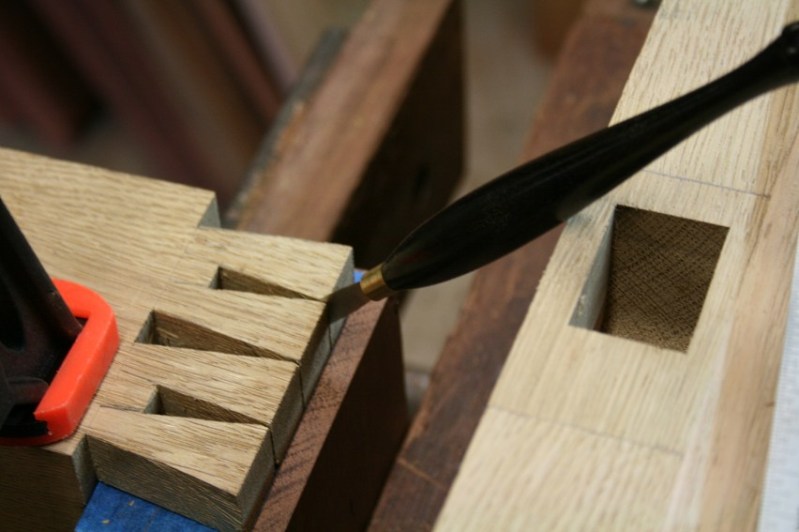
... gets you this ...
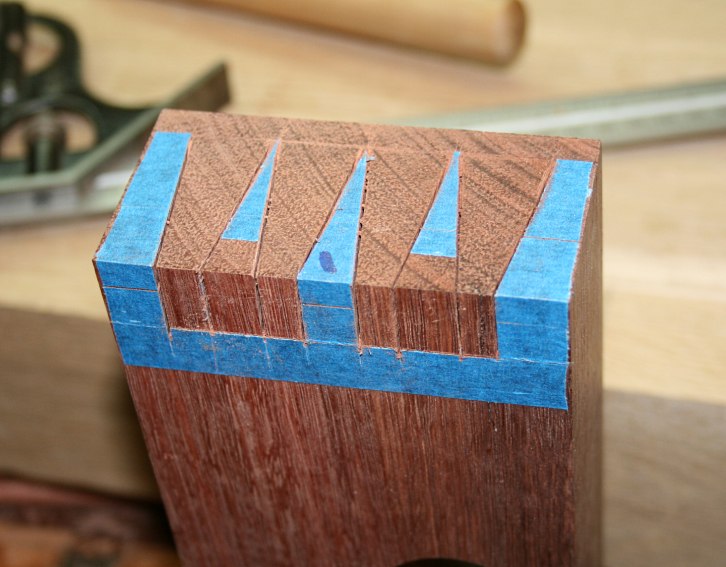
... and these ...

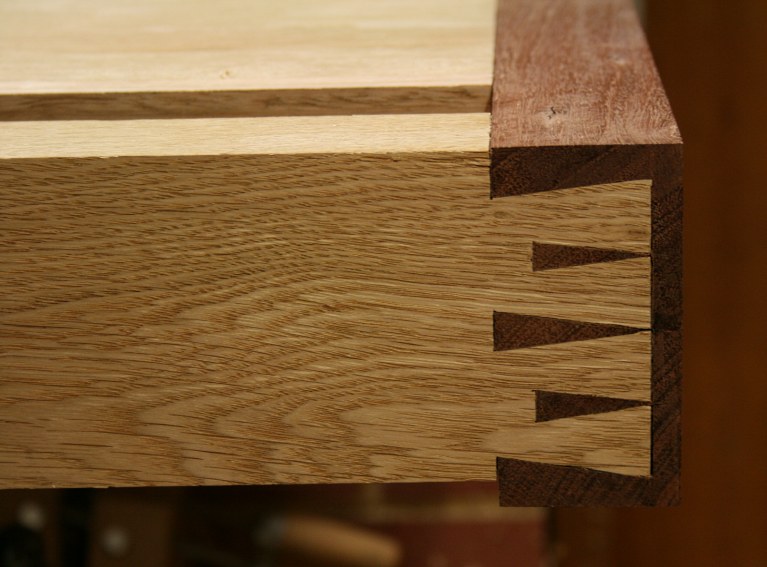
Details here:
http://www.inthewoodshop.com/ShopMadeTools/BuidingaBench4.html
Regards from Cape Town
Derek
Re: What do you use to mark walnut?
#23Re: A little more: a part I neglected to comment o
Winton Applegate
OK I can see the not seeing thing.
PS: Ha, ha, ha I realized after I made up this post that I am using this tape mark as a saw line at work all the time, though not for precision work. I have to cut off a threaded metal tube, about 1-1/8 " diameter, occasionally. The accuracy needs to be +/- 1mm. More like + 0/-1mm. We have a fancy saw guide tool designed by a fool and it is too much messing with and time to use. I can't mark on the metal with a magic marker because it is threaded. What to do ?
Why wrap a piece of masking tape around it of course and cut to that ! ! !
The tape has just enough width to , when the edge is ended with the edge I started, produce a square enough cut.
So seeeee I'm an old hand at cutting to a taped edge.
Ha, ha, ha
The comment with which I had a problem , or at the time thought I did, was that the knifed line was too wide or (I get what you say but can't quite put it in simple terms).
Such as
But too wide sometimes, when the saw drops into it. Other times not wide when the wood is too hard and so is hard to see (certainly not walnut) I was just thinking walnut. For walnut the chalk works exceedingly well.
The tape sure makes a nice, non-drop-in-able, place to align the saw for the cut.
"NDIAM" not catchy. Maybe "NDIA Mark". Could be a whole new field of research. There are probably government grants available. If we have to have marks we may as well have well made, government approved, marks without those awful pitfalls of the past,
And I thought all that pain was just part of woodworking.
To see the lines for precision sawing in general I go with these; the long focal length . . .
What follows is an excerpt from a post in another, albeit disreputable, forum.
I like these things ! ! !
http://www.fdjtool.com/ProductInfo/lm800.aspx
Batteries last a good long time.
Being a hopeless tool turkey I have three headset/visors and four lenses of different mag. � Only one lighted. � It is especially great for seeing down into mortises.
Be sure to get the optional loop.
I use them for many other tasks besides woodworking.
I use the high power for sharpening if I have a problem with the edge. � One must have the visor within a couple of inches of the work for that one.
I have a weak one for sawing dovetails that can be well away from the work. � Two more in between.
My eyes were fine until I started spending all my time in front of the computer screen in this damned chat room.
: � )
end of excerpt
As a side note I think what you are doing on the wood is the equivalent of what you and I might do to mark fine lines on metal.
You are bluing the wood.
Albeit with a bolder though accurate line. I got it.
Metal working layout lines:
(talk about FINE lines and hard to see and to cut to closely. Dammed paring chisels just DO NOT hold up for this work either).
That is, apply blue dye to a polished metal surface and when we scribe through the dye the shiny metal shows through the matt blue as a spider web thin line.
http://www.youtube.com/watch?v=kqxgzpobygM
For those who want to see go here and skip to just a bit before the middle of the youtube. (For anyone who was confused about my comment in another forum on the use of the prick punch for precision hole location and saw blade handle hole drilling this is your video.) (in some cases a more useful punch is a transfer punch for transferring hole locations from the handle to a saw blade to be mated to the handle.)
From the moment I read your original post I thought of artist's frisket.
Probably the blue tape works just fine, as in deed you have said it works just fine.
I hear that and am not disputing it.
Now.
But, have you experimented with high tack artist's frisket.
http://www.amazon.com/Grafix-Extra-Frisket-12-Inch---4-Yards/dp/B0065F1OS6/ref=sr_1_1?ie=UTF8&qid=1373824065&sr=8-1&keywords=grafix+extra+frisket
Leaves a clean hard line and is a material designed for the type of thing you are doing.
One reservation is it may not bend well at a ninety degree corner. It is very thin though and so it may do fine. I have only used low tack and on flat surfaces and it has been a while at that.
What do you or others think ? Probably the only advantages would be a harder, non stretchy line, easier cutting (it's only purpose is to be cut to leave a clean edge) and perhaps more tack (also does not leave glue behind)
See, I can and did go on and on. I encourage you to do so as well. Somebody in another forum said they wouldn't argue with you. My reply was "Why not, at the very least we will learn something".
PPS: I see that you did go on and add more ! Good man !
Hey I thought I recognized the exact same pins from your new work bench vise and I was right ! At least my visual/memory isn't completely gone. Yet.
You're right, no tape edge snagging or pealing up-age in that photo.
Yes I was picturing FK marking between his pins with a pencil, on light colored wood (pins first/tails last). As far as my saying it is a dullish pencil point, he doesn't seem to twirl or spin the pencil as he marks and even if he did I bet it gets a bit roundy and less accurate after a couple of drawer sides.
I always say "Let me see him do that in some really hard wood" but he probably would just go on and do it.
PPPS: does anyone know where I can get the best price and a case of blue tape ?
PPPPS: I still think you need a real Klausz tail vise.


