New WoodChat!
Home Articles Forums Gallery Marketplace Videos

WoodCentral Forums

Knowledge You Can Build On — Est. 1998

Support WoodCentral when buying things you need

Bailey Style Plane question

Posts

Bailey Style Plane question

#1

Bailey Style Plane question

Tony Wilkins

I've been using wooden planes since I started because I thought they would be better for my now weak body. I have a cheap #5 that the post office virtually destroyed; I was playing with it the other day and before deciding not to waste any more time on it I decided it might be worth a try to see what a better metal plane would be like. I'm looking at a jack but maybe a jointer This leads me to a couple of questions:

A. in the bevel down world, how does the user experience differ between Lee Valley and Lie Nielson planes?

B. Am I crazy to think that 'moving down' a number would work - i.e. setting up a #4 as a Jack (cambered blade, opening mouth etc.) or a #6 as a short jointer?

TIA,

Tony

Re: Bailey Style Plane question

#2

Michael Donaldson

Re: Bailey Style Plane question

Michael Donaldson

A. Lee Valley and Lie Nielsen planes both work extremely well, and both are a joy to use if they are sharp and set up properly. The tote geometry between the two is different, though. The Lie-Nielsen is patterned after the Stanley Bedrock planes, so it would feel similar to the jack plane you have, as far as the tote is concerned. The Lee Valley planes are a more modern take on traditional planes, and tend to have a steeper tote angle. If possible, I would recommend trying both out before you buy, as both are quality tools, it really comes down to preference.

B. Not necessarily crazy, but why? I suppose you could set up a #4 as a jack, but I don't see what you would gain over the #5. I use my #6 as a jointer all the time, if the size of the work piece warrants it. I've made some really small boxes where I actually jointed with a #3 because a 22" plane on 3" piece of wood is ridiculous. Bottom line, set up your tools how they work for your woodworking style. If you are getting the results that you want, you're doing it right.

Re: Bailey Style Plane question

#3

craigd

Re: Bailey Style Plane question

craigd

Regarding B, if the muscle strength is a problem, then a smaller iron and lower blade angle is the direction you want to move in; they will be easier to push. Probably my favorite plane size is a #3 and I have several that I use regularly, set up for sorta rough work or smoothing. I've also used them for edge jointing.

You might also want to check out Japanese planes, they are lower angle than Western planes and the way you use them is more conducive to using your whole body to move the plane (rather than just your arms).

Re: Bailey Style Plane question

#4

What about bevel up?

Tony Wilkins

Hadn't thought much about them but I've seen that bevel up planes can be good at the low angle - mightn't that fit my needs?

Looked at Japanese planes and have an inexpensive one. I like them and will probably get a bigger/nicer one eventually but right now I think western planes better fit me.

Re: Bailey Style Plane question

#5

Re: What about bevel up?

Patrick Gibbons

Bevel up planes are tougher to push through wood. There is more resistance. Why not try a junior jack for a lighter jack plane. If a lighter plane is desired, than an older, quality plane will be a better choice than LV, LN, Clifton. Old Stanleys, Millers Falls, etc are lighter planes than new premium planes.

Re: Bailey Style Plane question

#6

Bevel up tougher to push?

Alex Y

Bevel up planes are tougher to push through wood.
I've never heard that before. Why?

I don't disagree with your statement, because I don't have any really valid comparison. But I am surprised. My only experience with BU are block planes and a LV Low Angle Jack, with which I have had no problems with excess resistance. But I don't yet have strength issues, and I don't have comparable bevel down planes to compare. The closest comparison is my vintage #8, and I haven't noticed that my #8 is easier to push than my LAJ, unless I have a high-angle blade in the LAJ.

Why would a BU plane be harder to push, if they both were meeting the wood at 45*? And it seems the BU would be easier to push if, e.g., you were using a blade ground at 25*, for a 37* angle of attack.

Re: Bailey Style Plane question

#7

It is the other way around

Derek Cohen (in Perth, Australia)

Bevel up planes are tougher to push through wood. There is more resistance.

Sorry Patrick, but that is completely incorrect. It is the other way around.

Theoretically, there should be no difference in pushing two planes, one BU and the other BD, both at the same cutting angle, regardless of how this is achieved. However there is more to it than the angle of the included bevel - there is also the factor of centre of effort. BU planes have a low centre of effort, and this allows one to expend less energy when pushing the plane.

See here for a more detailed explanation: http://www.inthewoodshop.com/Commentary/ToolingForFeel.html

If you really want to experience a plane that is hard to push, compare a BU smoother with a 60 degree included angle versus a BD LN #3 or #4 with a 50 degree bed (that's 10 degrees lower than the BU plane) but with a closed up chip breaker. I get excellent results from the BD plane set up this way, but it takes more than twice as much effort to push through the same wood.

Regards from Perth

Derek

Re: Bailey Style Plane question

#8

Re: Bailey Style Plane question

CStanford

There is no iteration of cast iron (or bronze) plane that you will find easier to push than a wood-bodied plane. Any suggestion otherwise is doing you a disservice.

Re: Bailey Style Plane question

#9

Re: Bailey Style Plane question

John in NM

Can't help you with the first part, but B is easy. For a jack plane there is the 5 1/4 size. It's narrow like a #3 but longer than a smoother. No idea why they made it (or why Stanley did half the stuff they did :D ), but one of those would answer well for lighter yet longer.

However, factoring in the strength problem, I too think you're better off sticking with wood planes. A wood plane with a waxed sole and sharp blade is quite easy to move along.

You might also try some of the Asian style that are pulled rather than pushed. Although I know very little about them, it seems that pulling the plane gives you a mechanical advantage when range of motion is limited.

Re: Bailey Style Plane question

#10

Re: Bailey Style Plane question

Tony Wilkins

I know you're right and that's the reason I got the woodies to begin with. I guess I'm curious; when I tried the broken Union (IIRC) #5 I got cheap it didn't feel too bad.

Re: Bailey Style Plane question

#11

Re: Bailey Style Plane question

cstanford

Just a different feel. Change can feel good for a short period of time. No way a metal jack will be less fatiguing than its wooden counterpart.

Re: Bailey Style Plane question

#12

Maintenance

Bill Houghton, Sebastopol, CA

If you go with a metal plane, wax the sole (furniture paste wax) often, and keep the iron atom-splitting sharp. Both of these will reduce effort. Also, yes, consider one of the narrower planes - 5-1/4, 3. Lighter and less pushing effort.

Re: Bailey Style Plane question

#13

Re: Bailey Style Plane question

Tony Wilkins

You are correct. I think I'll hold off on the metal plane for a bit, got much else I need more.

Re: Bailey Style Plane question

#14

Re: Bailey Style Plane question

Wiley Horne--So. Calif.

Hi Tony,

The answer to your question requires knowing the exact ergonomics of your planing posture. Do you sit to do this work? Or do you get your legs and back into the planing stroke? Is the weakness in your hands, or arms/shoulders, or lower back, or everywhere?

Is the difficulty in starting the cut, or in following through once the cut has begun? Where does strength begin to fail first?

All of our answers are pretty much shots in the dark, without knowing what's actually going on. I think you can feel support in discussing these matters, though they are personal, because you're talking to people who have seen a lot and experienced a lot themselves.

Wiley

Re: Bailey Style Plane question

#15

Re: Bailey Style Plane question

CStanford

Keep the bottom waxed or make an oil wicke. Keeping a candlestub from a hard, household candle somewhere around the bench seems to be the easiest route to take.

Re: Bailey Style Plane question

#16

Re: It is the other way around

Patrick Gibbons

I won't dispute that I am wrong. I used to have a LN bevel up jack that I used with a higher bevel for tough wood. Configured that way, it was tough to push through wood compared to a 45' angle. I never liked using it and later sold it. That impression of being harder to use stayed with me. I've not thought about the increased angle till now. So yes I'm wrong. Like Pavlov's dogs, I reacted rather than thinking. Sorry, I stand corrected.

Re: Bailey Style Plane question

#17

Re: Bailey Style Plane question

Patrick Gibbons

5 1/4 is a junior jack like I mentioned above. I believe they were used a lot in shop classes because they were lighter for young students.

Re: Bailey Style Plane question

#18

Tony, have you tried a Krenov plane?

Derek Cohen (in Perth, Australia)

I was wondering what style or shape grip would suit you best, with your reduced hand strength.

Wooden planes have an advantage for you in that they are light and naturally slick on wood (although metal planes become slick if you squiggle wax on them).

A low centre of gravity plane should also be easier to push. For example, a low slung Krenov-styled smoother should be less effort to push than a high sided coffin smoother.

Combine this with a custom hand hold (Krenov was well known for doing this), which places the effort on the palm rather than the fingers.

For example, a while ago I built two smoothers, both bevel down with a 55 degree bed, and both with a 1 3/4" wide 3/8" thick blade. The Krenov used a double iron by Hock and the coffin used a single tapered iron. They are essentially the same length, around 7".

The coffin is pretty traditional (one piece construction) ..
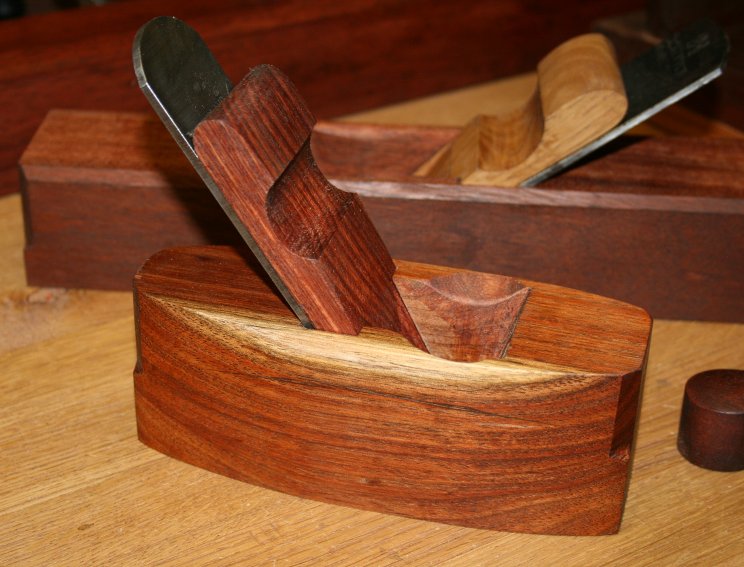

You are used to using one of these. It is very similar to your Old Street.

The Krenov has a low slung hand hold ...


Here is a Jim Krenov-made Krenov. You can see how he shaped the body to fit his hand ...
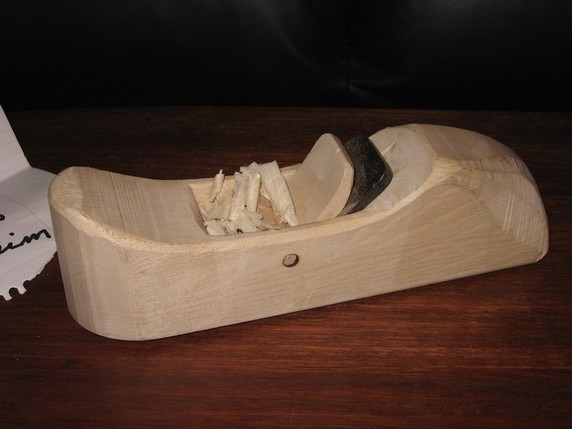

When I use these two smoothers alongside one another, it is evident that the Krenov is the more comfortable ... for me. I do not assume that this preference will extend to others. It requires more pushing forward than pushing down. The coffin does require more concentration and effort to keep it flat.

Have you tried a Krenov smoother or trying plane in this style?

Regards from Perth

Derek

Re: Bailey Style Plane question

#19

I see that now.  I didn't read that post before.


Re: Bailey Style Plane question

#20

Re: Tony, have you tried a Krenov plane?

Tony Wilkins

That's a great insight Derek. I have eyed but not tried a Krenov style plane. I've though about getting one of the Hock block plane kits. I've also seen the planes that Scott Meeks does but am a long way from affording on of those (especially the try). I might have to bite the bullet and attempt to make one.

Re: Bailey Style Plane question

#21

Re: Tony, have you tried a Krenov plane?

Derek Cohen (in Perth, Australia)

Tony, the Hock kits look good value-for-money. Keep in mind that these do not correctly follow the heart of the Krenov design, which in my eyes is the cross pin design. Krenov shaped his to rotate a flat section, which then offered maximum registration for the wedge. The Hock kit offers a dowel, which creates a tiny area of registration. Of course this piece is easy enough to replace. However, if you are doing so, you may as well make the whole thing from scratch.

The Krenov laminated design is essentially a machine-made plane, with only the shaping at the end done with rasps.

There is a detailed pictorial on my website: http://www.inthewoodshop.com/ShopMadeTools/BuildingaKrenovSmoother.html


Regards from Perth

Derek

Re: Bailey Style Plane question

#22

Re: Tony, have you tried a Krenov plane?

Tom

I actually think the pin is the main flaw in the Krenov design, which I have been making since the late 70s, and know a bit about. When I make them I make the wedge as low profile as possible there is a drawing in one of his books that illustrates this well, and I try to shave down the pin that Derek has illustrated so that it has no thickenss greater than the pin above and below the dowel end. This provide everything Derek mentions while not so badly closing down the shaving escapement.

I also keep the vertical rise minimal at the mouth. Krenov often used a curve there, but it is easier to get a glossy result if one uses a flat surface as Derek shows, but there is no reason I can see to such height. The angle should parallel the breaker, and keeping it low say 3/16th. Too little may make it a little flexible, but I have never really seen that happen. The design here is closest to the Japanese, and their planes have far less vertical height. Actually planes like this are delightful with japanese blades, though it require a some additional cuts.

Speaking of the "flaw" I have the plane making video that Jim and the School did, and they pull a shaving with every stroke. That indicates they did not have proper adjustment, or proper geometry. So as great as they are, they can easily be improved.

Re: Bailey Style Plane question

#23

Re: Tony, have you tried a Krenov plane?

Tom

By the way, the ramp above the mouth, I usually lay that off as much as I can, even 45 or 35 degree. I can't say I have measured it. Works fine and reduces the chance the shavings will get trapped.

Re: Bailey Style Plane question

#24

Re: Bailey Style Plane question

Tony Wilkins

I put in some good (for me) work on a shaker style table in walnut. My wooden jointer was too large for the little 1 1/8" leg. Used mostly my Old Street Jack and my wonky Union #5. Don't know exactly why but I much preferred my metal plane. That was even with it's loose tote that won't tighten.