Re: Chisel Handle Sizes - Ritzy
Derek Cohen (in Perth, Australia)
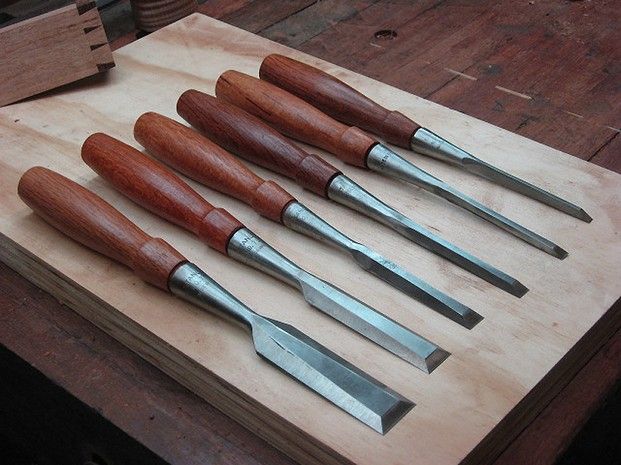
I think all those chisel handles have bad ergonomics, though obviously this is determined by what the rational is. Back in the 70s when I was building a lot of fly rods, I came up with my own handle design. I was attracted to handles like those shown by Derek, which in the fly game are called half wells. Mainly I liked the aesthetic. I was at the time Reading Charles Ritz's biography (that Ritz,yes). He had his own grip which was an inverted carrot, the reason for that being that it fills the thumb index area more naturally, but his grip was straight tapered. I built a grip like that and really liked it, so I came up with my own design which combined the Ritz taper, the half wells contour, and a swell to incorporate the uplocking reel seat.
Anyway, on chisels. The handles shown are the poorly designed half wells, the Japanese handles (though oddly not their push chisels) are the ritz, and a hybrid does not seem to exist, though given all the options someone probably has it.
The design points are: Design the grip so it does not cramp the hand; so that pushing the chisel is will supported, and in that mode follows the contours of the hand; and so that hammering does not cause an energy transfer into the hand. (or however you wish based on real world factors and not just the fact that someone else has the design).
Hi Tom
I Googled and found a Charles of the Ritz chisel handle. I must argue that it does not look very comfortable, and indeed a little fragile ..

The topic of chisel handle ergonomics could probably fill a few books. It certainly would make a great discussion, if not because all here have used a chisel, have a favourite one, and can pass an opinion.
Let's say that we want to design a handle for someone that experiences difficulty with hand strength. The tasks they want to use it for include dovetailing and general bench work. What would you advise?
In a case such as this I would immediately recommend a Japanese dovetail chisel, such as the Koyamaichi ...

These are fairly short chisels with short blades and handles.
Here is one alongside a standard Stanley (=LN) #750 and another long-handled version ..

The advantage of the Koyamaichi is that it does not require hand strength at all for tasks where it may be tapped with a gennou. The gennou imparts control and downforce.
That short handle on the 750 should work in the same way.
By contrast, I would not enjoy either of these chisels for paring work. While they facilitate pushing with the heel of the hand - and in the case of the 750, that finger grip offers additional leverage - their short length makes it harder to judge angles.
For paring work I prefer a longer chisel. This is the reason for the extended 750 handle - and that is my hybrid handle for paring and hammer work. What is interesting for me is that the Veritas handle is very similar (if you include the ferrule), both in length and girth.
Veritas and LN, again ...

Does it matter whether the extension is in the handle or the blade?

My preference is for a longer handle, as in the Japanese slick here. I just feel that I am working closer, and this creates more feedback. Is this the same for you? What is your preference?
Regards from Perth
Derek