New WoodChat!
Home Articles Forums Gallery Marketplace Videos

WoodCentral Forums

Knowledge You Can Build On — Est. 1998

Find a woodworking club near you

Update on Kist.

Posts

Update on Kist.

#1

Update on Kist.

Derek Cohen (in Perth, Australia)

Here is an update on the kist, or blanket chest.

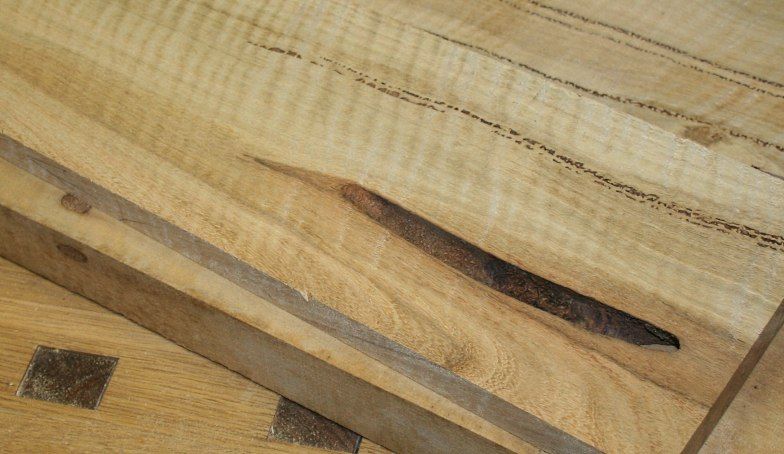
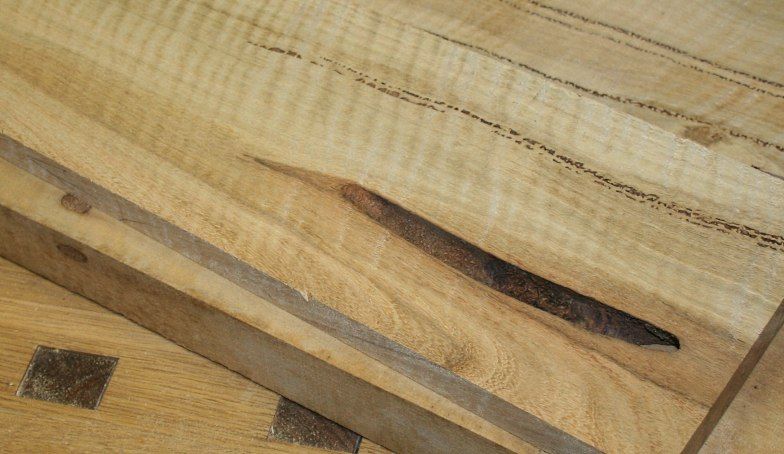
One of the issues that I faced when building from Curly (or Fiddleback) Marri was that it is far from being clear wood. It is filled with veins where resin has dried and fallen out. These need to be filled with black-tinted epoxy. However, too many of these would make the wood look like a Dalmatian. :\

Here is an example. This goes all the way through the 3/4" board ...

I had started with 10" wide boards. By the time I had cut around these, some were only 4" wide. It was going to be necessary to join boards to reach the 20" panel width I required.

Joining boards is complex enough when there is figure to match, but here this was further complicated by the fiddleback in the boards - having this run in any direction but with each other would made the combination untidy and accentuate the fact that several boards were used. I think most of us try to make joined boards look like a single, wide board.

I am curious what others do to match boards - go through lots of stock to find the widest, best matches? Tint/stain boards to hide colour changes? What do you do when there is just enough for the piece one is building?

I really only had just enough for four sides and the lid, and spent quite a bit of time moving around boards to create an integrated, interesting combination. For three panels - the front and the two sides - I managed to use three boards each. The rear panel, which will go against a wall, has four boards. I think it epitomises what I wanted to avoid (but just could not with the limited stock available - and, yes, I did try and obtain more).

To obtain the best match, the grain of each board does not all flow in the same direction. This should make planing a little more complex, however the grain switches direction all the time, so who is to say in which direction the grain actually lay. :) There was a lot more scraping done than just planing.

Yesterday I glued the panels together along with the base, which floats in a dado.

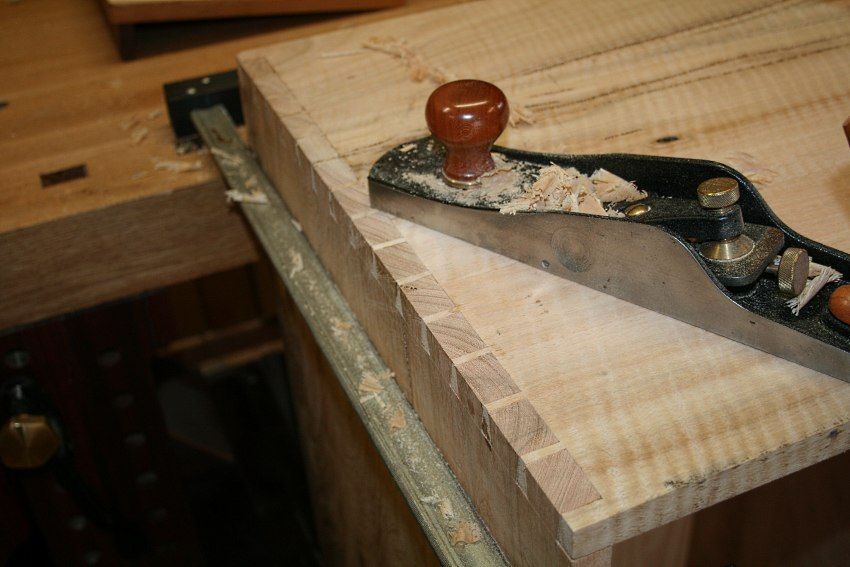
Today I planed down the sides.

I do love it when the first plane strokes uncover the details that lie below ...

All sides were given a final scraping.
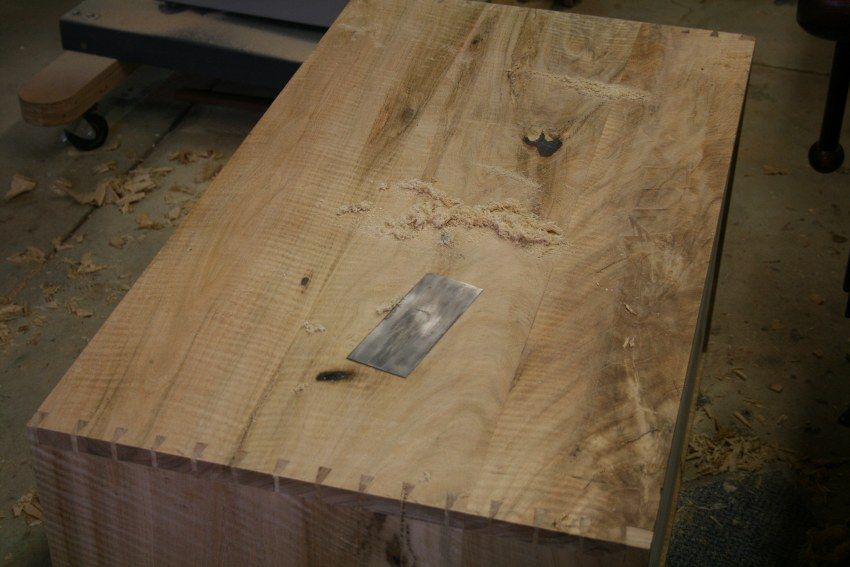

Then came a couple of coats of Danish Oil - the fiddleback will respond best to oil.

First, the worst - the rear panel - fortunately it will be hidden! ...
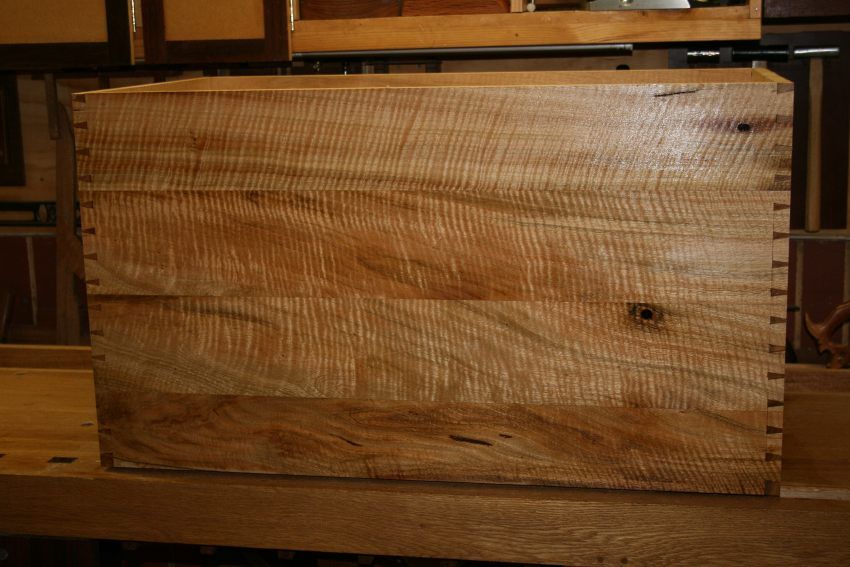

Here is the front panel ...
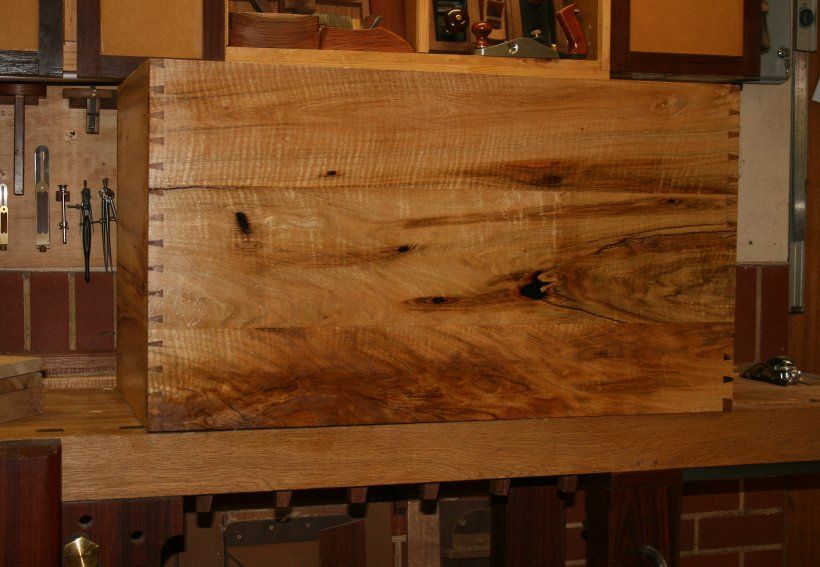

From one side ...
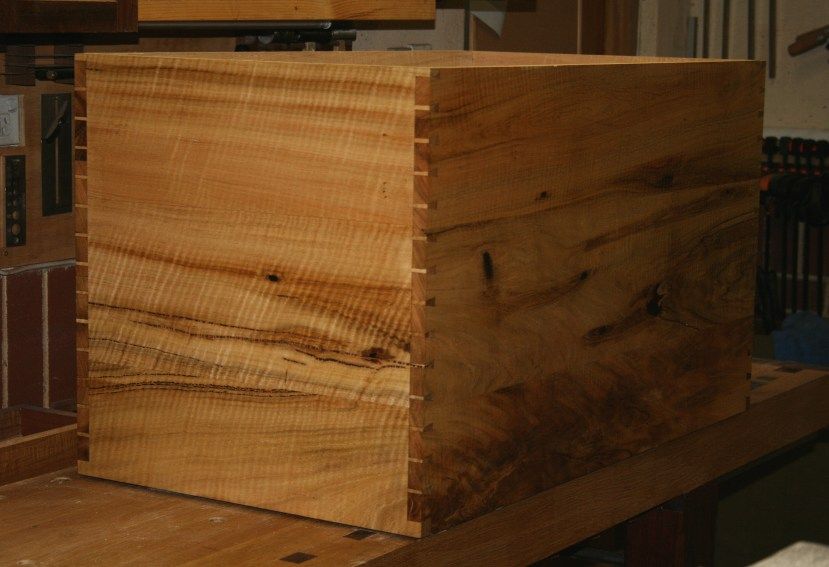

... and the other ...
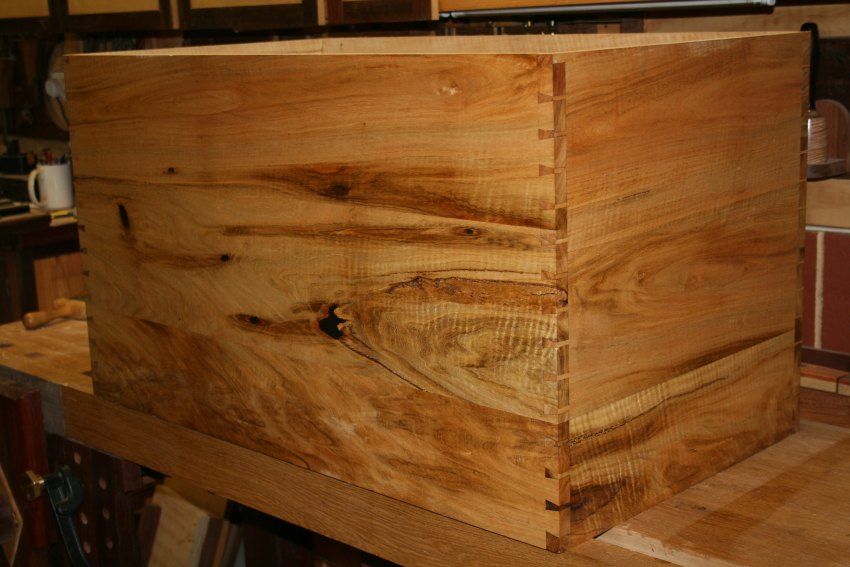

Unfortunately the fiddleback figure was not clear in some of these picture. It is really striking ...
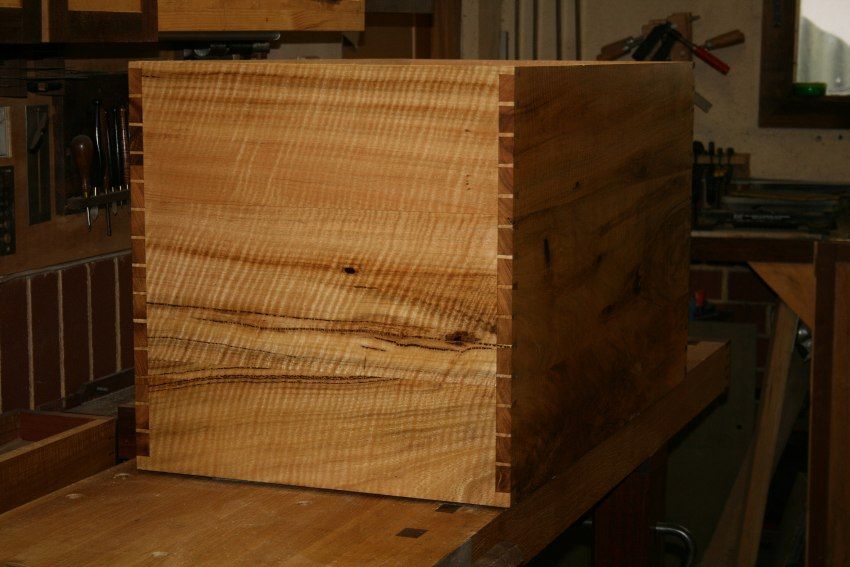

That gets me about one third of the way through this project. The remainder promises to be more fun.

Regards from Perth

Derek

Re: Update on Kist.

#2

Re: Update on Kist.

Warren in Lancaster, PA

What would I have done? I think I would have gone for the wider boards and overlooked the defects. Using three and four boards in a panel gives it that old-fashioned 20th century look, like it was made in a factory. To my eye, voids, even small cracks would look better. I probably would roll my eyes if somebody brought me wood like that, but in the end a figured wide board, even with substantial defects, would look good.

Re: Update on Kist.

#3

Re: Update on Kist.

Derek Cohen (in Perth, Australia)

Thanks for your opinion, Warren. To just go with the defects was a serious consideration early on - I have incorporated such in some of the pieces I have built. The problem was that, after jointing and thicknessing, there would have needed to be three boards per panel anyway. So would you have used two wide panels and a skinny one, used random widths, or attempted to equalise them? Of course, the other option would not to have used the timber - used something easier - but I am confident it will turn out special by the time I am finished. There is still a lot to do.

Regards from Perth

Derek

Re: Update on Kist.

#4

Re: Update on Kist.

Kevin French

The figuring, grain and defects all work great in that piece.

Nice job

Re: Update on Kist.

#5

Re: Update on Kist.

roger lance

Derek.....I'm sure that if we had our choices, we would all use wide boards from the same tree and minimize any distraction of glue line or other imperfection. However, there is another quality/characteristic that should also be acknowledged in discussing the making of fine furniture....and that is production....actually making something....which can be delayed indefinitely because we don't have perfect stock....I say hats off to the man who is making things to the best of his ability (which is considerable in your case) imperfections and all. Your house must be an interesting place.

Re: Update on Kist.

#6

The use of the term "kist"....

roger lance

Up here in the back woods of Michigan and other isolated rural places, we might say, "I took my best girl to the drive-in in my pick-up and we kist and kist thru most of the show." A little different.

Re: Update on Kist.

#8

Good line, Roger

Bill Houghton, Sebastopol, CA

...although I've been intrigued by the word. There's a Dutch (and possibly also German) furniture form, the kast, which is in essence a large armoire. One of the distinctions, as I understand it, of a kast is that it's designed to be broken down for transport.

Although, when I look the word up, the first definition is a space for clothes storage. I wonder whether Derek's "kist," apparently from what I can tell a South African furniture word, is named based on that definition; and whether it's related to the Dutch (and possibly German) "kast."

Re: Update on Kist.

#9

Re: Good line, Roger

Edward in Vancouver

Having spent some time in german speaking Switzerland, "Kisten" (or in Swiss-german, "Chiste") is a storage box, the same word was also used in the Swiss army to refer to to the military prison cell..........

Re: Update on Kist.

#10

Re: Good line, Roger

Sgian Dubh

In Scotland chests are known as kists-- it's a common word. Slainte.

Re: Update on Kist.

#11

Jesper, Denmark

Re: Good line, Roger

Jesper, Denmark

In our version of indo-european/germanic language, a "kiste" is a common word for coffin or for a chest for storage of clothes.

Re: Update on Kist.

#12

Re: Good line, Roger

Derek Cohen (in Perth, Australia)

Kist was the term used in my childhood growing up in Cape Town. No doubt the influence was from the Dutch, via Afrikaans, but in reality it is a term that is found in many languages and countries, such as Scotland and Denmark.

Typically it refers to "a large wooden chest in which linen is stored, esp one used to store a bride's trousseau".


I Googled the term and found a Dutch furniture site, with this interesting modern interpretation ...


Typically, they sit at the end of a bed. This one is off a South African website ...


I recall this as a common style (wood is Imbuia) ...


Regards from Perth

Derek

Re: Update on Kist.

#13

Re: Good line, Roger

Kees

Sorry for replying in three forums about your kist, Derek. I just get kind of enthousiastic when I see Dutch words in English. Allthough your's comes from South Africa which is one of the rare places on earth where you hear the Dutch language, all be it in its own peculiar way.

Anyway, kist is the same as chest in English. Any chest. For example a toolchest is "gereedschapskist" in dutch. And kast is a cupboard, with doors or open like a bookcase. So they are closely related but not the same.

Something else alltogether. I am always wrestling with the matching of boards in a panel too. Before planing the woodsurface is mosty invisible behind the sawmarks and all the dirt, so at least you should do some skip planing. But when I put in all the work to plane the surface, it is kind of hard to reject a board. I definitely prefer an invisable glueline, but that is hard to com by.

In my kitchen I accentuated the gluelines with a narrow strip of wallnut between the maple boards. An idea I got from an Italian designkitchen, and it looks pretty good I'd say.


img

Re: Update on Kist.

#14

Re: Good line, Roger

Derek Cohen (in Perth, Australia)

Anyway, kist is the same as chest in English. Any chest. For example a toolchest is "gereedschapskist" in dutch. And kast is a cupboard, with doors or open like a bookcase. So they are closely related but not the same.

So "Hand Tools" would be handgereedschap? In Afrikaans (that funny Dutch :) ) it is spelt "gereedskap".

Regards from Perth

Derek

Re: Update on Kist.

#15

Kind of a goofy line really.....

roger lance

Interestingly, my mother's parents were Dutch....but, as you can see, I've lost contact with my heritage. When my grandparents came to America, they first went to England to book passage on a ship for them and their, at that time, five children. Somehow, my grandfather was short of the money needed for all seven tickets...so they were bumped off the first boat....and were put on the next boat leaving as extra money was being wired to them by my grandfather's brother. The ship they got bumped from was the Titanic.

Re: Update on Kist.

#16

Re: Update on Kist.

Patrick Gibbons

Derek, I wouldn't have used that wood because of its difficulties. I would have used it for boxes or something else where only a single board was necessary. Making it into a panel would have been very frustrating for me because of the work involved- I'm lazy. That being said, you have done a very good job of putting it together. The curl is striking. It doesn't matter how others would have done it. The wood dictates its own agenda. The real issue is if the piece is attractive or not. The natural beauty of the wood is wonderful. If not a grand slam, it's a home run at the very least. As we like to say here in Texas, that dog'll hunt.

Re: Update on Kist.

#17

Re: Kind of a goofy line really.....

Kees

That's a spooky story Roger!

Derek, yes tools is gereedschap or gereedskap in South Africa. We love the South African language because it is so weird and so familiar at the same time. It's not always easy to understand.

Re: Update on Kist.

#18

The compromises of woodworking

Bill Tindall, E.Tn.

Everything I ever built lacked "perfect" lumber and any time spent studying other's furniture reveals that we all have this issue. So when it comes to making the decisions about choosing what something is to be built with compromise is required and the compromise depends on one's personal values and objectives, as well as what is available.

Curly stuff doesn't readily assemble in panels without clashes of grain pattern at the joints. Most of the attempts at curly maple tops I have seen I thought were unattractive. As a result I would not attempt to incorporate curly wood into a top or large panel assembled from several boards of varying grain pattern. However, plenty of other fine woodworkers have not chosen this constraint with curly maple.

Stepping back, suppose one has some curly stuff and wants to use it. Or, suppose one needs a trunk and is looking for something to build it out of. Personally, if I could not have gotten seamless joints by one means or another I would have used the curly stuff for an application where it fit better, a center panel of a box lid for example. And, I would have found something to build trunk sides from that assembled attractively- all highly personal judgments that someone else, or everyone else, would not agree with.

I "solved" the problem on the ash top by resawing the curly stuff into veneer which more favorable book matched and the result was a top with joints that don't clash. Personally, if I had not been able to get "seemless" panel joinery I would have chosen another top material. I don't try to force wood into an application.

That said, our lumber philosophy, and opportunity, is about as opposite as it can get. If I desire some sort of wood, be it species or grain, I go find a log and have it sawed into what I want. "Salvage" is not a significant part of my woodworking. Hence, I am an irrelevant critic on your lumber choice. But had you asked beforehand I would have advised to use the curly stuff in another application.

Re: Update on Kist.

#19

Re: The compromises of woodworking

Tom

wood is a natural material and never perfect I guess, but there are degrees. I would say much of the wood used in lutherie is perfect, and what is more, is better than most of what was used in prior centuries. Brazilian Rosewood being a notable exception. Periodically I see these articles where someone on the east coast holds a course in making some fantastic highboy, or something, and all the "kits" are nearly perfect pieces of mahogany, a wood that is going to become illegal soon, and is all but unobtainable. Some east coast boatbuilders actually charter vessels and go to the third world source to get their wood.

But on the flip side, there are those like Maloof who bought lower grade walnut out of preference. Because it was more interesting, and his signature pieces used a lot of short pieces of weird proportions.

The key thing is to have some kind of sensible plan, and reason for one's choices.

Re: Update on Kist.

#20

Ellis Walentine

Matching wood grain

Ellis Walentine

Hi Derek,

As usual, you have shown us yet another wonderful piece in progress. Thanks for that. I can sympathize with the ordeal of coming up with attractive panel matches when your available materials are wildly different and of limited quantity. It looks like you've done about as good a job as you could with the boards you had at your disposal.

Every time I make a design, I ask myself "What is the ideal solution, based on what the customer wants/expects?" If you are the customer, all that matters is how you feel about the look of the piece. If the bar is raised, you may have to deal with more demanding aesthetic choices.

Matching curly stock is often particularly problematic visually if the curls are at some angle to the axis of the board(s). The resulting herringbone patterns may or may not be pleasing or acceptable. Ideally you'll have bookmatches, or at least be able to saw the pieces to move the curls perpendicular to the axes of the boards. When it comes to matching amorphous heartwood patterns, finding a pleasant match may be even more challenging. It also helps to have plenty of extra stock on hand so you have more of a palette to choose from. All these variables add time and expense to this kind of project.

Ellis

Re: Update on Kist.

#21

Re: Matching wood grain, a technique

Bill Tindall, E.Tn.


On flat sawed lumber the edges will be rift cut and often capable of a good match. Something that works often is to make two adjacent cuttings along the length of the board and then "fold" the second cutting back on the edge of the first as illustrated in the picture. I guess one might call this " knife hinge matching". Most of my tops and side panels have been matched this way.

Re: Update on Kist.

#22

Painting with wood

Derek Cohen (in Perth, Australia)

Thanks Ellis and Bill.

Ellis, I am sure that others, like I, first think of Jim Krenov when it comes to deciding what to build from a specific piece of wood .. letting the wood decide. Alternatively - and Warren made this point earlier - that one should choose the wood to match a project. He would not have selected Curly Marri for a project where a single board could have avoided the clashing of joined panels, or he would have gone with a wide panel that included all the faults. Bill, you suggested something similar (actually, you suggested spending more on wood! It might therefore surprise you to know that these Curly Marri boards in their rough sawn state cost me $450. Not cheap!).

The decision to cut away many (not all) the faults in the boards was partly because the faults were not attractive. While I am not a fan of 99% of live edge furniture, I do enjoy the natural faults that occur in most woods. Often I choose these deliberately and emphasise the fault as a feature. Mostly these involve a few faults that blend in with the surrounding figure. Curly marri is not like that. The faults are not attractive. They are just holes in the wood ...


Large, small ... lots of them.

So why use the wood at all? Because it is beautiful. It has potential just waiting to be unleashed. Curly Marri is quite rare. There is not much around here in Western Australia, where it grows. There is a fair amount of Marri, but Marri has the colouring without the charm, the warmth, and the figure. Marri is not expensive and is used a lot by local furniture makers. With all the voids filled in with black tinted epoxy, this furniture tends to look like a spotty Dalmation. The epoxy takes the place of figure.

What I wanted to do was try and join up the best of the wood and create boards that flowed together as naturally as possible. This is what we all try and do, so it is not an unusual factor. What it was, however, was an exercise in creativity. That is why I termed it 'painting in wood'.

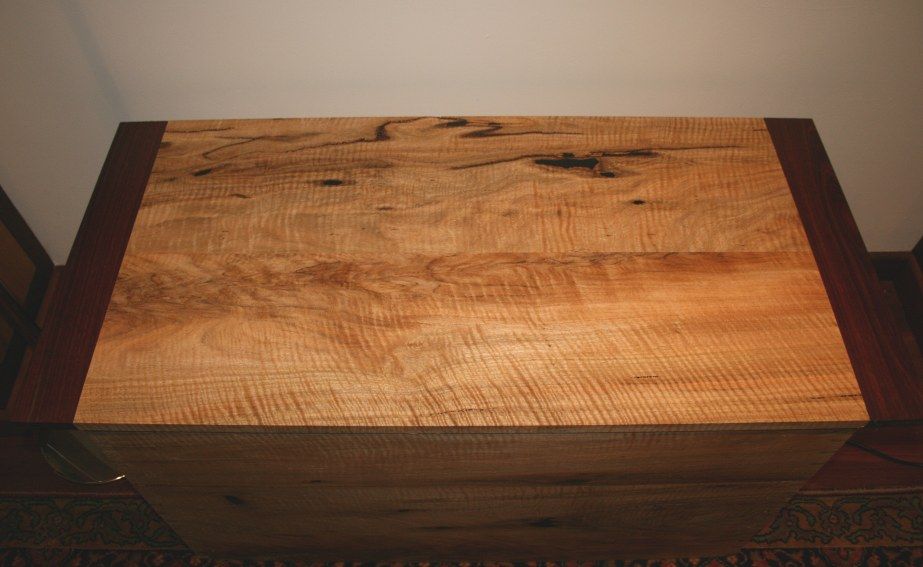
I have essentially completed the lid, and I will show this shortly (try to avert your gaze!). There was enough to fashion the top out of two long boards, and I played around with these to get the best out of them. One option would have been to bookmatch one. I did not want to do so. The aim was to avoid too much symmetry in the wood as the design itself is very symmetrical.

What I have below is incomplete. I have not yet decided on proportions. The kist has been placed in an alcove (between built-in bookcases and in front of a large window). It will be storage and side table between two black leather seats. What I have to decide on is the width of the breadboard ends - do I make them narrower?

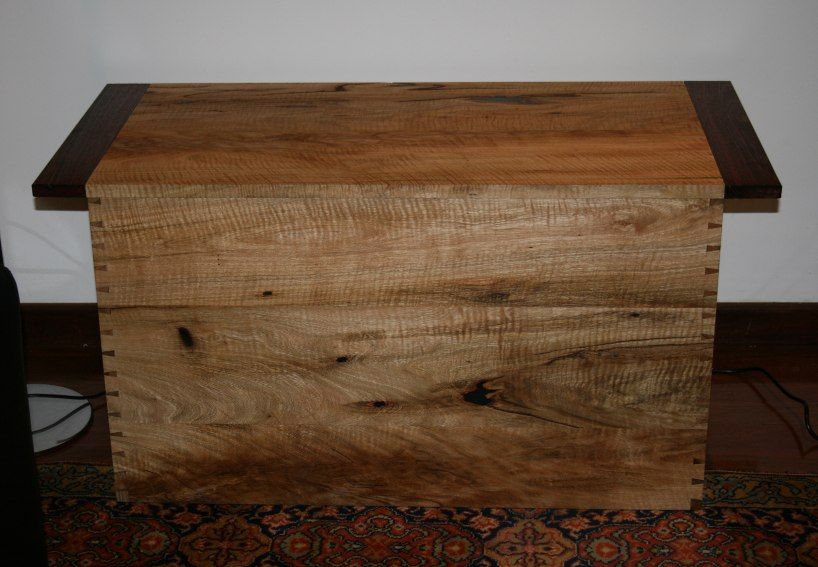
The Jarrah breadboard ends will link with a Jarrah base. How high I can make the base will determine whether I go ahead with my original design, or modify it. The plan is to build a base that sits proud of the outside and into the front of which I can build (hide) two drawers alongside one another. If you noticed before (or now) that the pins are different widths at the corners, this was so that there is support for a section around the base so that the dovetails are symmetrical along their length after the base is fitted. I'll leave the design of this to your imagination for now! Got to keep something back to surprise you later :)

Here is the top (at this stage) ...


And here is the front view - minus the base. The point here is to show the blending of the three boards ...


All comments and criticisms welcomed.

Regards from Perth

Derek

Re: Update on Kist.

#23

A lot to learn here

Ron Harper

Yes, Derek, I agree that the icons paint with good. I also agree with Krenov that the things that set apart the great pieces are very subtle. A trip through the kitchen sections of big box stores will expose cabinets with the grain of rails and stiles criminally mismatched. In some cases all they would have had to do is flip the boards.

Using wood with flamboyant grain presents a special set of challenges. First, and may be the simplest, is the actual matching of grain, as difficult as that can be. I personally have made pieces that used flame grain that either produced too stark a contrast or overpowered the rest of the piece. We have all seen pieces made with wood with a grain so extravagant that it seemed to overpower the space it occupied. Much to learn.

Re: Update on Kist.

#24

Re: Painting with wood

Bill Houghton, Sebastopol, CA

To my eye, those jarrah ends look tacked on and out of place. The fact that the joint is aligned with the top edge of the case, combined with the wood contrast, makes the jarrah look like it was randomly added with no connection to the rest of the design.

Whether shortening the top so that the jarrah aligns somehow with the case, or adding a detail that makes the jarrah look less random; not sure. And the base may tie it together, once it's in place.

Re: Update on Kist.

#25

Re: Painting with wood

Derek Cohen (in Perth, Australia)

Hi Bill

Good points. That is why I have moved the kist indoors to live with as is for a week. This will give me a better sense of how the parts balance. I can visualise the base, which you cannot, so I have a different perspective. Nevertheless I share the same concern. At this stage I feel the breadboard ends need to be cut back about half way.

Regards from Perth

Derek