New WoodChat!
Home Articles Forums Gallery Marketplace Videos

WoodCentral Forums

Knowledge You Can Build On — Est. 1998

Portable Sawmill & Tree Service – Abingdon, VA

Tooling for Feel

Posts

Tooling for Feel

#1

Tooling for Feel

Derek Cohen (in Perth, Australia)

Derek, you use the LV router, and have designed and made granny tooth routers.

Are there substantial differences that make one preferred over the other?

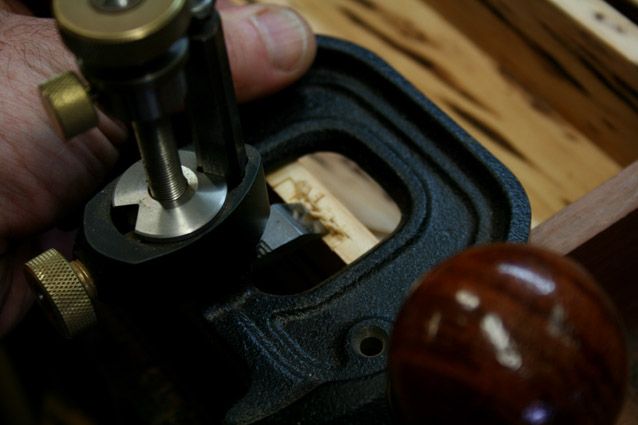
I was asked this question in a thread on the LV router plane on WoodNet after I posted this picture of using the LV router plane for hinge mortices ..

Here is another picture (from my review - but sporting a shopmade depth stop, which has since been replaced) ...


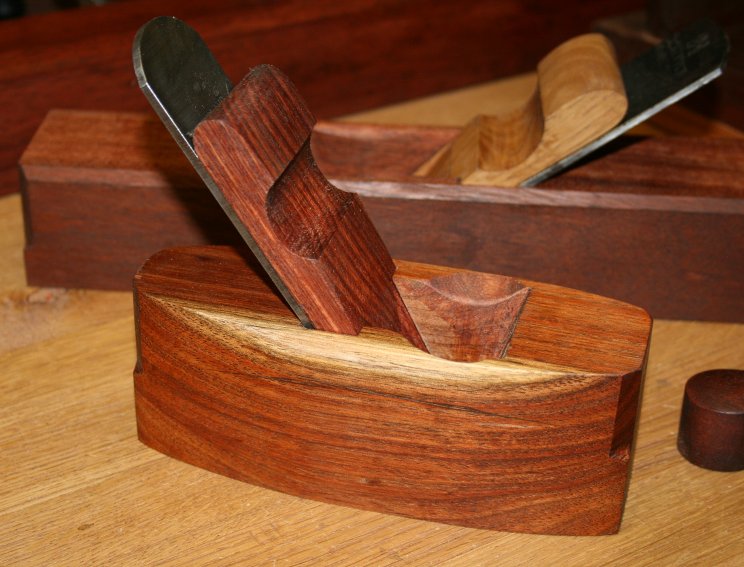
What stimulated the question was a recent post I made of a smaller wooden router plane I designed (borrowing a little from the ECE) and built ...
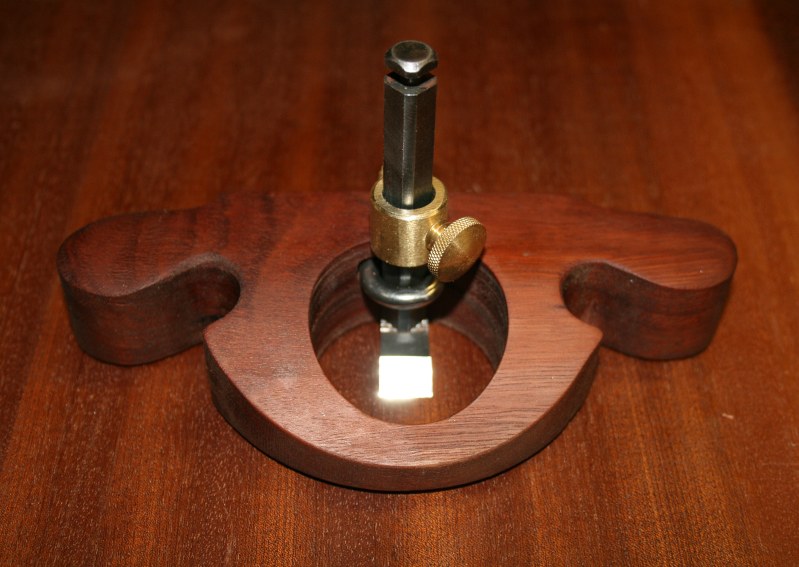
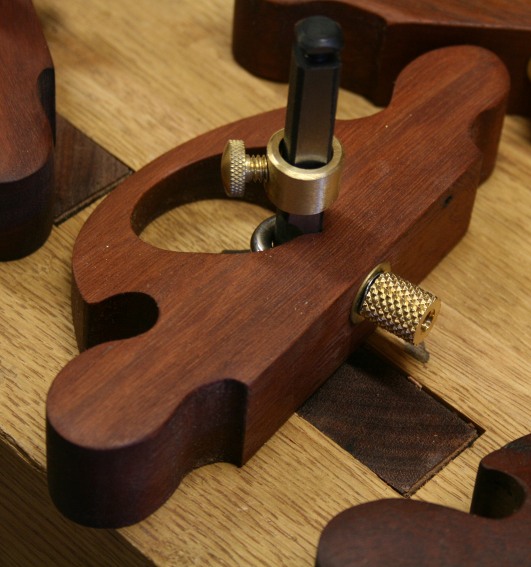

Keep in mind that the thread is about "feel" and not these router planes. What is "feel"? I think of this as the feedback you receive when the blade hits the wood. You know exactly what is going on at the coal face. It is akin to driving a big Cadillac with so much suspension that you float over the road never knowing whether there are bumps or potholes .... versus .... a Morgan, with its wooden chasis and hard suspension and direct steering. Made to go fast, and not great on the road, but completely involving.

One of the advantages of planing wood with a hand plane rather than a machine is that you get to know the surface of the wood (although sometimes too much of a good thing is a bad thing - such as this mongrel Curly Marri I am planing up for a blanket chest! :( ). When planing interlocked grain you feel when the plane is starting to struggle and resist cutting. You stop in mid shaving, adjust the stroke/depth of blade/direction of cut.

In my experience the difference in feedback varies in part with the centre of gravity. The further from the work surface, the lower the feedback. Conversely, the lower the centre of gravity, the greater the feedback. In part, feedback also depends on the "centre of effort". C of E is a yachting term to refer to the action of the wind on the sail - where it places it force ... low or high on the sail. Pressure at the top of the sail is different to pressure at the bottom of the sail. In a similar manner, force directed at the low end of the blade creates more stability and controlled power. For this reason, a plane with a low centre of gravity requires less effort to push than a plane with a high centre of gravity, for example, a traditional jointer versus a razee jointer ...


This is the reason I build razee woodies ... and yet I often return to the LV BU Jointer ...


Add to the equation a plane with a low centre of effort - a bevel up plane is an example of this - and you will understand their attractiveness to many. They are easy to push and easy to control.

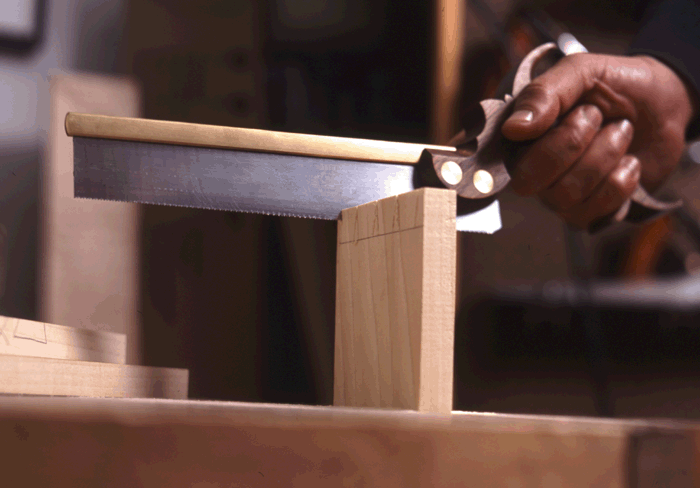
I could make a similar case among backsaws - those with tall plates versus those with low plates. Some will argue that tenon saws benefit from a tall plate to aid in orientating in the vertical. I agree. I am only pointing out which feels easier to use. However we then get to dovetail saws, and a low plate saw, such as the Gramercy, has a very different feel to high plate saws (with a similar teeth configuration).

So, what about the router plane?

I recall a comparison of router planes by Chris Schwarz where he preferred the high knobs of the LN/Stanley over the lower, canted knobs of the LV. Interestingly, he commented that "the rakish handles (of the LV) feel better when you grip them with your pinky fingers at the base of the tool (palms on the sides of the knobs)". In other words, when you are pushing the router plane from directly behind the blade. (Link: http://www.popularwoodworking.com/article/lie-nielsen-large-router-plane).

This is the way I often use the LV router plane - pushing with my thumbs directly behind the blade (not in the picture above, where the router plane was being held one-handed for the photo of the hinge mortice). I prefer the lower slung LV knobs to the upright LN/Stanley knobs because they direct the C of E downward. (I must admit that none of this occurred to me when I was comparing the Stanley and the LV in my review written in 2006: http://www.inthewoodshop.com/ToolReviews/The%20Veritas%20Router%20Plane.html)

When I built the wooden router plane, it was expressively designed to be used this way - thumbs behind the blade. This creates not only a low centre of gravity, but a low C of E. To describe it, it feels closer to paring with a short chisel (see ... short butt chisels for feel verses long paring chisels for directionality).

There is plenty of power in this small router plane, in spite of the low weight, since the centre of effort minimises wasted energy. The high centre of effort importantly maximises the feedback one receives, and it is this that makes it my current go-to router plane.

A rather long winded answer to a short question.

Regards from Perth

Derek

Re: Tooling for Feel

#2

Re: Tooling for Feel

Patrick Gibbons

Your long answer gives a context to your opinion, thus a more valuable post.

Re: Tooling for Feel

#3

Re: Tooling for Feel

roger lance

Hi Derek.....fine post.....unfortunately for me, my sailing days are becoming only a fond memory.....I do remember that there were a number of concepts/terms that help explain a sailboats performance/feel including center of effort, center of lateral resistance, center of mass, etc.....and these ideas do seem to apply to the "feel" of a tool.....perhaps another old salt can add to this analysis.

Re: Tooling for Feel

#4

Feedback from tool to hand

Wiley Horne--So. Calif.

Hi Derek,

Excellent post, extensive and thought-provoking!

I'd like to put in an opinion (and it's no more than that) on feedback from the tool, where you have a heightened awareness in your hand of what the tool is doing, and it brings up in your mind's eye a picture of what is happening at the edge or tooth.

I liken this feedback to the concept of fidelity--you're feeling the signal, not the noise. I find this related to center of mass and perceived power, but not identical. For example, in Japanese joinery saws (as opposed to western ones), there is little mass or momentum in the tool, yet it's possible to feel the cutting action with great fidelity. (Japanese planes do have that low center of mass thing going on, even though you're pulling it.)

I think the feedback you get from the tool is related to a kind of ratio--the amount of work the tool is doing per sawtooth or per cm of engaged edge, divided by the amount of work you're doing. The maximum feedback is experienced when you're using little effort, but the tool (whether large or small) is moving a lot of wood per tooth or per cm of edge that is engaged.

Conversely, if you're using a lot of muscle power, it's difficult to feel what is happening at the edge, even if a lot of work is being accomplished--the feel of the tool cutting is swamped by "the noise" of your own effort.

There are things we do consciously and unconsciously to increase this fidelity or feedback through the hands. There's the old-time maxim 'let the saw do the work' or 'let the hammer do the work'. When sawing, I like to feel for the center of kerf--the very place where friction on the saw plate is minimum. To do this requires a loose grip, so that you can't be doing a lot of work yourself, compared to what the saw is doing. And of course sharpness is crucial--if the tool is even a little dull, you can feel yourself doing more and the tool doing less. We skew the plane or shave sometimes to get more cutting done relative to our own effort. We wax the plane sole, or the saw plate. Do you ever use a narrower plane for harder wood? Same thing.

There is not just tactile feedback through the hands. There is sound and visual, also. Two days ago I was using a Mike Wenzloff rip saw. This saw has a huge deep plate, and my hand was not really in line with the teeth for that reason, and yet the saw was doing all the work, I was putting little effort into sawing for the amount of work going on at the saw teeth. I couldn't really feel what the teeth were doing, but the sound was incredible, low and raspy. Different kind of feedback.

Or the combination of visual and tactile feedback when edge-jointing. I really prefer an old-time wooden jointer for this, compared to a very powerful, low center of gravity metal plane. Yeah, I get the power thing about the metal plane, and about having your hand in line with the line of work. But I prefer the visual feedback from the woodie. And more than that, the tactile feedback of the lead hand biasing the pressure this way or that across the board edge, depending on where the high line of the edge is. Making no claims here, just my own preference--people can edge join anyway they like.

Sometimes I use handle-less planes, rather than handled, to place my hands right over the work, right over the iron usually. For example, in ploughing--I can't feel where the plough is unless my hands are over the blade. Or using a coffin smoother (wooden or infill) over banding or inlay, where you want to know and feel exactly where the cutting is happening. The handle places the hand too far from the action. This is akin to Derek's observation about putting the fingers right at the blade section of a shave or a router.

Well, that's enough for now. Fidelity is feeling the signal not the noise, and is proportionate to tool's work divided by your work.

Wiley

Re: Tooling for Feel

#5

Why I use hand tools. Great post Wiley


Re: Tooling for Feel

#6

Re: Feedback from tool to hand

Derek Cohen (in Perth, Australia)

Hi Wiley

Interesting focus - one aspect that stands out is the different terms that we use to define something similar, and how these likely reflect our personal vocabulary and sensory orientation.

Your musical-sound analogy does vibrate with me (is it a give-away that I use a term like that? :) ) - subtracting the noise from the music. My terminology would be more visual, and I refer to the same thing as foreground-background.
I also think that you are partly correct to consider feedback to include both auditory and visual. To this one must add the kinesthetic. It is probably not possible to focus on one of these to the exclusion of the others, but likely one be in the foreground, the others remain in the background, as priorities determine. For example, as mentioned before, a high sided jointer or a wide plate saw will offer feedback about the vertical, however these are not desired each and every time. I built two smoothers recently, both with a 55 degree bed, and the same length. One is a classic coffin (high) and the other a classic Krenov (low). They work equally well. My preference is the latter, which indicates that I place greater focus on the kinesthetic than visual when planing (while you, as you described, look for the visual).


Plough planes - as you describe, my hand is also supporting the blade, not the body. Why do some ploughs have knobs on the toe? It seems counter-intuitive to me.

Saws, chisels ....

I am sure that others could analyse and describe their own preferences.

Regards from Perth

Derek

Re: Tooling for Feel

#7

Re: Feedback from tool to hand

TomD

"Well, that's enough for now. Fidelity is feeling the signal not the noise, and is proportionate to tool's work divided by your work."

I think the desired thing is that what one is feeling is the work, and not something superfluous, the "noise". But I am less sure the measure of that is work done over your work. If they were badly out of whack, then one would be putting a lot of work into making "noise" but not getting much done. An ideal situation would be nearly no work in for work out, but the feedback would be zero.

I remember reading a scientific study about putting where golfers were asked to choose the putters with the best "feel" which is something golfers believe is a tactile sensation. They rated putters a certain way. Later they were asked to try the same clubs while wearing ear muffs, and they found the putters they had selected had very poor feel. The test showed that a lot of what we believe is touch (in golf) is sound. The creation of sound is outside the work in/out equation, but apparently was important in this case. Complex subject.

(I am not confusing "noise" as in signal to noise, and the fact some putters made a pleasing sound)

Re: Tooling for Feel

#8

Re: Tooling for Feel ... Ahh! Thanks!

Bruce McCrory

Thank you very much, Derek. I never focused my reactions to tools in this way, beyond "it feels right..." It explains why I go to one "kit-bashed" low angle Millers block plane for even work probably better suited to a larger #3 or #4. I prefer it over 3 other block planes, which are usually sharper too.

Speaking of examples--and my new revelations. I spent a period of my life wielding chainsaws. When one listened, the tool provided a unique response to effort while moving through wood. Fidelity. Even through the machine's engine vibrations, it provided a kinesthetic learning experience, such as, when to pull free to avoid pinching. Being accustomed to "touching edges" and rakers three to four times a day (rarely sharpening) I have never overcome the jarring scream of a dull chain. For me the sound is worse than chalk miss-used on a board.

Very good explanation, Derek.