Pole Lathe
Ron Harper
Anyone have plans for a sturdy one of these. I will not need to take itapart and haul it in the trunk of my car, so looking for beefy.
Knowledge You Can Build On — Est. 1998
Pole Lathe
Ron Harper
Anyone have plans for a sturdy one of these. I will not need to take itapart and haul it in the trunk of my car, so looking for beefy.
Re: Pole Lathe Artisan channel
TomD
You are right that a lot of innovative features are related to trying to make them out of lumber, or compact, etc...
I would probably bury some posts out of doors...
http://www.youtube.com/watch?v=tDgIGzw4VtA
http://www.youtube.com/watch?v=tDgIGzw4VtA
If you look at it, you will see he is standing on a stool so his leg throw is in an efficient range. That would be tough to pull off on a long spindle...
Nice profile here on the artisan channel:
http://www.youtube.com/user/ArtisanMediaLtd/videos
Ben on his lathe:
http://www.youtube.com/watch?v=pNty07IyOAQ
This one has a bench which would be useful for those with less than two full legs. Big piece being turned on this one!
http://www.youtube.com/watch?v=XEibt31OlCA
http://www.themethodcase.com/the-wood-turner-by-leo-singleton/
Re: Pole Lathe Artisan channel
TomD
http://www.bodgers.org.uk/bb/phpBB2/viewtopic.php?f=14&t=1870
Re: Pole Lathe
Terry McClean
Check out this site for plans.
http://www.bodgers.org.uk/plans-menu/56-making-a-treadle-or-pole-lathe
Re: Pole Lathe
Warren in Lancaster, PA
I have used a Roubo lathe for 32 years and I recommend it. Here is the plate I copied.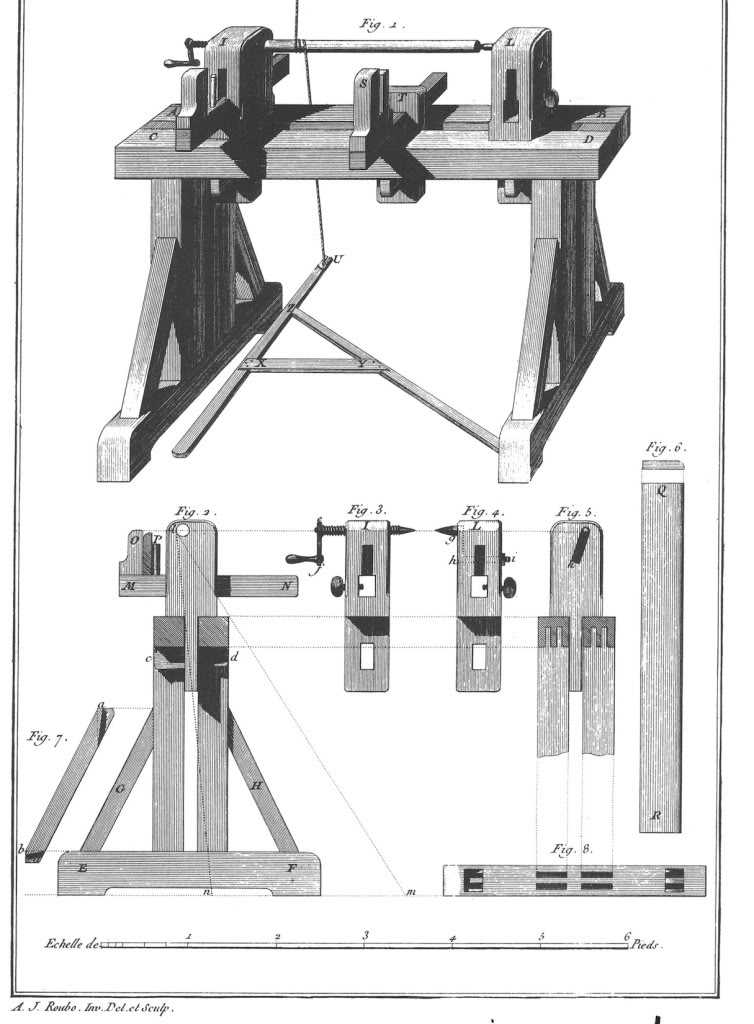
Re: Pole Lathe
Jim Crammond
Ron,
Dennis Laney based his on Roy Underhill's design (information and dimensions available in his latest book) but enlarged it and beefed it up. He has written several articles about it here
http://dblaney.wordpress.com/category/springpole-lathe/
Jim
Question for Warren
Patrick Gibbons
I am curious about what wood you used for construction and how it has acted over 32 years. As wood warps and moves, it would not be as stable as a lathe made of metal. Wasn't it Conover lathes that also had wooden beds?
Another question for Warren
Ron Harper
I absolutely love this design. I have a 9 ft basement with exposed floor joists for the rooms above. Could I attach a 12 ft pole to the floor joists laterally above the lathe to get the spring action that I need? Should I use green wood or could I laminate a couple of one inch pieces of oak?
Thanks
Re: Another question for Warren
John Pappas
Ron, for what it's worth. I have used a 'pole' lathe in my basement workshop, but I use a spring attached to a rod above the lathe. Not sure how that compares to the flexing of a pole, but it works. I tried a couple of springs before I settled on one. The first was simply too stiff.
Re: Question for Warren
Warren in Lancaster, PA
I used red oak 4x4 timbers that I got off a pile of used lumber at a junk yard. I would not hesitate to use green timbers for this lathe. However I would much prefer dried stuff for the puppets and wedges, because wedging works better with dry. The main thing is you have two centers that are solid. Wood dampens vibration better than iron, especially "dead" woods like red oak, ash, or beech. Of course weight is important also.
Re: Another question for Warren
Warren in Lancaster, PA
I think a nice set up is to have the pole parallel to the joists. If the joists rest on another beam, you can stick the butt end of the pole over the beam and the very end kick up on a board between the two joists. In any case the pole should be loose, just sort of wedged there, so you can make minor adjustments to where the end of the pole is above the lathe. The lathe should be very carefully set up so it will not rock, so you don't want to have to move the lathe.
I use a 13 foot hickory pole tapering from 2 3/4 to 2 1/4. You don't want a pole that is too short or too flimsy. I have read 14 feet in the literature. Yes, use green timbers rather than laminated.
Any way to post a Pic?
side question -- dust
Lars Parrington
having never used a wood lathe (powered or manual), i'm curious about the amount of dust and mess created.
for a powered lathe, my understanding is that it's significant. is it a lot of fine dust, or mostly larger chips/shavings that will fall out of the air quickly (when using sharp tools that is, not sandpaper)?
is there a reduction in dust/mess with a manual lathe as is common with so many other hand tools when compared to their power tool equivalents?
Traditionally, lots of lathes
Bill Houghton, Sebastopol, CA
In the late 19th century and on into the early 20th, a lot of lathes were made with iron castings for the head- and tailstock, with wood beds.
Re: side question -- dust
Ron Harper
Lars,
I am thinking that the dust, chips, shavings are waste that is sheared, skewed, scraped off the object being turned and not a function of electricity, or foot power. May pile up. Little quicker with the power tool, but when you are done, the amount of waste should be very close to equal.
Re: side question -- dust
Bill Tindall, E.TN.
It is my understanding that "in the day" spindles were turned green qith this sort of lathe....no dust.
Lathe "waste" is hard to capture. I have a large Oneida system that I can close down except for the hood at the lathe and it only catches dust. The chips have so much kinetic energy that they go where ever their velocity takes them and as Ron says they pile up about the feet.
Re: side question -- dust
Lars Parrington
thanks guys. i don't mind standing in pile of shavings, though i might mind if they fly off the lathe so fast they are scattered all around the shop (like when i use a router). i am mostly concerned with the fine dust. if i'd have to run a dust collector, i think that would defeat the purpose of having a foot-powered lathe.
Agree
Re: side question -- dust
TomD
If you cut wet wood, as was traditional for certain tasks, then there is virtually no dust, you can also wet sand the bowls with today's abrasives and while there is a little spatter, there is no dust. Ron is doing trad bowls, so his finishes are not sanded, therefore less dust. Same deal with skews on wet windsor leg type work.
Certain woods when cut create dust. Think of woods that create dust when cut with a plane, ring porous woods as an example. If these are cut dry the dust will be considerable. I bought a dust collector when I got a power lathe. But I only used it when scooping up the piles of shavings, and when dry power sanding.
Despite the interesting video of Ron Wood beating out a power turner, there are guys who could cut that bowl Ron made in a single pass inside and out, running a 3HP motor. Power lathes are probably the single most efficient means of creating waste, and objects in the home shop. Hand tools wise pole lathes aren't bad, because they employ leg power, but they still don't have three horses running flat out.
Re: Question for Warren - Conover lathes
TomD
"Wasn't it Conover lathes that also had wooden beds?"
I have one of those and I really prefer the wood bed. I made mine out of some inexpensive maple I had around, remember those days... Poplar was the suggested wood as it compresses better. The rest moves over it as if it is on ball bearings. I have had it about 15 years, and I have owned 6 other lathes all metal. Wood is better, just as accurate, and of course on can configure the bed to do any kind of turning one wants. I would like to try a stainless bed, but I don't know that I will get another lathe any time soon. I own a Union Graduate bowl lathe which is a tank, and I owned a General so it isn't as though I don't know a sturdy lathe. Oneways are built a few hours from here, and I have been to their factory, and bought one at one point, but in the end decided I didn't want it.
Pole lathes have even less connection between the tool point and the axis of the lathe. This is why one sees some pole lathes that have the non-nonchalant look of a swaybacked mule. Of course wood is capable of maintaining very close tolerances if required, think of action height on a guitar, which holds to thous though under 100 pounds tension on a classical where the wood in sections is only 1/8th inch thick. Meanwhile if anyone remembers my deflection test on a wooden jointer vs a cast iron jointer, they both had the identical thou deflection for loading. So it is pretty easy to make wood that is as stiff as cast in normal weights and sections. Cast is not stable, or necessarily high quality these days, while the best wood ever is still out there in some trees. Where wood is bad is in small sections and mechanisms, I still prefer a metal banjo where a modern lathe is concerned...
Re: side question -- dust
TomD
"I am thinking that the dust, chips, shavings are waste that is sheared, skewed, scraped off the object being turned and not a function of electricity, or foot power. May pile up. Little quicker with the power tool, but when you are done, the amount of waste should be very close to equal."
This is only partly true. First off, volume of dust/time is critical. Some guys are so into their hobies they are at them hours a day, in small low air volume shops, and if they to boot generate more dust/second, that is a real issue. Second they turn more dry wood, larger bowls by far, and they often use tropical woods.
Against the pole lathe is that it takes more cuts to get the same place, no peeling off shavings 1+ inches wide.
"It is my understanding that "in the day" spindles were turned green qith this sort of lathe....no dust. "
And out of doors to boot.
dust
Warren in Lancaster, PA
I hardly ever cut green wood on my pole lathe. Occasionally I will cut some spindles green and oversize, to be finished later. Green turning does not yield the clean and crisp turning that you see in 17th and 18th century work.
With the pole lathe it is much easier to learn sophisticated cutting technique and it is very inefficient to use scraping technique, so there is not much dust. I have never done any sanding on turnings; sanding would greatly degrade the surface.
Pic of lathe or of spring arrangement?
oh?
Bill Tindall, E.TN.
....you must not have seen the spindles on Curtis Buchannan's chairs. It would appear that hard maple turns as crisp as it gets when green and a lot faster.
BTW, Curtis will be doing a chair spindle turning demonstration for our May club meeting May 13 at Woodcraft, Boone's Creek, TN.
lathe chip scatter
Bill Tindall, E.TN.

I have not turned in awhile so practicing the shape of the bun feet seemed prudent. It seems reasonable to expect that chips coming from a cylinder rotating 1500 rpm are going to fly farther than chips created at a slower speed. These spread about 3' and I was covered. Roughing the cylinder makes the most scatter. The stringy finish cuts just fall away and collect beneath the work.


