Truing grinding wheel
rononkokomo
My Tormek grinding wheel is out of square. Facing the wheel, the left edge is perhaps 1/16th higher than the right. How to fix?
Thanks for your help
Knowledge You Can Build On — Est. 1998
Truing grinding wheel
rononkokomo
My Tormek grinding wheel is out of square. Facing the wheel, the left edge is perhaps 1/16th higher than the right. How to fix?
Thanks for your help
Re: Truing grinding wheel *LINK*
Bill Houghton, Sebastopol, CA
Doesn't the Tormek come with a dressing stone of some kind? If not, you can get them easily enough. I like the kind that Lee Valley offers (other folks offer it, too; and, if you've got a decent tool store in your town, you might be able to find one there). See the link below.
http://www.leevalley.com/us/wood/page.aspx?p=55075&cat=1,43072,43080&ap=1
Re: Truing grinding wheel
rononkokomo
Thanks.. Bought one
No ... this one ....
Derek Cohen (in Perth, Australia)
Hi Ron
The diamond bar that Bill referred to is only good for cleaning the face of the wheel, not for truing it up. I have that same one, and it works great for that purpose.
For truing and surfacing you need this ...
http://www.tormek.com/en/accessories/tt50/index.php

Regards from Perth
Derek
Derek's right
Wiley Horne--So. Calif.
Yes, this is the one. It is essential.
Wiley
Re: Truing grinding wheel
TomD
I just grab the rod, and snub down on it with my nuckle, then run my hand along the rest. Never had a problem. I can make nice cylinder or fitted tenons, on the lathe with the same move. That is work in the thou range than any beginer with the lathe can do. I also have a T shaped deal that has a bunch of small diamonds on the face, and simultanously flattens the whole face of the stone, but it is still freehand for square. I haven't tried it yet.
Why he's right (what I've learned)
Wiley Horne--So. Calif.
Ron,
There are three things to think about. Flatness, roundness, and square to the toolholder. You can take that diamond faced tool and, by holding it against any fixed support, achieve reasonable flatness and roundness. But to get the wheel face square to your tool holder, you have to have a rigid setup. Wolverine makes these among others. But since you have a Tormek, your tool-holder and wheel-truing setup is built in. That's why the Tormek truing device is the one to get--you're truing the wheel to the tool holder. (Not saying Tormek prices are reasonable, but this isn't the place to save money, if you've already got the Tormek machine).
Why does squareness matter? If you freehand hold the tool, it doesn't matter, you're doing everything by eye anyway. But if you use the toolholder, the way the machine is designed, then you can grind your chisels and irons right down to a primary burr, and it'll be about square. But if you use the toolholder and the wheel is not square, then you grind a skew every time.
Wiley
Be prepared...
Tony - Memphis
It takes a while. Especially to remove a sixteenth. I bought an aftermarket jig that works like the Tormek before Tormek offered theirs. It works real wel, just slow. It's not an exact technique either. It takes a little English. You can press too hard or not had enough and vary how much material is removed at a given setting. I try not to get mine too far out of kilter so I can avoid the process. It is painful to me.
Tony
Re: No ... this one ....
William Duffield
Note that JET makes a knock-off of the Tormek, the JSSG-10 Wet Sharpener. All the JET accessories and Tormek accessories are interchangeable and of equivalent quality. Often the JET sharpener and its accessories are substantially less than the Tormek equivalents. However, right now, Amazon is selling the JET 708018 DT-1 Diamond Truing Tool for $2 more than the Tormek TT-50 Truing and Dressing Tool.
One exception: I understand that the Tormek attachment for grinding bowl gouges works a lot better than the JET. The rhetorical question here is, "Who cares?" since the OneWay Wolverine system with a cheap slow speed grinder is vastly superior to either, since you are working with HSS turning tools.
nevermind...
Tony - Memphis
The Tormek jig is a better designt than what I bought. With mine, you have to keep your hand on the dresser back end. I like the Tormek much better. I may break down and get one. Looks like I can order it withouth the diamond piece which I already have.
Tony
Crowning wheel eliminates problem & is better
Bill Tindall
Before I gained experience grinding I thought the solution to grinding a chisel or plane blade was to have a wide flat wheel so as to grind most or all of the bevel at one time. This just isn't the best approach to grinding these things. Better is to grind at something approaching a point source on the abrasive. To that end the wheel should be crowned so that only a fraction of an inch contacts the blade at any time. The blade is then moved back and forth across this abrasive "point" to sharpen. All the fuss of flat and orthogonal abrasive surface becomes unimportant.
Re: Crowning wheel eliminates problem & is better
William Duffield
But then, why have a one inch wide wheel, if you are only grinding with the sixteenth or so at the center? Wouldn't there be some advantages to using the newly fractured abrasive particles all the way across the face of the wheel, before redressing it? Grinding at a single point at a time would seem to encourage non-straight and non-square edges, instead of reducing those sorts of inconsistencies. If I know that the face of the wheel is flat and square, then the spark pattern tells me that the blade's bevel is also straight. While it doesn't tell me that I'm grinding it square, that's why I have a square in my pocket, and why jigs are also handy. If the blade ends up a bit out of square, that's why lateral adjusters were invented.
Re: Crowning wheel eliminates problem & is better
Derek Cohen (in Perth, Australia)
Before I gained experience grinding I thought the solution to grinding a chisel or plane blade was to have a wide flat wheel so as to grind most or all of the bevel at one time. This just isn't the best approach to grinding these things. Better is to grind at something approaching a point source on the abrasive. To that end the wheel should be crowned so that only a fraction of an inch contacts the blade at any time. The blade is then moved back and forth across this abrasive "point" to sharpen. All the fuss of flat and orthogonal abrasive surface becomes unimportant.
Hi Bill
I use a crowned face on the wheels of my dry grinder. I learned this from Joel, and it works wonderfully well. However the face of the wheel on my Tormek is flat, and likely to stay that way.
I have never attempted to crown the wheel of the Tormek, so I cannot say that what follows is more than logic. It is not a tested fact.
Firstly, there are fundamental differences between the Tormek and dry grinder wheels. The Tormek is 2" wide, the grinder 3/4". The Tormek uses a jig to guide the blade across the wheel face at a constant angle, while the grinder has a flat stand across which the blade is pushed freehand at angles that are constantly adjusted as feedback is received.
That the grinder benefits from a narrow cutting surface is not in doubt. As I noted early, I have successfully used this method for some years. What one is doing is guiding a chosen section of the blade across the cutting section of the wheel. This continues until several sections of the bevel are ground into one continuous bevel face.
The Tormek works on a different principle. The guide bar is parallel with the wheel face, which means that (as long as this is set up correctly) the entire width of the bevel should be ground in one shot. This has the added benefit of speeding up matters. However I see the main benefit being the ability to "see" whether the bevel is being ground square. As the bevel is ground, the wear pattern is easy to see. It is possible to adjust the angle at which the blade is held to alter the grind angle (using the clamping screws). This takes seconds during the grinding process. So, flat Tormek wheel face for me.
Regards from Perth
Derek
agree
Bill Tindall
For the record, I don't disagree with anything you said. It's the futzing with a several hundred dollar sharpening machine to get it to do something that a cheap crowned wheel easily and quickly accomplishes that I was obscurely pointing out.
Re: agree
Derek Cohen (in Perth, Australia)
Hi Bill
There is a time and place for everything.
Having and using both a wet- and a dry grinder, I must admit to using the Tormek more of the time. Yes, it is a more costly piece of kit than a dry grinder, however it has a long life span and one must consider its value over time. In the grand scheme of some power tools that are available these days (and which there are many I do not own), it is not an expensive item.
The bottom line is that I find it altogether predictable in the way it works, utterly reliable, almost mindlessly easy, and it creates a completely safe medium for grinding steel. With a trued and clean wheel (220 grit), grinding is reasonably fast - just how often does one begin from scratch anyway?
I have a very nice half-speed dry grinder. One wheel is a Norton 46 grit 3X wheel, and the other is a Norton 46 grit white wheel. I hardly use the 3X any more as I dislike the mess it makes and the dust in the air. The white wheel get used mainly on shaping steel blades, or with lathe chisels.
The Tormek rules.
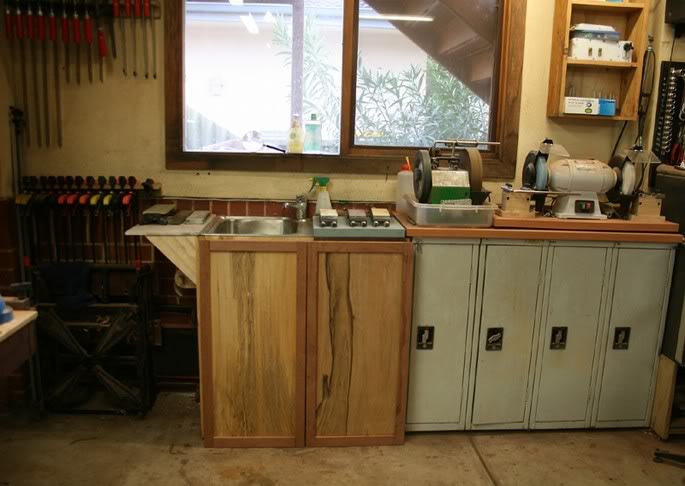
Regards from Perth
Derek
For the bystanders.....
Bill Tindall
1. As you correctly state....A "proper" wheel for a 7 or 8" grinder indeed throws grits around the neighborhood (see my article in the Article section on proper wheel selection for these grinders). I have finally moved mine out of the shop area to where abrasive grit contamination will not impact woodworking. This is a price to be paid for avoiding something that uses water and costs a pile of money.
2. You wheel choice is miles from what I consider an optimum alternative to a wet grinder. I don't think I could use it for grinding plane blades and chisels.
3. The Tormek is unequaled for sharpening sheep shears(I use a friend's). There are reasonable less expensive alternatives for chisels and plane blades.
The puzzlement of the Tormek
Bill Tindall
Everything about this machine would suggest that it would be confined to the Main Message board. It is an expensive motorized device with an assortment of jigs and a design philosophy that substitutes money and machinery for a modest amount of hand skills. Yet people that are capable of spring jointing edges, face planing figured woods, splitting 0.005" scribe marks with a saw, etc. reach for these unnecessary crutches when it comes time to sharpen.
If someone gave me one and I had water in the shop I would use it. I am not questioning that it works very well at removing metal in a controlled way with no risk to the tool by anyone who's knuckles don't drag on the ground. It is unsurpassed for sharpening sheep shears, and probably scissors too. However, I believe it is equaled for putting a hollow grind on a chisel or plane blade by the humble bench grinder equipped with a proper wheel, a tool most of us already have for sharpening lawn mower blades, and other farm chores.
I have never successfully hand jointed an edge, sawed a tenon, rarely successfully planed a surface (never level) and strive only to saw more or less near "the line". Yet I have no problem hollow grinding a thin Stanley plane blade with a proper 80 grit wheel at 3600 rpm. (A thin Stanley blade is the most difficult to do). These facts should demonstrate that any person striving for hand tool proficiency can use a bench grinder for sharpening. The grinding scratches left by an 80 grit wheel are promptly removed by the typical next step anyone uses in edge refinement. (high rpm leaves smaller scratches, I know not why) so the finer grit of the Tormek is no significant advantage either.
To deal specifically with the valid points you make......
"But then, why have a one inch wide wheel, if you are only grinding with the sixteenth or so at the center?" Well, because it is vastly easier free handing it on a crowned wheel. Been there and done that. If I ever wear out my 1" wheels, doubtful" they will be replaced by dirt cheap 1/2 " surface grinding wheels (less than $10)
"Wouldn't there be some advantages to using the newly fractured abrasive particles all the way across the face of the wheel, before redressing it? " A proper wheel dresses itself.
"Grinding at a single point at a time would seem to encourage non-straight and non-square edges, instead of reducing those sorts of inconsistencies." Choose you poison. Diddle with the wheel to keep it flat or learn the modest skills to grind straight on a crowned wheel.
If I know that the face of the wheel is flat and square, then the spark pattern tells me that the blade's bevel is also straight. While it doesn't tell me that I'm grinding it square, that's why I have a square in my pocket, and why jigs are also handy. If the blade ends up a bit out of square, that's why lateral adjusters were invented. .......All true
Re: The puzzlement of the Tormek
William Duffield
If someone gave me one and I had water in the shop I would use it.
I didn't know it had a sump pump attachment! I may have to look into one. 
I don't have a Tormek, or the JET equivalent, or a WorkSharp, or any of the other gizmos, either, just a slow speed grinder with the stock white wheels from Woodcraft and Wolverine tool rests. I used to burn chisel blades every so often, before I got the hang of it. Practice at that is a good use for BlueChips and other Borg chisels. I also tried out Derek's belt sander jig, but my 4" belt/6" disk sander can't keep a belt on straight anymore, and I also prefer a hollow ground bevel.
Re: Why would one
TomD
wet grind if dry grinding did not draw the temper?
I have a really big wheel that LV used to make, that has regular and 800 grip japanese stones, and it has basically never been used. Tried to sell it a few years ago for cheap, and even then nobody wanted it.
I've never really had a problem with the grit, it is like drywall dust it falls like a stone. But there is a lung issue. Almost everything I do I can breath hold through, but for big tasks I either use mutiple extration, or move out of doors.
What about this? *LINK*
Ron Harper
Joel is very knowledgeable. He seems to indicate that the coarse grit will shape an edge. I very rarely do serious damage to a cutting edge. I see that Charlesworth i also advocating slick MDF for stropping. I do know for a fact that the green paste adds value to an edge. Someone has raised a very good question as to how long that value i retained on a plane iron. What say you all? I would love to get rid of my grinders.
http://http://www.toolsforworkingwood.com/store/item/ST-DIAMLAP.XX/Search/Diamond%20paste/Diamond_Paste_(Water_Based)
Re: Crowning wheel eliminates problem & is better
joel moskowitz
because of this thread I am working on a blog entry that updates my article.
A cambered wheel doesn't make a point contact with a bevel except initally when you first touch the wheel to the iron. As you grind the wheel further defines the bevel and at its apex creates the maximum amount of hollow in the wheel. but the areas around the apex of the grinding wheel are also grinding just with lesser engagement to the iron.
This gives you initial control but as you grind you get more engangement (left to right) and faster material removeal. And of course with less engagement at the sides of the wheel you are protecting the sides of the iron until you are ready to grind the sides.
When I grind I also am wiggling the iron back and forth to ride the curvatire of the face of the wheel and get more engagement. what I love about the convex wheel face is how much control I get, and because I am still using most of the wheel surface I still grind pretty fast.
the blog will have diagrams so if I am talking gibberish hopefully it will all make sense at some point
Re: Crowning wheel eliminates problem & is better
Ron Harper
Joel, if one uses your diamond paste set up, how much does one really need a grinder?
Re: Crowning wheel eliminates problem & is better
joel moskowitz
I think the grinder is the most important power tool in the workshop. I hollow grind everything because it makes sharpening easier and faster. you are having the same problem I had before Barry Iles taught me how to grind. I was scared of it. I didn't have a reliable method, setup was finicky, and I did everything in my power to not have to grind. Therefore my tools got in sad shape and woodworking was harder.
In the process of learning to grind I burned a few tools. Barry told me a minor burn isn't worth getting excited about because you will hone past it pretty quickly. Now obviously burning tools isn't a good idea but that permission from Barry to be less finicky was really helpful.
I still burn the occasional tool but mostly not. Practice makes perfect but most important losing the fear was most important.
Get the right wheel, a decent dresser, any grinder you can get hold of (although I think the 3600 RPM 8" wheel grinders are too fast for me on carbon steel) find good instruction and get practicing.
Re: Crowning wheel eliminates problem & is better
joel moskowitz
Reading back I see that my post was a little harsh.
As for your actual question.
The Japanese never use grinders and never hollow grind.
They seem to have none the less functioned very nicely over the past 1000 years.
Diamond paste will make flat coarse honing go a lot faster.


