Essential jigs/aids for woodworking.....
roger lance
The tread below on alternative moxon vise and an earlier thread on a specialized jig to cut shoulders for tenons has made me wonder what jigs people find essential in their woodworking. I am a big fan of jig making....they are tools and make the work easier, safer, more accurate, and repeatable....but sometimes they are highly specific to a certain style/type of work and in a shop of limited space, we may have to get selective over which jigs we make and store. I'll list a few that I use often and like : shooting board and moxon at the bench; sliding miter table and tenoning jig on the tablesaw; enlarged drill press table with fence and hold downs; and tapering jig for the bandsaw.....there are many more ....what do you find extremely useful ??....or unnecessary ??

My dad was a home builder of the old school who was knowledgeable in many aspects of building. I worked with him while growing up...weekends and summers...and I developed an interest in working with wood to make things including furniture. Many years ago, I use to watch This Old House and then The New Yankee Workshop and since I had a room in the basement of my house that was suitable for a shop, I was inspired by Norm to outfit that shop and start making things for the house. Its good to come to an internet site to gain information and I hope that I can occasionally give some insight as well..
Re: Essential jigs/aids for woodworking.....
#2Re: Essential jigs/aids for woodworking.....
roger lance
see what I mean.....
Re: Essential jigs/aids for woodworking.....
#3Re: Essential jigs/aids for woodworking.....
William Duffield
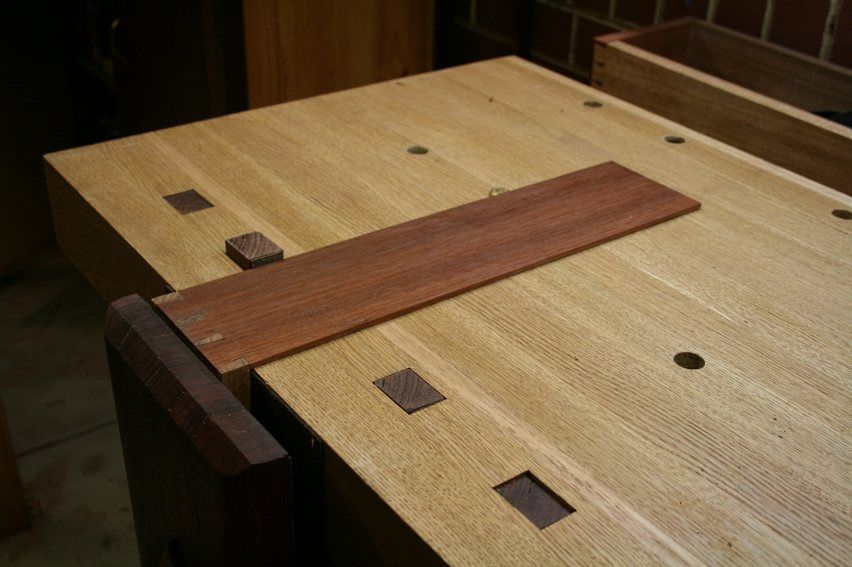
The first few accessories that come to mind (after the Loxiliary bench) are:
- my work light that drops into a 3/4" dog hole anywhere in my shop; I also have a handscrew with a couple of 3/4" holes in it that I can clamp about anywhere that I don't have a permanent dog hole.
- 3/4" FAMAG BorMax Forstner bit. When making dog holes in sugar maple, it doesn't take long to smoke the cheap Chinese bit, so I replaced it with this one many years ago.
- a sliding cross vise for my drill press. It is essential for mortising, whether using a hollow chisel mortising attachment, or using a Forstner bit followed by paring chisels. Mine is a Grizzly G1064, and while I'm not in love with it, it does what I need, and the price is right. I bolted it to the stock table a few years ago, and have never removed it.
- a patternmaker's vise. For my Loxiliary bench, I've thrown together some auxiliary jaws that accomplish a lot of what my main patternmaker's vise does.
I'll think of more later.
Re: Essential jigs/aids for woodworking.....
#4Re: Essential jigs/aids for woodworking.....
Derek Cohen (in Perth, Australia)
Hi Roger
Not technically a "jig" but aids for planing on the bench, such as bench stops ..
Similarly, simple bench hooks for crosscut sawing ...

... or sawing sliding dovetails and dados ..

Shooting boards for edges and ends ..

Paring angles ..

Regards from Perth
Derek
Re: Essential jigs/aids for woodworking.....
#5drawer blade dovetail maker
Bill Tindall
There is not better way to assemble a case than with dovetails. However they can be tedious if not impossible to do for a person of limited skills that doesn't have occasion to do them very often. I seize any crutch that comes along. I came up with this one on my own and others have found it as handy as I do. To my surprise Popular Woodworking didn't think it worthy of mention. I use this handy jig to make half tails on the ends of drawer blades. Because every blade is indexed off one reference face every tail is precisely identical. It makes case construction easy and reliable. 
Because every tail is identical there are ways of setting up to pare out the socket waste that uses a jig block to establish the socket width. This joint is so easy to make that I non-traditionally use it for every drawer blade leading to a fortress like case.
Re: Essential jigs/aids for woodworking.....
#6Re: Essential jigs/aids for woodworking.....
david weaver
Surface clamping stuff, including dog holes wherever you need them to be to hold the work without putting a lot of pressure on it.
And a peg hole or a fixture (or two) 2/3rds or so down the length of the bench (from the front vise) to hold long boards that need to be edge jointed.
Surface clamping duds that are short enough to work with most boards without interfering with planing.
Re: Essential jigs/aids for woodworking.....
#7Re: Drill Press Table Support
William Duffield
OK, now that you've dedicated your OEM DP table to your cross-slide vise, what are you gonna do when you want to use the DP for something else?
You run out to your local ACE hardware, to the plumbing department and buy a 4" steel nipple and a flange to fit. Take some measurements before you run out. the nipple that fits my DP is about 1-5/8" i.d. and about 1-7/8 o.d. YMMV. You'll probably find it is just a little oversize to fit the support in your DP, so you chuck the nipple in your scroll chuck on your lathe, and go after it with a mill bastard file. In less than 10 minutes it should be a snug fit. If you don't have a scroll chuck, you can screw the flange to a block of wood, and screw the block of wood to a face plate. That method is more difficult to get centered, so if you plan to make several accessory tables, buy an extra flange, and leave it set up for the lathe.

Re: Essential jigs/aids for woodworking.....
#8you could .....
Bill Tindall
keep the forum busy for days describing them all
Re: Essential jigs/aids for woodworking.....
#9Re: Essential jigs/aids for woodworking.....
William Duffield
This is a Loxahatchee Toolworks original chair spindle mortiser. I don't use this jig very often, but when I need it, I really need it. When fixing chairs, often I find a tenon has been broken off the end of a turned spindle, and I don't want to turn a new spindle. This jig is for drilling a mortise in the end of the chair spindle, so I can glue in a new tenon.
While the spindles are usually round, they are seldom cylindrical. If you were to clamp them in a vertical fixed v-block, they would not be held vertically. This jig allows me to clamp most any turned spindle and adjust it so that it's center line is exactly vertical. The clamping faces of the adjustable vertical member are in the form of a v-block, which clamps the spindle vertically in one dimension.

I didn't have an available broken spindle to star in the pictures, so my stunt double, a mostly completed black locust maul (a.k.a. a beetle) is the stand-in.
The horizontal pivot pin at the top and the adjusting bolt and knobs at the bottom allow the clamping block to rotate a few degrees in the other direction, so that the spindle can be brought into vertical alignment in the perpendicular direction.

The jig clamps in the cross-slide vise, which allows me to align the drill bit in my drill press with the center of the spindle. The table and cross-slied vise need to be swung well to the side to bring the spindle under the drill. Even though the vise's acme threads and metal jaws provide a very strong grip, you have to drill slowly and use a very sharp bit, or the jig will pivot under the downward force of the DP. The fixed vertical member is through-tenoned into the fixed horizontal member. It has a vertical slot cut in it through which the adjusting mechanism passes. The angle adjuster works a lot like the adjuster in a #112 scraping plane. All three wooden components are sugar maple.

The hole that has to be drilled in the end of the spindle is usually of a smaller diameter than the tenon that is needed to fit the joining chair part, so I have to turn a double-ended tenon, with two different diameters.
Re: Essential jigs/aids for woodworking.....
#10Re: Essential jigs/aids for woodworking.....
CStanford
That's a might more involved than me setting a bevel gauge and eyeballing it and drilling 'em with a brace and bit.
Re: Essential jigs/aids for woodworking.....
#11That takes the prize
Re: Essential jigs/aids for woodworking.....
#12Re: Essential jigs/aids for woodworking.....
William Duffield
Yeah, but I've messed up too many by misaligning the drill. Maybe if I had two spotters, but the bench dog is only good at spotting tennis balls and squirrels.
Re: Essential jigs/aids for woodworking.....
#13Re: Which Prize?
William Duffield
The Ig Nobel Prize, is what I'm hoping for. 
I think the geometry of the jig itself is pretty elegant. When I figured out how to build it, I realized that it was going to be really simple to attach it to the drill press, since I could just clamp it in the cross-slide vise jaws. Dead simple, and there would be lots of flexibility of adjustment. But when I actually installed it to put it to use, all the cranks and knobs and jaws got in every other gizmo's way. With about 8 degrees of freedom, the geometry is enough to give Euclid himself nightmares. But I'm persistent, and eventually get everything out of everything else's way, and it works. I now think there is a much better way, but it entails another trip to the ACE hardware, and another pipe flange and nipple, that I will just screw directly to the bottom of the jig's horizontal fixed member, dispensing entirely with the complications of the table and cross slide vise. It might save me having to write a thirty page manual explaining how to set it up.
Re: Essential jigs/aids for woodworking.....
#14Re: Essential jigs/aids for woodworking.....
TomD
Pretty much the only jig that jumps to mind is a shooting board, and even that is not a jig in some modes of use. I am pretty adamant about not making jigs mostly because I make so many different things that the jigs would take over the shop. I have made a ton of them for one thing or another. If I went back to production guitarmaking, I would make jigs and fixtures for every step, and on a slightly larger scale, I would make workstations for every step.
Re: Essential jigs/aids for woodworking.....
#15Re: Essential jigs/aids for woodworking.....
TomD
That is why I don't build jigs because I would drill that, if I get what you are doing, in one of my many lathes. Or maybe a milling machine. I don't like drilling endgrain with forstners, I like to use a spade drill, or a two flute milling machine bit. I have had lathes for a long time, but the other stuff only in the last few years.
Re: Essential jigs/aids for woodworking.....
#16The best aid of all! *LINK*
Derek Cohen (in Perth, Australia)
Blue Tape !!!!!
1000s of uses.
I posted one not so long ago about marking out half blind dovetails. This makes is so easy to see the transfered scribed lines (my second recommendation would be a good light source) ..

It is phenomenal. 99% of the time I go saw-to-saw. The only thing that holds me back writing this up for Pop Wood is that it is another dovetail article.

Regards from Perth
Re: Essential jigs/aids for woodworking.....
#17Re: Essential jigs/aids for woodworking..... *LINK*
James Watriss
Tough call. I think the most important thing to start with is a really good combination square. That's what let's me know how accurate everything is, helps me build the rest of my jigs, etc.
This week I've been working on a base for an office chair, and there's some really funky mitering going on, in some very thick wood, and that's really required me to push the accuracy envelope. Reference surfaces off of machines haven't been square or flat enough, so I bounced between power jointer and planer and bench and hand plane pretty frequently to get the first reference surfaces that would allow me to cut the 30 degree miter perfectly square, which then became a new reference surface... I needed the hand tools to push the accuracy level high enough to make it all possible.
Accuracy builds off of previous accuracies, and starting with a known accurate reference tool for straight and square is so critical...
More Here
Re: Essential jigs/aids for woodworking.....
#18Re: Essential jigs/aids for woodworking.....
William Duffield
What was I thinking when I put this together?
Yes, of course, drilling it on the lathe just about insures concentric mortises. I have a scroll chuck, a steady rest, and a keyless chuck to hold the bit in the tail stock. I have a very limited selection of end mills, but I think my brad point bits would work better than the Forstners in end grain. The limitation is the length of my lathe bed. It's sufficient for most chair parts, but I have an additional 8" under the DP chuck.
Re: Essential jigs/aids for woodworking.....
#19Re: Essential jigs/aids for woodworking.....
TomD
That did occur to me.
One of my lathes is a conover so bed length is a variable. For about 10 years the only lathe I had was a short bed, and I did have a bed extention for that one. And one of my South Bend metal lathes, the previous owner had a bed extension for woodturning on it. If I have to jig I prefer to make jigs that have many uses. Complex jigs look cool, but often have few uses.
What did I say for drill bits? I meant spade bits, they cut end grain like one wouldn't believe, much more free cutting. Basically a boring bit, which is another option.
Re: Essential jigs/aids for woodworking.....
#20Re: Essential jigs/aids for woodworking.....
William Duffield
Yes, Tom, you said spade bits, but I don't use them often, so I was curious whether you though brad points (which others have recommended for end grain) might work as well. I guess I just better do some experimenting with the spade bits I've been repurposing, but not on an antique chair.
Sometimes, though, the lathe doesn't do the trick, at least not without some serious jigging. The next chair spindle I need to perform this operation on is this bent back spindle.

Best repurpose I've yet found for cheap spade bits (not to disparage spade bits in general).

Re: Essential jigs/aids for woodworking.....
#21How....
Bill Tindall
will you go about repairing this chair. Will you take the back off and if so how?
Re: Essential jigs/aids for woodworking.....
#22Re: How....
William Duffield
It's fairly easy, now that I've got my "prize" jig set up and ready to go 
Yes, the back will need to be disassembled. The other lower back spindle tenon is also loose, so I should be able to get it out without a lot of difficulty, unless there is a nail holding it in place, but I haven't found any evidence of that yet. I'll know better when I've extracted the broken tenon.

This is one end of the lower back splat and the end of one spindle. Sorry for the background clutter, no photo booth. All of the joints have already failed. The biggest issue will be getting the nails out that hold the upper back splat to the back spindles. I think they were installed by the guy who made the chair, to facilitate glue-up.

I may be able to just pull out the splat tenon, splitting the end grain and with a pair of needle nose pliers working through the mortise, push the nail out through the back of the spindle. However, I'll probably have to drive them through and out the front of the spindle. I'll clamp a piece of scrap to the front of the splat, to minimize spitting of the wood and chipping of the paint, drive them through most of the way with a very small pin punch, remove the splat, push them back in, snip off the head through the mortise, pull them back out from the front, putty the hole and color the putty.
Then, I will need to build a new tenon in the bottom of the back spindle, similar to this mock-up: This is a scrap of poplar, just for illustration. I'll probably use some sugar maple for the real one.

The smaller diameter will match the diameter of the bit that I will use to drill the hole in the end of the spindle. The larger diameter will match the mortise in the chair seat. I'll cut it to match the length of the new mortise and glue it in place with epoxy. This won't be a problem, since it should never need to be disassembled. The rest of the joints will be scraped clean of old glue and reglued with hot hide glue when I reassemble the chair, just in case it ever needs to be taken apart for future repairs and whoever does the repair recognizes hide glue. The last step will be to cut the larger end of the tenon flush with the bottom of the chair seat.
It's too bad, but someone has already repaired it once, different joints, but using some kind of brown, non-reversible glue.
Re: Essential jigs/aids for woodworking.....
#23Re: Essential jigs...Melamine. Don't need a pic.
Bruce McCrory
Melamine surfaced sawdust board. Something bad always happens to the darling jigs I labor over.
I screwed a 30" ($2) section to a $18 saw horse. I have a $20 workbench that I can cover with glue, pepper with drill holes (until it rains); and flip over for a second life--if it doesn't get wet. Today, I screwed a scrap of pine into it for a shooting board.
I had Big Box cutting some plywood when I noticed a stack of the stuff in the discount bin. $12 should last me a couple of years.
Great stuff! And, no regrets. None.
Re: Essential jigs/aids for woodworking.....
#24"using some kind of brown, non-reversible glue"
Bruce, a MN Galoot
maybe urea-formaldehyde resin glue? I've used it on occasion, and I think my grandpa was a big fan of it (the stuff was glopped all over his shop). It dries excessively hard, highly water resistant, great for laminations, but I don't know if it successfully glues to itself.
Re: Essential jigs/aids for woodworking.....
#25Re: "using some kind of brown, non-reversible glue
William Duffield
Urea-formaldehyde was my first guess when I spotted it. (I've run into it in another restoration job.) Great for laminations and veneer, because it doesn't creep, but not so great for chair joints, which must remain flexible. There's a dollop dripped on a leg stretcher, and it is very hard, more so than the yeller glue and epoxies that I have used, but not nearly as brittle as old hide glue.


