New WoodChat!
Home Articles Forums Gallery Marketplace Videos

WoodCentral Forums

Knowledge You Can Build On — Est. 1998

VPS-Level Performance. Fully Managed. No Hassle.

Plane mouths, Seaton Chest

Posts

Plane mouths, Seaton Chest

#1

Plane mouths, Seaton Chest

Warren in Lancaster, PA

There was some discussion below about the mouth opening for a double iron plane. Although discussion has centered on Bailey planes, my most used planes are a jack plane I made in 1978 and a trying plane I bought used in 1979. Since these planes are used in much longer sessions than smoother or jointer, the lightness of a wooden plane is desirable.

In the recently released Seaton Chest book, Jay Gaynor gives measurements for the planes (practically as new from 1797) and from these I was able to compute the mouth sizes. Three double iron planes, smoother, jointer, and try plane, all had mouths about .04 inches. The double iron jack had a mouth about .065, the single iron jack about .055.

Re: Plane mouths, Seaton Chest

#2

Ellis Walentine

Can you explain?

Ellis Walentine

I don't want to pretend to know the reasons for the different planes having mouth openings of those dimensions, Warren. They're all within .020" of each other. My guess is that a jack plane is for thicker shavings, hence the slightly wider opening. Can you shed some light on it for me? On the surface of it, it seems like the critical elements are the thickness of the shaving each plane is expected to take, the way the iron is bedded in relation to the mouth opening and the extension of the cutting edge below the plane of the sole. (Sole of the plane?) :)

Ellis

Re: Plane mouths, Seaton Chest

#3

Re: Can you explain?

Warren in Lancaster, PA

In the discussion below some thought that a tight mouth was important for a double iron plane and some thought not. The planes in the Seaton chest come from an era when cabinetmakers were routinely preparing figured wood by hand and are close enough to their original dimensions to give us a window on their use. This is not a lot of data, but it does suggest that the makers might have worked to standards in the neighborhood of .21 for throat (without iron), .125 thick iron, .04 mouth, with the jack planes having slightly larger mouths to accommodate larger shavings. Since the smoothing plane and jointer have mouths that are larger than would be needed just to pass their thin shavings, it seems they were not concerned about very tight mouths.

Re: Plane mouths, Seaton Chest

#4

Speculations

Derek Cohen (in Perth, Australia)

Hi Warren

The specifications noted on the Seaton planes only indicate what was in that toolbox. While I'd like to believe that they knew what they were doing with plane design, progress happens. For example, steel planes came later (although one might debate whether these were advancements :) ).

A few questions of my own:

1. Is there a body of historic literature on mouth size available similar to that on chip breaker use?

2. Assuming that it is easier/more reliable to build steel planes with small mouths, would this have accounted for the larger mouths in the Seaton chest? That is, smaller mouths became a feature of improved chip control as manufacturing techniques changed. If so, what are the specifications for Spier and Norris infills?

3. What research has been done on mouth size (as opposed to anecdotal reports)? There is the assumption (based on logic?) that a smaller mouth facilitates better chip control. Is this fact or fiction?

Regards from Perth

Derek

Re: Plane mouths, Seaton Chest

#5

Re: Speculations

TomD

I use a lot of planes with gigantic mouths for roughing and such, sometimes they cut pretty nicely. I have some with very tight mouths for other uses. What is interesting about the new pics on chipbreakers is that they are not breaking the chips. That is one suggestion for their utility, that I have not seen disproved. But in the case now revealed, and as was happening in our Japanese hand planes, yet we could not see the details, the shaving is pressed down into the surface. It is not breaking, but being forced down (I should not we knew the shavings weren't breaking, I did not personally know they were pressed down. While my Japanese planes with breakers for fine work always had tight mouths, I don't know to what extent that improved the cut in this case.

Re: Plane mouths, Seaton Chest

#6

Re: Speculations *LINK*

Kees

In Holtzapfel (1856) you can find a picture of a plane with a prety damned fine mouth. (see the link below).

No idea what conclusion to draw from this, but he does mention one particular problem of wooden planes with tight mouth: wear. Your tight mouth won't have a long life when you really use the plane a lot.

When we look at the Kato video (Bill allready mentioned this) you can see that in this particular piece of wood, the mouth should have been realy super tight to have any benefit. Something like 4 thou.

When we look at iron planes. The old infills often didn't have such super tight mouths. Only the bevel up ones like the shoulderplanes and the mitreplanes.


http://books.google.nl/books?id=rVBIAAAAYAAJ&pg=PA480&redir_esc=y#v=onepage&q&f=false

Re: Plane mouths, Seaton Chest

#7

Re: Speculations

Derek Cohen (in Perth, Australia)

But in the case now revealed, and as was happening in our Japanese hand planes, yet we could not see the details, the shaving is pressed down into the surface. It is not breaking, but being forced down (I should not we knew the shavings weren't breaking, I did not personally know they were pressed down.

Tom, as you note, one of the arguments for a tight mouth is to support the chip. Another is to limit the thickness of the chip. Thin chips do less damage.

However, the issue is whether these factors were considered relevant at the time of Seaton, and whether the plane construction even permitted this type of tuning.

Regards from Perth

Derek

Re: Plane mouths, Seaton Chest

#8

Re: Speculations

Derek Cohen (in Perth, Australia)

In Holtzapfel (1856) you can find a picture of a plane with a prety damned fine mouth. (see the link below).

No idea what conclusion to draw from this, but he does mention one particular problem of wooden planes with tight mouth: wear. Your tight mouth won't have a long life when you really use the plane a lot.

Hi Kees, thanks for this info. This supports the point I was making, that is, a need to look at the bigger picture surrounding the information that Warren supplied about mouths of the Seaton planes.

Regards from Perth

Derek

Re: Plane mouths, Seaton Chest

#9

Literature

Warren in Lancaster, PA

There is not much literature on plane specifications before Holtzapffel (1743) or the 19th century patents. Nicholson (1812) says "the opening ... must be no more on the sole side of the plane, than what is sufficient for the thickest shaving to pass with ease." I don't recall Roubo (1769) discussing this; it is certainly not diagrammed in his plates. Roubo does not mention the double iron, but he was a cabinetmaker who owned a business; I guess we don't know that he told everything he knew.

With the Seaton planes we are relatively confident that the planes received only moderate use and have their original irons. We also know that they were purchased by a very capable cabinetmaker, not a joiner or an amateur.

It is not hard to make the mouth of a wooden plane the opening you want. The irons in the Seaton chest planes were hand forged and lacked uniformity. I think the mouths would probably have been adjusted individually.

From my decades of experience I can say that with a tapered iron the mouth opens up more quickly from the wearing of the iron (it gets thinner as you work your way up) than the wearing of a beech sole. A tight mouth is not necessary for preventing tear out, but the mouth opening could have some influence on the optimum settings for the cap iron.

Re: Plane mouths, Seaton Chest

#10

Some things to calculate

Bill Tindall

I managed to stick a stick in my eye while cutting some trees (I even had safety glasses on). I cut one eye and I can hardly see or I would look up these data. Maybe someone else can.

In the Kato paper translated on Steve's web site there is a figure that provides data on the downward force on a freshly sharpened blade. This force is provided by the incipient shaving being pushed up. To an approximation this will be the force necessary to hold the shaving down. Then one could estimate the area of a plane sole and calculate the total force necessary on the plane to equal this force. For a flat sole in uniform contact I expect this force will be bigger than what is normally porvided in hand planing. It may turn out that one can't push hard enoug on a uniform smooth plane sole to keep the shaving from lifting ahead of the blade tip. I'l look at the calculation when I can see well enough to read the Figure unless someone else wants to push the numbers around. ...just can't see to type anymore but you get the idea........

Re: Plane mouths, Seaton Chest

#11

Re: Some things to calculate

Kees

Ouch that hurts I guess!

I'm not quite sure if I really understand that diagram. It sais -0.5. On the y-axis the unit is kgf/9mm.

No idea what that 9 is doing in there?

The force pulling the blade down into the wood was -0.5 with the capiron at 0.2mm and -0.25 with the capiron at 0.1mm. So with the capiron closer to the edge, the downforce was less.

Re: Plane mouths, Seaton Chest

#12

Re: Some things to calculate

Kees

Well, I've been thinking a bit about this. The last physics education I got is 20 years ago, so I am a little rusty on these things. When we have a mechanical engineer overhere, please correct all my false assumptions and miscalculations.

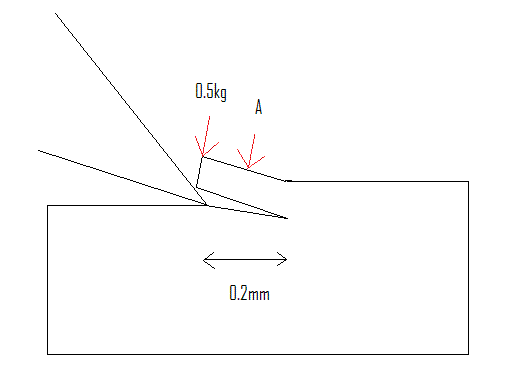
So in the video we have a splinter of wood, 9mm wide but only propagating 0.2mm deep into the wood (depth comes from looking how far the split goes in the Kato video). That splinter manages to excert a force of -0.5 kgf. That means, the wood forces the cutting blade down.

A smoother made with such a blade would have an area under the frontknop of about 9 x 50mm = 450mm2. But you only need to press down that narrow sliver of wood, 9 x 0.2mm = 1.8mm2. So you will have to put a downwards force of (450/1.8)x0.5 = 125 kgf on the front knob.

Now, you have seen me in my video. I don't really look like a 125 kg man, do I? If I would lean with all my weight on the front knob of the plane, I could only muster half of the neccessary force on the woodchip to hold it down into the wood.

Conclusion, to be able to use the mouth to prevent tearout, you will have to hollow grind your plane sole, like the japanese do with their planes.

Of course I could easily be off a factor of 1000 or so, so please verify my calculations.

Re: Plane mouths, Seaton Chest

#13

Re: Some things to calculate

Kees

On thinkingthis a little further, I suppose it's all a bit more complex.

The wood splinter acts like a leafspring. So it's going to be a matter to calculate how much force you need to press down the leafspring flat again. I'm afraid that's totally beyond the scope of my highschool phisics lessons.

How would you calculate the force needed at point A?


img

Re: Plane mouths, Seaton Chest

#14

Re: Some things to calculate

Kees

Ok, just to be sure I am not theorising a non practical situation, I did some tests with a piece of curly maple.

Plane is a Stanley #4 with a Ray Iles iron.

First a wide open mouth and the capiron pulled far away from the edge. Big and deep tearout was the result.

Then closing the mouth to something that passed a 0.10mm feeler gauge. When taking very fluffy shavings I could remove the tearout, but with a 0.7mm shaving there were still some spots with tearout.

Finaly, setting the capiron at 0.2 mm and opening the mouth again, everything was fine again, even with 0.1mm thick shavings. 0.15mm shavings made new (fine) tearout again.

Conclusion, yes a tight mouth works, but not as good as a close set capiron with a wide mouth. And closing the mouth to such a thin slit is realy fumbly on a Bailey plane! Especially because you can't reach the frog setting screw very well with a scredriver. The tote is in the way.

As always, take my fumblings with a shovel of salt. Experiment for yourself.

Re: Plane mouths, Seaton Chest

#15

Perspective

wilbur

This is a great example of where numbers really help. For me, I would think that a mouth opening on the order of 0.04-0.065" was pretty tight. But that's just me.

FWIW, the Japanese planes that I own have mouth openings in the 0.04-0.05" range as well.

Re: Plane mouths, Seaton Chest

#16

Re: Perspective

Kees

That's 40 thou, or 1 mm. I think that is quite wide in fact.

4 thou or 0.1mm. That's tight.

Re: Plane mouths, Seaton Chest

#17

So, what should we do?

Tony - Memphis

I'm a casual hand plane user. I have an old Stanley #4 with a hock iron - everything else is stock. How should I prepare the chip breaker? Is it worth replacing with an aftemarket?

Thanks for the help.

Tony

Re: Plane mouths, Seaton Chest

#18

craigd

Re: So, what should we do?

craigd

I'm with Kees on this one - the chip breaker setting trumps the mouth opening (Bailey planes). I've never used anything but stock chip breakers, they work fine but can be finicky.

To prep the chip breaker I would:

- Put the breaker flat on the sandpaper and push/pull to make the lip flat. You want it to sit on the blade light tight.

- Sand the front of the hump smooth on flat surface. I put my finger in the hump and draw it towards me while tilting it to vertical. This makes it nice and round and puts a tiny flat at the tip. I go to 320. Strop if you like.

- Open the mouth (see photo for settings that all work). The bottom plane was close to 1/8".

- Set the breaker to 1/32"

- Test. Move the mouth only after finding a breaker setting that works.


Re: Plane mouths, Seaton Chest

#20

Stay tuned.....

Bill Tindall

An article is on the way to answer this very question.

Re: Plane mouths, Seaton Chest

#21

Re: Some things to calculate

Warren in Lancaster, PA

It takes very little deflection of the wood tissue to concentrate the force in the area at the front of the mouth. The front of the mouth limits the deflection.

Re: Plane mouths, Seaton Chest

#22

Re: Perspective

Warren in Lancaster, PA

Chris Schwarz has talked about using a mouth in the .002 range to reduce tear out. Larry Williams says

"a mouth opening tight enough to help control tear out, somewhere around .005" or a little more... "

Re: Plane mouths, Seaton Chest

#23

Re: Some things to calculate

Kees

So you say something like, the shaving lifts the front of the plane up a little bit, so all the force on the front knob is concentrated to the shaving?

Like I said, this is all far beyond me, and I shouldn't write about it at all. Nonetheless it's intrueging.

Re: Plane mouths, Seaton Chest

#24

Re: Some things to calculate

Warren in Lancaster, PA

What I am saying is that once there is a small deflection in the surface of the wood ahead of the cutter, there is a tiny wave of higher material that the plane rides on. So the force is not spread over the entire sole, but concentrated on the front edge of the mouth. The fact that people actually see the difference in surface quality by having a tight mouth is evidence that the force is sufficient to make a difference.

Re: Plane mouths, Seaton Chest

#25

Re: Perspective

david weaver

Before we started this, I found on a bevel down plane that .004" worked nicely.

Of course, that limits the shaving depth, but that plane does still work very nicely.

It cost me $275 just in materials to build it, though, and the two #4 style smoothers I bought to play this game in early march cost me $11 and the following that up with a nicer one I spent $20. I did pay to ship them both, and I bought 5 $3 irons at home depot, made one myself and then did splurge and get a $40 tsunesaburo blue steel iron (which is the finest bench plane smoother iron I have ever seen - it does ruin my cheap streak, though).

I shouldn't minimize the infill that I built, it may not look professional, but it works very nicely. I just found, surprisingly, that almost none of the other hand-tool-only folks were willing to learn to work metal in the same "trust your hands and eyes to mark it, cut it, size it and fit it together" kind of way.

The planes that I've been trying this with intentionally have wide mouths (to my eyes). They are probably in the range of 1 1/2 millimeters, there just is no more room to make them bigger, but I can conclude it's not the mouth doing the work of managing the quality of the surface.