WoodCentral Forums

Est. 1998 — 27 years of woodworking knowledge

Chip breaker experiment: session four

Posts

Chip breaker experiment: session four

#1

Chip breaker experiment: session four

Derek Cohen (in Perth, Australia)

Rationale

The conclusion after Session Three was (1) I had either not found the sweet spot for the very hard Jarrah I was planing, or (2) the effect of a chip breaker deflecting shavings is wood dependent.

Session Four

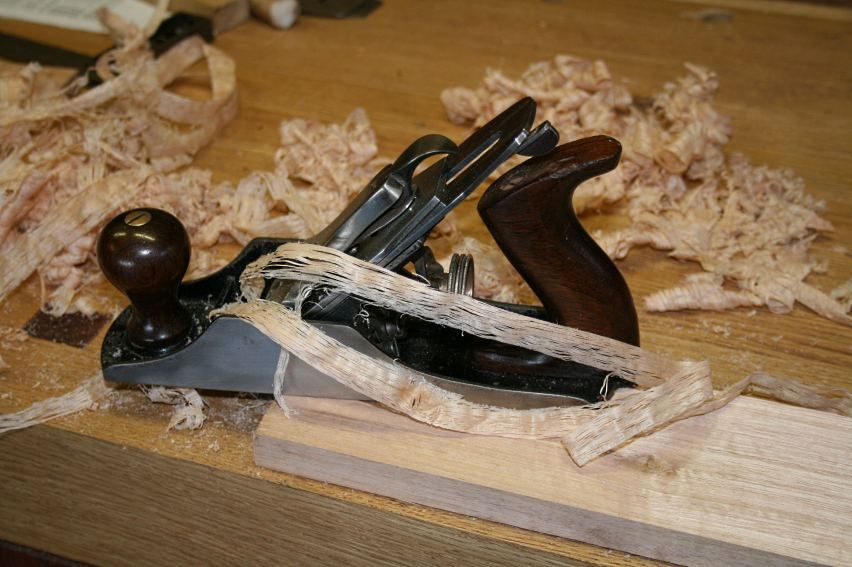
The plane is an unmodified Stanley #604 with LN chipbreaker (given a 70 micro bevel and slightly cambered) and a custom M4 blade.

This time around I chose a piece of Tasmanian Oak. For non-Aussies, this is (in my experience) similar in density to USA White Oak and also to European Oak. Tassie Oak is not an oak, however, it is a eucalypt. As such, it tends to be a little more interlocked. This piece was fairly typical.

How would I know if I was in the "sweet spot"? Well the video shows the shavings coming off the chip breaker vertically. This is why I have begun to think of the chip breaker (never again a "cap iron"!) as a "chip bender".

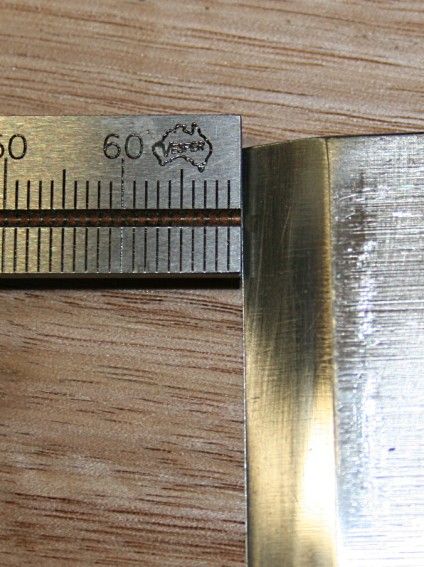
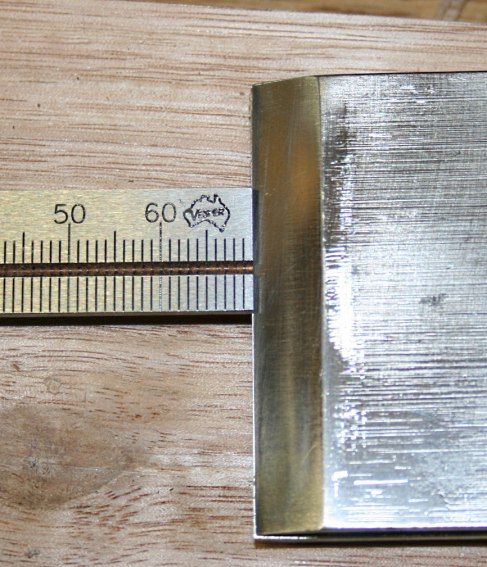
I set the chip breaker at a modest 0.3 (keep in mind that the chip breaker readings are slightly larger at the edge of the blade compared to the centre of the blade) ...
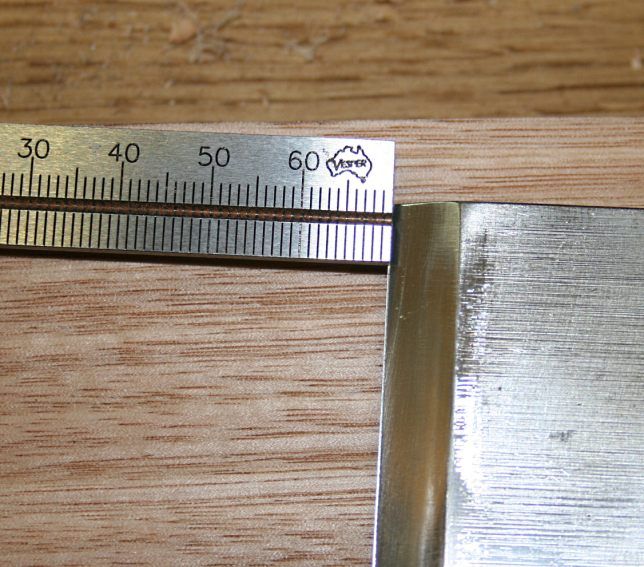

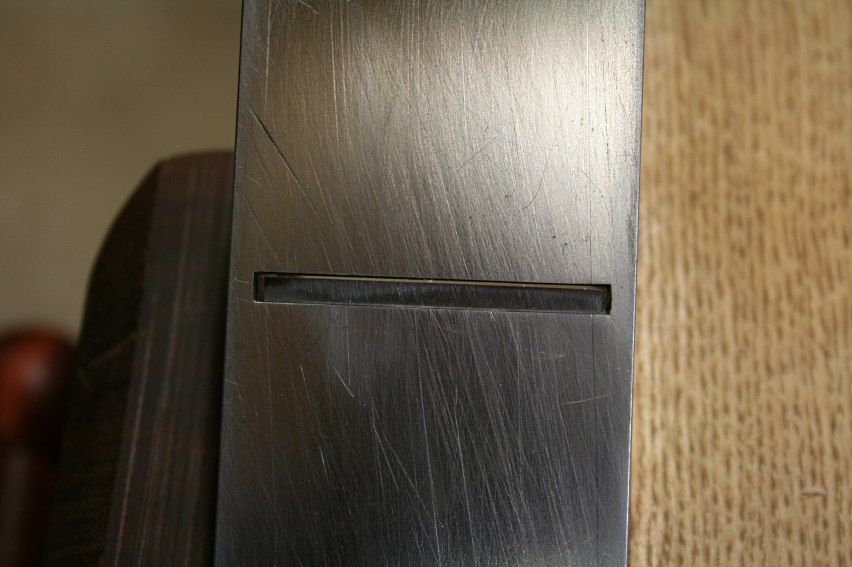
The mouth was "wide" at about 1mm. No effort was made to close it down as I normally would do for a smoother.

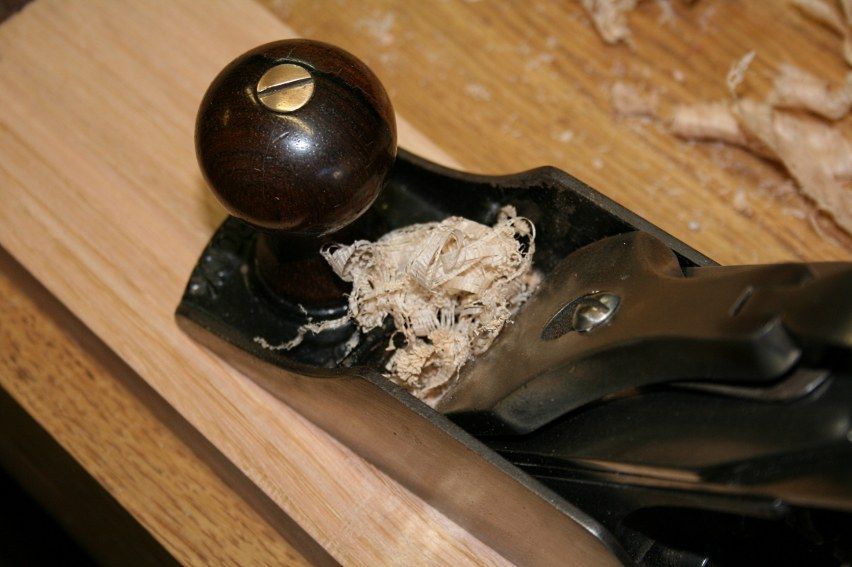
Here is the result ..
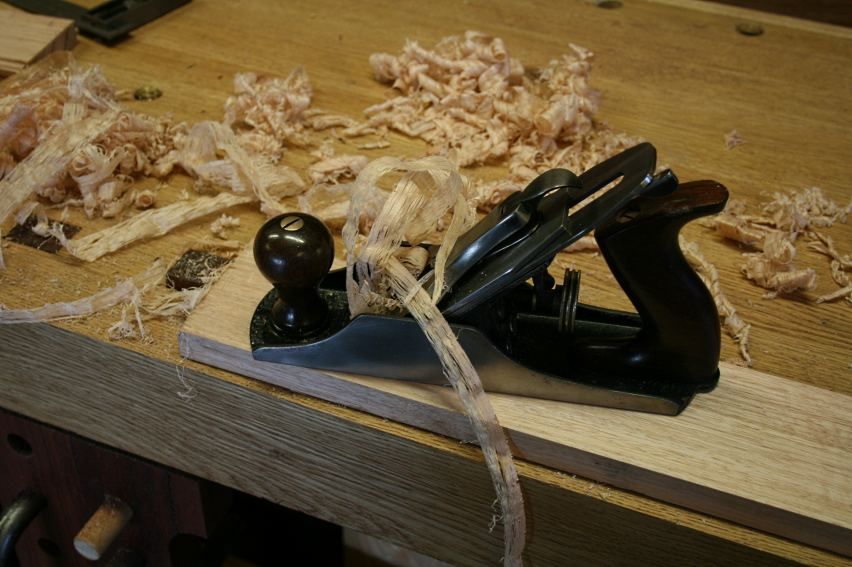


This was a good result. In the background you can see shavings from a chip breaker set back about 3mm. Those shavings are curled.
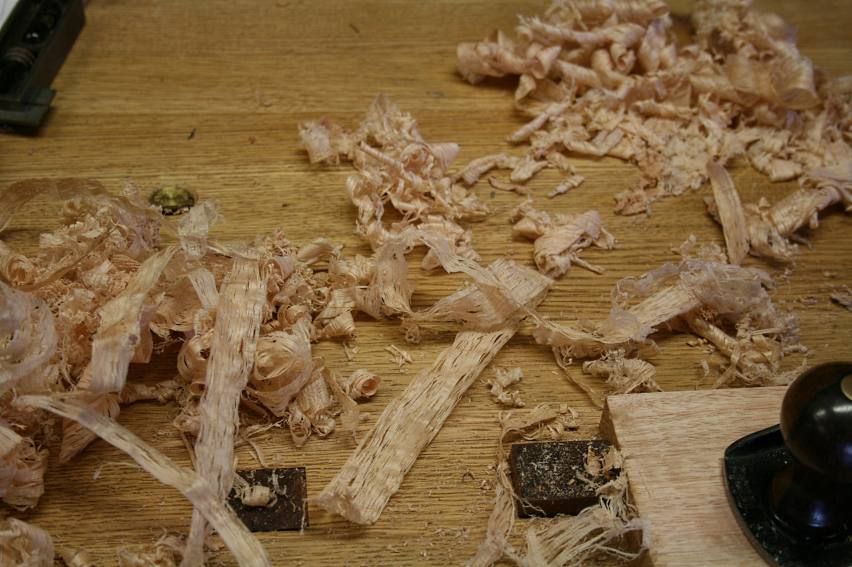

Of particular relevance here is that the planing took place into the grain.
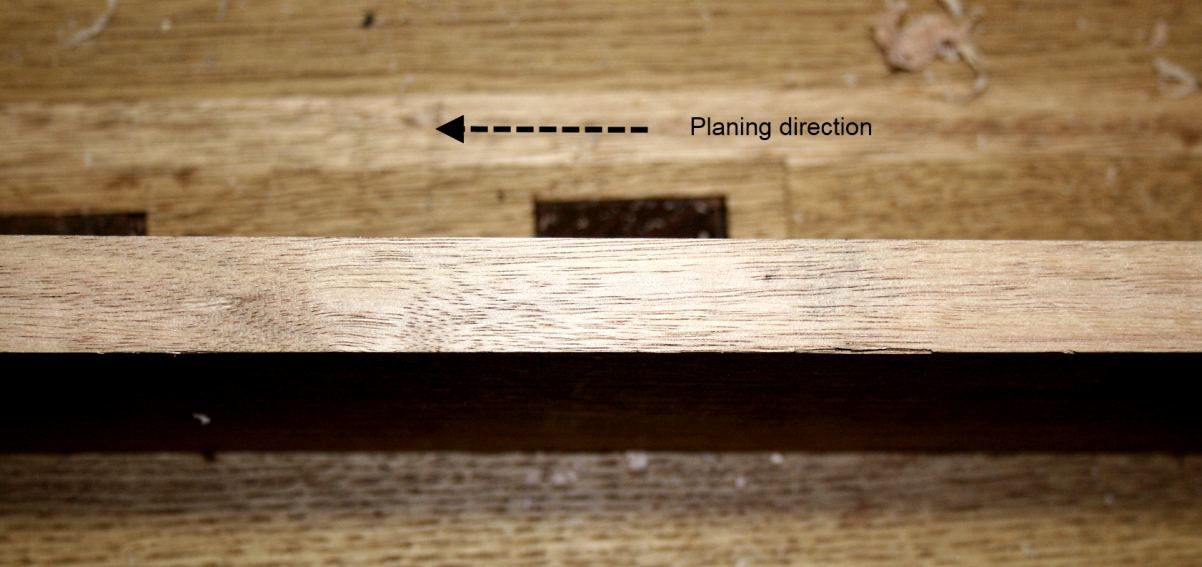

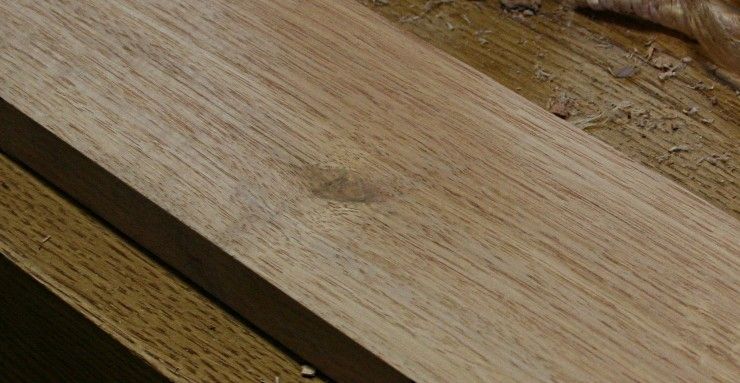
The surface result was also superior - a shiny, clear and tear-out free finish ...
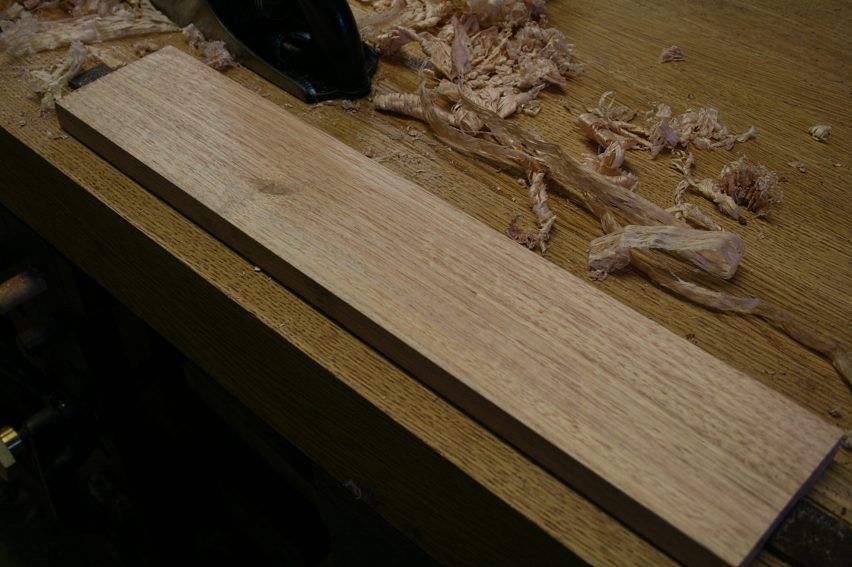

A close up around the knot reveals the absence of tear out ...

The second part of this session now moved to closing up the chip breaker to about 0.1 - 0.2mm ..

The result of this was very similar to Session 3, where the plane struggled to cut.

Clearly the chip breaker is now too close. However this is further evidence that it has a significant effect on the way the plane cuts.

For Part 3 the chip breaker was returned to the position of Part 1 ..

That particularly nasty piece of Jarrah (which is almost like end grain in the one section) was brought back. The #604 proceeded to plane this. The result was a little better than on the previous occasion, but not really that noticeably so. The board had some straight grained sections that were softer, and where the plane met this area, the shavings where long and straight. The surface quality was poor.
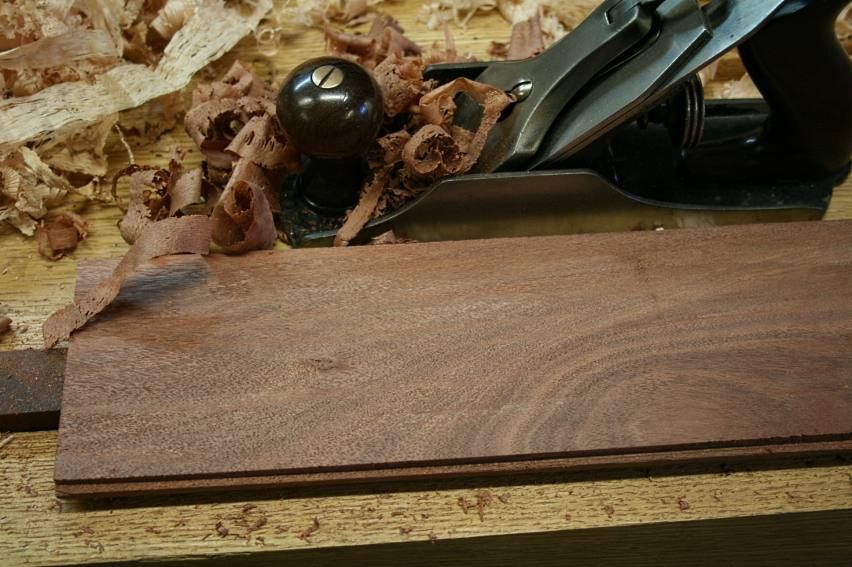

The LN #3 (with 55 degree frog, chip breaker set back 3mm) had its turn. The result was the same as before: decent surface to the touch, a noticeable improvement over the common angle #604 ...
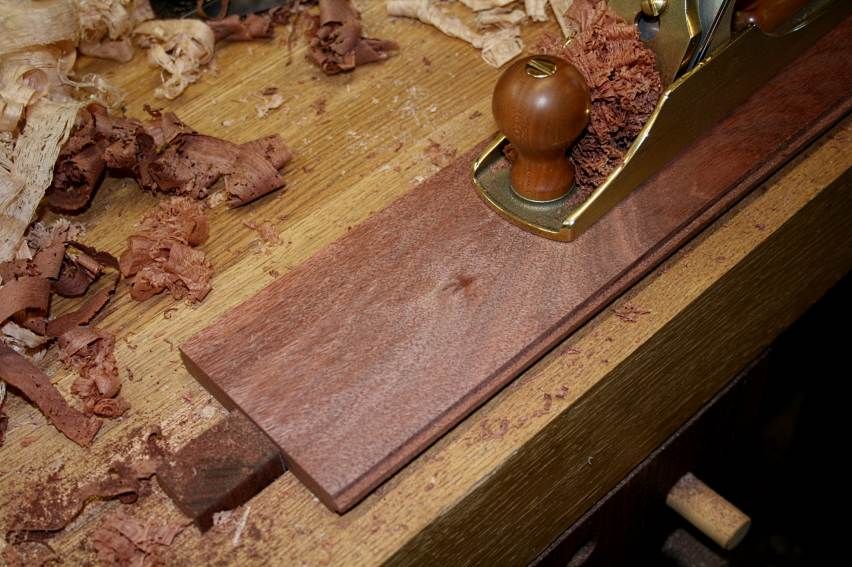

The chip breaker in the LN was now adjusted to 0.3mm and the board planed again. The result was a significant improvement in the quality of the surface ..
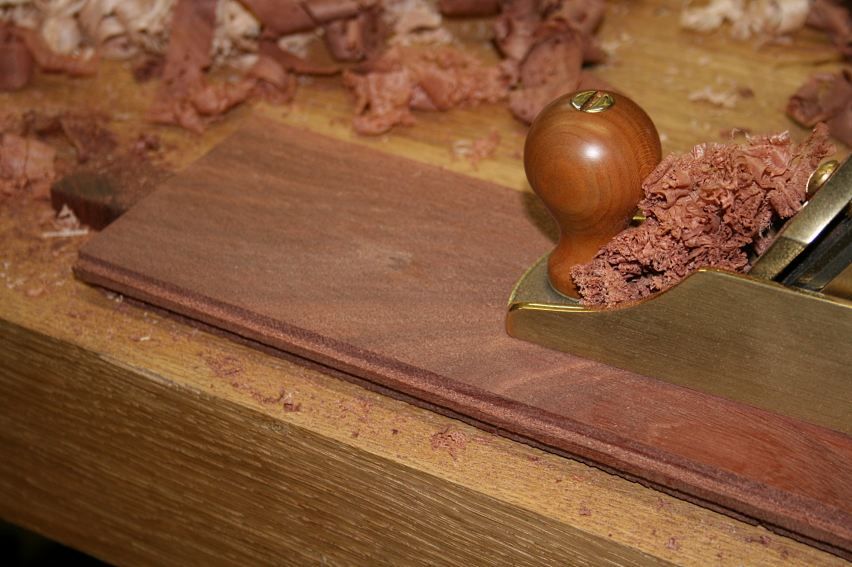

This was repeated with the Veritas Small BU Smoother (with a 62 degree cutting angle). In the previous experiment the SBUS left a clearly better surface than the 55 degree LN #3. This time the SBUS was shaded ...
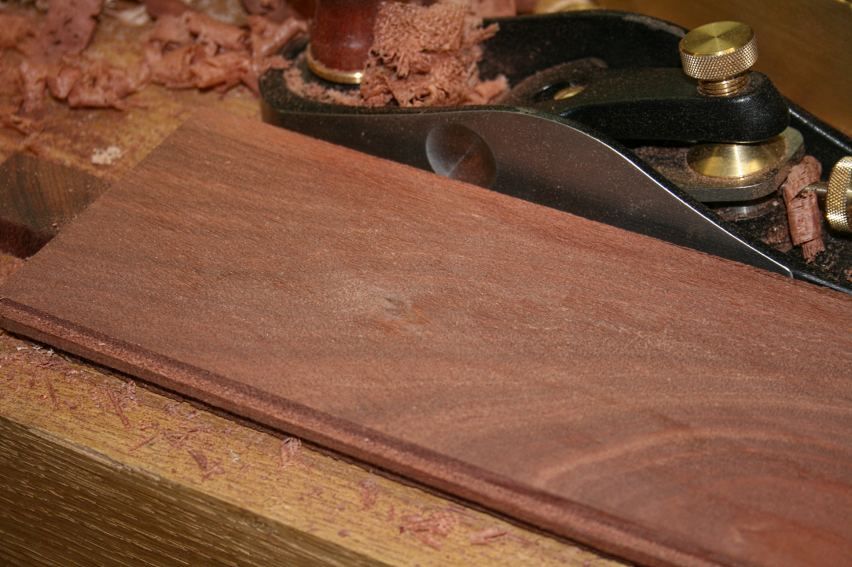

Neither LN nor SBUS produced shavings that were vertical. THis must be due to the high cutting angle.

Conclusions

There does appear to be a performance difference in the woods used thus far, indicating that the technique is likely to be wood dependent. The chipbreaker does, nevertheless, appear to be capable of improving the performance regardless of the wood type. However cutting angle does play a part as well, with a higher cutting angle still seen to be important for hard woods with interlocked grain.

Regards from Perth

Derek
Re: Chip breaker experiment: session four

#2

Re: Chip breaker experiment: session four

Philip Duffy

Thanks, Derek. As usual, you make perfect sense to me in your analysis. Philip

Re: Chip breaker experiment: session four

#3

Re: Chip breaker experiment: session four

Curt Putnam

As Artie Johnson used to say "Very Interrresting..." (Laugh In)

Any way, Thank you.

The conclusion that I am drawing from all of this is that a common Bailey can be made to perform at the the level of a BU plane and at the extreme, to surpass a BU in surface finish.

Thanks, Curt

Re: Chip breaker experiment: session four

#4

Re: Chip breaker experiment: session four

Derek Cohen (in Perth, Australia)

Hi Curt

No, on the contrary, I conclude that higher cutting angle is an important requirement in achieving good performance on interlocked, hard woods. However, the chip breaker is also a factor in improving performance. It remains, however wood dependent.

Regards from Perth

Derek

Re: Chip breaker experiment: session four

#5

Re: Chip breaker experiment: session four

Curt Putnam

Hi Derek,

Are you concluding that a double iron plane will produce superior performance when properly set up or is a BU plane with proper blade as good?

I realize that you work with extreme woods that I will never see, but it is good to know what happens at the extremes. Can you categorize your findings into AU and US groups? Are they significantly different? IOW, if I'm only going to work with maple, walnut and cherry are the conclusions different for me than for you - working on jarrah and the like?

Re: Chip breaker experiment: session four

#6

Re: Chip breaker experiment: session four

Derek Cohen (in Perth, Australia)

Are you concluding that a double iron plane will produce superior performance when properly set up or is a BU plane with proper blade as good?

I realize that you work with extreme woods that I will never see, but it is good to know what happens at the extremes. Can you categorize your findings into AU and US groups? Are they significantly different? IOW, if I'm only going to work with maple, walnut and cherry are the conclusions different for me than for you - working on jarrah and the like?

Hi Curt

I look at it this way at present - setting the chip breaker at the ideal distance to utilise the angle at its leading edge is like adding about 10-15 degrees to the cutting angle.

Cutting angle is still cutting angle, regardless of whether it is used on a BU or BD plane.

As with wood with more interlocked grain, such as in Oz, there is a need to use higher cutting angles. Yada, yada.

Woods in Oz vary from exceptionally hard and interlocked (almost all West Australian woods) to softer and straight-grained. I imagine that the woods in North America is much the same, but with a much, much smaller percentage of the gnarly stuff. This does not alter the planing issues. It just means that you can get away with lower cutting angles.

For the gnarly stuff, you have a choice of using BU planes with high cutting angles, or BD planes with moderate cutting angles plus chip breaker adjustment, or BD planes with high cutting angles.

Regards from Perth

Derek

Re: Chip breaker experiment: session four

#7

Interlocked grain

Warren in Lancaster, PA

No, on the contrary, I conclude that higher cutting angle is an important requirement in achieving good performance on interlocked, hard woods. However, the chip breaker is also a factor in improving performance. It remains, however wood dependent.

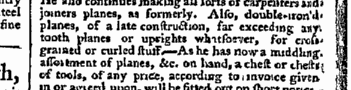
I have been using the double iron for interlocked grain for more than 35 years. The double iron plane was designed for this type of work. A high angle plane is unnecessary.

Here is what Samuel Carruthers wrote in 1767:


Re: Chip breaker experiment: session four

#8

Re: Interlocked grain

Derek Cohen (in Perth, Australia)

I have been using the double iron for interlocked grain for more than 35 years. The double iron plane was designed for this type of work. A high angle plane is unnecessary.

Hi Warren

Not according to the results here, which are reasonable conclusions to draw from the existing data. Yes, it needs to be done again, and again. The results will be challenged in a scientific framework - that is the way to conduct research - and future results may change the position I take at this time. However the current results speak for themselves at this stage.

Regards from Perth

Derek

Re: Chip breaker experiment: session four

#9

Re: Interlocked grain

Mark Hennebury

I, like Warren have been using a chipbreaker set close for over 35 years. This as far as I new was standard practice. To find how close to set it I always would experiement to find what was too close. So it was always set around that "sweet spot" I mostly used native North American hardwoods, Birdseye Maple being the bechmark for plane setup. I taught classes on hand plane tuning and setup, and wood structure as a prerequisite for taking other project classes. That's what the beginners class was about, understanding wood and being exposed to what an incredible job can be achieved with a well set up hand plane. The classes were three hours a night, one night per week for eight weeks, and all they had at the end of the course were nice shavings and an new window opened in their mind.

I have only ever used standard cheapy Record handplanes with standard bed angles, I just put a lot of work into tuning them up, and they have worked fine.

By the way its about time you lapped the sole of your plane.

Re: Chip breaker experiment: session four

#10

Re: Interlocked grain

Derek Cohen (in Perth, Australia)

Hi Mark

I am not sure what you are saying. Are you saying that I did not experiment in finding the sweet spot? Are you saying that my interpretation of these results is incorrect?

If I come across as defensive it is not intended. I am fully willing to toss out the conclusions if you can show me where the data would be incorrectly obtained, that is, if procedure was incorrect. I am not afraid of making mistakes! :)

Scientific method is about the ability to replicate. That is only part if it - one must also observe correct procedure. Rhetoric is not a sufficient rejoinder in this situation. Critique of procedure would be helpful (and not the sole of the plane - although I agree it could do with a little work - it is however flat, and the scratches show up because of the flash. It did perform well in the way intended on the Tasmanian Oak).

Regards from Perth

Derek

Re: Chip breaker experiment: session four

#11

Re: Interlocked grain

mark Hennebury

Hi Derek,

There has been a lot of flap over this "new found chip bender effect" the past month.

Many people seem to approach things with preconceived ideas and seek to confirm those. Many have chosen their plane styles and touted their opinions as facts for many years. Wood cutting is not opinion its physics, not Japanese Style or infil or single iron or double or whatever.

Lets review what we are trying to achieve: cleanly cut surface, with no tearout.

From a logical perspective:

Blades are wedges, bed angle increase the wedge affect, tearout is created by the wedging effect of the shaving ahead of the cutting edge. From a strictly observational point of view, the lowest possible bed angle and the lowest possible bevel grind angle would seem to get the blade tip in to cut the would fibers the best. It would also seem that coupled with a close throat that pressed down on the shaving and a close chip breaker would make the most sense.

If you look at the pictures from the Kato video it would lead me to believe that the most important part of preventing tearout would be the part that is not in the video, the leading edge of the throat opening.

So to me its important to have a lapped and polished plane sole, with a cleanly filed and polished throat edge just ahead of the knife, this edge should also be filed to form a vee on the inside with the bed angle, so that you have shaving clearance with the chipbreaker up really close to the tip. You throat looks to be square from the picture , although i cant be sure as i cant see it really well. The leading edge of the throat should be pressing down on the wood to hold it from lifting when the blade is cutting.

It would seem to me that a high angle bed is going in the wrong direction, and would seem to me to be pushing and scraping the wood more than cutting. And although it may not cause tearout it is probably not going to give you as good a surface.

So looking at this from a logical, observational perspective, high bed angle never made any sense to me.

Having used supersurfacers and handplanes for many years,I am quite sure that low bed angle works quite well. So its not just an opinion without any backup.

Re: Chip breaker experiment: session four

#12

Re: Interlocked grain

Derek Cohen (in Perth, Australia)

Hi Mark

I agree with your comments about a smooth, flat leading edge to the mouth. If there are chips or depressions, then this can be a cause of tearout. If there are striations, it can affect the shaving (I am not sure if this is so here, because this is how Tasmanian Oak shavings typically appear).

It would seem to me that a high angle bed is going in the wrong direction, and would seem to me to be pushing and scraping the wood more than cutting. And although it may not cause tearout it is probably not going to give you as good a surface.

So looking at this from a logical, observational perspective, high bed angle never made any sense to me.

Having used supersurfacers and handplanes for many years,I am quite sure that low bed angle works quite well. So its not just an opinion without any backup.

I have many years experience using planes with high beds and/or high cutting angles. I understand the view that they scrape rather than slice. Nevertheless they can and do produce a very smooth, if not reflective surface, in hardwoods. In the Australian context, where especially in my neck of the woods, the local fare is interlocked and hard, high angle planes make a lot of sense.

What is old/new is the notion of using the chip breaker to control tear out in a common angle plane. While you say it is old - and I am not questioning this at all - for a great many woodworkers (ask the forum to raise their hands), this is something they have little or no experience in doing. Chip breakers were "cap iron" that only served to stiffen the vibration in a blade. That is, if the performance was improved by a chip breaker, it was because of reducing vibration, per se.

So we are to some extend rediscovering the wheel. However there is more to this than just that. We also know that other strategies improve the performance of planes on interlocked or reversing grain. And this experiment was intended to examine some aspects.

Regards from Perth

Derek

Re: Chip breaker experiment: session four

#13

Re: Interlocked grain

mark Hennebury

Hi Derek,

We are all on the journey, and seeking to gain a better understanding of how things work. I am sure that for all of our opinions have found sufficient evidence to convince ourselves of their value, the discussions on this forum serve to present arguments from which we can question our own views and maybe grow. I have long been fascinated with handplanes, and trying to understand how this simple tool works. I am still looking and learning, and appreciate being part of the discussions. I offer only my opinions and observations, and am only happy to have a discussion, (however heated) on any points: that's the way we get to change our opinions, its only by being forced to defend them that we may find the weakness in them. So Don't mind me poking at you, just poke back.

so I am happy to see evidence of high angle planes working, as i found the concept a little curious. I also don't have the experience with the woods that your are using.

Re: Chip breaker experiment: session four

#14

Re: Interlocked grain

Derek Cohen (in Perth, Australia)

We are all on the journey, and seeking to gain a better understanding of how things work. ...

so I am happy to see evidence of high angle planes working, as i found the concept a little curious. I also don't have the experience with the woods that your are using.

Hi again Mark

We are all fiddlers ... fiddling away to salve our never ending curiosity.

Here is a different approach I took to dealing with the local hardwoods. This is a bevel up smoother with a high bed angle. Typically they are 12 degrees. Then you need to add a high bevel (of around 50 degrees) to get them in the half pitch range, which is tested as the ideal cutting angle. Here I used a 25 degree bed, which could lower the bevel to 35 degrees. The aim was to minimise the incursion of a wear bevel, and to make the bevel easier to freehand (35 degrees with a camber is doable. 50 degrees is not). This is one of my favourite smoothers.


Regards from Perth

Derek

Re: Chip breaker experiment: session four

#15

Re: Interlocked grain

Mark Hennebury

Hi Derek,

I am not hundred percent sure what you are saying,

" to get them in the half pitch range, which is tested as the ideal cutting angle."

"The aim was to minimise the incursion of a wear bevel"
But it looks like you get good results.

Re: Chip breaker experiment: session four

#16

Many ways to skin a cat

Derek Cohen (in Perth, Australia)

Hi Mark

At the start of this chip breaker journey Warren made the comment that the reason he preferred a common pitch Stanley over a higher angle plane was because the lower cutting angle should leave a smoother, more polished finish. There have been a number of similar posts here in this vein, particularly from David. You commented earlier ...

It would seem to me that a high angle bed is going in the wrong direction, and would seem to me to be pushing and scraping the wood more than cutting. And although it may not cause tearout it is probably not going to give you as good a surface.

I chose a piece of Jarrah for testing that was all about surface finish. I commented elsewhere to David that the surface looked like end grain. It does, however have a grain direction. It is just extremely interlocked. It is not the type of wood I would use for building furniture. It is the wood from Hell. It does, however, quickly reveal which set up can and cannot leave a smooth surface finish.

It was apparent in earlier tests that the high cutting angles actually left the better surface finish to the touch. This is not as easy to see in the photos.

The conclusions I reached in this experiment included evidence that the chip breaker effect was real (hurrah!) but that there was a limit after which cutting angle appears to take over, or adds to.

I suspect that among some who do not use high cutting angles there is the equivalent misunderstanding experienced by those that do not use chip breakers appropriately. That is, that high cutting angles are for scraping and do not polish a surface.

The photo I posted of the BU infill shows a shaving that is clearly the result of shaving wood rather than scraping wood. It left a polished surface. All my other high angle planes - both BU and BD - do the same. Here in Oz high angle planes are fairly common place - just look to the success of HNT Gordon planes, an Aussie company that builds only high angle planes.

What I take from this experience is that I may be able to hot rod the performance of my double iron planes, particularly the couple of LN smoothers whose cutting angles (at 55 degrees) were not keeping up with the 60 degree BU designs.

Regards from Perth

Derek

Re: Chip breaker experiment: session four

#17

Re: Chip breaker experiment: session four

Charles

Good post. Thanks.

Re: Chip breaker experiment: session four

#18

Re: Many ways to skin a cat

Charles

Oh, I think there's always been a trade off when using a high angle smoother (or scraper) - you do sacrifice that shimmering surface in order to prevent tearout since tearout would totally detract from the overall appearance of the board. In other words, you give up something to prevent something worse. Life and art are like that, eh?

In other words, the Earth still rotates on its axis.

Re: Chip breaker experiment: session four

#19

Re: Many ways to skin a cat

Mark Hennebury

I guess that I should try a peice of Jarrah.

Re: Chip breaker experiment: session four

#20

craigd

Re: high angle vs low angle

craigd

Mark writes:

It would seem to me that a high angle bed is going in the wrong direction ... And although it may not cause tearout it is probably not going to give you as good a surface.

I've been wondering about this for a while, so as an quickie experiment, I took a piece of apple and planed it with cutting angles of 45º, 55º and 60º and after each, felt the surface (for smoothness) and examined it with a 10x loupe. In each case, as far as I was able to determine, the surfaces were the same.

In our discussions of Angels dancing, I feel that our language is a bit sloppy, as it may be that a surface that looks just dandy to me might look like crap to someone else. Lacking Mark or Warren looking over my shoulder, how do I differentiate the sub-par from the sublime?

Re: Chip breaker experiment: session four

#21

Adding to the physics

Bill Tindall

If the grain isn't laying flat the blade must cut through wood fibers, not just wedge them apart. You all know that a low angle plane is better at slicing fibers because that is what you use for end grain planing. If the blade is sharp and the angle low there is no tear-out because the wood fibers are supported by neighbors while being sliced.

However, low angle applies more, as Kato and Kawai call it, "levering force" to lift these fibers ahead of the blade tip if these fibers angle into the direction of planing. *If* the mechanics of the plane can work to prevent this lift, tear-out will be eliminated. The function of the mouth to prevent lift is straightforward. Getting things just right for optimum "cap iron effect" as Kato and Kawai call it, is not. The mechanics of the cap iron and the mechanical properties of the wood must interact in a way the converts a (plane pushing)force perpendicular to the lifting wood fiber to a force that pushes it down. An analogy might be sailing which I don't understand other than a wind pushing one way can be made to push the boat another.

Knowing the resources that a company can and will apply to optimizing a mechanical device(Supersurfacer) I can believe that a 40 degree bed angle and 30 degree blade bevel must be optimum for dealing with a wide variety of hard and softwoods. On the other hand, if one sufficiently searches exceptions can likely be found. If the exception is some wood or wood figure that is rarely used in building stuff this discovery does not detract from the utility of the conclusion. It would seem that effort and electrons would be better devoted to exploring the utility of the cap iron effect in more relevant timbers.

What the Kato-Kawia video and papers have done for me is teach me the mechanics of how a plane blade interacts with wood fibers. Whether I ever employ this knowledge or not, the insight gained has been rewarding.

Re: Chip breaker experiment: session four

#22

Re: high angle vs low angle

Derek Cohen (in Perth, Australia)

I've been wondering about this for a while, so as an quickie experiment, I took a piece of apple and planed it with cutting angles of 45º, 55º and 60º and after each, felt the surface (for smoothness) and examined it with a 10x loupe. In each case, as far as I was able to determine, the surfaces were the same.

Hi Craig

That is what I keep saying. I am not sure how Apple planes, however, that is, whether it is so well-behaved that you could use any plane on it?

With regards the high cutting angles, what constitutes a "scraping action"? I am curious at which angle does this occur? There is this common assumption that 55 degrees and over involves a scraping action, which must leave a poorer surface quality. A shaving from a half pitch smoother (I take for granted that the blade is sharp) can leave a polished surface on most woods. Too low an angle can also leave a poor surface on many hard woods. Still, the effect of a low cutting angle on softwood can be sublime. There is a place for all. Everything is a compromise. Still, a slightly "matt" surface is preferred if it is tear out-free in wood that is vulnerable this way. Such a "matt" surface is still light years ahead of a sanded finish, and after a finish is applied who can tell the difference?

In our discussions of Angels dancing, I feel that our language is a bit sloppy, as it may be that a surface that looks just dandy to me might look like crap to someone else. Lacking Mark or Warren looking over my shoulder, how do I differentiate the sub-par from the sublime?

I would like to hear other opinions.

Regards from Perth

Derek

Re: Chip breaker experiment: session four

#23

Re: high angle vs low angle

david weaver

Try it with cherry or walnut. Apple is probably almost as hard as maple, and the harder the wood, the more difficult it is to see the difference.

This might be of little value to derek, if he is cleaning up jarrah out of a power planer, but for those of us in the US, especially if you're dimensioning wood by hand (something that might be a rotten experience with much jarrah), you'll probably tend toward medium hardwoods.

And with them, the difference is pretty easy to notice.

But my original thumping about this whole thing wasn't really even that much about the surface, it's about whether or not someone needs to get a different plane to plane curly maple (which every beginner loves to play with for some reason). Almost the second thing it seems out of the fingers of most beginners is "ok, i need a plane for tougher woods like curly maple". Once in a while someone will say something about cost being an issue, and the whole point of this (I have been maybe second or third most vocal about it since experimenting in mid march) is that most people will not work anything for practical purposes that they can't work with a common bench plane, and setting the second iron is something a beginner can do fine.

The worst thing I've yet to work is quartered cocobolo (which is pretty rank if it's dead quartered, far far worse than curly maple), and even at that I've seen no difference in capability of planes.

Re: Chip breaker experiment: session four

#24

Recognizing Surface Quality

Steve Elliott

". . . how do I differentiate the sub-par from the sublime?"

On woods that take on a "deep" appearance when cleanly cut, the difference in surfaces is dramatic. The deep appearance is due to a property called chatoyance, which comes from the French word for "cat's eye." It's almost like a wiggle picture, where the angle of view changes what you see. In curly wood it can seem like you're looking down into the surface by 1/4" or more. On some woods (African mahogany comes to mind) color matching is not possible because each piece changes from dark to light when viewed from different angles.

Lower planing angles help bring out chatoyance because they cause less distortion of the wood below the cut line. The higher the planing angle, the more force the blade exerts on the wood. This can cause either loss of chatoyance or just a cloudy surface, something I've seen especially on Douglas fir.

👍 This page answered my questions

Your vote helps other woodworkers quickly find the answers and techniques that actually work in the shop.