New WoodChat!
Home Articles Forums Gallery Marketplace Videos

WoodCentral Forums

Knowledge You Can Build On — Est. 1998

This $39 jig will make you a WOODWORKING GOD!

Two jigs for dovetails.....

Posts

Two jigs for dovetails.....

#1

Two jigs for dovetails.....

roger lance

The first jig is really a take-off from a procedure Derek Cohen showed a few months back when he was cutting half-blind dovetails in hard jarrah for drawers to his campaign chests. Derek was using a small router free hand to waste out the area between the pins on his drawer fronts and I thought that a couple of simple jigs would eliminate the risk of cutting into the dovetail base line and give some more control to the procedure....


so this is what I came up with....a T-board for referencing a fence to the drawer front at 90* and a base for my 310 laminate trimmer that gave me more physical control of the router and would bump into the 90* fence and limit any movement in that direction. But first we need to align the jig to the drawer....


note that the jig is set-up just shy of the marked dovetail baseline on the drawer stock. Then the router is used to waste out material....


I like to make at least two passes with the router to get the final depth of waste removal....the number of passes depends on the hardness of the wood being used....


This photo is a little out of focus but you can still see the dovetail baseline after removal of the waste.

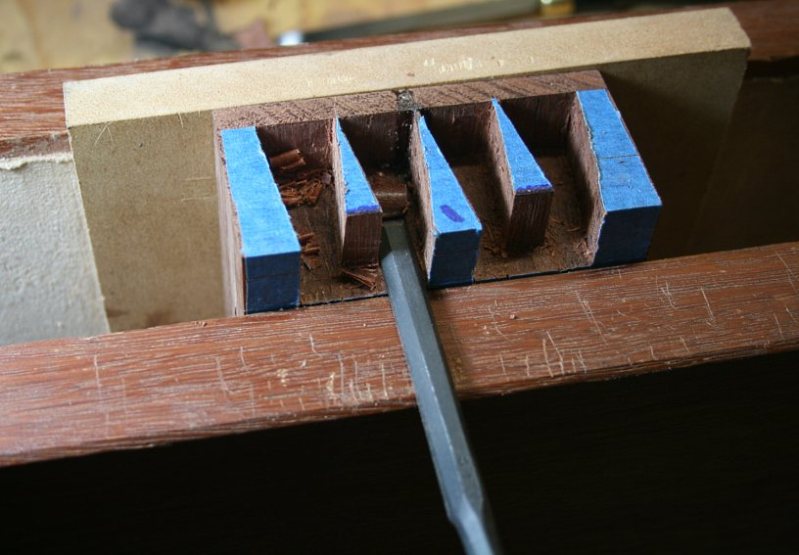
The second jig is dedicated to the few woodworkers still standing that have not succumbed to Roubo-ism and have resisted drilling 3/4" holes all over the surface of their bench tops but yet realize that it would be good to hold stock in a manner similar to what can be done with holdfasts....


As configured this jig will hold drawer fronts/sides up to 10" wide and will allow the finishing up of your half blinds with chisels/mallet just like you Roubo-ists.


Hope you like the variation, Derek. Thanks for looking.

Re: Two jigs for dovetails.....

#2

Re: Two jigs for dovetails.....

Derek Cohen (in Perth, Australia)

Excellent Roger. I think that your jig would have come in handy when I started dovetailing the drawers. Now I use a method that reduces the need for powered tools to a minimum. Of course, this is just another choice. Using the router method, as you show (and as I did earlier on), provides less clean up. Using my current method involves more chisel work, but it still remains quieter and nearly as quick. Only no router needed.

A few weeks ago I was a presenter at the Perth LN Tool Event. One of the technique I demonstrated was the use of blue tape to assist in marking out half-blind (half-lap) dovetails, especially for older eyes trying to see the transferred marks on dark Jarrah.

Essentially, I used a hand drill to produce as many holes into the endgrain as close as possible to the base of the pin. Something like this picture (from the campaign cabinet build), but not as tight to the baseline, nor as neat ...


I spent all day, for two days, chopping out these dovetails at the Tool Event. Each example was about 6" wide and contained 4 tails. Drilling out the lot with my old Panasonic took about 2-3 minutes. I could have used an eggbeater, but I was trying to save time (Damn Rob Cosman's eyes for producing great videos that depict dovetails completed in 3 minutes. Now everyone expects the same .. :) ).

As an aside, accurate marking and sawing to the marks is 99% of dovetailing. The remaining 1% is waste removal. The speed of waste removal depends on your method of doing so. It is this 1% that can take 90% of the time in forming the dovetail. After 2 days of dovetailing I was pleased (and relieved! Oh how much more relieved than proud !!!) to look back and note that every board I worked went together "off the saw". Anyway, back to to discussion ...

Once these holes are drilled, one can simply split out the waste with a few chisel taps ..


Link: http://www.inthewoodshop.com/Furniture/TheLastDovetail.html

With a hand drill there is the need to clean up the baseline, but a couple of well-placed chops cleans this out, and then the final result can be fine tuned on the Moxon ...


So ... not a criticism of the jig you built intended. Just a slightly longer but power tool reduced method. Indeed I believe it was Bill who argued for tighter routing than I was prepared to attempt. If I was doing multiple drawers again I would be considering your jig very seriously.

Regards from Perth

Derek