New WoodChat!
Home Articles Forums Gallery Marketplace Videos

WoodCentral Forums

Knowledge You Can Build On — Est. 1998

Need a tree taken down or milled?

Hand tools and small boxes

Posts

Hand tools and small boxes

#1

Hand tools and small boxes

David Klear

Long time lurker here

Now that everyone is building a workbench I was wondering about ways of holding work. Not the normal work that is generally talked about but small pieces that need to be dadoed,rabbetted,dovetailed or edge molded. Something like small boxes. Say down around 1-5 " long and wide and a couple inches high like I have been asked to build :). Easily done with electric tools. Not so much (for me) trying to use hand tools. Regular clamps and such get in the road on things so small. So I ask the question. And look forward to your knowledge

Thanks

Re: Hand tools and small boxes

#2

Re: Hand tools and small boxes

roger lance

David....this is a clamping device I made long ago for holding small parts for planing etc....you push in the part from the right and the wedge tightens....hit the wedge on the left to loosen....works quite well....currently using it for gluing parts to make a cutting gauge fence.


Re: Hand tools and small boxes

#3

Jack Guzman from Maine

Re: Hand tools and small boxes

Jack Guzman from Maine

Hand screw clamps are excellent aids for holding small items. Stand a small handscrew with jaws upward and use it as a vise. Clamp the handscrew to the front edge of the bench with another clamp. There are other variations of this idea sometimes using two handscrews but that's the general idea.---Jack

Re: Hand tools and small boxes

#4

Re: Hand tools and small boxes

Derek Cohen (in Perth, Australia)

Hi David

I must rave above my new tail vise - ideal for holding small pieces for planing ...


But ... the one tool that holds and shapes small lengths of wood - the type joined in boxes - is the shooting board. No shop should be without one!

Making a mitred pencil box is child's play with the donkey's ear attachment ...


Having shot (shooted?) these to length with the square fence and/or roughly sawn the mitres on your mitre box, just slip them into the shooting board, and have your way with them ...


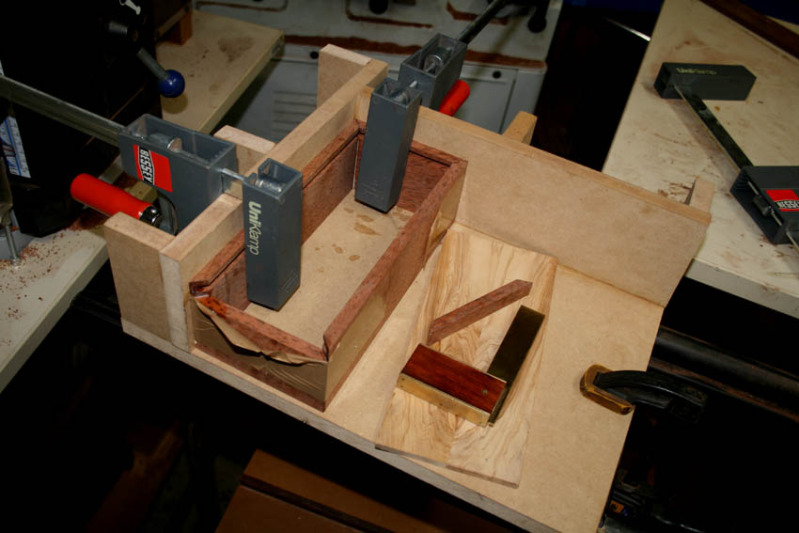
Now here is a jig that holds a box square while glueing up (necessary for mitres) ..


And the result is ...


Regards from Perth

Derek

Re: Hand tools and small boxes

#5

Re: Hand tools and small boxes

SteveA

Hi,

That's a question that comes up a lot. And there's really no simple answer. How you hold the work really depends on what you're attempting to do.

Naturally, having a bench with a tail vise is extremely handy, as is a patternmaker's vise. And there are lots of workholding jigs that use wedges, and/or eccentric cams that you can build. And, sometimes, it's just a matter of holding the wood against some sort of stop with your left hand, and using the tool with your right. (If you're going to do that it might be a good idea to have one of those kevlar gloves...)

But I would make two suggestions for sure: First, whatever you do, make sure it works well by testing it with scrap pieces. When something like that goes wrong you can easily lose a valuable piece of wood, and possibly other things that are even more valuable. And second, think about doing things like dadoing, rabbeting, and edge treatments before you cut to size. This can be a little wasteful but sometimes the ease of working and the time saved is more than worth the bit of extra wood you're using.

Re: Hand tools and small boxes

#6

Re: Hand tools and small boxes

Dave Klear

Hi guys

Sorry about being away, got side tracked by a big oak tree that leans toward the house and has had a hive of bees in it for two years. So with a little help with some chain,a truck and tractor we took it down and took out the hive. Pictures can be seen here if anybody is interested. It was 6 ft long

https://plus.google.com/u/1/photos/100847892867924761353/albums/5724248247001408561

AS far as what we are talking about Thanks for the ideas, they have given me some ideas of my own. At the risk of getting a bad rep my first post. I don't think i explained well. I have this relationship going with a Stanley 45 and 55 last year or so. And mostly what i was talking about was edge work or close to it as in grooving for the bottom. The 45 requires that you be a minimum of 5/8 off the table for the fence to work. And that means that if you want to work on something 1/4-1/2 thick and maybe 2-3 inches wide you have to put something under it and clamp that all together and still be able to work on the edge. Say to put an Ogee on the edge. With what has been posted I have an idea to make a shooting board, clamp ,vise thing that clamps in the vise. It being about as complicated as the 45 :).

I can't see the names but I think it was Derrin,Darin ? that showed the miter board. I was wondering if you or somebody could shoe me hoe you groove your bottoms with hand tools. Again I apologize I don't want to come off wrong. Though I have had them a long time I am only a year into the "hand tools only" adventure. If you want to know kinda a where I am at. I have a blog attempt here. Just an old country hills boy work.

http://tnwoodwright.blogspot.com/2012/01/bedroom-workshop-back-again.html

Re: Hand tools and small boxes

#7

Re: Hand tools and small boxes

Dave Klear

I guess I screwed up that reply and got it in the wrong place. is there a way to move it? Not feelin real intelligent this morning :)

Re: Hand tools and small boxes

#8

Re: Hand tools and small boxes

Dave Klear

Ok Just to add to the horror. Somebody send me to the learning spot to learn how to edit and such. Sorry I can' seem to find it.

Re: Hand tools and small boxes

#9

Re: Hand tools and small boxes

Derek Cohen (in Perth, Australia)

I was wondering if you or somebody could shoe me hoe you groove your bottoms with hand tools.

Hi Dave

Grooving a board with a #45 - or any plough plane - is a simple task. It is just a matter of clamping a board to a bench and then running the fence of the plough plane along its edge. Fences are adjustable, and so you can dial in the distance from the edge you want the groove to be planed.

Here is the Veritas Small Plow cutting a groove ...


I don't have a decent picture to illustrate this, but here is a recent one of the Veritas plow (substitute Stanley #45) planing a rebate. The important feature here is the clamping that allows the side of the board to overhang the bench. For grooving a drawer or box bottom you would simply move the "rebate" in-board as a groove.


Hope this makes sense.

Regards from Perth

Derek

Re: Hand tools and small boxes

#10

Re: Hand tools and small boxes

David Klear

I see what your doing. I have the same holdfasts :) My problem is that after years of cabinet work I have tons of stuff that is only 2-6 inches wide and maybe 4-12 inches long. SO i am not able to use larger stock, groove or mold it and then cut it to size. I know I probably should have thrown the stuff away but now I have a lady that wants me to build these small boxes to sell :)

Your plough plane doesn't get in the road of the hold fasts as the 45 does even with short rods on narrow stock. But It does add to the idea I have in mind. IF it works I should be able to quickly hold any size of small ,should I say tiny :) stock and do it quickly. Maybe i should be talkin miniatures. :) Like your boxes

Re: Hand tools and small boxes

#11

Re: Hand tools and small boxes

David Klear

Just looked at your new bench pics. Lots of ideas there Thanks. Nice Bench

Re: Hand tools and small boxes

#12

Re: Hand tools and small boxes

Warren in Lancaster, PA

There are lots of ways to do this kind of thing. Here is one. Say you want to make a groove in a side that is 3/8 x 2 x 6. Take a board that is longer and wider and nail a thin batten about 1 3/4 from the edge. Put a flat head screw in the far end so that it protrudes about 1/4 inch. Fasten the board to the bench and lay your box side up against the screw and alongside the batten. The action of your planing holds the piece in place against the batten and the screw, and you can do one box piece after another without any clamping.

Here is another way I use at the corner of the bench. Make a small 1x1 cut out in the corner of a thin piece of wood and fasten this piece on the bench so that it engages the right front corner of the work piece. This is what you are going to plane against. Use a quick clamp to hold the right rear corner of the work piece. This method is a little more secure, but you do have to clamp and unclamp for each piece. What you don't want to do is have set up time for each piece you want to do.

Re: Hand tools and small boxes

#13

Re: Hand tools and small boxes

Hank Knight

Dave,

If you'll open a post you've made, there will be a shaded (gray) box at the top that has a button for "Edit." click on it and enter your password. It will iopen oyur post and let you edit it. I'm not sure oyu can change it's position in the chain, but you can edit it otherwise.

Hank