Re: How come.....
Pam Niedermayer
The Chinese economy is dependent on exports, so they subsidize shipping costs and keep the Renminbi devalued.
Pam
Knowledge You Can Build On — Est. 1998
Re: How come.....
Pam Niedermayer
The Chinese economy is dependent on exports, so they subsidize shipping costs and keep the Renminbi devalued.
Pam
Or Australian Great Bower Bird in reverse *LINK*
Pam Niedermayer
This male Bower Bird goes for the opposite effect, putting larger objects further from the female's view to make all objects look the same size.
Re: Why not? and...
Pam Niedermayer
I noted that sleds were superior solutions to raising the bench height, regardless of bench style, and that I saw nothing inappropriate about Tom's suggestion.
With regard to the "dead zones", I am referring to a the 5" or 6" that is taken by the width of the leg where one cannot place square dog holes without compromising their design. This should not affect the ability to clamp something for morticing, since the board here is likely to be longer than 6". It also should not prevent one clamping a board that enters the "dead zone", since all one needs to do is use a spacer.
Of course. Therefore, the dead zone doesn't make a bit of difference. No?
Pam
Re: I meant to build it this way!
Guillaume Dery
I don't but I do use a planing stop. I keep dual rows of dogholes (front and back) for my wedges. I jsut use the backside of one of my wedges as a planing stop. It jsut drops into 2 dogholes to act as a planing stop. I have also been known to just pop up a benchdog to plane against
Re: Planing stop in use *PICS*
wilbur
Here's my planing stop being used by itself with a relatively narrow board. I should add that I usually remove the leg vise chop to get it out of the way.

Here it is being used with a wider panel. (This happens to be the bendy panel that was giving me issues.) I took a scrap piece of wood, put it against the planing stop, and used my holdfast to anchor the other end. I move the board side to side to plane the surface, so all of the planing action happens towards the front part of the bench.

Hopefully this is self-explanatory.
Re: Planing stop in use *PICS*
Derek Cohen (in Perth, Australia)
Hi Wilbur
Thanks for the pics.
Something struck me when looking at your bench and planing stop. Am I correct in assuming (from the position of the leg vise) that you are right handed?
My question is, as one who prefers Japanese planes, why is the leg vise and - especially - the planing stop on the left side of your bench? Surely, if pulling a plane, you would work into the right side of the bench.
And if you wanted to use by push- and pull planes, had you considered placing the leg vise and planing stop at the centre of the bench?
Regards from Perth
Derek
Re: Planing stop in use w/Japanese planes *PICS*
wilbur
Hi Derek,

I am right handed. For Japanese planes, I have separate planing stop on the right side of my bench. In fact, one of the reasons I went with a Roubo is that it was one of the few bench designs that I found that didn't have an end vise, leaving the right hand of the bench open for a planing stop for Japanese planes. I felt that planing into an end vise with a Japanese plane would not be good for the end vise in the long run. Of course, what I didn't know at the time was that I could have taken any bench plan and just left out the end vise. But I still like the Roubo, as the thickness of the bench top is reminiscent of the type of beam that would be used in a Japanese planing beam.

Here's how this planing stop works. I have a pair of insert nuts in the bench top. A 1/4-20 brass flat head screw is installed in the insert nut, and adjusted to an appropriate height. A piece of scrap wood butts up against the screws, the workpiece is placed against the scrap wood, and the plane engages the workpiece, which hits the scrap wood, which runs into the screws. I put a little countersink so that I can lower the screw to below the surface of the bench top if I need to.
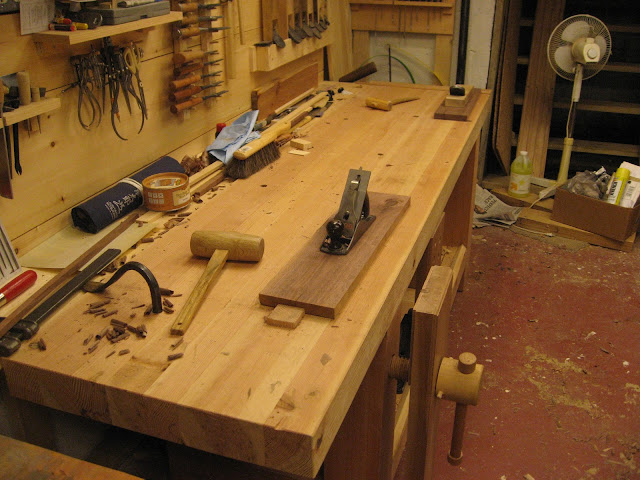
So this way I can use my workbench with either Japanese or western planes. As far as edge planing goes, the traditional design of a Roubo has a crochet at the left end, and that is really what a board that is being edge planed butts into. I've found that the leg vise and sliding deadman holds a board tightly enough that the crochet is unnecessary. At least I haven't felt the need to build one in the 2 years that I have been using my bench. So I use the same set up for edge planing with Japanese planes. If I happen to not clamp a board for edge planing tightly enough with the leg vice and the sliding deadman, the board tends to sink down rather than shift left or right, so to me that says that the issue of whether to plane into or away from a leg vise for edge planing isn't really an issue at all.
Re: Planing stop in use *PICS*
Dean J in MN
I made sure I had a holdfast hole lined up with the front of my planing stop on my bench. That way I can just place a batten across the bench (as shown in the photo by Wilbur) but not rely on the holdfast pad alone to keep in place. The batten is banked against the shaft of the holdfast and the planing stop.
Re: Planing stop in use *PICS*
wilbur
That's a great idea. I'll probably be drilling another hole in my workbench real soon.


