Home Articles Forums Gallery Marketplace Videos

WoodCentral Forums

Knowledge You Can Build On — Est. 1998

This is the most versatile work station you will ever use

Joinery Saw

Posts

Joinery Saw

#1

Joinery Saw

Derek Cohen (in Perth, Australia)

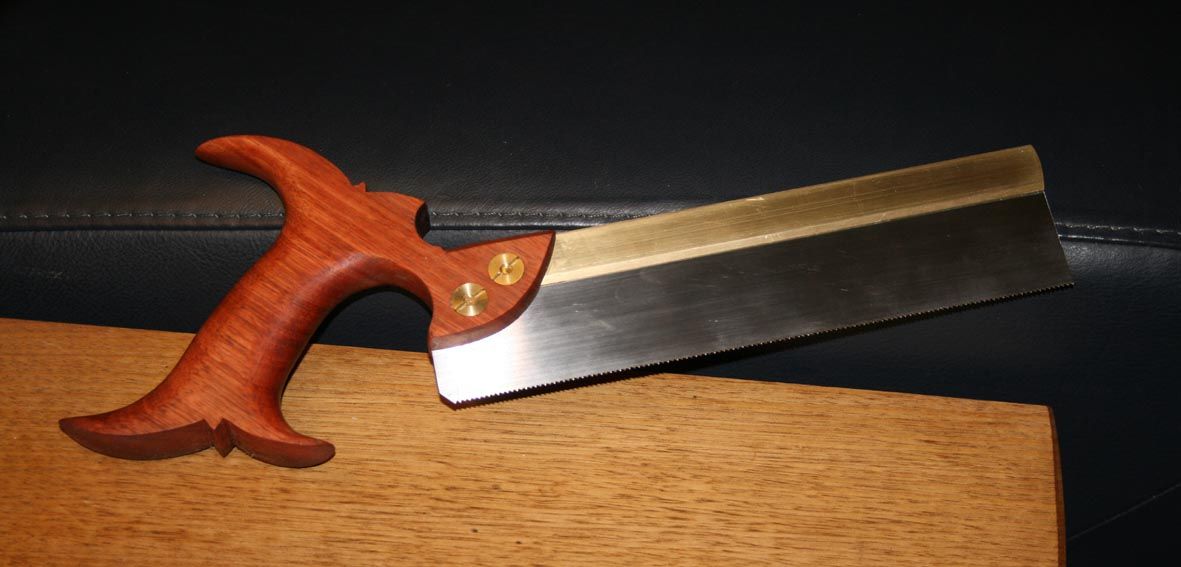
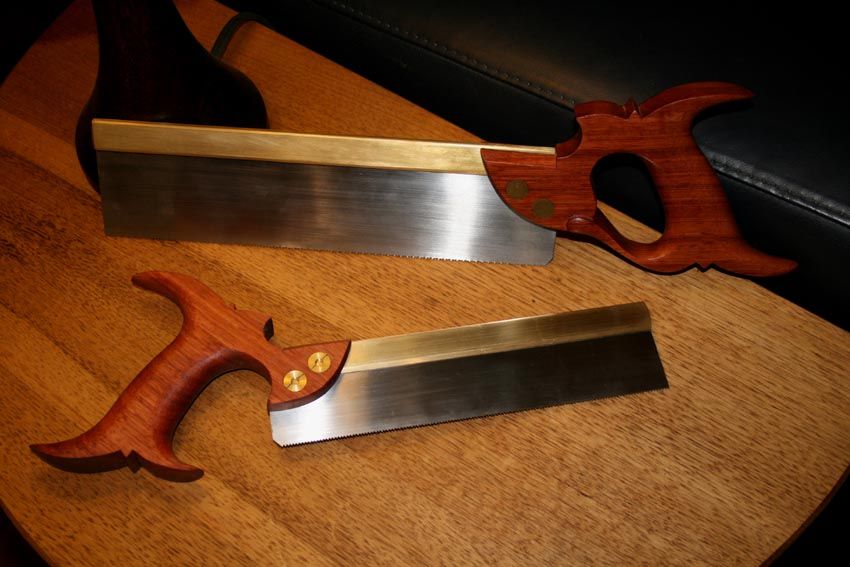
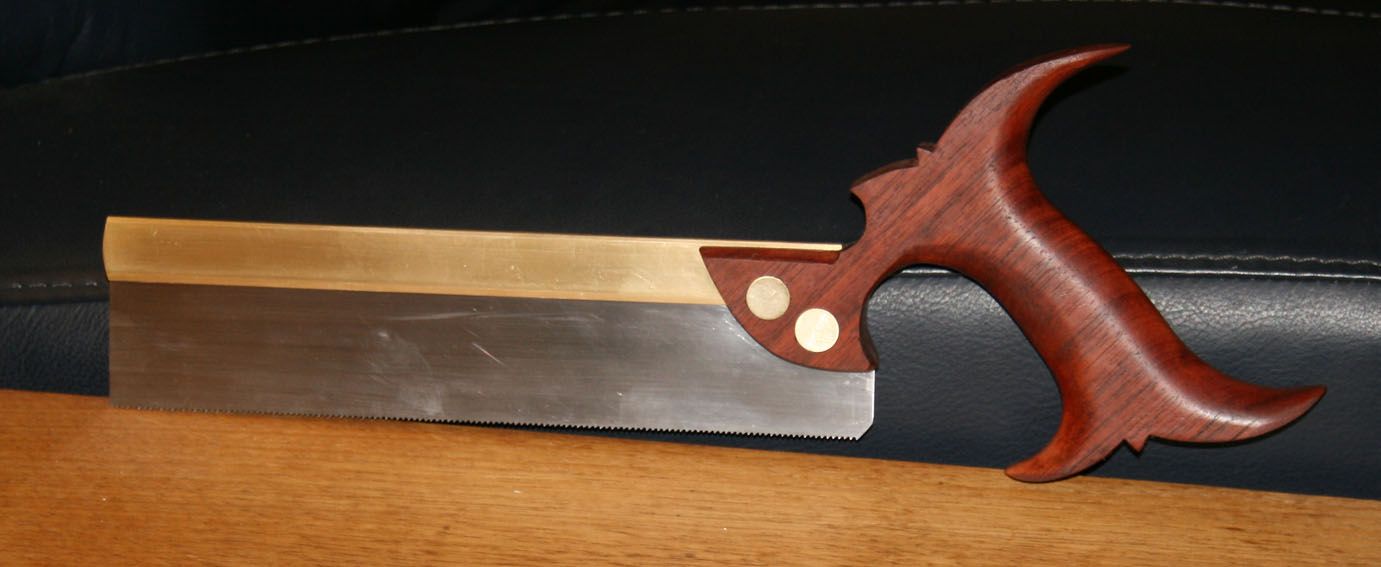
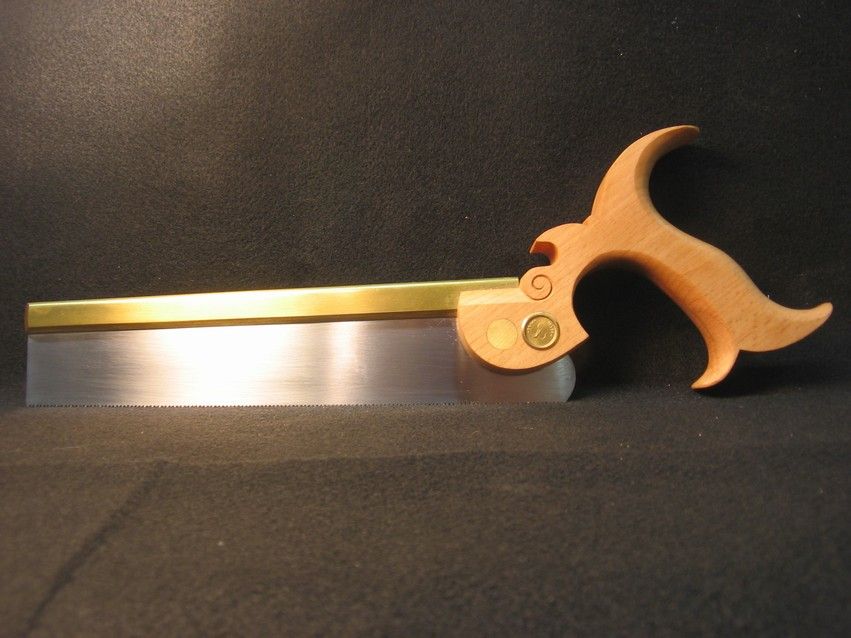
Taking a break from cutting what seems like an endless procession of dovetails, I decided to make a joinery saw. This has been on my list of saws to make for a while. It compliments the carcase saw I built recently. There is a family resemblance in the designs of the two saws.

The plan was for a 9" long plate with 1 1/2" of cutting area and 16 ppi crosscut. The carcase saw is essentially a larger version, with a 14" long plate, 2 1/4" cutting area and 14 ppi crosscut.

The joinery plate is also a slimmer 0.018" thick.

The build was not uneventful. Don't you hate it when this happens ...
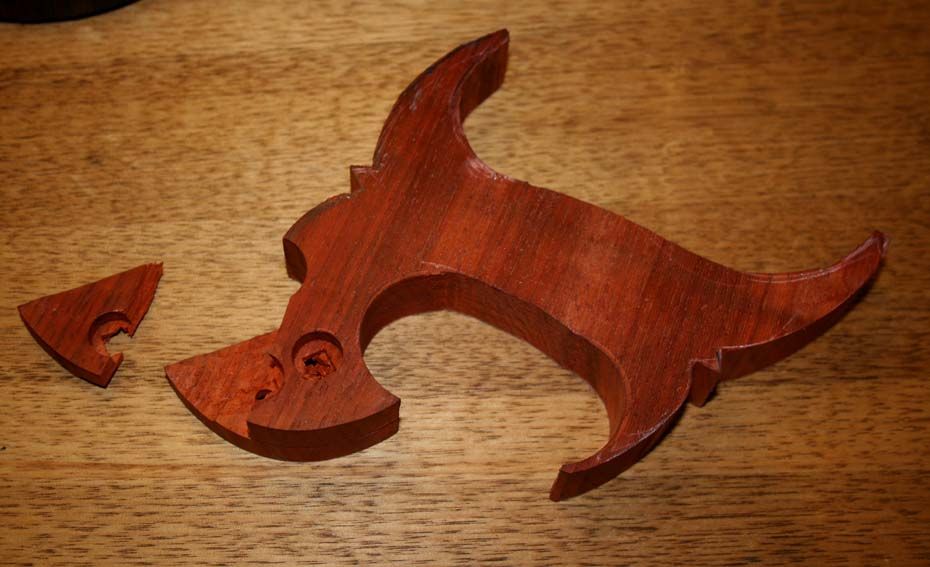

That was Padauk, from a chunk that was a Christmas present. It was always a borderline choice as it felt soft and brittle. Then I was not careful enough when chiseling the mortices for the screws. Live and learn ...

In the end I used the same Jarrah board that I had for the carcase saw.

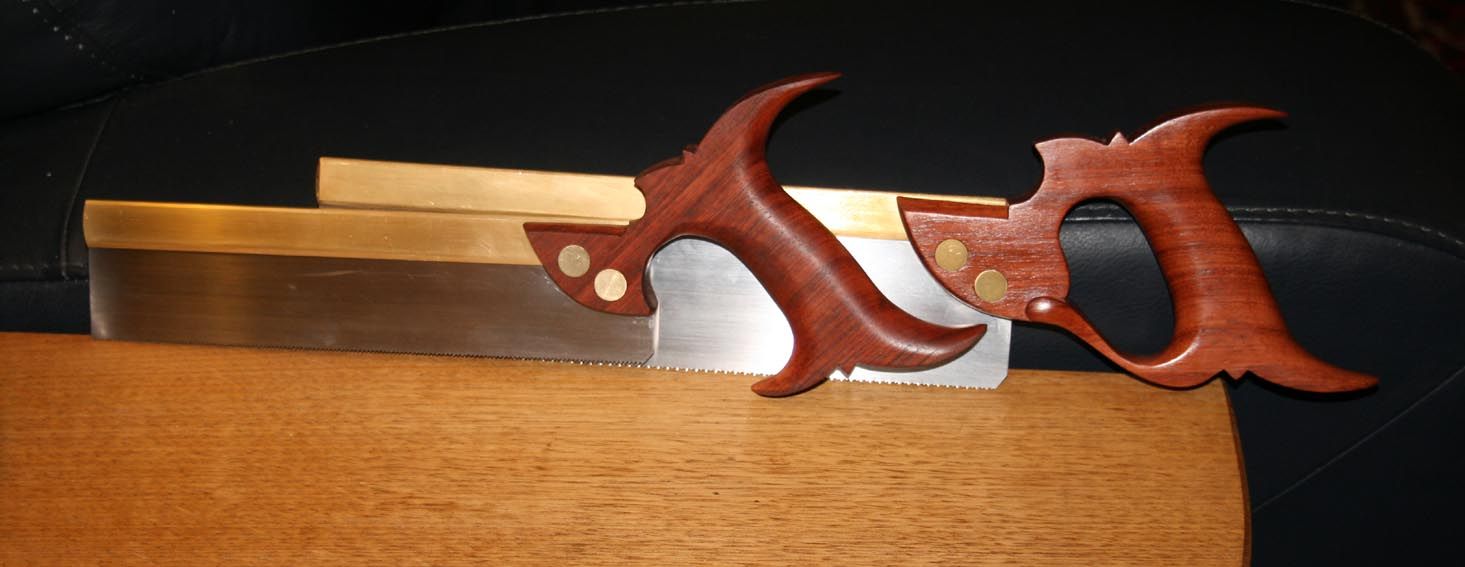
Here is the joinery saw (apologies for the pictures which do not do justice to the grain) ...


Thanks for looking.

Regards from Perth

Derek
Re: Joinery Saw

#2

Re: Joinery Saw

Todd Nebel

Very Nice Derek! Maybe we can trade my Shaker table for those saws? Yeah, I didn't think you would go for that.

Re: Joinery Saw

#3

Discussion point ...

Derek Cohen (in Perth, Australia)

Klaus (Two Lawyers Toolworks) asked me a question anout the handles of these saws ..

Hi Derek,

... One thing: the rear line of both of the grips is nearly straight. Maybe you feel that to be comfortable. Then all is good. Perhaps you should try to make a handle in your own shape which has a hump at the rear side of the grip just to compare the comfort. I'm pretty sure that you' d like the different feeling.

Regards

Klaus

Klaus' question reminded me of the one of the design features of the saws, something that I have failed to emphasize, and one which I would enjoy hearing comments about.

What I have here for handles is something a little different from those (with the "hump") that I have made in the past. I suspect that others, such as Andrew Lunn (ex-Eccentric Toolworks), have done similar, although their reasoning may be different from mine (and perhaps it is the same ...?).

Here is one of Andrew's dovetail saws ...


My aim is to not only have a comfortable handle, but also to create a controlled grip. The comfort comes from sizing the handle to my palm, and including enough of a "bump" to fit into the palm. It is there but disguised by the second factor, which goes to control.

The second feature is that the handle is triangulated. That is, it is thicker at the base. What this does is support the underside of the hand, and lift it up, where it snuggles into the underside of the horn. The underside of the horn is where I believe the control lies.

Here is a picture of Ernest Joyce using a tenon saw. Note how he uses his thumb on the upper horn to lighten the weight on the saw ...


A while back Chris Schwarz posted something similar. In his case he used the lower horns to do the same thing.

Link: http://lostartpress.wordpress.com/2011/08/01/i-found-a-use-for-my-lower-horn/

That's my theory anyway. I do find the saws very comfortable to use.

Regards from Perth

Derek

Re: Joinery Saw

#4

Re: Joinery Saw

roger lance

Derek....I'm just a pilgrim in the land of hand tools so I can't comment on points of control and shaping for increased comfort....but I can say that those are some very attractive/beautiful looking tools.

Re: Joinery Saw

#6

Love it

Bill Houghton, Sebastopol, CA

That grip violates all the rules I was ever given on how to hold a saw handle...but it must have worked for him, and he certainly had plenty of experience. Once again, multiple ways to pet a cat.

I'm reminded a little of the several trombone players in the marching band our younger son was part of for a while (he played banjo - an eclectic marching band). Every single one of them holds the horn differently, and none of them the way I was taught, and which I found comfortable and stable. But the grips work for them.

Re: Joinery Saw

#7

Re: Discussion point ...

TomD

Hmm. That looks awkward. Did Joyce say he was doing it for control for the reason described. I have no difficulty getting different weight on the saw without resorting to that.

As far as humps are concerned I say two things:

- The venerable Colt 45 1911 has two mainspring housings one with a hump, one without, not to mention many variants since. So it would seem there are many ways of fitting the hand.

- More to the point, there are many ways of gripping grips. Normally the cheapside is the hand filling grip. A lot more sophisticated is orienting the angle of the hand to create a low torque grip. This works well without the hand swelling lump, once the correct contact point is taken.

I'm not in this thread, and from the look of it disagree with a lot of it, but Moebow's pics half way down show how reducing torque is achieved. It is archery, but this applies to the old archery stuff as here, and the new stuff, and the mechanics are the same for sawing, and planing. What it is about is whether when pushing on a handle you push straight or twist. And most people will not get it right unless they are helped by a coach, or excellent video etc... So it is possible to shoot for decades while goofing it badly.

http://leatherwall.bowsite.com/tf/lw/thread2.cfm?forum=23&threadid=223722&messages=8&CATEGORY=5

Re: Joinery Saw

#8

Re: Discussion point ...

Bob Hackett

I would say that when working with any tool (be it a bow or rifle, an axe or a saw) the idea is to make it an extension of your hand. You want it to go where you intend in the most natural way possible and steering or directing that tool should be accomplished with maximum comfort and minimum thought.

That being said,we are all unique individuals and we`ll never know what works best for each of us unless we explore new and different things. I know simple alterations to grip points can make all the difference in performance and especially in the comfortable extended use of tools.

We are supplied with a "one size fits all" starting point and need to keep that in mind. David B`s tip for improving saw function thru the use of a form fitted handle and proper fixing of the work to allow better ergonomics was an eye opening exercise for me. I have since applied that information to many of my hand tools with excellent results.

One of the unforseen benefits is others don`t find using my modified items to be near as comfortable for them once they are personally fit to my hands. People don`t ask to borrow these tools and they are less likely to be damaged by someone picking them up and using them here in my shop.