New WoodChat!
Home Articles Forums Gallery Marketplace Videos

WoodCentral Forums

Knowledge You Can Build On — Est. 1998

Support WoodCentral when buying things you need

drawer fitting

Posts

drawer fitting

#1

drawer fitting

Bill Tindall

We have finally arrived at drawer fitting in this drawer discussion. In an earlier post someone mentioned clamping drawers for fitting.


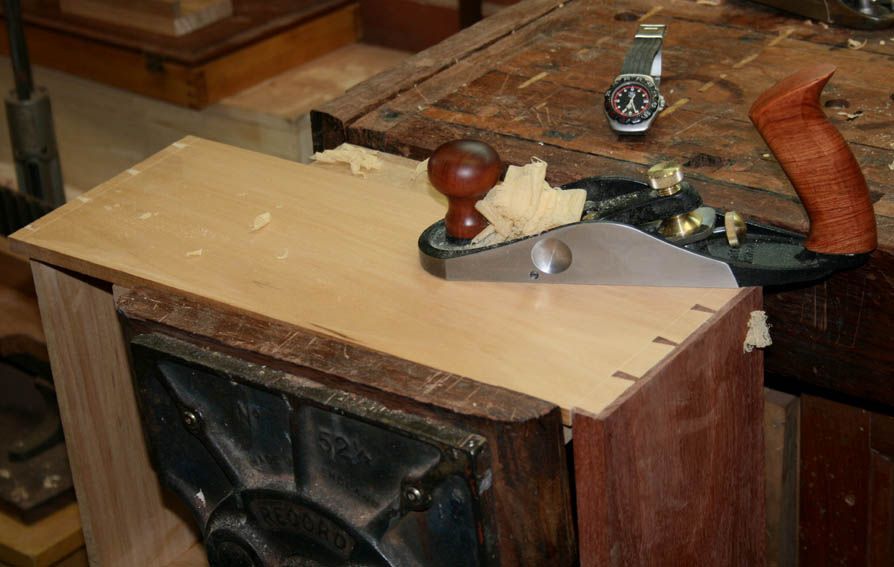
Many don't clamp a drawer for fitting. They use the arrangement pictured. I keep on hand a variety of 3/4" plywood widths to accommodate different drawer depths. The plywood gets fastened to the bench and the bottomless drawer hung over it for planing. To my amazement the first time I tried it this clampless arrangement holds the drawer just fine for planing its sides. It is an easy task to move from planing to testing and back (maybe many times in my case).

Re: drawer fitting

#2

Fit standards

Bill Tindall

My criteria for a well fit drawer is as follows. No matter the size it needs to be able to be smoothly closed by pushing with one finger on any corner. This criteria requires a delicate balance between tightness to prevent racking, and looseness to enable ease of closing. I work on a drawer until it meets this criteria starting with a too tight drawer. When it's right the smoothness exceeds by far even the ball bearing mechanical drawer guides.

Re: drawer fitting

#3

Re: Fit standards

GolfSteve in Calgary

Just for fun, after finishing my last "piston fit" drawer in a side table, I measured the total side-to-side clearance with feeler gauges to be 8 thousandths of an inch.

I use a similar drawer planing board when fitting drawers. Works well. I usually wrap the board in paper towel to avoid marring the drawer sides.

Re: drawer fitting

#4

The perils of "piston fit"

Bill Tindall

This response is not to be critical of what you have been successful doing in your situation but rather a warning to others whose circumstances could prove to be different.

It is unnecessary both from an aesthetic and an engineering perspective to have "piston fit" tolerances. I have been building several "drawered" objects of late and have taken every opportunity to examine hundreds of drawers in professional shops and high end antique stores. Drawer gaps of something closer to 1/32 on a side are most common, they work perfect and they look good. When facing these decisions I am a great believer to do what the majority of professionals do, presuming that what they do has stood the test of time. That would be to target a total side to side gap of about 1/16". If you don't trust my numbers, collect your own. But in the end I recommend building to the tolerances used successfully by others that have a wealth of practical experience with the issue.

If you are building for yourself and you can predict the environment of the piece then closer tolerances are less risky. If a drawer sticks after a few months it can be removed to the shop and fixed. The problem worsens if the 2nd generational owner moves to Louisiana and it sticks 50 years later. I fear that all piston fit drawers will eventually suffer this fate. But then I am paranoid about some things where I have been bit.

A case in point. Over the course of the past few months one case side of the chest I am building has cupped a tiny, but significant amount. The cup is unfortunately to the inside. While I can maintain a side to side total gap of about a 1/16"on the drawer front I have had to readjust the drawer width behind the front from what it was to a bit less. There is no significant difference in racking between "piston fit" and a total 1/16" gap so this larger total gap will be maintained along the length of the drawer in case this side moves again.

Bottom line: Old furniture with a drawer that routinely sticks will likely be thrown out. I build to avoid this fate.

PS....I am commenting in the context of larger chest of drawer sized drawers.

Re: drawer fitting

#5

Re: drawer fitting

Derek Cohen (in Perth, Australia)

Hi Bill

Two points from my recent posting:

I used this method when planing down the sides of the drawer ..


All I did was clamp a piece of MDF between the jaws of the vise. This was overwide and set low so that the insides of the jaws supported the drawer as well.

The second point is that I prepare in advance for planing by arranging that the grain runs towards the rear of the drawer. I do not want to plane towards the halfblind end. To avoid spelching (breakout) at the through dovetail end, use a block plane to add a fine chamfer across the end of the board.

Regards from Perth

Derek

Re: drawer fitting

#6

Two good tips...especially

roger lance

the orientation of the side grain away from the drawer front.

Re: drawer fitting

#7

minor hijack, re spelching and DC

Ian (in Sydney, Australia)

Hi Derek

I first heard the word spelching on David Charlesworth's Lie Nielsen hand planing DVD

At one point David mentions the need to avoid "spelching" and you can hear the production crew gasping with disbelief at the words used by the "crazy Englishman"

To hear tonight that he has been very seriously ill and then read your caution against "spelching" brough back the memory.

Re: drawer fitting

#8

Re: minor hijack, re spelching and DC

Sgian Dubh

Ian, I have to admit I first came across the words spelch, spelched and spelching sometime back in the 1960s when we had a retired cabinetmaker working in the school woodwork shop. Of course that was in the UK, and spelch and its derivatives are British descriptions of what the Americans call breakout. Slainte.