New WoodChat!
Home Articles Forums Gallery Marketplace Videos

WoodCentral Forums

Knowledge You Can Build On — Est. 1998

Super Resolution Thermal Imaging Camera

Against the clock

Posts

Against the clock

#1

Against the clock

Derek Cohen (in Perth, Australia)

I am curious about the speed at which the pros work. One reference I had was 6 1/2 hours to make a high end drawer. I consider the style of drawers I am currently building to be high-end drawers - that does not imply that I can build them at the level of the pros (I do not), but one measure of improving skills is the efficiency with which one completes these tasks. In other words, could I build a drawer with reasonable speed?

6 1/2 hours includes, I assume, all preparations: thicknessing and dimensioning of boards, finishing and installation of handles. The first two were done earlier. The last will come later.

So I set the target at 4 hours. Not the 20 minutes that Frank Klausz gives himself. Not the 3 minutes which he can dovetail an end. Fours hours because it is about 3:00 p.m. Saturday afternoon, and I have until 7:00 p.m. before I must shut up the shop and get ready to join friends for dinner. Later than that and my wife will have a few choice words for me!

There are about 25 pictures here. I hope the documentation is interesting rather than pedantic. Well, you can always skip to the end! :)

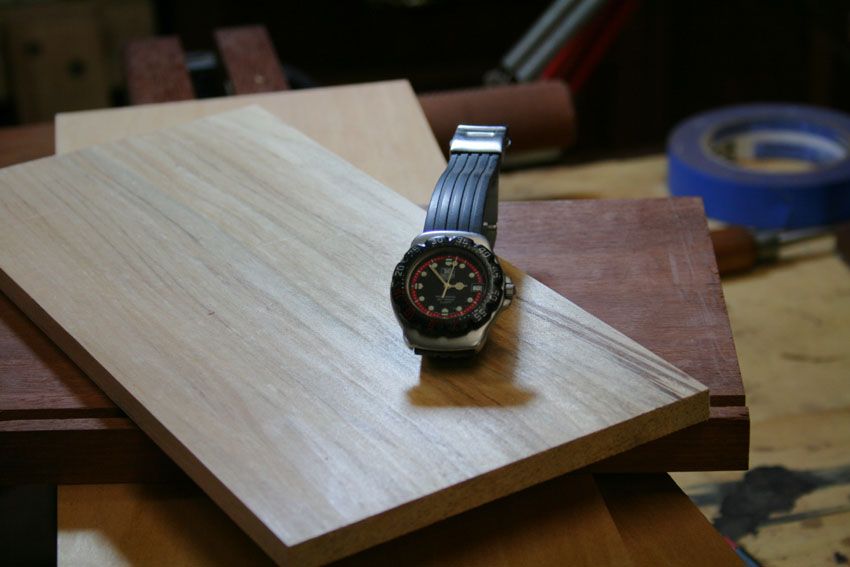
The start. 2:54 p.m. Fresh boards.


15 minutes to mark and saw the tails ..
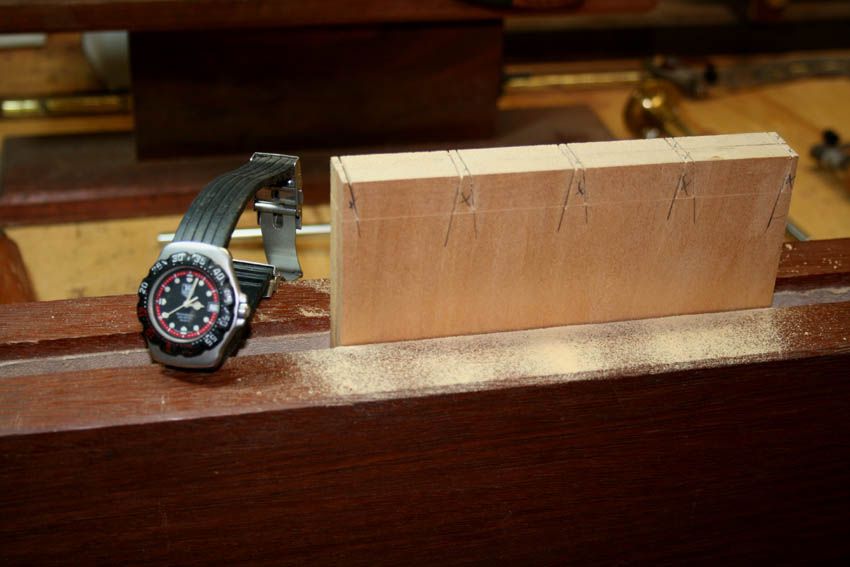

The shortcuts involve doubling up where ever possible. Gang sawing boards and ditto clearing the waste ...
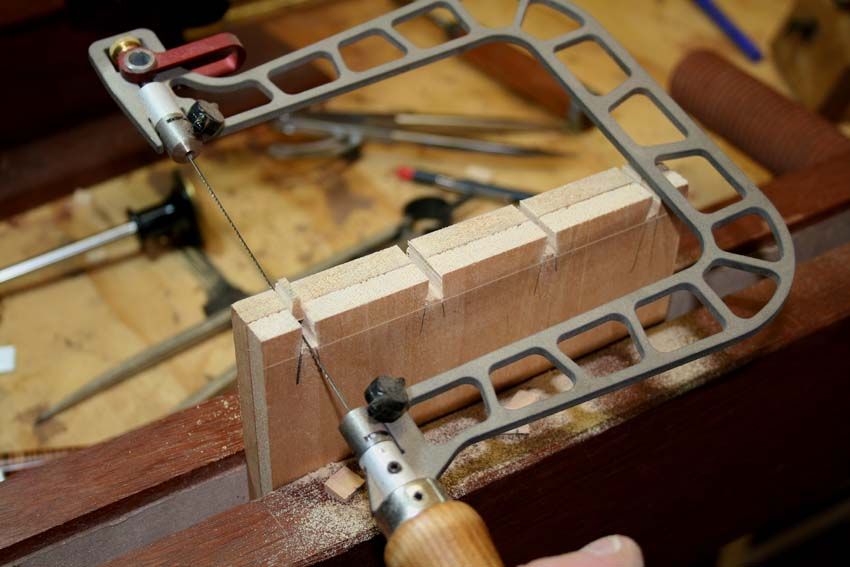

10 minutes to chisel the waste ..


3:17 p.m. and time to start the half-blind tails.
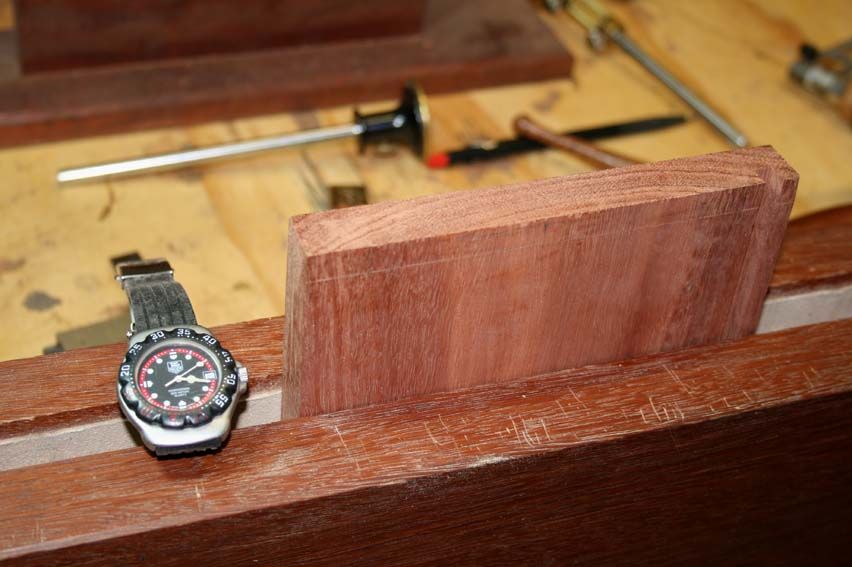

How long does it take to mark out with the blue tape? Including applying the tape, transfering the tails to the pin board, and removing the excess blue tape .. 10 minutes ..
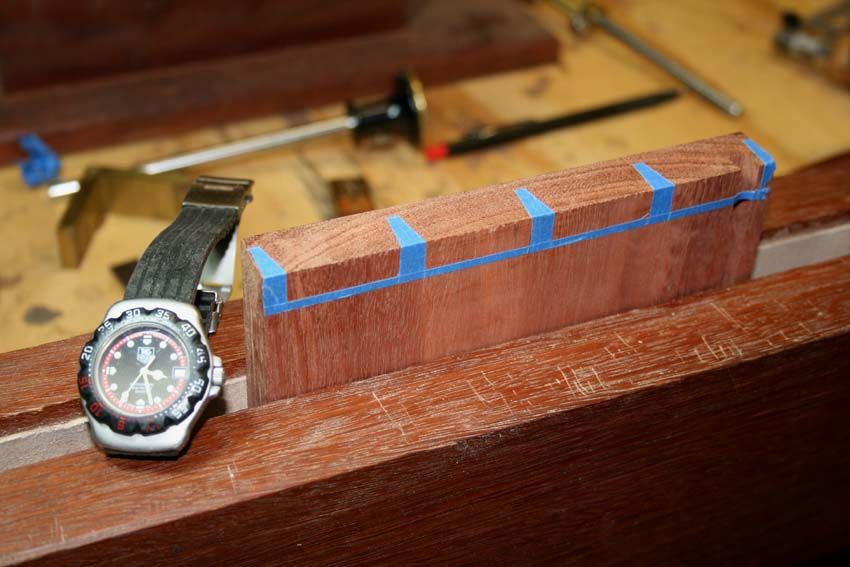

Sawing the pins ..
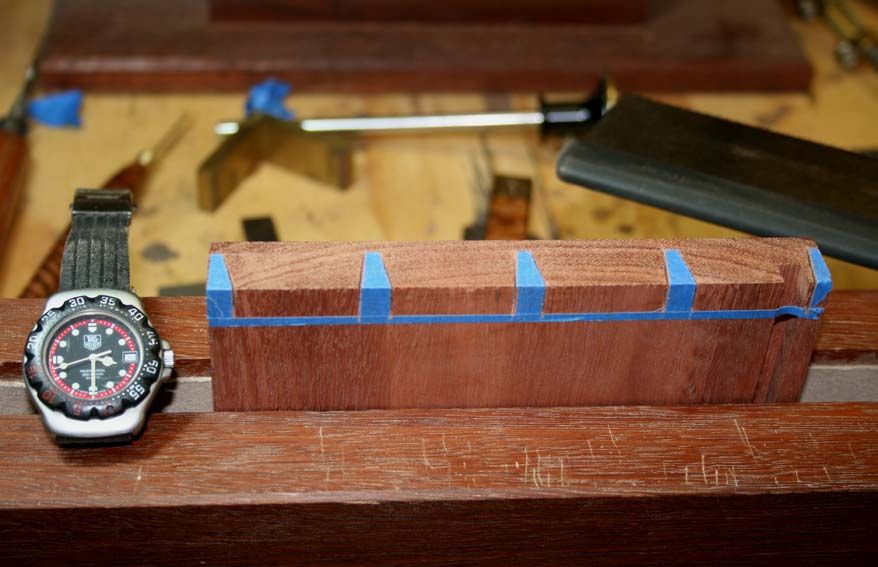

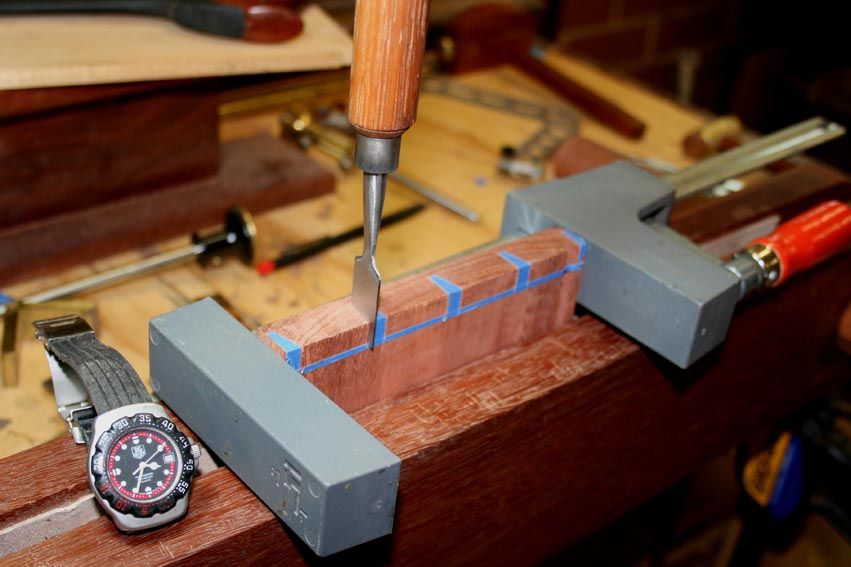
Using the kerf chisel ..

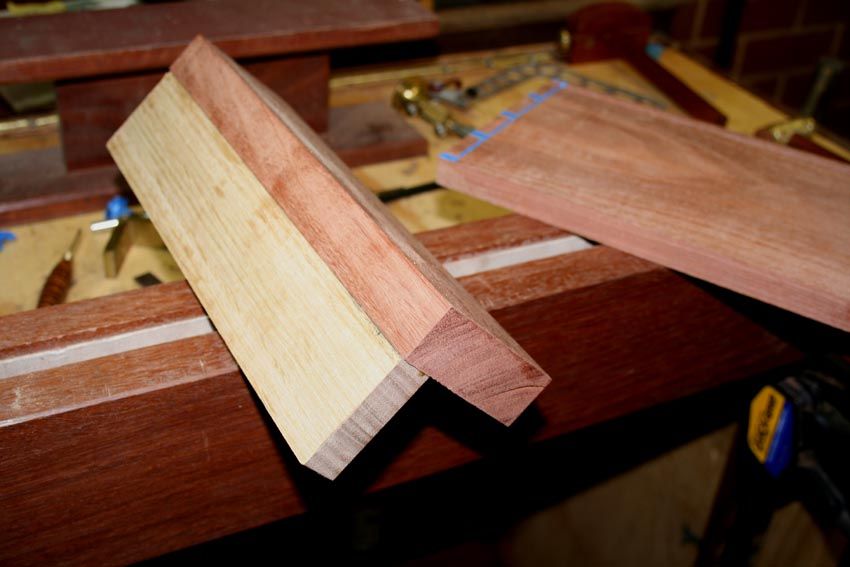
OK, now for something completely different (on a hand tools forum) ... using a power router to remove waste. I was shown this method a year ago by Niel Erasmus. Simply, it is just an extended platform for the router ...
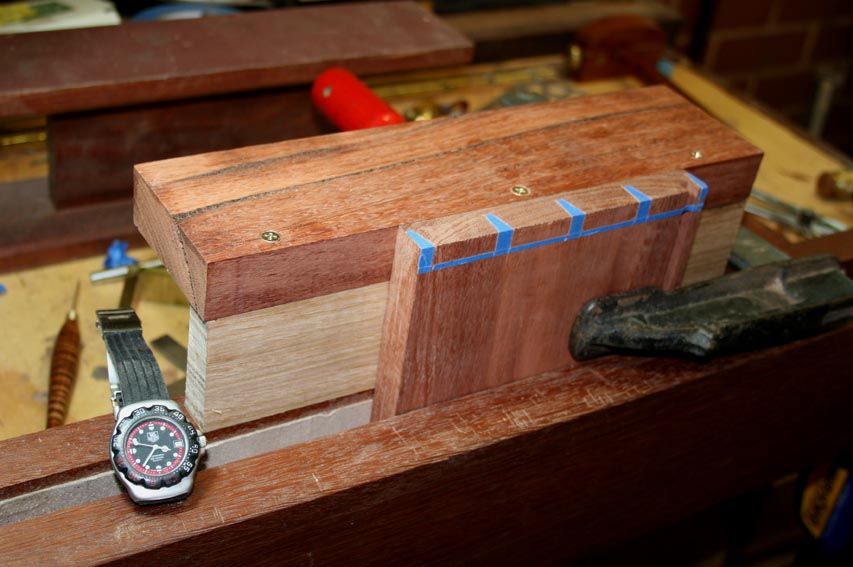

.. and the use if a 1/8" carbide bit ...
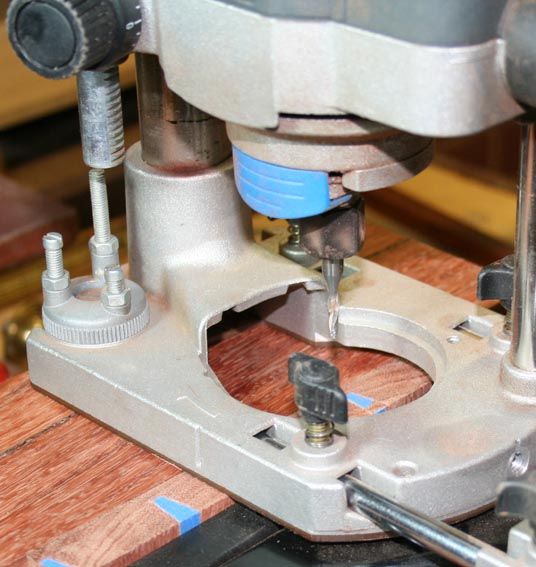

I could have set the fence to run against the boundary of the pins, but decided to end a 1/32" short and finish with chisels ...

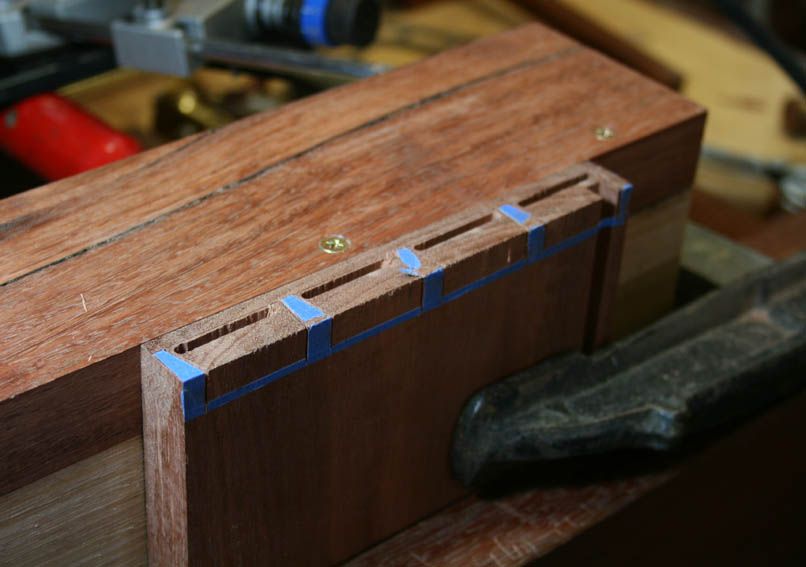

The remainder of the waste was removed ...
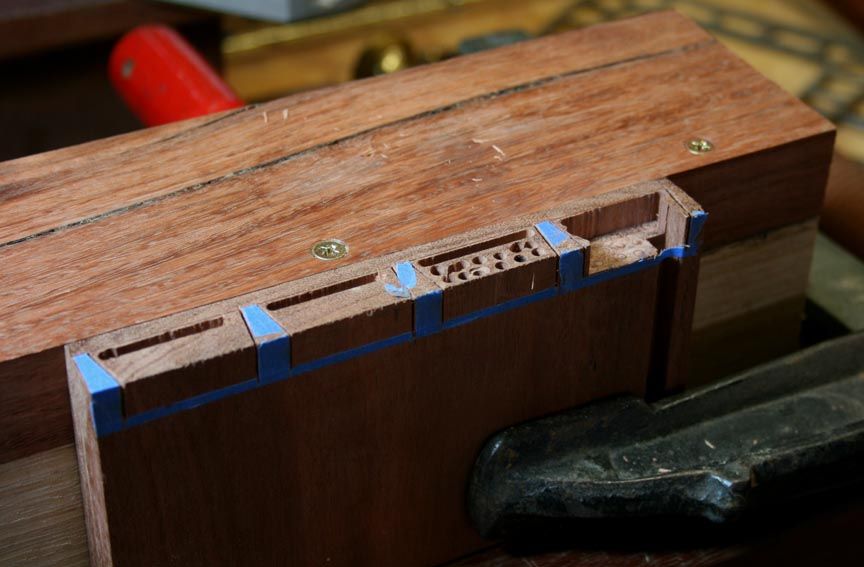

This took 12 minutes.
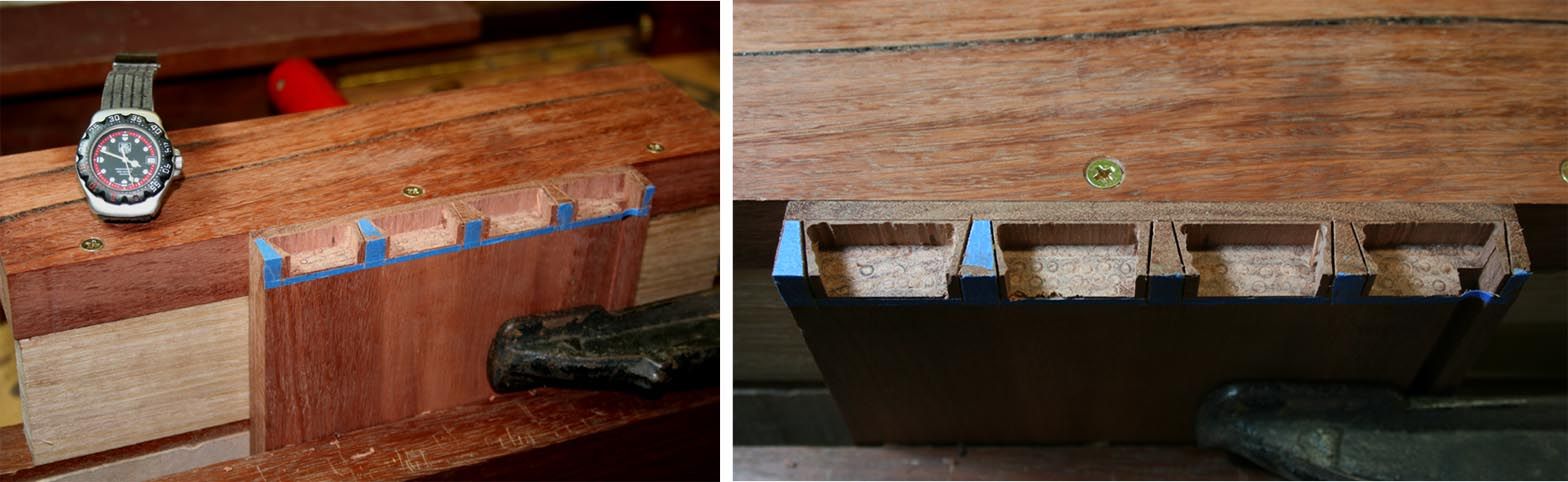

The remainder of the waste was removed with chisels ..
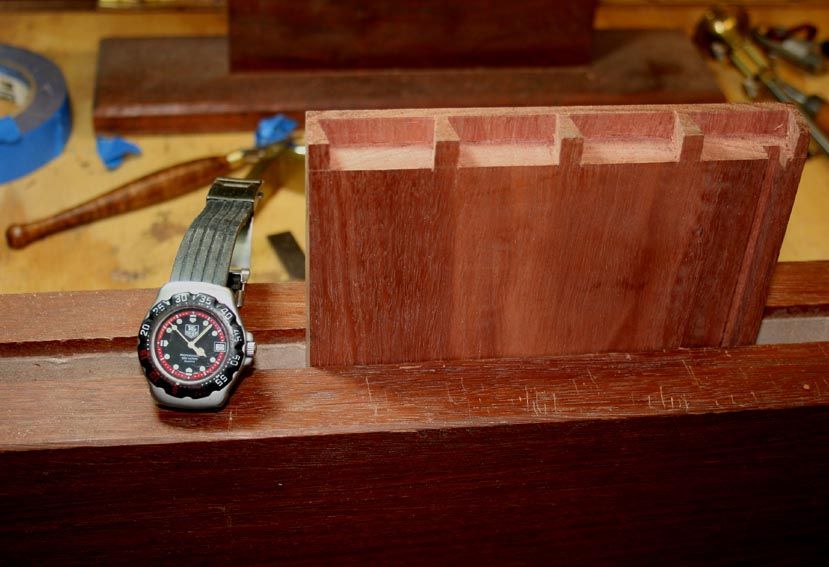

So, 23 minutes to remove all the waste from the pin board. I would estimate that this required about 1 1/2 hours with a chisel (emphasizing that I am referring to removing hard, brittle Jarrah).

The tail board goes on without any need for fine tuning ...


Note: Ian asked whether I bevel the tails before fitting. Bevels are cut on both the insides and the ends of the tails to avoid maring the straight edges of the pins.

The second side is repeated - I will spare all the detail here - and this takes about the same time as gthe other side ...
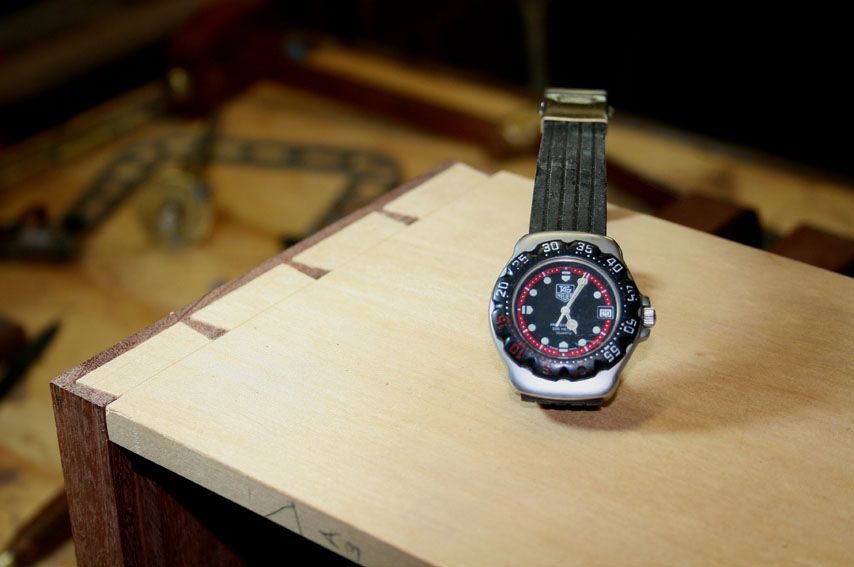

Now the front end of the drawer is complete. It's taken about 2 hours so far. Time for the other end.
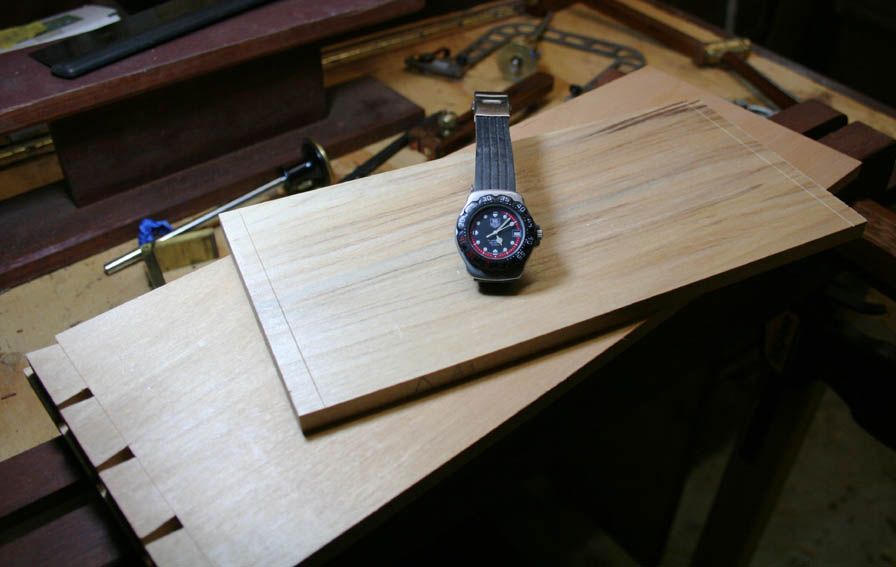

19 minutes to mark, saw and clear the waste from the tails ...
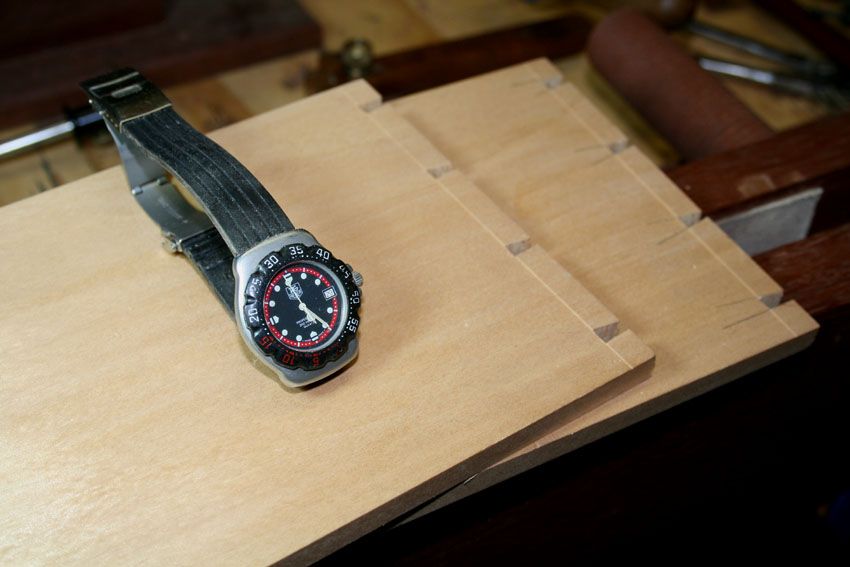

15 minutes to transfer the tails to the pin board, saw and chisel. And then about 30 minutes for the other side (both boards shown here) ...
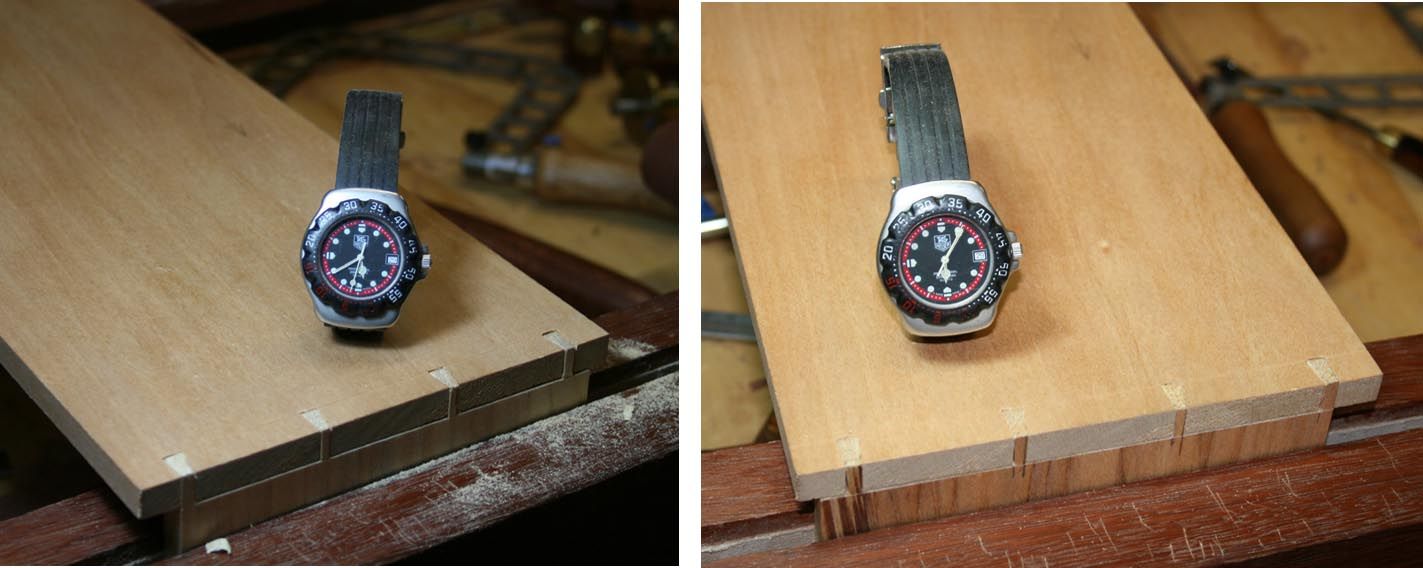

It takes a couple of minutes to test the fit of all four sides (Eddie - note that I widened the small tail after our last discussion) ...
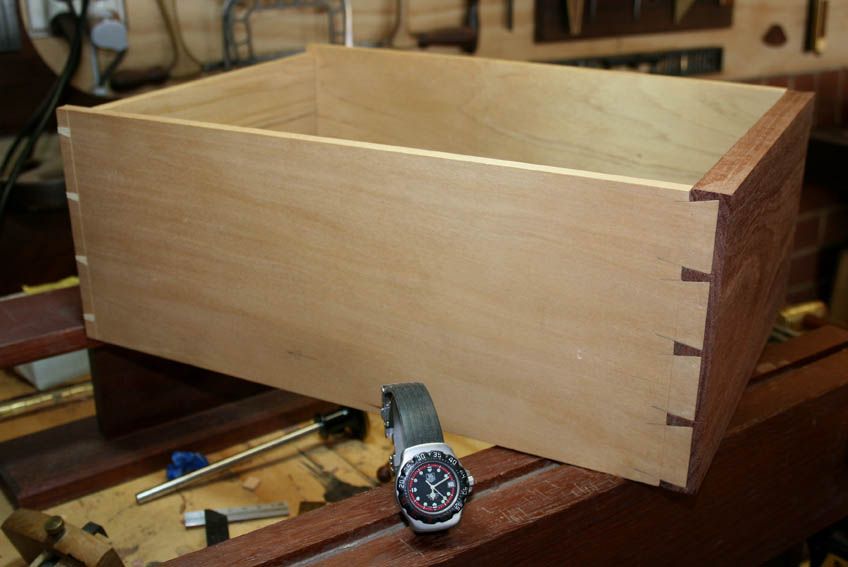

A test fit of the drawer into the drawer space reveals that some tuning it needed.

It was very close but I decided to glue it up as before (in the squaring jig), then tune it once the glue dried after 25 minutes ...
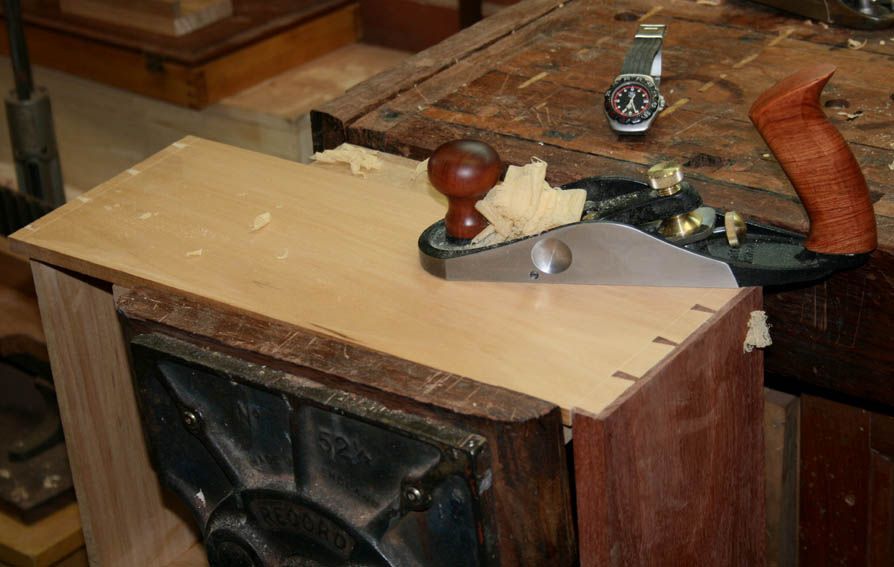

I will write a review of this new small Veritas BU smoother. It is exceptional.

The drawer now fits perfectly ...
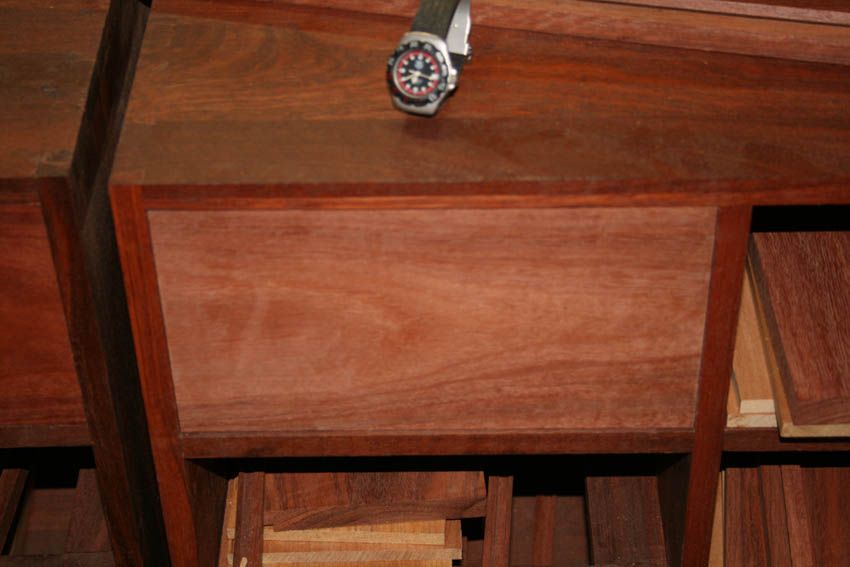

... but the slips now need to be added (gad, we are cutting it fine for time - Lynndy will kill me if I am late) ...
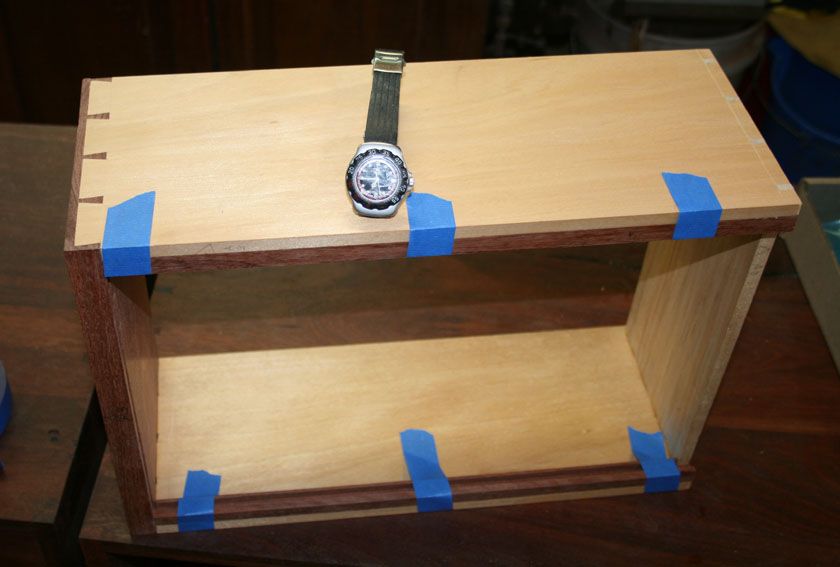

The slips attach quickly with rubbing, the rear chamfers are added (at 30 degrees) and we are done!
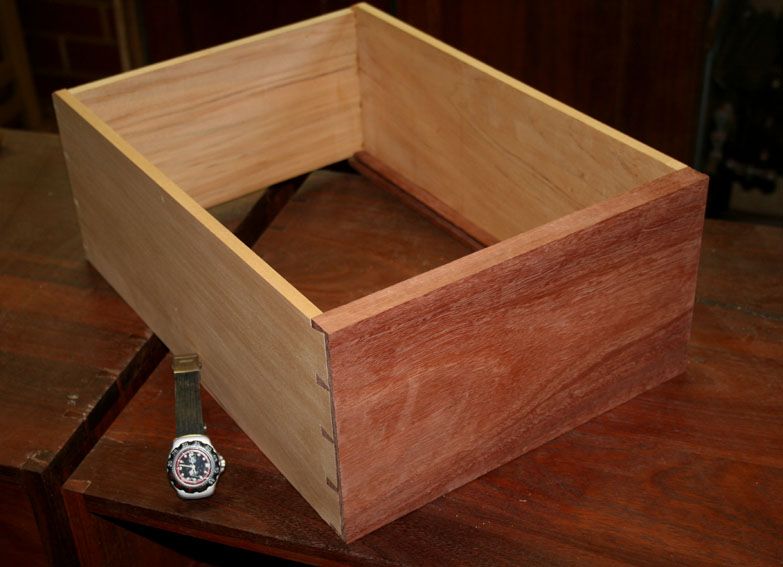

Installed with one coat of Danish Oil on the exterior ..
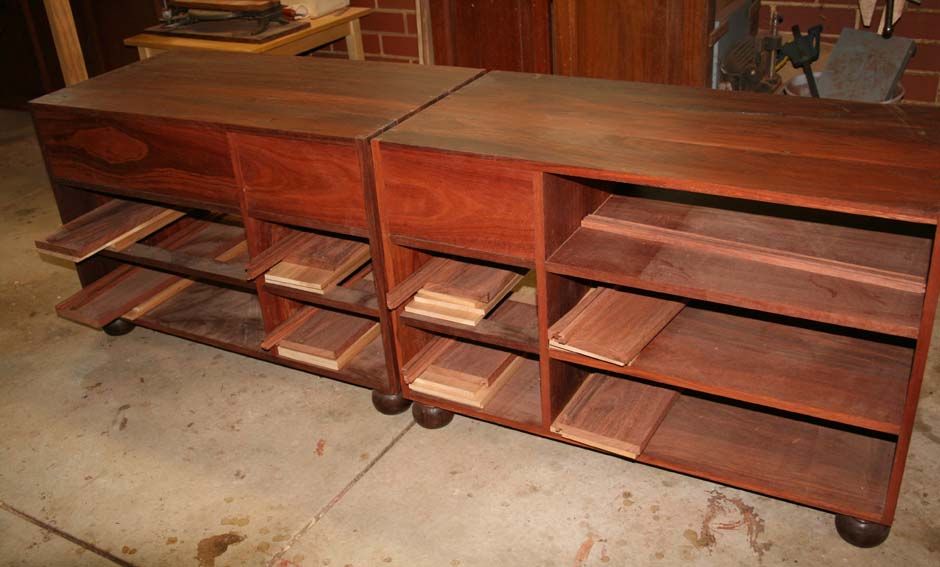

I am off for a few beers, and never do I want to work at this pace again!

Regards from Perth

Derek

Re: Against the clock

#2

I hope you had a great time at dinner

roger lance

Derek....is there a particular reason that you choose to complete the waste (about picture 14) by making numerous plunge cuts instead of just wasting the area directly? Congratulations on another fine presentation!

Re: Against the clock

#3

Re: I hope you had a great time at dinner

Derek Cohen (in Perth, Australia)

Thanks Roger.

I made plunge cuts as the bit is narrow (1/8") and I was concerned that it might snap if I used too much lateral pressure. Removing some of the waste that way took little time, and then it was relatively easy to waste the remainder.

Dinner was excellent. :)

Regards from Perth

Derek

Re: Against the clock

#4

Flummoxed by your router technique

Bill Tindall

I am flummoxed by the router technique. It seems unduly complicated compared to the alternative and I don't see the benefit of these extra complications. For all the futzing with a fence and platform you seem to wind up the same place as if the board had simply been put face down on the bench and the waste free-handed away to near the scribed base line, except the opposite base line was pared to in your case. And what is the purpose of what appears to be drilled holes in the waste?

When I use a router I set a 1/4 or 3/8 bit to the length of the drawer side tails, fasten the drawer front in the vise, back side up, and route away the waste to the base line and saw kerf as close as I dare.

Re: Against the clock

#5

Re: Flummoxed by your router technique

Derek Cohen (in Perth, Australia)

Hi Bill

Of course I could do this better. That is only the second time I have tried using a router this way. So just call me cautious.

But the method has potential.

Regards from Perth

Derek

Re: Against the clock

#6

Doing this for comfort or speed ?

Bob Hackett

I am not understanding the recent threads that seem to be comparing speed and alternative techniques.

One of the reasons I embraced WWing was to get away from the rush of my metalworking day job where the emphasis was always on how much billable time was involved and how to cut that time in order to remain ahead of our competition.

When I go out to my shop I am thinking about making something useful using the best techniques I am currently capable executing in a relaxed fashion and the time factor is usually the last thing on my mind. I could care less how long it takes for someone else to do what I plan to do.

Scratch around enough and you`re bound to come across any number number of people who can do things faster,smarter,better or more efficiently than you can. As long as I`m happy and content what difference does it make to me, my friends and family or the occasional stranger who wanders in and buys my work?

Face it guys,if you`re looking for the quickest,most efficient way to get from point A (rough sawn lumber) to point B (finished product) then you`re posting on the wrong board.

Re: Against the clock

#7

Re: Doing this for comfort or speed ?

TomD

"I am not understanding the recent threads that seem to be comparing speed and alternative techniques.

One of the reasons I embraced WWing was to get away from the rush of my metalworking day job where the emphasis was always on how much billable time was involved and how to cut that time in order to remain ahead of our competition."

If a guy forces you to run 25 miles it's called torture, if you force yourself it is called a marathon. Whatever you think, you are setting a pace, and if you could go twice as fast while seeming to use less effort, why wouldn't you want someone else to sort out how that goes?

"... best techniques I am currently capable executing in a relaxed fashion and the time factor is usually the last thing on my mind."

Where do you think those best techniques come from?

" I could care less how long it takes for someone else to do what I plan to do.

Scratch around enough and you`re bound to come across any number number of people who can do things faster,smarter,better or more efficiently than you can. As long as I`m happy and content what difference does it make to me, my friends and family or the occasional stranger who wanders in and buys my work?"

Apart from the fact that you might be able to produce twice as much stuff for your family or customers... Would you want to learn methods that actually were less productive than your current crop of methods. Would you accept being slowed down to say 20% of your current production? If not why not?

"Face it guys,if you`re looking for the quickest,most efficient way to get from point A (rough sawn lumber) to point B (finished product) then you`re posting on the wrong board."

If this degenerates into a discussion of machines you may have a point (though less than 50% machines has got to get discussed somewhere, and if the audience is this group so be it). My favorite quote from FK's dovetail video is that "Hand work is production!", or words to that effect. The idea that hand tools are just for a bunch of old guys who like blowing what is left of their time, is just one way to go. Maybe we would attract more young people if we gave them something that wasn't a near dead experience. I'm 52, but started self-directed woodworking when I was around 18. I was around woodworking my whole life, because my dad was an advanced amateur, and all my other relatives were also involved. but 18 was around the point when it crossed over from being a chore. At the time my other main interests were kayaking, and rock and ice climbing. In my mind woodworking fit right in. But wasn't because it bore a resemblance to the march of the dead. I saw similar themes to the ice climbing I was doing. I felt I would be better at it, if I spent summers framing the way some of the more independent guys did. I didn't just see it as a sport or something, but I still was interested in it's physicality.

The whole thing about lessor means is you have to adapt the ends. If you say you want straight grain wood then splinting it out is actually faster at every level than bandsawing it. If you say you want certain types of dovetail, then they don't make machines to do those, though they might be able to, just don't. Machines are only faster in all respects if you want to make machine made artifacts. Oddly the culture simultaneously prizes most highly mechanization, and the products that can't be made that way. Presumably because one allows you to buy the other.

Re: Against the clock

#8

Re: Flummoxed by your router technique

TomD

"I am flummoxed by the router technique. It seems unduly complicated compared to the alternative and I don't see the benefit of these extra complications."

Well obviously in a big piece with multiple drawers you need to devote one router setting to making a perfectly registered cut that is the most difficult one to make clean. And for that minor concession to time you get perfect results across the piece.

Now that I have the hammer, Bill, of knowing you respect Tag Frid, let me put it in Fridian terms. Tag wanted the exact same thing, but took a far more desperate measure. He back-cut at dovetail angles the whole socket interface that is parallel to the front of the drawer. He then counted on modern glue to hold his pieces together. This is a comparatively desperate measure. I just assume that it worked for his work over reasonable time frames, but stuff eventually gives out, then you are left with a mess since the lake of glue in there is nor re-glueable. Comparatively Derek can either use the registered surface to index a chisel, or could back cut it like Frid, but would have a lot more material in the high load area that has a proper fit.

"When I use a router I set a 1/4 or 3/8 bit to the length of the drawer side tails, fasten the drawer front in the vise, back side up, and route away the waste to the base line and saw kerf as close as I dare."

That is how I did it back in the 70s when I first cut through dovetails, except I firsts wasted with a fret saw, so all the router had to cut was the line. I hate router dust. If the socket size allows the use of a dovetail cut even on the pins then the dovetail will trim right to the saw line since only the tip will be (under-) cutting. One simply has to remember to always be climb cutting, that way a large bit actually gives better control.

Re: Against the clock

#9

Re: I hope you had a great time at dinner

TomD

OK. So on the machinery part of this exercise, I notice a little bobble in the pieces that would seem to destroy the whole utility of the approach if it didn't yield clean lines. Seems to be in the outboard sockets, so my advice would be to extend the fence at the back. Then add to the fence on the router, projections that allow it to bear on the main fence also. This will eliminate the tendency of the router to dive at the ends. If the precision of that is daunting I have some other ideas.

On a technique level, one way to avoid dips is to make your wasting pass counter clockwise, and only remove the last fat whisper clockwise. You need enough meat so it cuts, but no more.

Another option depending on socket size is the fly cutter. It will allow you to do the reference, but won't carry it down in the corners, on the positive it will be deeper in the center. The set-up and all else is probably a positive.

Remember that when you make an initial penetration you are making a balance between a climb cut and a regular cut, if you drift to the left rotation it will unbalance on you and can get unpleasant, so plunge with a fractional bias to the right and to the clockwise. The detail here is you want your final plunge to be maxed on the left so you don't have to suck in there. Freehand power tools! What fun.

Speed wise, I am not convinced this is all that faster than hand work, simply because in routing you don't get the big chunks, except sometimes with the slotting cutter. As far as jigging the result is concerned, one can jig hand tools also. A fence is not a power tool.

Re: Against the clock

#10

I go at it the other way, Derek

Andrew F in Australia

I mark out traditionally, and if only one or two drawers, cut them traditionally.

Quicker, easier, quieter, less mucking around.

Only difference to your technique is that I lay the boards flat on the bench as I do not like routing into endgrain. A bit frought with danger when it grabs.

On dovetails, I still cut them traditionally with the saw (no overcut.)

If it's a big run, I do the following to remove the waste:

Stick a Leigh jig dovetail bit in one lightweight $40 router, a straight bit in a trimmer, set them to depth accurately, use a fence to set the width of cut accurately and then cut away to the baseline (or about 3/16 off the baseline to allow for the dovetail bit angle, once again, the fence stops cutting in too far.)

By doing this, you've only got a light paring cut to finish the job/clean out the corners.

Looks good.

Cheers,

Andrew

Re: Against the clock

#11

I'm not sure they're mutually exclusive

Bill Houghton, Sebastopol, CA

I don't see any reason why doing something in a way that the individual finds comfortable and enjoyable has to preclude doing it quickly. I don't know that I'd adopt Derek's method - I use routers, but find myself looking for ways not to - but he seems to find the comfort level OK.

There's a pleasure in doing things efficiently that I think we all recognize; I know, to wander from woodworking, that when I'm working on the car and realize that I'm doing a procedure well and quickly, I get a buzz of pleasure from that realization.

Bob implies, rightly, that few of us here on this board are doing woodworking for a living, so, really, it's an issue of what works for an amateur. And there, I think, it's always finding the pleasures in getting it done and enjoying the doing. On the one hand, working like they're all billable hours (minutes!) is probably not fun for most of us; on the other, actually finishing something brings a pleasure all its own.

Sounds like Bob won't be getting out the routah for his dovetails any time soon; that's fine. Sounds like it works for Derek; that's fine, too.

Re: Against the clock

#12

Re: I'm not sure they're mutually exclusive

Bob Hackett

I`m more the a "enjoy the journey" than "get to the destination via the expressway" kind of guy when it comes to doing things for myself. I have an extensive background in manufacturing and especially dealing with things like time studies,piece work and getting paid based on flat rate manuals.

When working in my home shop with whatever material is at hand I tend to focus on making things to a level of quality and finish that many people would consider excessively wasteful of time and effort. I do it that way because I enjoy doing it.

Too many times to count in my day job I have had to go back and redo something that someone with less experience took a shot at and rushed thru only to botch the job. One of the mantras I used to preach to those "everything`s a rush job" kind of guys was that some times the quickest way to do something was to take your time and most importantly to take the time to think. think not about the quickest way but the best way to go about what is involved and then to do the job the best way you possibly can.

It`s a nice tutorial and I`m sure folks got a lot out of it but in the end the statement that the OP didn`t want to have to work to those type of conditions was what jumped out at me. Every time I have been involved in work where the objective was to set a timeline and then beat that timeline the primary lesson was that the more time you shave off what was a comfortable pace the closer you get to disaster. Once the disaster factor manifests itself then all that time you saved goes right out the window. Now you get to start all over again and even before you start you`re behind schedule and down material. Why would anyone subject themselves to something like that for pleasure? I`ve done things like that to make money or win a bet but for me the production mentality stops the moment I hang my work coveralls in my locker at my employer`s place of business.

Not saying anyone is wrong or right here,just saying some of you folks seem to have vastly different priorities than I do when you use your spare time to work on your own stuff. If that`s what floats your boat then more power to you.

I`ll be over here relaxing with a big smile on my face. :D

Re: Against the clock

#13

Re: Against the clock - lessons learned

Derek Cohen (in Perth, Australia)

This began as an exercise to discover how to improve my work efficiency. I also wished to experience what it means to be working flat out. In reality what usually happens is that I work for about an hour, at an unhurried pace, check on the family, slip back into the shop, then after another hour, have a coffee or sharpen a blade, work a little more, break to pick up email .... I try not to hurry - after all this is just a hobby. However I was curious to see how the other half live and work, and to get an estimate of what is reasonable to expect working the methods I do.

It is relevant to know that this is only the second time I have used a router this way, so part of my clumsiness was excessive caution (fear of overrunning the lines). Also, I was essentially copying the method I recall being shown by Neil Erasmus, who impressed me with his skill with the router. Clearly the memory has dimmed somewhat over the past 12 months.

If I use it again I would do it differently. I usually lay the pin board down flat, chop down into the cross grain, and then split the waste out with a blow with the grain. I think that this is what Richard was showing in this picture ...


This is why Jarrah is such a pain to work - it is so hard that wide chisels do not penetrate readily when chopping into the cross grain. Use narrower chisels. I think it would be enough to rout or drill alongside boundary line, and then split the waste to remove it. I think that this would be as fast as routing the entire pin.

Just a note about the waste I left when routing: this was removed with a few chisel strokes. I still prefer to chisel the last bits for more defined edges.

As I noted earlier, what drove the experiment was the need to find more efficiency - not for production-like speed (I am never going to be a pro, nor attempt to emulate a pro), but simply to find a better methodology. I think that the internet video demos tend to paint an unrealistic picture of the time it takes to build things - such as the 3-minute dovetail - and most hobbiests, such as myself, benefit from discovering what is real to boost our esteem and confidence.

Efficiency is not simply about speed. It is about minimising errors. Working beyond one's comfort zone inevitably increases mistakes. Increasing skill levels inevitably increases efficiency. Nothing new there.

Regards from Perth

Derek

Re: Against the clock

#15

Re: Against the clock

Charles

You didn't have to put the watch in the pics. We would have believed you.

Rolex?

Re: Against the clock

#16

Re: Against the clock

Charles

Sorry, Tag Heuer

Re: Against the clock

#17

Re: Against the clock

Charles

Gene Schultz saws out with a coping saw, as far as dares go, the tail sockets of the pin board of a half-lap dovetail.

Might have been a late 1980s article in FW (it was in color). I tried this once but didn't particularly care for it but you might want to experiment with it.

I think making several saw cuts in the tail socket waste is probably as fast as anything. That router routine, the way you do it, would scare the hell out of me.

Re: Against the clock

#18

Re: Against the clock

Warren in Lancaster, PA

I would say that the portion of drawer making that you chronicle is minor part of the whole. For drawers this size I do this dovetail portion which you show in about 30 minutes, maybe a few extra minutes for jarrah. Things like stock selection, stock preparation, gluing and fitting all take significant time. Of the methods discussed here, I am not sure that a router or hollow chisel mortiser or the like would save time for someone skilled with a chisel, and perhaps using these tools would discourage you from gaining these chisel skills.

Re: Against the clock

#19

Re: I'm not sure they're mutually exclusive

TomD

"Once the disaster factor manifests itself then all that time you saved goes right out the window. Now you get to start all over again and even before you start you`re behind schedule and down material. Why would anyone subject themselves to something like that for pleasure?"

This is one of my standard quibbles with most woodworkers they mix up practice and production. If you want to beat the clock to improve your performance you should probably do it outside of the context of production (meaning making stuff, not "work" or some other loaded term). It is really one of the most basic aspects of learning a skill to break out the parts and practice them separately. It seems that the vast majority of people in woodworking never practice, they just do projects at various levels of competence, and under different degrees of performance robbing pressure. There is no reason why the practice needs to be tense if it isn't mixed in with production. Driving range vs. tournament. Every practice session should be mentally defined and there should be no confusion over results. Lets say you were practicing getting flow in your sawing, then you would not beat yourself up over not following the line. If you did the flow practice as part of a project it becomes at some level impossible to actually reduce the process to the thing one wants to practice. You have to be on the line to make the project, so you can only practice outcomes not process, kinda the opposite of what you want.

I'm also not convinced that speed and quality are in any way at odds. It is difficult to ride a bicycle very slowly. Then it becomes easier at a wide range of speed, then it gets difficult again at the very highest speeds. Speed is better because you can't do stuff wrong at speed. All the good positive feelings of flow or apt timing come into play when the unnecessary motions are stripped away. It feels good, and the results are good. Then speed it up a bit more and suddenly something needed is dropped and quality suffers. Modern management wants to run everything at the highest possible speed so there is always flirtation with overdoing it. My sense is most people are running at 20% of where that would start to happen. And at much shorter durations. There is a lot to gain and not much to loose speeding up.

Re: Against the clock

#20

The defining line

Bob Hackett

I think when most people (people in management especially) get into trouble is when they confuse fastest with best as you say. At the shipyard to was "hurry up and get it done,that`s good enough" and speed was king.

One of my favorite quote came from a discussion between one of my co-workers and an area manager in charge of the building of one of the ships; "You people think that if it takes one man in a rowboat 60 days to row across the Atlantic if you can find a way to cram 60 people into that same rowboat we ought to be able to do it in a day". You can take all the skill in the world and put it in one place but if you don`t allow for the proper amount to time to allow things to unfold as they should then you are just setting yourself up for failure.

Keep Rob Cosman or any of the other big names up for 48 hours straight and see how many dovetails they blow out. You need to allow for that recovery time in order to have your brain working properly and stay on top of things. Your focus goes out the window and many people who are working "under the gun" find it too stressful for them to operate at peak efficiency. They start thinking about cutting the time rather than cutting to the line.

The focus shifts to what you need to do next and when that happens then you are no longer paying as close attention to what you`re doing as you should. The "good enough" factor kicks in and now instead of your best effort you are settling for meeting a standard rather than exceeding it.

When making things in my own shop for friends and family I have been known to remove every time piece from the shop area as time is the last thing I want to think about. I want to turn out the best possible piece I can possibly make for them and hopefully learn a few things along the way. It`s just me the tools and the material then.

When I`m working for myself I refuse to allow time into the equation to start compromising things.

Re: Against the clock

#21

Re: The defining line

Pam Niedermayer

Yeah, I stopped wearing a watch thirtysome years ago and never have clocks hanging in sight and normally have the computer clock hidden.

Pam