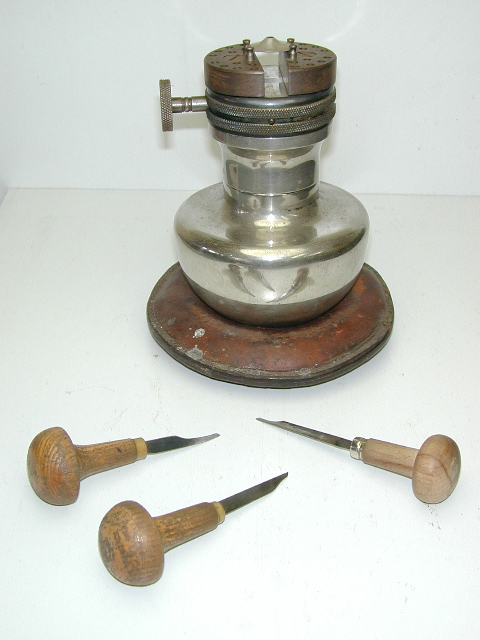
Re: Whatsit identification
Peter Mcbride
Stephen,
So, if you had a collet lathe, would you take out the collet the right size for the work...fit up that thing which is 10 times too big, has a chunk of wood as big as a hand and the most unsophisticated, unbalanced chuck ever contemplated, then fit up the work ready for turning......?
Here are some of the watch and clock tools I've collected. Look at the boxes of bow drill tools...they are tiny.
http://www.petermcbride.com/watchtools/
I'm afraid that suggesting this is used in a lathe for anything to do with watch, clock or jewellery making shows a fundamental lack of understanding of how that work is done, and how highly accurate and refined are the tools used. The scale is the thing. It's as big as a hand, and that is just 10 to 50 times too big for the work.
I've made jewellery for 35 years. As well as the tools above I've a significant collection of jewellery making tools that date back to the 1850s, and a pretty comprehensive working knowledge of how jewellery was made through history. I have 4 watchmakers lathes, and 2 more small lathes that could be used for jewellery, and all of them are too small for what you suggest.
I use a couple of tools of this type. and, I've seen wooden ones like it used by now retired and deceased engravers....please believe me....that is part of an engraving tool. It would never find it's way on to a lathe. The person who you suggest might use it (that would be me) would think it absurd. You must remember we are making a far more complicated object than that tool, and so we just make the right tool for the job, including a collet if it's needed.
Here is another picture of the engraving ball vices. The shaft isn't ever fixed, and I have no idea what you are talking about using a hammer to engrave jewellery.
Regards,
Peter
www.petermcbride.com