New WoodChat!
Home Articles Forums Gallery Marketplace Videos

WoodCentral Forums

Knowledge You Can Build On — Est. 1998

Personalized Wooden Watches, Engraved Free

Japanning

Posts

Japanning

#1

Japanning

David McDonnel

I have an old Bailey plane that someone has stripped, actually looks like they media blasted the thing. If I wanted to paint the interior of the body what do I use? It's always referred as Japanning. I have some Japan colors that I used for tinting grain fillers years ago but they say on the can they dry Flat sheen. I tried some and they sure do. They are Behlens product. What do I need to do to get the glossy sheen? Different product?

Mac

Re: Japanning

#2

Moses Yoder

Re: Japanning

Moses Yoder

Japanning is a mixture of something like linseed oil and black pigment like asphaltum which is then baked on the plane. There are recipes around to make your own, but they are hard to find. There was a company in New York that sold jappaning, I forget the name and don't know if they are around any longer. I think maybe they were called Liberty Paint Co. I have a couple quarts around for my own use and found it easy to apply and very durable. If you want to, you can use gloss black spray paint, just don't tell anyone. There are people around here capable of finding you with only your IP address and a compass, and when they do find you it won't be pretty.

Re: Japanning

#3

Stephen Shepherd

Re: Japanning

Stephen Shepherd

Pour out a small quantity of roofing tar [asphaltum and some hydrocarbon solvents] into a container and allow it to stand for several hours to flash off the stuff you don't want.

Then mix it with equal parts of non-urethane spar varnish, McCloskey's Man o War Marine Spar Varnish [gloss] or Ace Hardware non urethane spar varnish in gloss.

Apply to plane. It will dry completely in a couple of weeks depending on temperature or humidity or you can 'bake' it in an oven at 220 degrees F for an hour or so. Get permission before using the oven for such purposes.

Stephen

Re: Japanning

#4

Moses Yoder

Re: Japanning

Moses Yoder

Is this thin enough to apply with something like an artists brush? Also, do you use one coat or more than one coat?

Re: Japanning

#5

Jack Guzman from Maine

Re: Japanning

Jack Guzman from Maine

I went to Woodcentral's articles section and typed "japanning" into the search box. This is what I came up with http://www.woodcentral.com/articles/handtools/articles_117.shtml

Re: Japanning

#6

Stephen Shepherd

Re: Japanning

Stephen Shepherd

I use camel brushes [squirrel hair] rather than bristle brush to apply this stuff. And I try and get a good finish in one coat. Sometimes that is not possible so it can be re-coated after about 24 hours under dry and warm conditions.

This finish has a nice brown background on the thin edges just like the original japanning.

You can also get the same results using Gilsonite, which is a dry powder, when mixed up benefits with heat when mixing and applying.

Stephen

Re: Japanning

#7

WAG ! . . .

steve mackay

WAG Japanning, LLC

Bill Gustafson

oldtools@taconic.net

518.392.2845

He's a good guy and nice too.

You want "Japanning".

He'll even e-mail you the application instructions and cureing schedual. Its authentic asphaultum BUT it doesn't stink when you bake it. I thought this was all alchemy before I tried it but its a piece of cake. And NOTHING else has "that look".

Re: Japanning

#8

Stephen's Cold Cure for All That Ails ...

Derek Cohen (in Perth, Australia)

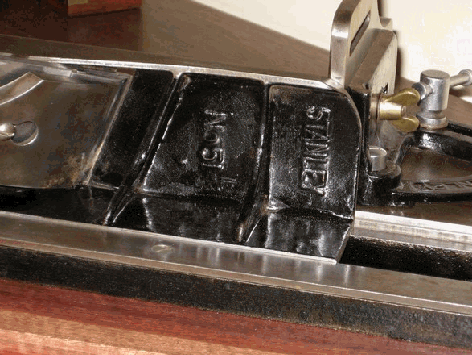
I spent several years restoring a Stanley #51/52 that had really seen better days. In the course of this I had to strip all the remaining japanning. About 3 years ago I got to the stage where I needed to replace the japanning, and Stephen came to my rescue with his formula (in a post above).

Full details near the end of this article: http://www.inthewoodshop.com/ToolRestorations/Restoring%20a%20Stanley%205152.html

I modified the recipe slightly, partly for my convenience (because I had asphaltum powder already), and partly because my method was a little easier (and just as effective) ... possibly a little more authentic .. ?? Neverheless, it remains essentially Stephen's recipe.

Mix asphaltum powder (available from art supply stores) with the marine spar varnish of your choice. Get it to a moderate treacly consistency, which is just thick enough to be runny.

What you will notice when you paint on thin coats (don't try all at once) is that the colour is brown not black. However the more coats you add, the blacker it becomes, and the end result will be pitch black.

The mixture is self-levelling, so do one axis at a time. Leave it to dry out in the sun for a few hours, then add the next coat/axis.

Leave for two weeks as-is before using in anger, or bake in the oven (I have never done this so cannot recommend temperatures or duration).

One important tip: never try to paint over partially-removed original paint/japanning. The end result will look absolutely horrible with lumps and bumps!

Here are a few samples ...

Before:
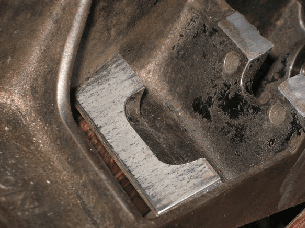
After:
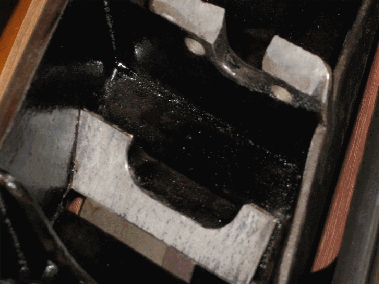

Regards from Perth

Derek

Re: Japanning

#9

Re: Japanning

Michael Brady

Liberty on the Hudson still makes Old Pontypool japanning finish. I would recommend it if you want to bother with the authentic stuff. I have made japan finish from asphaltum and Man-O-War varnish and it worked very well, but was a mess to make, store, apply and let dry. I air-brushed it on. I definitely would not do it again. Rather, I find that high-solids industrial coating in a spray can is just as satisfactory. A company called Seymour of Sycamore makes a great version of this, called SRO. It is a gloss finish, but use of the tool will quickly add the right patina to it.

The other drawback to real japanning was that it was not very resistant to anything that might have a solvent in it. Perhaps it was not fully cured.