New WoodChat!
Home Articles Forums Gallery Marketplace Videos

WoodCentral Forums

Knowledge You Can Build On — Est. 1998

REAL MILK PAINT

How is this tool best sharpened and adjusted

Posts

How is this tool best sharpened and adjusted

#1

How is this tool best sharpened and adjusted

Bill Tindall


I have had this scraper for several years and never had a favorable experience with it. I have come to learn that unfavorable hand tool experiences have largely been a result of improper sharpening and I suspect this too is the case.

As is, the tool is grabby and I have too little control of what it is scraping-digs and chatters. I have come to learn that with a card scraper such performance is due to too much burr. But on this tool....?

The blade came beveled, about 45 degrees but I am unsure if a burr is also added to this bevel and what the best angle of grind should be.

Second, there is an adjustment screw that would flex the blade, analogous to flexing about one's thumbs for a card scraper, I suppose? This thumb screw adjusts depth of cut....?

Bottom line, what is proper sharpening and thumb screw adjustment to get good control of the shavings.

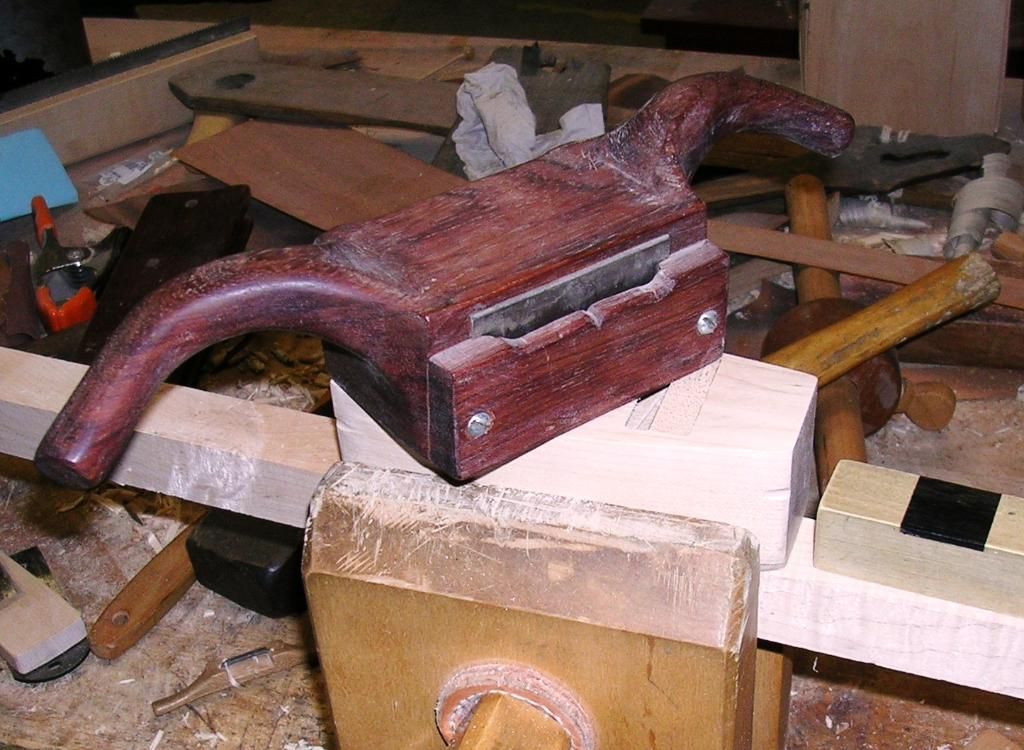
Re: How is this tool best sharpened and adjusted

#2

Stephen Shepherd

Re: How is this tool best sharpened and adjusted

Stephen Shepherd

45 degrees is a good angle but up or down 5 won't matter. File a very slight camber on the blade at that angle, rounding off the sharp ends. Turn a double burr just like on a card scraper.

Put the body of the scraper sole down on a flat surface and install the blade so it is flush with the bottom and tighten things up.

Make a small plug of thick leather that will fit down the thumb screw hole and replace the thumb screw, this will help reduce chatter.

Adjust the thumb screw until the blade bows just below the sole.

Stephen

Re: How is this tool best sharpened and adjusted

#3

Re: How is this tool best sharpened and adjusted

Bob Hackett

I find that if you do what was suggested in Stephen`s post and it`s till too aggressive then just using the iron honed and without turning a burr can sometimes tame it down to a point where it`s a little more controllable to start off and get a feel for how it`s supposed to operate.

Re: How is this tool best sharpened and adjusted

#4

Stephen Shepherd

Re: How is this tool best sharpened and adjusted

Stephen Shepherd

When I was an apprentice about 35 years ago I watched a German cabinetmaker re-sharpen, turn a burr on a metal cabinet scraper blade while it was installed in the scraper.

He used a pointed three sided burnisher, he would remove the bow from the cabinet scraper by backing off the thumb screw [he also did this when the tool was not in use]. Then he would flatten out the back side with a few strokes, then turn the burr on the bevel side.

I have wooden cabinet scrapers, so I always remove the blade to put on a new burr. The wooden cabinet scrapers don't have the same chatter problem as metal cabinet scrapers.

Stephen


img

Re: How is this tool best sharpened and adjusted

#5

Re: How is this tool best sharpened and adjusted

Derek Cohen (in Perth, Australia)

I have wooden cabinet scrapers..

Ah ha! Stephen that explains why you suggested filed a fine camber onto the blade .. ala a plane blade. This is unnecessary with the Stanley #80, as the thumbscrew curves the blade and this creates camber. More or less curviture creates more or less camber.

Bill, I must admit that I only use this scraper plane for removing glue. While I do have a couple of scraper planes - the small Veritas and a Stanley #112 - both of which work very well, I prefer to use cabinet/card scrapers. Compared to all these, the #80 is a coarse-ish performer. I can get it to take fine shavings, but the absence of angle adjustment means that the angle of the hook on the blade becomes more important.

I would recommend that you try the blade sans hook to start. Sharpen it as if it were a plane blade (except that the bevel angle is about 45 degrees - traditionally ... I would use a 30 degree angle, so sacrificing a little edge retention for increased edge keenness). Try it this way first, then add a 5 degree hook, and compare this addition.

Let us know how you get on.

Regards from Perth

Derek

Re: How is this tool best sharpened and adjusted

#6

Re: How is this tool best sharpened and adjusted

Alan Schwabacher

When you use a card scraper, you can adjust the angle as you work to get the best shavings. That angle depends on the type of hook you've made, and how coarse a cut you want. Probably on the stock too, but I've not compared that.

In any case, try the blade as a card scraper as you sharpen and turn the hook. When it cuts properly at the angle you want, that's the hook you want. Install it in the body and use it.

If you could adjust the angle (as in the Veritas scraper plane) you would adjust the plane angle to the angle you had found worked best as a card scraper. You do not have as fine control over this one, so if you have a choice, Derek's assignment of this one to coarser tasks makes sense.

Re: How is this tool best sharpened and adjusted

#7

Thanks to all, working better

Bill Tindall

Perhaps I should have explained the need. The large chest of drawers is done except for smoothing and finishing. Normally I would take a piece outside, crank up the air sander and be ready to finish is a short time. But this thing is too heavy for me to handle by my self, or even wife assisted, so I am attempting to get it smoothed, stained and sealed in the shop. Then the plan is to get help, lug it up the stairs and spray its finish on the cement pad in front of the garage. Then lug it indoors to await delivery to daughter.

The need was to smooth some glue joints that were misaligned in spots by a tiny fraction. As is usually the case a hand plane was ineffective in spot smoothing the case side and I didn't have the courage to hand plant the whole side to sufficient flatness that the plane got all the projecting edges. Why a plane refuses to mow off an edge sticking up 0.010" here and there remains a mystery but I have come to accept this fact.

Once sharpened and adjusted the scraper tool mowed off the projecting edges just fine, although chatter was a constant threat.. Some modest sanding and I will be ready to proceed with staining and sealing which I can do in the shop. The objective is to minimize the time it spends in the garage getting finished and exposed to spring dampness .

Re: How is this tool best sharpened and adjusted

#8

you could follow Lee Valley's instructions

ian in sydney. Australia

Hi Bill

Lee Valley's instructions for preparing their version of the #80 are here

http://www.leevalley.com/US/shopping/Instructions.aspx?p=46437

I think "out of the box" the blade had a 45� bevel one end and a pronounced camber (something like a 12" radius) the other. Dad has one and I'll try to get a photo of the blade when I'm over his place tomorrow -- that's tomorrow my time :)

45� and no burr should get you started.

Re: How is this tool best sharpened and adjusted

#9

Stephen Shepherd

Derek, my wooden cabinet scraper has a thumb screw

Stephen Shepherd

Re: How is this tool best sharpened and adjusted

#10

Stephen, I like that idea of leather...

Joe Shelton

to dampen chatter. I use leather some for a variety of tightening and dampening "fixes", but working it is always an adventure.

Are there tools that will cut little circles and shapes? What glues are best to fix leather to metal, and leather to leather?

TNX

Joe

Re: How is this tool best sharpened and adjusted

#11

Stephen Shepherd

Re: Stephen, I like that idea of leather...

Stephen Shepherd

Joe,

'Are there tools that will cut little circles and shapes? What glues are best to fix leather to metal, and leather to leather? '

I use small round leather punches, also the kind with the wheel that makes small round holes of various sizes in leather. Inexpensive items at local leather supply shop. You can use a plug or bung hole cutter but the leather is a bit tricky to drill.

You can also use a knife or chisel and make little squares then carefully remove the corners until they fit.

And of course you would use hide glue to glue everything including leather to metal [etch the metal with a fresh cut clove of garlic] and of course leather to leather with hide glue is appropriate. A drop of glycerin in the hide glue will keep it flexible.

Stephen

Re: How is this tool best sharpened and adjusted

#12

Glue...

John in NM

If you don't want to try the hide glue Stephen suggests (though I like the stuff and would give it a shot personally), contact cements like Pliobond or maybe DAP would do the trick. Pliobond is a favorite of camera restorers and bamboo rod builders (though not quite antiquey enough to be in Stephen's good graces :D )

Apply to both surfaces, allow to dry a bit and press together. Too dry is not good, you want it tacky but not enough to stick to your finger.

Re: How is this tool best sharpened and adjusted

#13

Re: Stephen, I like that idea of leather...

Phil Joines

If you just need a few holes a piece of steel or brass tube with the end sharpened will work. Tap it in with a mallet an board. Square or rectangular tube works too.

Re: How is this tool best sharpened and adjusted

#14

The thumb screw ...

Derek Cohen (in Perth, Australia)

Hi Stephen

I recall that you had an article either in FWW or PW magazine .... or was it Woodworking magazine .. ? I looked for it but could not find it. Where was it published?

Apologies for the mistake. The picture you posted does not show the thumbscrew, so I assumed that it was held flat - and hence the camber added to the blade. I stll go with what I wrote earlier, that is, by curving the blade with a screw, then then automatically adds the necessary camber.

The addition of leather reminds me of the spring that Paul Hamler added to his scraper plane insert. I have not tried this, so cannot comment on the worth of these methods.

To all: link to an old thread here about a cheap scraper plane (the cheapest!): http://www.woodcentral.com/cgi-bin/archives_handtools.pl/bid/3107/pro/search/pmd/sread/srchid/27026Q3F73vkmxPqx2Cr1306053049/spage/1/sanc/111583/sbid/3107/md/read/id/111583/sbj/jointer-length-scraper-plane-on-the-cheap/

Regards from Perth

Derek

Re: How is this tool best sharpened and adjusted

#15

Stephen Shepherd

Fine Woodworking

Stephen Shepherd

Re: How is this tool best sharpened and adjusted

#16

Stanley #80 blade

Ian (in Sydney, Australia)

blade from a Made in England Stanley #80

Note the curvature one end, as far as I can tell this is unchanged from when Dad bought the tool sometime before 1960.


Re: How is this tool best sharpened and adjusted

#17

Re: Stanley #80 blade

Bill Houghton, Sebastopol, CA

My No. 80 (purchased 1980s/90s?) came with the same cambered edge on one side, straight on the other, pre-ground to 45 degrees in both cases (and a cute little plastic cover for the edge, to keep your fingers from getting hurt on the upper, exposed, edge when the blade is installed). I've always assumed, but never tested my assumption, that this is for really coarse work like (PARENTAL WARNING: tool abuse) paint and finish scraping.

Re: How is this tool best sharpened and adjusted

#18

not so

Bill Tindall

Once sharpened and adjusted it mowed off the occasional "steps" where the boards in glue joints were slightly misaligned. It made shavings like a plane. And.....now and then it chattered and vibrated the case side like a drum head. Got to get the leather dampener in there.

Re: How is this tool best sharpened and adjusted

#19

Alternate view *LINK*

Derek Cohen (in Perth, Australia)

Hi Bill

I suspect that the vibration is caused by the blade not cutting correctly, and that this is due to the way the blade is set up, not the blade support of the #80, per se.

I few years ago I compared thick and thin scraper blades in a #112. Both cut well but the thin blades caused a high pitched skreech. Paul Hamler (who knows just about everything about scraping planes) wrote back, �all that the screeching is caused by the scraper gods not being happy with the relationship of the angle of the burr, the initial depth setting of the blade and the pitch setting of the frog. In order to keep the gods happy all three must be set proper�.

Chatter is due to either poor blade support or a dull blade. Setting up the blade with a hook at the incorrect angle with cause it to act is if it were dull.

So you may need to look more closely at the angle of the hook you are creating on the blade. Since the blade is at a fixed angle in the #80, this is more loikely the culpret. For reference, I have not experienced chatter with my #80.

Regards from Perth

Derek


Thick vs Thin scraper blades

Re: How is this tool best sharpened and adjusted

#20

Clarifying

Bill Houghton, Sebastopol, CA

In saying that "it" was meant for coarse work, I meant the cambered edge on the blade as delivered by Stanley - not the tool itself.

Glad to hear that it's begun to work at times for you.