Is this the future ...?
Derek Cohen (in Perth, Australia)
For the past two years John Payne and I have been discussing steels used in knife-making, and their has potential application to woodworking tools. He has already produced a number of chisels in CPM 3V steel, and these have demonstrated superior edge-holding to A2.
John sent me a three chisel blades and 1 plane blade to test. I have not reached the testing stage yet, but I thought I would show the steel and pass on my observations with regard sharpening them.
This weekend has been all about painting. Oh how I hate painting walls! Every now-and-then, however, I managed to escape (while the paint dried) to the workshop to make the chisels.
This is what I produced over yesterday and today:
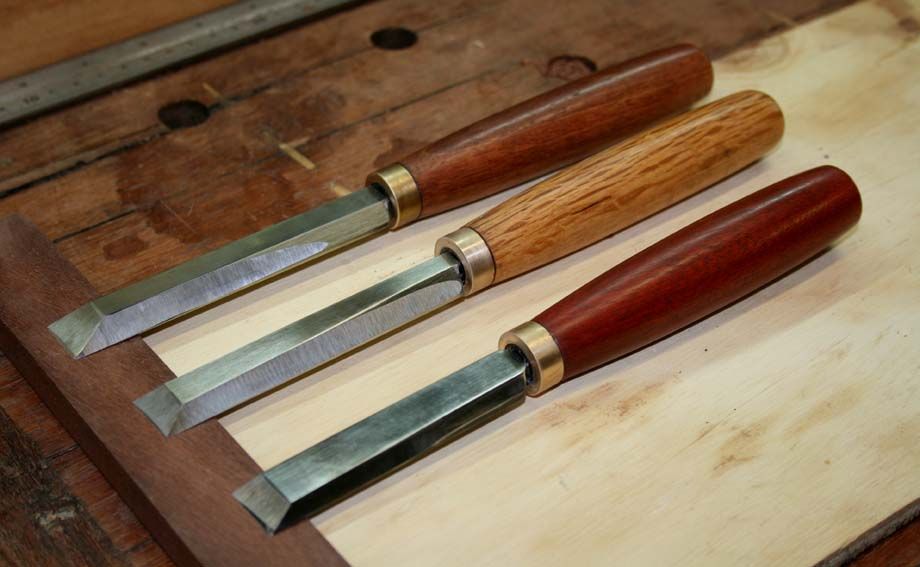
From the top: Jarrah handled CPM 3V, She-oak handled CPM M4, and Bloodwood handled CPM 10V.
The Bloodwood handle is rather special. Exactly 2 years ago Tony Zaffuto (TonyZ) sent me a piece of Bloodwood infused with Resinol, a piece large enough for one chisel handle. I've been saving it for something special. I think that 10V qualifies. Thanks again Tony!
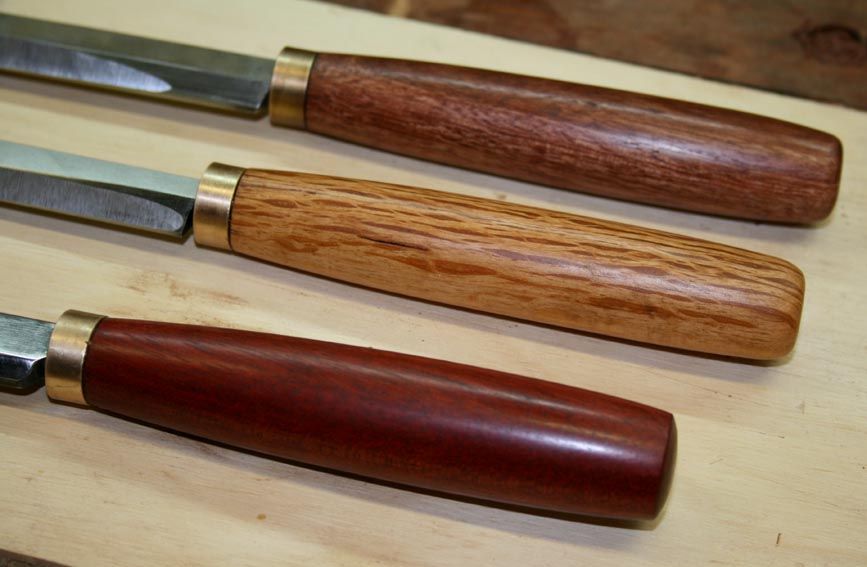
All of these handles can take a serious beating, but the Bloodwood/Resinol is effectively indestructable.
The chisels are all 3/4" wide. I plan to test them out chopping the endgrain of dovetail pins. So I have also hollow ground the shoulders to make it easier to avoid bruising the edges of the dovetails.
The 3V is ground at 25 degrees (as it will cope with this), while the M4 and 10V are ground at their preferred 30 degrees.
How tough are these steels? Here is a chart comparing them ..
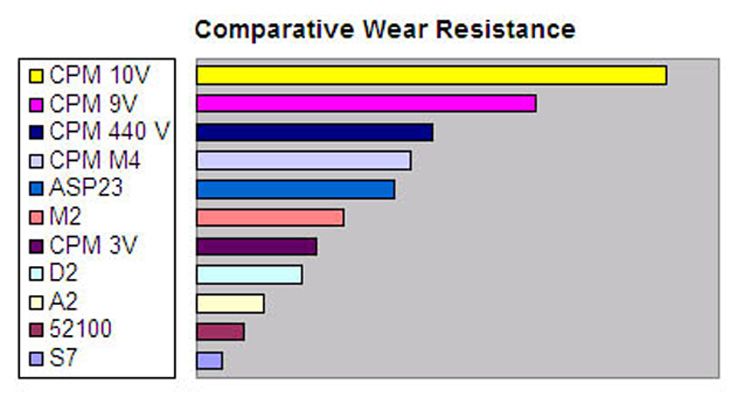
Source: http://www.hamiltonknife.com/CPM_V10.htm
M2 steel is the HSS with which we are familiar. This has more than double the wear resistance of A2. Now M4 is about double M2 (with 3V a little behind M4), and 10V is more than double that!
Sharpening ...
I hollow ground all the blades on an 8" grinder with a Norton 46 grit white wheel. Grinding was not too bad, but clearly slower on the 10V. The advantage to using these steels is that you do noit have to be concerned about overheating them.
I have been using a couple of CPM 3V plane blades for a while. Sharpening has been hit-and-miss. Pro Shapton 1000 ceramic waterstones remove the steel without any difficulty (in fact this stone is fast), but I have been less happy with the 5000 and 12000 Pro Shaptons on this steel.
Consequently I decided to just use oil based diamond paste on all the stones. I have a set up that uses steel plates (from an old saw) glued to hardwood. The set comprises 40, 10, 1 and .5 microns.
This combination quickly created a razor edge on the 3V and M4 (the M4 literally laughed at the Shaptons, which made no impression on them). However try as I might, I could not get past fine scratches and a dull grey finish with the diamond paste on the 10V. Out of sheer desparation I turned back to the Pro Shaptons ... and you know what - they rapidly turned the scratches to a shine! Go figure.
I have lots of dovetails to chop/pare in my current project, so the next month should see these blades getting a solid workout.
Regards from Perth
Derek

 :D:D
 This picture shows a deformation failure of a carbon steel chisel edge in a dovetail chopping test. The metal is all there, it is just deformed.
 This second picture shows a chipping failure in a dovetail chopping test. This steel is M2 and there are divots missing from the edge. This M2 steel taken to its optimum hardness lacks sufficient toughness for a chopping chisel. The deformed edge can largely be restored with something like a hard ARK stone which straightens it back into cutting position.
 Beautiful mirror finish on the bevel edges... but now my next concern... the back(s). So far I've tried WD-40 wet, WD-40 mopped kinda dry... same problem: stiction. I think what I need to do next is flip the CI disk over and cut some channels for swarf removal/stiction eradication... questions: 1) simple cross-hatch or grid pattern? 2) How best to cut the grooves?


